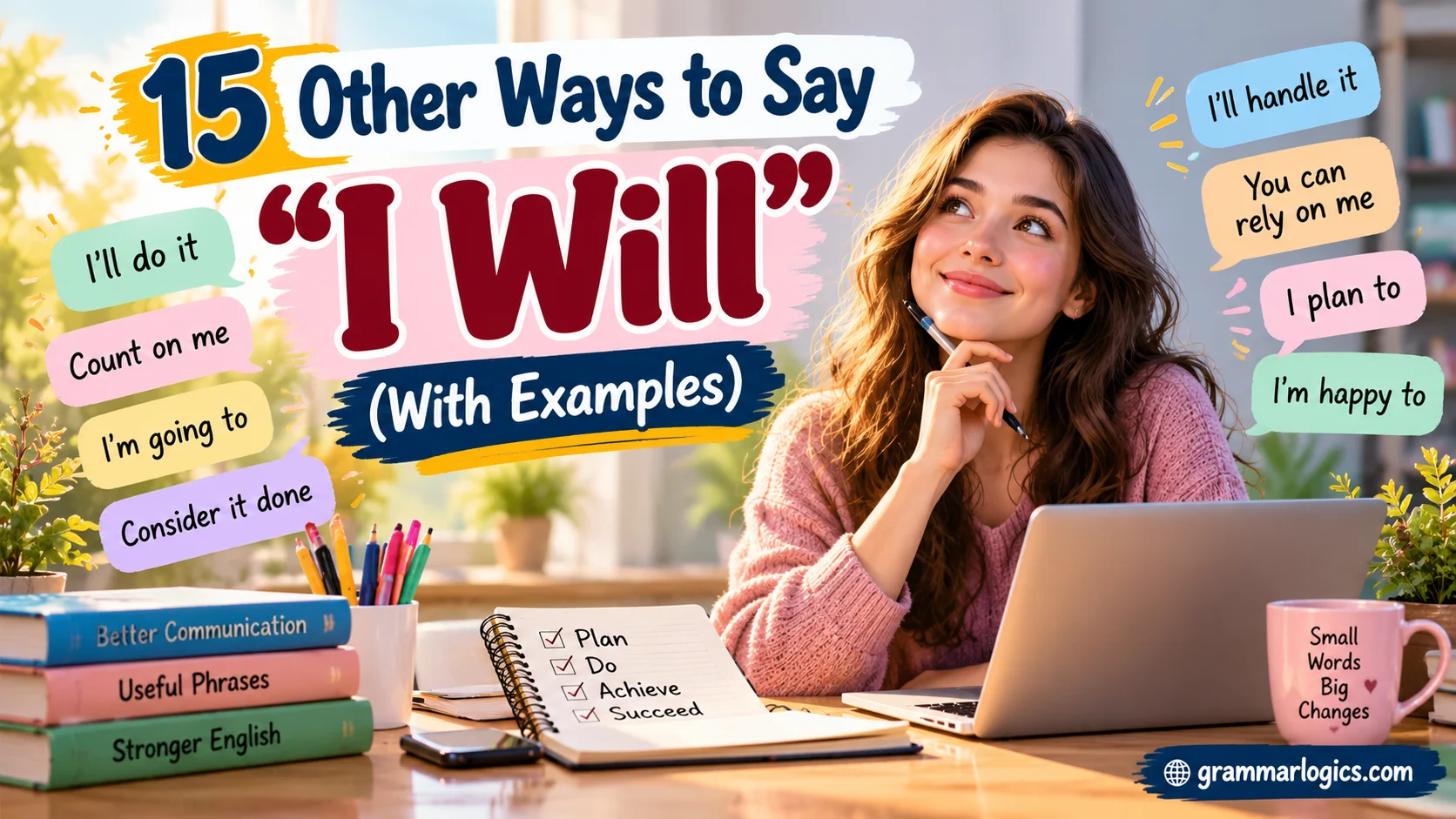
Discover 15 other ways to say “I Will” to express your intentions clearly and confidently. Explore useful alternatives, meanings, and examples for everyday conversations and professional writing.
“I Will” is a simple phrase that expresses commitment, intention, and determination. Whether you are speaking with friends, writing an email, or making a promise, choosing the right words can make your message clearer and more meaningful. There are many situations where using other ways to say “I Will” can make your communication sound more natural, professional, or personal. For example, you might want to express confidence in a task, reassure someone that you will help, or confirm your plans for the future. Learning different expressions allows you to communicate your intentions with greater clarity and choose words that suit the situation.
These alternatives can also help improve your English vocabulary and make everyday conversations more engaging. In this article, we will explore 15 other ways to say “I Will” with clear meanings and practical examples. You will discover useful alternatives such as “I’ll Make Sure,” “I Promise,” “I Intend To,” and “I’m Going To,” along with explanations of when each expression works best. Some phrases are ideal for professional emails and workplace conversations, while others are better suited to friendly discussions, personal commitments, or reassuring someone you care about. By understanding their meanings and tones, you can express your plans, promises, and intentions more confidently in both spoken and written English.
What Does “I Will” Mean?
“I will” is a phrase used to express a future action, intention, decision, promise, or willingness to do something. It combines the subject “I” with the modal verb “will,” which commonly indicates what a person expects or intends to do later. For example, “I will call you tomorrow” communicates an intention to make a phone call in the future. In everyday English, the phrase can also show determination, as in “I will finish this project.” Its exact meaning depends on the situation, the speaker’s tone, and the words that follow it. Although “I will” is grammatically correct in both formal and informal communication, other expressions may communicate a more specific feeling or commitment.
Common Situations Where “I Will” Is Used
People use “I will” in many everyday situations. In personal conversations, it can express plans, such as visiting a friend or helping a family member. In text messages, it communicates a quick decision or response. At work, it can show responsibility for completing a task, meeting a deadline, or following up with a customer. Students may use it when discussing assignments or future goals, while professional writers may use it to explain planned actions.
The phrase is also useful when making promises or showing determination. However, different situations call for different wording. A formal email may benefit from a clear statement of responsibility, while a conversation with a friend may sound more natural with a relaxed expression. Choosing an appropriate alternative helps make your intention, confidence, and level of commitment easier to understand.
Is It Professional or Polite to Say “I Will”?
Yes, “I will” is professional, polite, and grammatically correct when used appropriately. In workplace communication, it can demonstrate accountability and make responsibilities clear. For example, “I will send the revised document by Friday” communicates a specific commitment without unnecessary explanation. The phrase is also suitable for personal messages, academic writing, and formal correspondence.
However, its tone depends on the context. A firm statement can sound confident in a professional setting but may seem too direct in a sensitive conversation. When offering assistance, a warmer expression may feel more welcoming, while a promise-related phrase can communicate a stronger commitment. The important thing is to select wording that accurately reflects what you intend to do rather than choosing a more elaborate phrase simply to sound formal.
Advantages and Disadvantages of Saying “I Will”
Advantages
- Clear communication: The phrase communicates a future action directly.
- Accountability: It can show that you accept responsibility for a task.
- Versatility: It works in professional emails, everyday conversations, and personal messages.
- Confidence: It can demonstrate determination when discussing goals or decisions.
- Simplicity: Its familiar wording makes it easy for English learners to understand and use.
Disadvantages
- Repetition: Using the same phrase repeatedly can make writing sound monotonous.
- Limited emotional nuance: It may not communicate warmth, enthusiasm, or willingness as clearly as a more specific expression.
- Different levels of commitment: Readers may interpret it as a promise even when the speaker intends only to describe a plan.
- Context sensitivity: In some situations, a more specific expression can clarify whether you are offering help, making a firm commitment, or discussing an intention.
15 Other Ways to Say “I Will”
- I’ll
- I’m going to
- I plan to
- I intend to
- I promise to
- I’ll make sure to
- I’m committed to
- I’m happy to
- Let me
- I can
- I’m prepared to
- I expect to
- I aim to
- I’m willing to
- I’m set to
1. I’ll
Meaning
“I’ll” is the contraction of “I will.” It expresses a future action, intention, decision, or promise in a shorter and more conversational form.
Definition
A shortened form of “I will,” used to describe what someone plans or agrees to do.
Detailed Explanation
“I’ll” communicates essentially the same meaning as “I will,” but it generally sounds more natural in everyday speech. It is especially common in conversations, text messages, and friendly emails. Although the contraction is also acceptable in many professional emails, the full form may suit particularly formal documents better. The choice between them usually depends on the desired style rather than a difference in basic meaning.
Scenario Examples
Scenario: A friend asks you to call later.
Example: “I’ll call you after dinner.”
Scenario: A colleague needs a document.
Example: “I’ll send you the updated file this afternoon.”
Best Use
Use “I’ll” in everyday conversations, text messages, friendly emails, and natural professional communication.
Tone
Tone: Conversational, friendly, direct. Its shortened form creates a relaxed flow without changing the intended commitment.
2. I’m Going To
Meaning
“I’m going to” expresses a future action or an intention that has usually been considered or decided already.
Definition
A phrase used to describe a planned or intended future action.
Detailed Explanation
This expression often suggests that a person has already made a decision or has some plan in place. Compared with “I will,” it can sound more connected to an existing intention. For example, “I’m going to study tonight” describes a personal plan, while “I will help you” may express a decision made at that moment. The two expressions sometimes overlap, but “I’m going to” is particularly useful when talking about plans.
Scenario Examples
Scenario: You have arranged your evening around studying.
Example: “I’m going to review my notes before the exam.”
Scenario: You have decided to improve your daily routine.
Example: “I’m going to start exercising regularly next month.”
Best Use
Use it for personal plans, daily routines, future intentions, and informal discussions about upcoming activities.
Tone
Tone: Casual, purposeful, natural. It often suggests an intention that already exists.
3. I Plan To
Meaning
“I plan to” communicates that you intend to do something as part of a decision or arrangement.
Definition
A phrase that describes an intended future action or a course of action being considered.
Detailed Explanation
This expression emphasizes planning rather than simply making a spontaneous decision. It works well when discussing goals, schedules, projects, and personal ambitions. Unlike a strong promise, it does not always guarantee that the action will happen because plans can change. It is useful when you want to communicate your intention honestly without suggesting that every detail is already settled.
Scenario Examples
Scenario: You are discussing your career goals with a mentor.
Example: “I plan to develop my writing skills over the next six months.”
Scenario: A friend asks about your weekend.
Example: “I plan to visit my grandparents on Saturday.”
Best Use
Use “I plan to” in professional discussions, academic work, personal goal-setting, and conversations about schedules.
Tone
Tone: Thoughtful, organized, practical. It communicates intention without necessarily making a firm promise.
4. I Intend To
Meaning
“I intend to” expresses a deliberate intention to perform an action.
Definition
A phrase indicating that someone has a clear purpose or decision to do something.
Detailed Explanation
This expression often sounds more formal and deliberate than “I plan to.” It emphasizes what a person means or has decided to do rather than the details of a schedule. It can be helpful when discussing serious goals, personal decisions, or professional objectives. However, it may sound unnecessarily formal in a casual conversation about simple activities.
Scenario Examples
Scenario: You are explaining your professional development goals.
Example: “I intend to complete the certification before the end of the year.”
Scenario: You want to clarify your position during a serious discussion.
Example: “I intend to resolve this issue fairly.”
Best Use
Use it in formal conversations, professional statements, serious personal discussions, and goal-oriented writing.
Tone
Tone: Deliberate, formal, determined. It emphasizes purpose and a considered decision.
5. I Promise To
Meaning
“I promise to” communicates a strong commitment to perform an action.
Definition
A phrase used to assure someone that you will make a genuine effort to do something or fulfill an obligation.
Detailed Explanation
This expression carries more emotional weight than a simple statement about the future. It is appropriate when trust, reassurance, or a meaningful commitment matters. Unlike “I will,” it explicitly presents the statement as a promise, so it should not be used casually when you are unsure whether you can follow through. In personal relationships, it can provide reassurance, while in professional settings it should be reserved for commitments you can reasonably meet.
Scenario Examples
Scenario: You reassure a friend that you will attend an important event.
Example: “I promise to be there for your graduation.”
Scenario: You have agreed to correct a mistake.
Example: “I promise to review the details more carefully next time.”
Best Use
Use it for meaningful commitments, personal reassurance, apologies, and situations where trust is important.
Tone
Tone: Sincere, reassuring, committed. It creates a stronger expectation than a neutral statement of intention.
6. I’ll Make Sure To
Meaning
“I’ll make sure to” emphasizes that you will take care to complete a particular action.
Definition
A phrase expressing a commitment to remember, check, or ensure that something gets done.
Detailed Explanation
This expression is particularly useful when the task requires attention or follow-through. It can reassure the listener that you recognize the importance of the action rather than merely acknowledging it. Compared with “I will,” it places additional emphasis on care and responsibility. However, it does not automatically guarantee a particular result; it communicates your commitment to taking the necessary steps.
Scenario Examples
Scenario: A colleague asks you to include an important attachment.
Example: “I’ll make sure to attach the final report before sending the email.”
Scenario: A friend reminds you about an upcoming appointment.
Example: “I’ll make sure to leave home early so I arrive on time.”
Best Use
Use it in workplace communication, task management, reminders, customer service, and situations requiring careful follow-through.
Tone
Tone: Responsible, reassuring, practical. It highlights attention to detail and accountability.
7. I’m Committed To
Meaning
“I’m committed to” expresses a strong dedication to a goal, responsibility, or course of action.
Definition
A phrase indicating that someone is dedicated to pursuing or maintaining something.
Detailed Explanation
This expression emphasizes dedication rather than one isolated future action. It is often used when discussing long-term goals, professional responsibilities, relationships, or personal values. Unlike “I will,” it commonly takes a noun or an -ing verb, as in “I’m committed to improving my communication.” It is therefore not a direct grammatical replacement in every sentence. Choose it when you want to communicate sustained effort and seriousness.
Scenario Examples
Scenario: A team leader discusses workplace standards.
Example: “I’m committed to supporting the team’s professional development.”
Scenario: You explain your approach to learning.
Example: “I’m committed to practicing English every day.”
Best Use
Use it for long-term goals, leadership statements, personal development, and professional commitments.
Tone
Tone: Serious, determined, professional. It emphasizes dedication over a single promise.
8. I’m Happy To
Meaning
“I’m happy to” expresses willingness and a positive attitude toward doing something.
Definition
A phrase used to offer assistance or show that you are pleased to help.
Detailed Explanation
This expression is especially useful when you want your message to sound warm and cooperative. Rather than focusing only on a future action, it communicates that you are willing to do it. It is common in customer service, workplace emails, and friendly conversations. However, it is not a universal substitute for “I will”: it works best when the action is something you are glad or willing to do.
Scenario Examples
Scenario: A colleague asks for help preparing a presentation.
Example: “I’m happy to review your slides before the meeting.”
Scenario: A customer needs additional information.
Example: “I’m happy to explain how the process works.”
Best Use
Use it for polite offers, customer communication, professional emails, and friendly assistance.
Tone
Tone: Warm, polite, cooperative. It makes an offer feel welcoming rather than purely transactional.
9. Let Me
Meaning
“Let me” is used to offer to do something, take an action, or begin helping with a situation.
Definition
A phrase expressing an offer or intention to take a particular action.
Detailed Explanation
“Let me” often sounds immediate and practical because it focuses on beginning an action. For example, “Let me check that for you” is a natural way to offer assistance. Unlike “I will,” it can also function as a request for permission or an invitation to allow the speaker to act. Its meaning depends on the context, so it is most suitable when you are offering to do something rather than describing any future event.
Scenario Examples
Scenario: A customer cannot find an order number.
Example: “Let me look up your order details.”
Scenario: A friend is struggling to carry several bags.
Example: “Let me carry one of those for you.”
Best Use
Use it for immediate assistance, everyday conversation, customer service, and situations where you are taking initiative.
Tone
Tone: Helpful, proactive, friendly. It communicates readiness to act in the moment.
10. I Can
Meaning
“I can” communicates ability, availability, or willingness to perform an action, depending on the context.
Definition
A phrase indicating that someone has the ability or opportunity to do something.
Detailed Explanation
This expression is useful when you want to focus on what is possible rather than make a definite promise about the future. For example, “I can help you tomorrow” communicates availability, but it may not be as firm as “I will help you tomorrow.” It can sound reassuring when discussing skills or offering assistance. Because it primarily expresses ability or possibility, it should not replace “I will” when a definite commitment is necessary.
Scenario Examples
Scenario: A classmate needs help understanding a lesson.
Example: “I can explain the first exercise after class.”
Scenario: A colleague asks whether you are available for a meeting.
Example: “I can join the call at 3 p.m.”
Best Use
Use it for offers of assistance, availability, capability, and discussions about what you are able to do.
Tone
Tone: Helpful, practical, flexible. It communicates possibility without always creating a firm commitment.
11. I’m Prepared To
Meaning
“I’m prepared to” expresses readiness to take an action or deal with a situation.
Definition
A phrase indicating that someone is ready and willing to do something when necessary.
Detailed Explanation
This expression emphasizes readiness, preparation, or acceptance of a possible responsibility. It can be more formal than “I will” and is especially useful when discussing challenging tasks, negotiations, or important decisions. Depending on context, it may communicate willingness to take action without suggesting that the action has already been scheduled. It can also sound serious, so it is less natural for small, everyday activities.
Scenario Examples
Scenario: A project manager discusses a challenging deadline.
Example: “I’m prepared to work with the team to resolve the remaining issues.”
Scenario: You participate in a formal discussion about a proposal.
Example: “I’m prepared to consider the suggested changes.”
Best Use
Use it in professional discussions, negotiations, formal statements, and situations involving readiness for a challenge.
Tone
Tone: Formal, composed, confident. It highlights readiness rather than simply stating a future action.
12. I Expect To
Meaning
“I expect to” expresses an anticipated future action or an outcome that someone believes is likely.
Definition
A phrase used to describe something a person anticipates doing or believes will happen.
Detailed Explanation
This expression emphasizes expectation rather than a definite promise. For example, “I expect to finish the report today” communicates what you believe will happen, but circumstances could still change. It is useful when giving realistic updates about schedules, progress, or future plans. Because it can sound less certain than a firm commitment, avoid using it when someone needs an unequivocal assurance that you will complete a task.
Scenario Examples
Scenario: A colleague asks when a report will be ready.
Example: “I expect to finish the analysis by Thursday.”
Scenario: You discuss an upcoming training course.
Example: “I expect to learn several useful techniques during the workshop.”
Best Use
Use it for project updates, professional planning, predictions about your own actions, and discussions involving uncertainty.
Tone
Tone: Measured, realistic, professional. It communicates a reasonable expectation rather than an unconditional promise.
13. I Aim To
Meaning
“I aim to” communicates a goal or an intended result that someone is working toward.
Definition
A phrase expressing the objective a person hopes or intends to achieve.
Detailed Explanation
This expression emphasizes purpose and the result you want to accomplish. It is particularly suitable for personal goals, business objectives, and professional development. Unlike “I will,” it does not necessarily promise that the outcome will be achieved; it communicates what you are trying to accomplish. It also works especially well with verbs such as “improve,” “achieve,” and “provide,” where the focus is on a desired result.
Scenario Examples
Scenario: A writer explains a goal for a new article.
Example: “I aim to make the topic easier for beginners to understand.”
Scenario: A team discusses its customer service priorities.
Example: “I aim to respond to every inquiry within one business day.”
Best Use
Use it for professional objectives, personal ambitions, project goals, and statements about intended outcomes.
Tone
Tone: Purposeful, professional, aspirational. It emphasizes a target rather than guaranteeing an outcome.
14. I’m Willing To
Meaning
“I’m willing to” communicates that you are ready to agree to an action or consider doing something.
Definition
A phrase expressing openness or readiness to do something, sometimes despite inconvenience or difficulty.
Detailed Explanation
This expression emphasizes willingness rather than certainty that an action will occur. It is useful when negotiating, discussing responsibilities, or offering a compromise. For example, “I’m willing to discuss the proposal” communicates openness to a conversation without promising to accept it. It can sometimes sound cautious because it describes what you are prepared to do rather than making a definite commitment. This makes it useful when boundaries or conditions matter.
Scenario Examples
Scenario: Two colleagues are negotiating project responsibilities.
Example: “I’m willing to take on the additional task if we adjust the deadline.”
Scenario: A friend wants to discuss a disagreement.
Example: “I’m willing to listen and understand your point of view.”
Best Use
Use it in negotiations, conflict resolution, discussions about boundaries, and situations requiring cooperation or compromise.
Tone
Tone: Open-minded, cooperative, measured. It expresses readiness without guaranteeing unconditional agreement.
15. I’m Set To
Meaning
“I’m set to” indicates that someone is scheduled, positioned, or ready to do something, depending on the context.
Definition
A phrase used to describe an action that is arranged or expected to happen.
Detailed Explanation
This expression is often used when an event or action is already scheduled or arranged. For example, “I’m set to present the findings tomorrow” suggests that the presentation is on the schedule. Compared with “I will,” it places greater emphasis on readiness or an established arrangement. It is not always suitable for promises or spontaneous decisions, and the exact meaning depends on the surrounding sentence.
Scenario Examples
Scenario: A colleague asks about your presentation schedule.
Example: “I’m set to present the quarterly results on Monday.”
Scenario: You discuss a planned training session.
Example: “I’m set to lead the first workshop next week.”
Best Use
Use it for scheduled activities, professional updates, planned presentations, and arrangements that are expected to take place.
Tone
Tone: Confident, practical, businesslike. It suggests that an action is arranged or expected rather than merely considered.
FAQs
What is another way to say “I Will”?
Several alternatives include “I’ll,” “I’m going to,” “I plan to,” “I intend to,” and “I’ll make sure to.” The best choice depends on your intention. Use “I plan to” for an intended action, “I promise to” for a firm commitment, and “I’m happy to” when offering assistance.
What does “I Will” mean?
“I will” expresses a future action, intention, decision, or promise. For example, “I will finish the assignment tonight” communicates an intention to complete the work later. Its precise meaning depends on the context and the speaker’s level of commitment.
Is “I Will” professional?
Yes. “I will” is appropriate for professional communication because it clearly communicates responsibility and future actions. For example, “I will share the meeting notes by the end of the day” is direct and suitable for a workplace email.
What is a more polite way to say “I Will”?
When offering help, “I’m happy to” is a warm and polite option. For example, “I’m happy to review your application” sounds welcoming. In other situations, “I’ll make sure to” can communicate careful follow-through, while “Let me” works well when offering immediate assistance.
Which alternative works best in formal communication?
“I intend to,” “I’m committed to,” and “I’ll make sure to” can work well in formal or professional settings. Choose “I intend to” for a deliberate objective, “I’m committed to” for sustained dedication, and “I’ll make sure to” when emphasizing responsibility for a specific action. The best option depends on the message you want to communicate.
Conclusion
Choosing the right expression can make your communication more precise, natural, and meaningful. Although “I will” is a clear and versatile phrase, its alternatives allow you to express different intentions, from making a promise to offering help or describing a future plan. Expressions such as “I plan to” communicate intention, while “I promise to” emphasizes commitment and “I’m happy to” adds warmth to an offer.
Other phrases, including “I’m willing to” and “I expect to,” help communicate openness or uncertainty when a definite promise would not be appropriate. When selecting other ways to say “I will,” consider your audience, the situation, and the level of certainty you want to convey. The best wording is the one that communicates your meaning honestly and clearly.