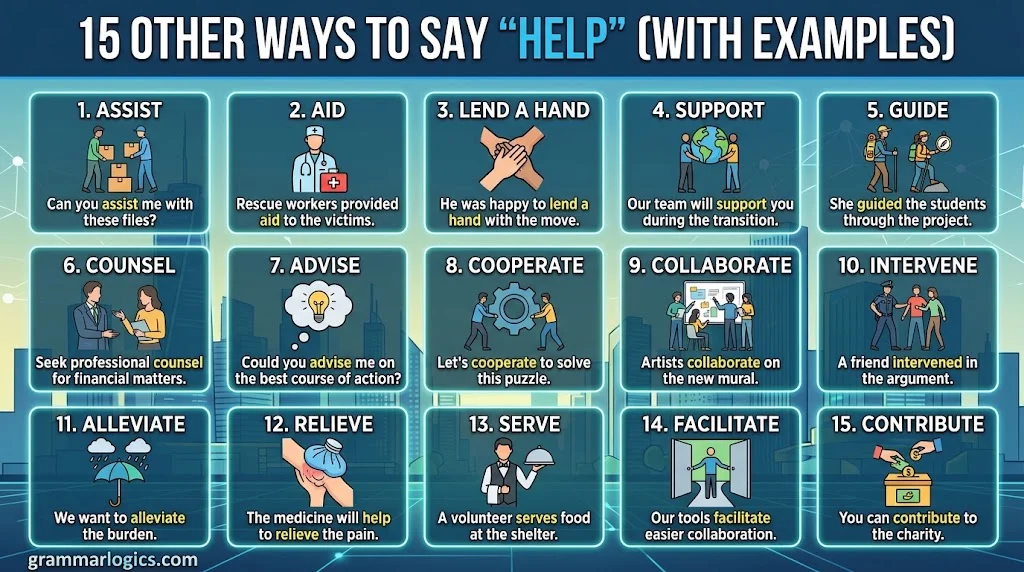
Help is an important part of everyday communication, allowing us to offer support, solve problems, and make life easier for others. Learning other ways to say “help” can make your writing and conversations more natural, polite, and effective.
Whether you are writing an email, talking to a friend, or communicating in a professional setting, choosing the right words can make a meaningful difference. Expressions such as offer assistance, lend a hand, and provide support can help you communicate your intentions clearly. Each phrase carries a slightly different tone, so understanding when to use it can improve your vocabulary and help you sound more confident in different situations.
In this guide, you will discover 15 useful alternatives to “help” with clear meanings and practical examples. These expressions will help you communicate more effectively in professional emails, everyday conversations, academic writing, and friendly discussions. You will also learn which phrases sound more formal, polite, casual, or supportive. Whether you want to ask someone for help, offer assistance to a colleague, or express your willingness to support a friend, these alternatives will give you more ways to express yourself naturally and choose the most appropriate phrase for every situation.
What Does “Help” Mean?
Help means providing assistance, support, or resources to someone who needs them. It can involve making a difficult task easier, solving a problem, offering advice, or supporting someone emotionally. For example, when you help a friend move furniture, you provide practical assistance. When you help a colleague understand a new process, you share knowledge that makes their work easier.
The word can function as both a verb and a noun. As a verb, it describes the act of assisting someone, as in “I can help you with your project.” As a noun, it refers to the assistance itself, as in “Thank you for your help.” Depending on the situation, help can communicate kindness, cooperation, responsibility, or a willingness to make a positive difference.
Common Situations Where “Help” Is Used
People use the word help in many everyday situations. Friends might offer help with moving, studying, or handling a personal problem. Family members may help one another with household responsibilities, while students might ask teachers for help understanding difficult lessons. In text messages, the word often appears in simple requests such as “Can you help me?” or “I need some help with this.”
In the workplace, help is common when colleagues collaborate, share information, or solve problems together. Customer service representatives may offer help to customers who have questions or complaints. In formal emails, phrases such as “provide assistance” or “offer support” can sound more polished. Choosing a suitable alternative allows you to express the kind of help you mean instead of relying on the same word in every situation.
Is It Professional or Polite to Say “Help”?
Yes, help is both professional and polite when used appropriately. It is a standard English word that works well in conversations, emails, meetings, and formal communication. For example, “Could you help me review this document?” is a courteous and natural workplace request. Similarly, “I’m happy to help” communicates a friendly willingness to assist someone.
The best alternative depends on your audience and purpose. Provide assistance may sound more formal in business writing, while lend a hand feels more casual and friendly. Expressions such as support and guide are useful when you want to emphasize encouragement or advice rather than completing a task. The word itself is not impolite; the way you phrase a request, including your tone and level of directness, usually determines how respectful it sounds.
Advantages and Disadvantages of Saying “Help”
Advantages
The main advantage of using help is its simplicity. Almost everyone understands it, making it useful in everyday conversation and professional settings. It works as both a noun and a verb, so you can use it in requests, offers, explanations, and expressions of gratitude. Its flexible meaning also allows it to cover practical assistance, emotional support, and problem-solving without requiring complicated wording.
Disadvantages
Although help is versatile, it can sometimes be too general to communicate exactly what you mean. Saying “I need help” does not explain whether you need advice, physical assistance, technical support, or emotional encouragement. Repeating the word in several sentences may also make your writing less varied. In these situations, a more specific expression can communicate your intention more clearly and help the reader understand what kind of assistance is needed.
15 Synonyms for “Help”
- Assist
- Support
- Aid
- Lend a Hand
- Give a Hand
- Provide Assistance
- Offer Support
- Give Guidance
- Guide
- Come to Someone’s Aid
- Be of Service
- Facilitate
- Make Things Easier
- Back Someone Up
- Pitch In
1. Assist
Meaning
Assist means helping someone complete a task, solve a problem, or achieve a particular goal. It is a slightly more formal alternative to the everyday word help.
Definition
To assist means to provide practical support or contribute to another person’s efforts.
Detailed Explanation
Assist is especially useful when describing specific tasks or responsibilities. It sounds professional without being unnecessarily complicated. Unlike the broader word help, it often emphasizes a clear action or contribution. You might use it when discussing workplace duties, customer service, academic activities, or organized projects.
Scenario Examples
Scenario: A colleague needs help preparing a presentation.
Example: “I can assist you with the presentation slides before the meeting.”
Scenario: A customer has trouble completing an online order.
Example: “Our team will assist you with the checkout process.”
Best Use
Use assist in workplace emails, customer service conversations, academic settings, and other situations where a professional tone is appropriate.
Tone
Tone: Professional, respectful, and practical. It communicates willingness to help while maintaining a polished style.
2. Support
Meaning
Support means helping someone emotionally, practically, or professionally so they can continue working toward a goal or handle a difficult situation.
Definition
To support someone means to provide assistance, encouragement, or resources that strengthen their ability to manage a situation.
Detailed Explanation
Support is broader than help because it can describe ongoing involvement rather than a single action. It works particularly well when someone needs encouragement, reassurance, or continued cooperation. For example, supporting a friend through a stressful period may involve listening and checking in rather than solving the problem directly. In professional settings, it can also refer to providing resources or helping a team succeed.
Scenario Examples
Scenario: A friend is nervous about starting a new job.
Example: “I want you to know that I support you and believe in your abilities.”
Scenario: A manager is discussing team responsibilities.
Example: “Our department will support you throughout the transition.”
Best Use
Choose support for emotional encouragement, teamwork, personal relationships, and situations involving continued assistance.
Tone
Tone: Warm, reassuring, and dependable. It suggests that someone can rely on you over time.
3. Aid
Meaning
Aid means providing assistance or resources to someone who needs them. It often appears in situations involving practical needs, emergencies, or organized efforts.
Definition
To aid means to contribute something that helps a person, group, or activity.
Detailed Explanation
Aid is a concise alternative that often sounds more formal than help. It is common in expressions involving emergency aid, financial aid, medical aid, or humanitarian efforts. As a verb, it emphasizes contributing to a particular outcome, while as a noun, it can refer to the assistance provided. It is less conversational than lend a hand, so it may not be the best choice for every casual exchange.
Scenario Examples
Scenario: A community is collecting supplies after a flood.
Example: “The organization will aid families affected by the flooding.”
Scenario: A student is applying for financial support.
Example: “The university offers financial aid to eligible students.”
Best Use
Use aid in formal writing, emergency situations, educational funding discussions, and community assistance programs.
Tone
Tone: Formal, purposeful, and sometimes serious. It emphasizes practical assistance or resources.
4. Lend a Hand
Meaning
Lend a hand means offering practical assistance, usually with a task that becomes easier when another person helps.
Definition
To lend a hand means to volunteer your time or effort to help someone accomplish something.
Detailed Explanation
This friendly idiom is common in everyday spoken English. It suggests cooperation and a willingness to contribute without making the situation sound overly serious or formal. It often refers to physical tasks, household responsibilities, or shared projects, although it can be used more broadly. Compared with assist, it sounds more relaxed and personal.
Scenario Examples
Scenario: Your neighbor is carrying heavy boxes.
Example: “Would you like me to lend a hand with those boxes?”
Scenario: Your family is preparing for a celebration.
Example: “Everyone is lending a hand to get the house ready.”
Best Use
Use lend a hand when talking to friends, relatives, neighbors, or colleagues in a friendly and informal environment.
Tone
Tone: Friendly, cooperative, and approachable. It makes an offer of assistance feel natural rather than formal.
5. Give a Hand
Meaning
Give a hand means helping someone with a task or offering practical assistance. It can also mean applauding someone when used in a different context.
Definition
To give a hand means to contribute effort to help someone complete an activity.
Detailed Explanation
When used to mean assistance, this expression is casual and easy to understand. It is similar to lend a hand, although give a hand can sound like a direct offer to contribute. Context matters because “give someone a hand” can also mean applauding a performance. Including the task or surrounding sentence makes your intended meaning clear.
Scenario Examples
Scenario: A coworker is organizing files before a deadline.
Example: “I can give you a hand with those reports this afternoon.”
Scenario: A friend is assembling a new desk.
Example: “Can you give me a hand putting this desk together?”
Best Use
Choose give a hand for casual requests and offers involving practical tasks or shared responsibilities.
Tone
Tone: Casual, helpful, and conversational. It works well when people feel comfortable asking each other for assistance.
6. Provide Assistance
Meaning
Provide assistance means giving someone the support or resources needed to complete a task or resolve a problem.
Definition
To provide assistance means to make practical help available to a person or organization.
Detailed Explanation
This expression is more formal than simply saying help. It is useful when describing an organization’s responsibilities, a service offered to customers, or support available through an official process. The wording focuses on the assistance being made available rather than on personal closeness between the people involved. It can sound unnecessarily formal in a message to a close friend, so a simpler phrase may be more natural in casual conversation.
Scenario Examples
Scenario: A company is explaining its customer service options.
Example: “Our support team can provide assistance with account-related questions.”
Scenario: An administrator is explaining a school service.
Example: “The office provides assistance to students completing their applications.”
Best Use
Use provide assistance in formal emails, policies, service descriptions, official announcements, and business communication.
Tone
Tone: Formal, neutral, and professional. It emphasizes the availability of a service or organized support.
7. Offer Support
Meaning
Offer support means expressing a willingness to help someone, whether through practical action, encouragement, or resources.
Definition
To offer support means to make assistance available without necessarily requiring the other person to accept it.
Detailed Explanation
This expression places emphasis on willingness rather than on the help already being delivered. It is especially appropriate when someone may be dealing with a personal challenge or making an important decision. In a workplace, it can communicate that a manager or colleague is available to assist without taking control of the situation. It is a useful choice when you want to sound considerate and avoid putting pressure on someone.
Scenario Examples
Scenario: A friend is going through a difficult time.
Example: “I’m here to offer support whenever you feel ready to talk.”
Scenario: A supervisor is welcoming a new employee.
Example: “Please reach out if you need me to offer support during your first few weeks.”
Best Use
Choose offer support in personal conversations, mentoring, team communication, and sensitive situations where reassurance matters.
Tone
Tone: Considerate, reassuring, and respectful. It shows willingness while allowing the other person to decide what they need.
8. Give Guidance
Meaning
Give guidance means helping someone understand what to do by providing advice, direction, or useful information.
Definition
To give guidance means to help a person make decisions or approach a task more confidently.
Detailed Explanation
Give guidance is particularly useful when someone needs knowledge or direction rather than direct physical assistance. It can describe a teacher explaining an assignment, a manager advising an employee, or an experienced person sharing recommendations. Unlike the general word help, it identifies advice and direction as the main form of assistance. It does not necessarily mean completing the task for the other person.
Scenario Examples
Scenario: A student is unsure how to choose a research topic.
Example: “Could you give me some guidance on selecting a suitable topic?”
Scenario: A new employee is learning a company procedure.
Example: “My supervisor gave me guidance on handling customer complaints.”
Best Use
Use give guidance in education, mentoring, training, career discussions, and situations involving decisions or learning.
Tone
Tone: Helpful, thoughtful, and instructive. It communicates a willingness to share knowledge without taking over.
9. Guide
Meaning
Guide means showing someone how to proceed, understand a process, or reach a particular goal.
Definition
To guide means to lead or direct someone through a task, process, or decision.
Detailed Explanation
Guide is a strong choice when assistance involves explaining steps or helping someone find their way forward. It often suggests a more active role than offering general support. For example, a teacher can guide students through a difficult lesson, while a technician can guide a customer through troubleshooting. The expression is not always interchangeable with help because it emphasizes direction rather than doing the task on someone’s behalf.
Scenario Examples
Scenario: A colleague is learning new software.
Example: “I’ll guide you through the setup process before you begin.”
Scenario: A visitor cannot find a room in a large building.
Example: “Let me guide you to the conference room.”
Best Use
Choose guide for instructions, training, onboarding, learning, navigation, and step-by-step explanations.
Tone
Tone: Clear, supportive, and confident. It suggests that the speaker has useful knowledge or experience to share.
10. Come to Someone’s Aid
Meaning
Come to someone’s aid means stepping in to assist someone who is experiencing difficulty, danger, or an urgent problem.
Definition
To come to someone’s aid means to respond with assistance when another person needs it.
Detailed Explanation
This expression often suggests that someone actively responds to a need instead of simply offering help. It is especially suitable for emergencies, unexpected difficulties, or situations in which someone intervenes to protect or assist another person. Compared with lend a hand, it can sound more serious and dramatic. In ordinary situations, it may be unnecessarily intense unless the circumstances genuinely call for prompt intervention.
Scenario Examples
Scenario: A hiker has injured an ankle on a trail.
Example: “Another hiker came to her aid and contacted emergency services.”
Scenario: A colleague is struggling to manage an unexpected workload.
Example: “Two teammates came to his aid and helped prepare the urgent report.”
Best Use
Use come to someone’s aid when describing an active response to difficulty, an emergency, or a pressing need.
Tone
Tone: Concerned, decisive, and sometimes urgent. It emphasizes action taken in response to someone’s need.
11. Be of Service
Meaning
Be of service means being available or willing to assist someone, often by meeting a need or providing a useful service.
Definition
To be of service means to help someone by making your abilities, time, or resources available.
Detailed Explanation
This expression sounds more formal and service-oriented than everyday help. It is often used in customer relations, hospitality, public service, and professional conversations. It can communicate courtesy without sounding overly personal. For casual requests between friends, however, it may feel stiff or old-fashioned compared with simpler wording.
Scenario Examples
Scenario: A hotel guest asks about available facilities.
Example: “Our front desk team will be happy to be of service during your stay.”
Scenario: A professional is closing a business email.
Example: “Please contact me if I can be of service with any further questions.”
Best Use
Use be of service in hospitality, customer communication, formal correspondence, and situations where courteous service is central.
Tone
Tone: Courteous, formal, and service-focused. It conveys a respectful willingness to meet someone’s needs.
12. Facilitate
Meaning
Facilitate means making a process, activity, or task easier to complete.
Definition
To facilitate means to remove obstacles or create conditions that allow something to happen more smoothly.
Detailed Explanation
Facilitate is more specific than help when the main goal is to make a process work efficiently. A person might facilitate a meeting by encouraging discussion, organizing the agenda, and keeping the conversation productive. A coordinator could facilitate communication between different departments. Unlike assist, the word does not necessarily mean doing part of the task yourself; it may mean making it easier for others to do their work.
Scenario Examples
Scenario: A team leader is arranging a planning session.
Example: “She will facilitate the discussion so everyone has a chance to contribute.”
Scenario: Several departments need to share information.
Example: “The new system should facilitate communication between the teams.”
Best Use
Choose facilitate for meetings, collaboration, processes, training sessions, and organizational communication.
Tone
Tone: Professional, organized, and purposeful. It emphasizes improving how a task or process works.
13. Make Things Easier
Meaning
Make things easier means reducing someone’s effort, stress, or difficulty by taking action or improving a situation.
Definition
To make things easier means to remove complications or reduce the amount of work someone must do.
Detailed Explanation
This expression focuses on the result of assistance rather than the act of helping itself. It sounds natural in everyday conversation because it explains the practical benefit someone will receive. You can use it when offering to take on a task, simplify a process, or reduce pressure during a busy period. It is less formal than provide assistance and often feels more personal because it acknowledges another person’s workload or difficulties.
Scenario Examples
Scenario: A friend is overwhelmed while preparing for a move.
Example: “I can pack the kitchen boxes to make things easier for you.”
Scenario: A team is dealing with a complicated schedule.
Example: “Let’s combine these meetings to make things easier for everyone.”
Best Use
Use make things easier in daily conversation, teamwork, family responsibilities, and situations where reducing someone’s burden is the main goal.
Tone
Tone: Practical, thoughtful, and reassuring. It shows concern for the effort someone needs to make.
14. Back Someone Up
Meaning
Back someone up means supporting a person, especially when they need reassurance, confirmation, or another person’s assistance in a challenging situation.
Definition
To back someone up means to stand behind their actions or provide additional support when needed.
Detailed Explanation
This informal expression often suggests solidarity or cooperation. At work, you might back up a colleague by confirming accurate information during a discussion or helping them manage a difficult customer interaction. Among friends, it can mean standing by someone when they need support. It is not a universal substitute for help because it often emphasizes having someone’s back, confirming their position, or providing backup rather than completing an ordinary task.
Scenario Examples
Scenario: A colleague needs confirmation of what was agreed during a meeting.
Example: “I’ll back you up when you explain the decision to the manager.”
Scenario: A friend is handling a difficult conversation.
Example: “Don’t worry; I’ll back you up if you need me.”
Best Use
Choose back someone up in teamwork, informal discussions, group situations, and moments when loyalty or confirmation matters.
Tone
Tone: Loyal, confident, and informal. It communicates solidarity and a willingness to stand alongside someone.
15. Pitch In
Meaning
Pitch in means joining others to contribute effort toward a shared task or responsibility.
Definition
To pitch in means to participate willingly in work that needs to be done.
Detailed Explanation
Pitch in is a natural phrasal verb used when several people cooperate to get something accomplished. It often suggests that everyone contributes what they can rather than expecting one person to handle the entire job. It works well for group projects, community activities, household chores, and busy workplaces. Unlike guide or give guidance, it emphasizes participation and shared effort instead of providing instructions.
Scenario Examples
Scenario: Volunteers are preparing food for a community event.
Example: “We could use a few more volunteers to pitch in with the preparations.”
Scenario: A restaurant becomes busy during the lunch rush.
Example: “Everyone pitched in to serve the customers quickly.”
Best Use
Use pitch in for collaborative tasks, group projects, volunteering, shared household work, and situations where people need to contribute together.
Tone
Tone: Casual, cooperative, and energetic. It encourages people to take part and share the workload.
FAQs
What is another way to say “help”?
Some useful alternatives are assist, support, lend a hand, provide assistance, and pitch in. The best choice depends on whether you mean practical assistance, emotional encouragement, professional support, or teamwork.
What does “help” mean?
Help means giving someone assistance, support, or resources to make a task easier or solve a problem. It can refer to practical actions, emotional encouragement, advice, or other forms of assistance.
Is “help” professional?
Yes. Help is appropriate in professional communication, including meetings, emails, and workplace requests. For a more formal tone, you can use assist or provide assistance, depending on the sentence.
What is a more polite way to say “help”?
You can say “Could you assist me with this?”, “Would you mind lending a hand?”, or “I would appreciate your support.” These expressions communicate a request politely, although the most natural choice depends on the situation.
Which alternative works best in formal communication?
Provide assistance is a strong choice for formal emails, official documents, and customer service messages. Assist is also suitable when you want professional wording that remains concise and natural.
Conclusion
Choosing the right alternative to help allows you to communicate more clearly and express your intentions with the right tone. Words such as assist and provide assistance work well in professional settings, while lend a hand and pitch in feel more natural in casual conversations. When someone needs emotional encouragement, support or offer support may communicate your meaning more effectively.
For situations involving advice or direction, give guidance and guide are often better choices. Remember that similar expressions do not always mean exactly the same thing. Consider your audience, the situation, and the kind of assistance you want to provide before choosing your words. The most effective expression is the one that makes your message clear, respectful, and appropriate.