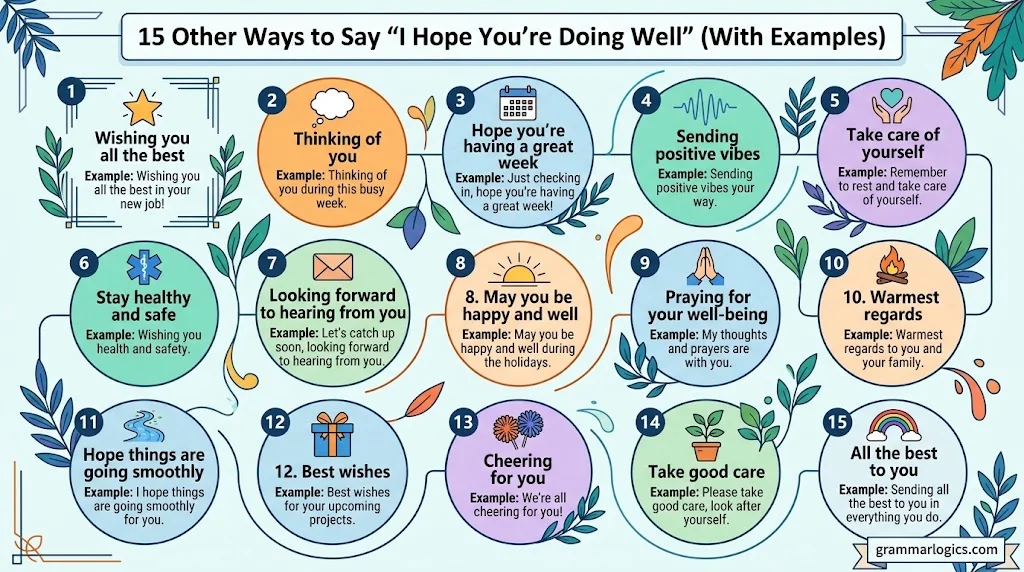
“I hope you’re doing well” is a polite and friendly expression often used to begin emails, messages, and everyday conversations.
There are many natural ways to express “I hope you’re doing well” while keeping your message warm, respectful, and professional. Whether you are writing to a colleague, contacting a client, greeting a friend, or reconnecting with someone after a long time, choosing the right words can make your message feel more personal. Some alternatives sound formal and businesslike, while others express genuine care and friendliness. Learning these expressions will help you improve your communication skills, avoid repetitive greetings, and create a positive first impression in both personal and professional settings.
In this guide, you’ll discover 15 other ways to say “I hope you’re doing well”, along with clear meanings and practical examples to help you use each expression confidently. These alternatives are useful for professional emails, workplace communication, friendly messages, and formal correspondence. You’ll also learn which phrases work best when contacting someone for the first time, following up on a conversation, or checking in with a person you care about. By understanding the tone and context of each expression, you can make your writing sound more natural, thoughtful, and engaging while building stronger connections with your readers.
What Does “I Hope You’re Doing Well” Mean?
“I hope you’re doing well” is a polite and friendly expression used to show that you wish someone good health, happiness, or general well-being. It communicates care, goodwill, and consideration without asking a direct question about the person’s life. People commonly use it at the beginning of emails, letters, text messages, and everyday conversations. The phrase can be professional when addressing a colleague or client, but it can also feel warm and personal when speaking to a friend or relative. Although it is a positive greeting, it does not necessarily mean the speaker knows anything about the other person’s current circumstances.
Common Situations Where “I Hope You’re Doing Well” Is Used
This expression is especially common in email greetings. You might use it when contacting a colleague, following up with a client, or writing to a teacher after some time apart. It also works in personal messages when you want to reconnect with an old friend, check on a relative, or start a conversation with someone you have not seen recently.
On social media and in text messages, shorter and more casual alternatives can sound more natural. In professional communication, a slightly more specific greeting may help establish a connection without making the message feel overly formal. Choosing a different expression can also make your message feel more sincere when you genuinely want to know how someone is feeling.
Is It Professional or Polite to Say “I Hope You’re Doing Well”?
Yes, “I hope you’re doing well” is both polite and professionally appropriate in most everyday business situations. It is commonly used in emails to coworkers, managers, customers, and professional contacts because it expresses goodwill without being intrusive. Its tone is respectful but not excessively formal, making it suitable for many workplace relationships.
However, the phrase can feel generic when repeated in every email. For a closer friend, a more personal greeting may show greater warmth, while a formal letter might benefit from a more restrained opening. In urgent business communication, skipping the greeting and stating the purpose directly may be more considerate of the recipient’s time. The best wording depends on your relationship, the message, and the level of formality required.
Advantages and Disadvantages of Saying “I Hope You’re Doing Well”
Advantages
The main advantage of this expression is its versatility. It works in professional emails, personal messages, and conversations with people you know well or only slightly. The wording is friendly, respectful, and easy to understand, making it useful for English learners and fluent speakers alike. It also creates a positive opening without requiring the recipient to share personal information. Because it is familiar, it rarely sounds inappropriate in ordinary communication.
Disadvantages
The phrase can sound routine or impersonal when used repeatedly, especially in business emails that follow the same format. It may also feel slightly distant when messaging someone close to you, since a specific question about their life can express more genuine interest. In urgent situations, the greeting may delay the main point. Additionally, if someone is dealing with a difficult situation, a general expression of goodwill may not communicate the sensitivity or support that a more thoughtful message requires.
15 Alternatives to “I Hope You’re Doing Well”
- I Hope You’re Having a Great Day
- I Hope All Is Well
- How Have You Been?
- I Hope Things Are Going Well for You
- I Hope You’re Keeping Well
- I Trust You’re Doing Well
- I Hope Life Is Treating You Well
- How Are Things Going?
- I Hope You’re in Good Health
- I Hope Everything Is Going Smoothly
- It’s Good to Connect With You
- I Hope You’ve Been Well
- Sending My Best Wishes
- I Hope You’re Having a Good Week
- I Wanted to Check How You’re Doing
1. I Hope You’re Having a Great Day
Meaning
“I hope you’re having a great day” expresses a wish that someone’s current day is happy, enjoyable, and positive. Unlike the original phrase, which refers to overall well-being, this greeting focuses on the person’s experience today.
Definition
A friendly expression used to wish someone a pleasant and successful day.
Detailed Explanation
This alternative sounds upbeat and cheerful. It is particularly suitable when you want to create a positive impression without asking a personal question. The phrase feels natural in everyday conversations and friendly workplace emails. Because it focuses on the present day, it may be less suitable when reconnecting with someone after several months of silence.
Scenario Examples
Scenario: Writing to a coworker.
Example: “Hi, Sarah! I hope you’re having a great day. Could we discuss the presentation this afternoon?”
Scenario: Messaging a friend.
Example: “Hey! I hope you’re having a great day and getting some time to relax.”
Scenario: Contacting a customer.
Example: “Hello, Mr. Adams. I hope you’re having a great day. I’m following up on your recent inquiry.”
Best Use
Use this greeting in friendly emails, casual messages, customer communication, and everyday conversations when you want to sound positive and approachable.
Tone
Tone: Cheerful, warm, friendly.
Its optimistic wording helps establish a welcoming atmosphere without sounding overly personal.
2. I Hope All Is Well
Meaning
“I hope all is well” expresses a general wish that things are going smoothly in someone’s life. It is close in meaning to the original phrase but can refer to a person’s circumstances as well as their well-being.
Definition
A polite expression wishing someone well in their personal or professional life.
Detailed Explanation
This expression is slightly more concise than “I hope you’re doing well.” It works especially well when you do not know much about the recipient’s current situation. The wording is neutral enough for professional emails but remains friendly in personal correspondence. However, it can sound somewhat conventional if you use it as the opening of every message.
Scenario Examples
Scenario: Reconnecting with a former colleague.
Example: “Hi, Daniel. It’s been a while since we last spoke. I hope all is well with you.”
Scenario: Writing a professional email.
Example: “Dear Ms. Carter, I hope all is well. I’m writing to discuss the upcoming meeting.”
Best Use
Choose this expression for professional emails, follow-up messages, and reconnecting with acquaintances when you want a simple, respectful greeting.
Tone
Tone: Polite, neutral, professional.
Its broad meaning makes it appropriate for relationships that are friendly but not especially close.
3. How Have You Been?
Meaning
“How have you been?” asks about someone’s well-being over a period of time. Unlike the original expression, which simply wishes someone well, this alternative invites a response about their life or experiences.
Definition
A question asking how someone has been feeling or what has been happening in their life recently.
Detailed Explanation
This phrase is particularly natural when speaking to someone you have not seen or contacted for a while. It communicates interest and gives the other person an opportunity to share an update. It often sounds more personal than a standard email greeting, especially when you already have a relationship with the recipient. Because it is a question, use it when you are prepared to listen to the answer rather than simply opening a message.
Scenario Examples
Scenario: Meeting an old friend.
Example: “It’s been ages! How have you been?”
Scenario: Reconnecting with a former classmate.
Example: “Hi, Emma! I came across our old school photos and wondered how you’ve been.”
Scenario: Catching up with a relative.
Example: “How have you been since your move? I hope everything is settling into place.”
Best Use
Use it when reconnecting with friends, relatives, former colleagues, or acquaintances after some time apart.
Tone
Tone: Personal, friendly, interested.
The direct question makes it more engaging than a general well-wishing statement.
4. I Hope Things Are Going Well for You
Meaning
This phrase expresses the hope that someone’s circumstances, activities, or plans are progressing positively. It extends beyond personal health to include work, relationships, studies, and other aspects of life.
Definition
A considerate expression wishing someone positive progress in their current circumstances.
Detailed Explanation
“I hope things are going well for you” feels thoughtful without being overly intimate. It is useful when you know someone is managing a project, starting a new job, or experiencing a major change. The wording suggests interest in their overall situation rather than simply offering a routine greeting. Compared with the original phrase, it places slightly more emphasis on how life is progressing.
Scenario Examples
Scenario: Checking in with someone who started a new job.
Example: “Hi, Alex. I hope things are going well for you in your new role.”
Scenario: Contacting a friend who recently moved.
Example: “I hope things are going well for you and that you’re settling into the new neighborhood.”
Best Use
This expression works well in personal emails, professional follow-ups, and messages to people going through changes.
Tone
Tone: Thoughtful, supportive, courteous.
It conveys interest in someone’s circumstances without demanding a detailed update.
5. I Hope You’re Keeping Well
Meaning
“I hope you’re keeping well” expresses a wish that someone continues to enjoy good health and general well-being. The word “keeping” emphasizes maintaining that well-being over time.
Definition
A polite greeting wishing someone continued good health and wellness.
Detailed Explanation
This expression is particularly natural in British and some other varieties of English. It can sound a little more traditional than “I hope you’re doing well,” but it remains perfectly understandable in professional and personal communication. It is especially appropriate when writing to an older relative, a long-standing professional contact, or someone you have not contacted recently. Although it often refers to health, it can also communicate a broader wish for well-being.
Scenario Examples
Scenario: Writing to a family member.
Example: “Dear Aunt Linda, I hope you’re keeping well. We’d love to see you soon.”
Scenario: Sending an email to a long-term client.
Example: “Hello, Mr. Wilson. I hope you’re keeping well. I’m contacting you regarding your latest order.”
Best Use
Choose this phrase for polite correspondence, traditional email greetings, and personal messages where continued well-being is the main sentiment.
Tone
Tone: Courteous, gentle, slightly traditional.
Its considerate wording makes it suitable for respectful relationships without sounding stiff.
6. I Trust You’re Doing Well
Meaning
“I trust you’re doing well” communicates an expectation or confident hope that the recipient is well. It expresses goodwill in a slightly more formal way than the original phrase.
Definition
A professional expression indicating that you expect someone is well and wish them continued well-being.
Detailed Explanation
The word “trust” gives this greeting a more formal, composed quality. It is useful in business correspondence, especially when contacting someone with whom you have an established professional relationship. In this context, “trust” means that you hope or expect things are going well; it does not mean that you are discussing personal trust. However, the wording can sound stiff in casual texts or messages to close friends.
Scenario Examples
Scenario: Writing to a business partner.
Example: “Dear Mr. Bennett, I trust you’re doing well. I’m writing to confirm the details of our agreement.”
Scenario: Following up with a professional contact.
Example: “Hello, Priya. I trust you’re doing well. Would you have time for a brief call this week?”
Best Use
Use this expression in formal emails, business correspondence, and communication with established professional contacts. For a friendly text, choose a more relaxed alternative.
Tone
Tone: Formal, courteous, composed.
The confident wording gives it a professional feel, although it may sound impersonal in close relationships.
7. I Hope Life Is Treating You Well
Meaning
“I hope life is treating you well” expresses a broader, more personal wish that someone is experiencing happiness, positive circumstances, and general satisfaction with life.
Definition
A warm expression wishing someone a positive and fulfilling experience of life.
Detailed Explanation
This alternative feels more reflective than a standard greeting. It suggests an interest in the person’s overall life rather than just their health or immediate activities. It works particularly well when reconnecting with someone after a long gap or sending a thoughtful personal message. Because it has a slightly expressive quality, it may feel too sentimental for a brief, routine business email.
Scenario Examples
Scenario: Reconnecting with a childhood friend.
Example: “It’s wonderful to hear from you after all these years. I hope life is treating you well.”
Scenario: Writing to a former university classmate.
Example: “I saw your recent update and wanted to say hello. I hope life is treating you well.”
Best Use
This phrase is best for personal messages, reconnecting with old friends, and thoughtful correspondence.
Tone
Tone: Warm, reflective, heartfelt.
Its broader meaning adds a personal touch without requiring the recipient to discuss any particular issue.
8. How Are Things Going?
Meaning
“How are things going?” asks about a person’s current circumstances, activities, or general progress. It is a casual question rather than a direct statement of goodwill.
Definition
An informal question inviting someone to share an update about their life or current situation.
Detailed Explanation
This expression sounds relaxed and conversational. It is useful when you want to start a discussion rather than simply offer a polite greeting. Depending on the context, the question may refer to work, studies, family life, or personal plans. Unlike the original phrase, it encourages a reply and may invite more specific information, so it is best used when you have time to engage in a conversation.
Scenario Examples
Scenario: Greeting a teammate at work.
Example: “Hey, Sam! How are things going with the new project?”
Scenario: Talking to a friend over coffee.
Example: “How are things going? I feel like we haven’t caught up in forever.”
Best Use
Choose this alternative for casual conversation, friendly workplace chats, and informal messages where an open-ended question feels natural.
Tone
Tone: Casual, approachable, conversational.
Its relaxed wording encourages interaction rather than serving only as a formal email opening.
9. I Hope You’re in Good Health
Meaning
“I hope you’re in good health” expresses a direct wish that someone is physically well. It is more specifically focused on health than the broader phrase “I hope you’re doing well.”
Definition
A considerate expression wishing someone physical wellness and freedom from illness.
Detailed Explanation
This phrase is useful when health is genuinely relevant to the conversation. It may suit a message to an older relative, someone recovering from an illness, or a person you have not seen for a long time. Its wording is more serious and formal than an everyday greeting, so it can sound unusual in a quick message to a close friend. It also should not be used to imply that you know someone is ill when you do not.
Scenario Examples
Scenario: Writing to an older relative.
Example: “Dear Uncle James, I hope you’re in good health and enjoying some peaceful days.”
Scenario: Sending a thoughtful letter to someone living far away.
Example: “It has been some time since we last spoke. I hope you’re in good health and spirits.”
Best Use
Use it in thoughtful letters, respectful personal correspondence, and situations where health is a relevant concern.
Tone
Tone: Respectful, caring, somewhat formal.
Its specific reference to health makes it more appropriate for certain personal situations than for routine business greetings.
10. I Hope Everything Is Going Smoothly
Meaning
“I hope everything is going smoothly” expresses a wish that someone’s tasks, plans, or responsibilities are progressing without problems.
Definition
A polite expression wishing someone an uncomplicated and successful experience with their current activities.
Detailed Explanation
This phrase focuses on progress and the absence of difficulties rather than general health or happiness. It is especially useful when someone is managing a project, organizing an event, or dealing with a demanding workload. Compared with the original phrase, it is more situation-oriented and can demonstrate that you are thinking about a specific responsibility. However, it may sound slightly impersonal if your main goal is to reconnect on an emotional level.
Scenario Examples
Scenario: Checking in with a colleague handling a deadline.
Example: “I hope everything is going smoothly with the report. Let me know if you need anything from me.”
Scenario: Contacting someone organizing a conference.
Example: “I hope everything is going smoothly with the preparations for next week’s event.”
Best Use
This expression works best in professional communication, project updates, event planning, and messages about ongoing responsibilities.
Tone
Tone: Supportive, practical, professional.
Its emphasis on smooth progress makes it especially useful when the recipient has something specific to manage.
11. It’s Good to Connect With You
Meaning
“It’s good to connect with you” expresses appreciation for establishing or renewing contact with someone. It does not directly wish the person well, but it creates a positive opening for communication.
Definition
A courteous expression showing that you appreciate the opportunity to communicate with someone.
Detailed Explanation
This alternative is particularly appropriate in professional settings where you are contacting someone for the first time or resuming a business relationship. It shifts the focus from the recipient’s well-being to the value of the connection itself. The wording can feel more purposeful than a conventional greeting, especially when you have a clear reason for reaching out. In a personal conversation, however, a warmer question may feel more natural.
Scenario Examples
Scenario: Contacting a new professional connection.
Example: “Hello, Maya. It’s good to connect with you. I enjoyed reading about your work in education.”
Scenario: Following up after an introduction.
Example: “It’s good to connect with you, Daniel. I look forward to discussing our shared project.”
Best Use
Choose this phrase for networking messages, professional introductions, business emails, and online work-related communication.
Tone
Tone: Professional, welcoming, respectful.
It acknowledges the relationship and sets a positive tone without making assumptions about the other person’s life.
12. I Hope You’ve Been Well
Meaning
“I hope you’ve been well” expresses a wish that someone has enjoyed good health and well-being over a period of time. It is especially suitable when you have not spoken to the person recently.
Definition
A polite expression wishing someone continued well-being since your last interaction.
Detailed Explanation
The present perfect phrase “you’ve been” connects the past period with the present. This makes the expression particularly natural when reopening a conversation after weeks, months, or even years. It is similar to “I hope you’re doing well,” but it more clearly acknowledges the time that has passed. The wording is suitable for both professional and personal correspondence, although the surrounding message determines how warm it feels.
Scenario Examples
Scenario: Emailing a former manager.
Example: “Hello, Mr. Lewis. I hope you’ve been well. I wanted to ask whether you might be available to provide a reference.”
Scenario: Reconnecting with an old friend.
Example: “Hi, Sophie! I hope you’ve been well. I’d love to hear what you’ve been up to lately.”
Best Use
Use it for reconnecting, follow-up emails, personal letters, and professional messages after a period of silence.
Tone
Tone: Warm, polite, considerate.
Its reference to the time since your last contact gives the greeting a natural sense of reconnection.
13. Sending My Best Wishes
Meaning
“Sending my best wishes” communicates goodwill and a sincere hope that positive things happen for someone. Unlike the original phrase, it does not specifically ask about or refer to their current well-being.
Definition
An expression conveying kind wishes for someone’s happiness, health, success, or future.
Detailed Explanation
This phrase is more of a closing sentiment or standalone message than a direct substitute for a routine greeting. It works well when acknowledging an important event, offering encouragement, or sending a thoughtful note. Depending on the context, it can sound caring, celebratory, or respectfully formal. It is less suitable as the opening of an ordinary email if you intend to ask a question or discuss a specific matter.
Scenario Examples
Scenario: Wishing a colleague well before a new role.
Example: “Congratulations on your new position. Sending my best wishes for this exciting next chapter.”
Scenario: Writing a card to a friend.
Example: “Thinking of you as you begin this new journey and sending my best wishes.”
Best Use
Choose this expression for greeting cards, milestone messages, farewells, congratulations, and supportive personal notes.
Tone
Tone: Sincere, thoughtful, supportive.
Its emphasis is on goodwill rather than on starting an ordinary conversation.
14. I Hope You’re Having a Good Week
Meaning
“I hope you’re having a good week” expresses a wish that someone’s current week is going positively. It is more time-specific than the original expression.
Definition
A friendly greeting wishing someone an enjoyable and productive week.
Detailed Explanation
This phrase is especially natural when sending an email or message during the working week. It creates a conversational opening without requiring the recipient to explain how they are feeling. It can sound professional when writing to a colleague and friendly when messaging someone you know well. Since it refers specifically to the current week, it may be less appropriate in a message that is meant to express deeper concern or reconnect after a long absence.
Scenario Examples
Scenario: Sending a Monday morning email.
Example: “Good morning, Laura. I hope you’re having a good week. Could you review the attached document when you have time?”
Scenario: Messaging a friend midweek.
Example: “Hey, I hope you’re having a good week! Are you free to catch up this weekend?”
Best Use
Use it in weekday emails, work messages, casual check-ins, and friendly conversations.
Tone
Tone: Friendly, positive, relaxed.
Its reference to the week makes it feel timely and conversational without becoming overly personal.
15. I Wanted to Check How You’re Doing
Meaning
“I wanted to check how you’re doing” communicates that you are reaching out because you want to know about someone’s well-being. It expresses a more direct and personal interest than a general greeting.
Definition
A considerate statement introducing a question about someone’s current feelings or circumstances.
Detailed Explanation
This expression is especially useful when you genuinely want to check on someone rather than simply begin an email politely. It can communicate concern, support, or a desire to reconnect, depending on your relationship and the surrounding message. It is more purposeful than the original phrase because it explains why you are reaching out. When someone may be facing a difficult time, adding a gentle reassurance that they do not have to respond immediately can make the message feel less demanding.
Scenario Examples
Scenario: Checking on a friend who has been quiet lately.
Example: “Hey, I wanted to check how you’re doing. No pressure to reply right away, but I’m here if you need me.”
Scenario: Following up with a colleague after a difficult week.
Example: “Hi, Mark. I wanted to check how you’re doing after everything that happened last week.”
Scenario: Contacting a family member.
Example: “I wanted to check how you’re doing and see whether there’s anything I can help with.”
Best Use
Choose this phrase for personal check-ins, supportive messages, conversations with friends or family, and thoughtful workplace communication.
Tone
Tone: Caring, direct, supportive.
It communicates genuine interest more explicitly than a standard greeting, making it especially useful when the person’s well-being is your main concern.
FAQs
What is another way to say “I hope you’re doing well”?
You can say “I hope all is well,” “I hope you’ve been well,” or “I hope things are going well for you.” For a casual conversation, “How have you been?” sounds natural. For a professional email, “I hope all is well” is a concise and polite choice.
What does “I hope you’re doing well” mean?
It means you wish someone good health, happiness, and general well-being. It is commonly used to open emails, start conversations, and reconnect with people. The phrase communicates goodwill without requiring the recipient to share personal details.
Is “I hope you’re doing well” professional?
Yes, it is appropriate for most professional emails and workplace messages. You can use it when contacting colleagues, managers, clients, or business partners. However, if you communicate with the same person frequently, a more specific greeting or a direct opening may sound more natural.
What is a more polite way to say “I hope you’re doing well”?
“I hope you’re keeping well” and “I trust you’re doing well” are polite alternatives. The first can sound traditional and considerate, while the second is somewhat more formal. For a professional email, either can work depending on your relationship with the recipient and your usual communication style.
Which alternative works best in formal communication?
“I trust you’re doing well” is a suitable choice for formal business correspondence, especially when contacting an established professional connection. “I hope all is well” is another good option because it is concise and neutral. For formal communication, the rest of your message should also remain clear, respectful, and appropriate to the situation.
Conclusion
Choosing the right greeting can make your communication feel more natural, thoughtful, and personal. Although “I hope you’re doing well” is a polite and versatile expression, alternatives such as “I hope all is well,” “How have you been?” and “I hope things are going well for you” offer different ways to connect with others.
Some phrases are better suited to professional emails, while others express warmth, concern, or genuine interest in someone’s life. Consider your relationship with the recipient, the purpose of your message, and the tone you want to create before choosing your words. The most effective expression is not necessarily the most formal or elaborate one; it is the one that fits the moment and communicates your intentions sincerely.