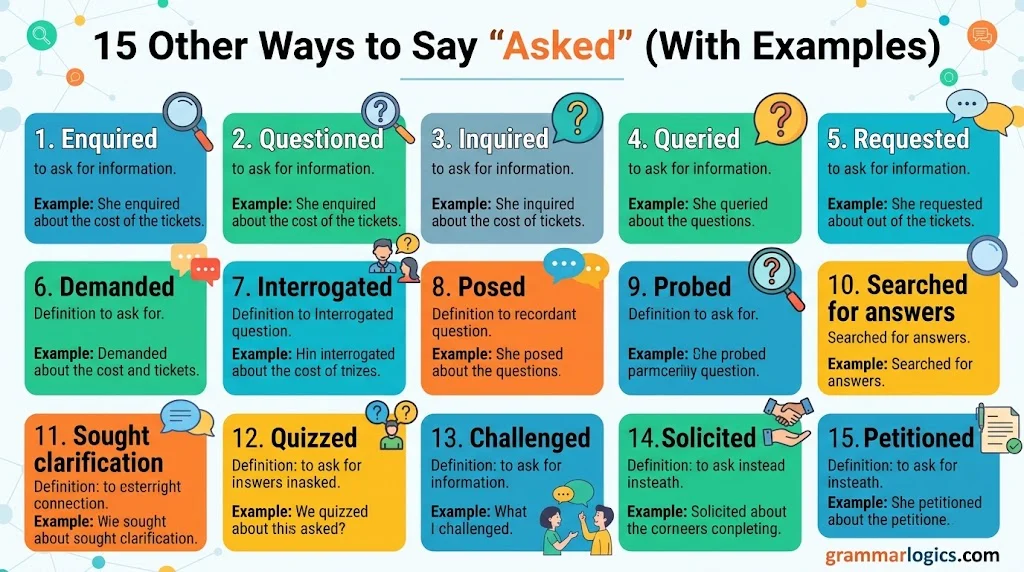
Choosing the right words can make your communication clearer, more natural, and more engaging. The word “asked” is common in everyday conversations, but using different expressions can add variety and meaning to your writing.
When telling a story, writing an email, or describing a conversation, choosing suitable alternatives to “asked” can help you express curiosity, politeness, or interest more effectively. Different words can also show how someone speaks or what they want to know. For example, “inquired,” “questioned,” and “requested” each carry a slightly different meaning. Understanding these differences helps you select the most appropriate expression for every situation. Whether you are writing an essay, a blog post, or a professional message, using varied vocabulary can make your sentences sound smoother and more interesting. It also helps you avoid repeating the same word throughout your writing, making your content easier to read and understand.
Learning other ways to say “asked” can improve your vocabulary and make your English sound more fluent. Although “asked” works well in most situations, alternatives can communicate a speaker’s intention more precisely. For instance, “inquired” sounds more formal, while “wondered” can express curiosity or uncertainty. Similarly, “questioned” may suggest doubt, and “requested” often indicates a polite or formal appeal. Choosing the right expression depends on the context, tone, and relationship between the people involved. By exploring these alternatives, you can make your conversations, stories, emails, and articles more expressive. These word choices are especially helpful for students, writers, bloggers, and English learners who want to develop stronger communication skills and write with greater confidence.
What Does “Asked” Mean?
The word “asked” is the past tense and past participle of the verb “ask.” It means that someone requested information, posed a question, or asked another person to do something. For example, “She asked me about my weekend” means she wanted to know how my weekend went. Similarly, “He asked me to help him” means he requested assistance.
The meaning of “asked” depends on the situation. It can describe a simple question, a polite request, a formal inquiry, or a request for permission. In everyday English, the word is common because it works in many contexts. However, alternatives such as inquired, questioned, and requested can communicate more specific intentions or different levels of formality.
Common Situations Where “Asked” Is Used
People use “asked” in everyday conversations, text messages, emails, school assignments, workplace discussions, and personal relationships. A student might ask a teacher for clarification, a colleague might ask for a document, or a friend might ask about someone’s plans. The word also appears frequently in storytelling when describing what one person said to another.
Sometimes, a more specific expression makes the meaning clearer. For example, “inquired” can suit a formal question, while “requested” is useful when someone wants something done. In a story, “wondered” can describe a person’s curiosity, although it does not always mean they directly asked someone. Choosing the right wording helps readers understand the purpose and tone of the communication.
Is It Professional or Polite to Say “Asked”?
Yes, “asked” is both professional and polite when used appropriately. It is a neutral word that fits everyday conversations, business emails, academic writing, and formal discussions. For example, “I asked the manager for clarification” sounds natural and professional. The word itself is not rude; politeness usually depends on the wording, context, and relationship between the people involved.
In more formal situations, alternatives such as inquired or requested may sound more precise. “I inquired about the application process” emphasizes seeking information, while “I requested an extension” describes asking for something specific. In casual conversations, “wanted to know” may sound warmer and more conversational. The best expression depends on whether you are asking a question, requesting an action, or describing someone’s curiosity.
Advantages and Disadvantages of Saying “Asked”
Advantages
The main advantage of “asked” is its simplicity. It is easy to understand, widely used, and suitable for many situations. It works well in both spoken and written English without sounding unnecessarily formal. It also allows writers to describe questions and requests clearly, making it especially useful for everyday communication and storytelling.
Disadvantages
Although “asked” is versatile, using it repeatedly can make a paragraph or story feel monotonous. It may also lack the precision needed to distinguish between a question, a formal inquiry, a request, and a challenge. In some contexts, a more specific verb can communicate the speaker’s intention more accurately. Choosing a suitable alternative adds variety, clarity, and tone without making the writing complicated.
15 Synonyms for “Asked”
- Inquired
- Questioned
- Requested
- Wanted to Know
- Sought Information
- Consulted
- Invited
- Pleaded
- Begged
- Urged
- Wondered
- Interrogated
- Queried
- Appealed
- Petitioned
1. Inquired
Meaning
Inquired means asked for information about something. It is a slightly more formal alternative to “asked” and is often used when someone wants details, clarification, or an update.
Definition
To inquire means to seek information by asking a question.
Detailed Explanation
“Inquired” sounds more formal than the everyday word “asked.” It is particularly useful when describing professional, administrative, or official communication. Unlike “requested,” it generally focuses on obtaining information rather than asking someone to take action. It can make writing sound polished without changing the basic meaning.
Scenario Examples
Scenario: Someone wants an update about a job application.
Example: She inquired about the status of her application.
Scenario: A customer needs information about a service.
Example: I inquired about the delivery schedule before placing my order.
Scenario: A student needs clarification from a teacher.
Example: Daniel inquired about the instructions for the final assignment.
Best Use
Use “inquired” in professional emails, formal conversations, customer service, and situations where someone seeks specific information.
Tone
Tone: Formal, respectful, professional.
It sounds measured and courteous, making it suitable for communication where a polished tone is helpful.
2. Questioned
Meaning
Questioned means asked someone a question or expressed doubt about something. It can describe a neutral request for information or a more challenging attempt to understand someone’s actions or claims.
Definition
To question means to ask questions, seek explanations, or challenge something.
Detailed Explanation
“Questioned” can sound more direct than “asked,” particularly when someone wants an explanation or doubts a statement. It is common in discussions, investigations, interviews, and debates. The word may suggest curiosity, scrutiny, or skepticism depending on the context. Unlike “inquired,” it can imply that the person is examining or challenging something rather than simply requesting information.
Scenario Examples
Scenario: A teacher wants a student to explain an answer.
Example: The teacher questioned Maya about her reasoning.
Scenario: A team member is uncertain about a proposed decision.
Example: He questioned whether the new schedule would be practical.
Best Use
Use “questioned” when describing direct questions, requests for explanations, investigations, or situations involving doubt.
Tone
Tone: Direct, analytical, sometimes challenging.
It can be neutral, but the surrounding sentence determines whether it sounds curious or confrontational.
3. Requested
Meaning
Requested means asked someone for something or asked them to do something. It is especially useful when the purpose is to obtain assistance, permission, information, or a particular action.
Definition
To request means to ask for something politely or formally.
Detailed Explanation
“Requested” is more specific than “asked” when a person wants something to happen. It commonly appears in workplace communication, official correspondence, and customer service. The word often sounds more formal and deliberate than the original expression. However, a request is not necessarily a command; the other person may still choose whether to agree.
Scenario Examples
Scenario: An employee needs more time to finish a project.
Example: I requested an additional day to complete the report.
Scenario: A customer wants a copy of a receipt.
Example: The customer requested a digital copy of the receipt.
Scenario: A student needs permission to leave early.
Example: Ahmed requested permission to leave school before the final bell.
Best Use
Use “requested” in professional emails, formal applications, customer interactions, and situations involving a specific need or action.
Tone
Tone: Polite, formal, purposeful.
It communicates a clear intention while maintaining a respectful distance.
4. Wanted to Know
Meaning
Wanted to know means that someone asked a question because they wanted information or an explanation. It is a natural, conversational expression that emphasizes curiosity.
Definition
To want to know means to desire information about a person, situation, or subject.
Detailed Explanation
This expression is more conversational than “inquired” and often sounds natural in everyday storytelling. It highlights the person’s interest in learning something rather than the formality of the question. It works particularly well when explaining why someone asked a question. Unlike “questioned,” it usually does not suggest criticism or suspicion.
Scenario Examples
Scenario: A friend is curious about weekend plans.
Example: My friend wanted to know whether I was joining them on Saturday.
Scenario: A parent asks about a child’s school day.
Example: Her father wanted to know what she had learned in class.
Best Use
Use “wanted to know” in casual conversation, personal messages, stories, and informal writing.
Tone
Tone: Conversational, natural, curious.
It sounds approachable and focuses on the person’s interest in an answer.
5. Sought Information
Meaning
Sought information means tried to obtain facts, details, or an explanation. It is useful when describing a person’s effort to learn about a subject.
Definition
To seek information means to look for knowledge or details, often by asking questions or consulting sources.
Detailed Explanation
This expression sounds more formal and descriptive than “asked.” It may refer to asking a person directly or gathering information from several sources. Unlike “inquired,” which usually describes a question, “sought information” can include research and other ways of finding answers. It is particularly suitable for reports, academic writing, and professional summaries.
Scenario Examples
Scenario: A researcher needs background details for a project.
Example: The researcher sought information about local recycling programs.
Scenario: A customer is comparing different services.
Example: Before making a decision, we sought information about the available plans.
Best Use
Use “sought information” in reports, academic writing, research descriptions, and formal explanations of information gathering.
Tone
Tone: Formal, purposeful, analytical.
It emphasizes the process of finding information rather than the exact words spoken.
6. Consulted
Meaning
Consulted means asked someone for advice, guidance, or professional knowledge. It is most appropriate when the person being approached has relevant experience or expertise.
Definition
To consult means to seek advice or information from someone knowledgeable.
Detailed Explanation
“Consulted” is not a direct replacement for every use of “asked.” It suggests that someone sought guidance, considered another person’s opinion, or discussed a decision with them. It is common in professional, medical, legal, educational, and business contexts. Choose it when advice or expertise matters more than simply receiving an answer.
Scenario Examples
Scenario: A business owner needs financial guidance.
Example: The owner consulted an accountant before changing the company’s budget.
Scenario: A student is uncertain about a university application.
Example: Sara consulted her academic adviser about choosing a degree program.
Best Use
Use “consulted” when describing advice-seeking, professional discussions, and decisions that benefit from another person’s expertise.
Tone
Tone: Professional, respectful, considered.
It suggests that the other person’s knowledge or judgment is valued.
7. Invited
Meaning
Invited means asked someone to attend an event, join an activity, or take part in something. It is appropriate when the question involves an offer of participation rather than simply seeking information.
Definition
To invite means to ask someone to join, attend, or participate.
Detailed Explanation
“Invited” is useful when “asked” refers to extending an invitation. It often carries a friendly or welcoming feeling, although formal invitations can also be professional. Unlike “requested,” which may focus on an action or item, “invited” emphasizes someone’s opportunity to participate. It should not be used as a synonym when the original sentence describes an ordinary question.
Scenario Examples
Scenario: A friend wants someone to attend a celebration.
Example: Lily invited me to her birthday dinner.
Scenario: A manager encourages a colleague to join a meeting.
Example: The manager invited the design team to share its ideas.
Best Use
Use “invited” for social gatherings, meetings, events, collaborative activities, and opportunities to participate.
Tone
Tone: Friendly, welcoming, encouraging.
It suggests openness and gives the other person a chance to accept or decline.
8. Pleaded
Meaning
Pleaded means asked earnestly or emotionally for something, often because the situation feels important or urgent.
Definition
To plead means to make an emotional or urgent request.
Detailed Explanation
“Pleaded” is much stronger than the neutral word “asked.” It often communicates desperation, distress, fear, or a strong desire for someone to agree. The word appears in emotional conversations, dramatic writing, and some legal contexts. It is not suitable for ordinary questions unless the situation involves a strong emotional appeal.
Scenario Examples
Scenario: Someone asks a friend not to leave during an argument.
Example: “Please stay and hear me out,” he pleaded.
Scenario: A child wants another chance after making a mistake.
Example: The child pleaded with her parents to let her explain.
Best Use
Use “pleaded” in emotional conversations, personal conflicts, urgent requests, and storytelling that needs to convey strong feelings.
Tone
Tone: Emotional, urgent, vulnerable.
It communicates that the request matters deeply to the person making it.
9. Begged
Meaning
Begged means asked for something very earnestly, often with desperation or a strong feeling of need.
Definition
To beg means to ask insistently or desperately for something.
Detailed Explanation
“Begged” is more intense than “asked” and often suggests that someone feels they have little power or few alternatives. It can communicate distress, desperation, or an urgent desire for help. In some situations, it may make the speaker seem vulnerable or dependent. Because of its emotional strength, it is best reserved for situations where an ordinary request would not express the intensity accurately.
Scenario Examples
Scenario: Someone urgently wants a friend to forgive a serious mistake.
Example: He begged her to give him another chance.
Scenario: A child wants to stay at a friend’s house.
Example: Noah begged his parents to let him stay until dinner.
Best Use
Use “begged” in emotional stories, desperate requests, and situations where the person is asking with unusually strong urgency.
Tone
Tone: Desperate, emotional, intense.
It conveys a stronger need than a typical request and may sound dramatic.
10. Urged
Meaning
Urged means strongly encouraged someone to do something. It often involves a recommendation or warning rather than a simple question.
Definition
To urge means to encourage or persuade someone firmly to take action.
Detailed Explanation
“Urged” is appropriate when someone wants another person to act, especially when the action seems important or time-sensitive. It can sound more forceful than “asked” because it suggests strong encouragement. Unlike “requested,” which may simply state a need, “urged” often emphasizes the importance of following the advice. It does not usually mean that someone merely asked for information.
Scenario Examples
Scenario: A friend encourages someone to seek medical advice.
Example: I urged him to speak with a healthcare professional about his concerns.
Scenario: A team leader wants colleagues to submit their work on time.
Example: The supervisor urged everyone to send their updates before Friday.
Best Use
Use “urged” for recommendations, warnings, calls to action, and situations where someone strongly encourages another person to act.
Tone
Tone: Firm, persuasive, concerned.
It communicates that the speaker believes the action is important.
11. Wondered
Meaning
Wondered means thought about something with curiosity or uncertainty. It can sometimes replace “asked” when describing an indirect question or an unspoken thought.
Definition
To wonder means to feel curious or uncertain and want to understand something.
Detailed Explanation
“Wondered” is not always a direct synonym for “asked” because it may describe a question someone never actually said aloud. It works well in storytelling when explaining a person’s thoughts or uncertainty. In polite conversation, “I was wondering whether…” can soften a question or request. This wording often sounds less direct and more tentative than simply asking.
Scenario Examples
Scenario: Someone is unsure whether a friend is available.
Example: I was wondering if you were free for coffee tomorrow.
Scenario: A person reflects on an unexpected decision.
Example: She wondered why the meeting had been canceled.
Best Use
Use “wondered” in narratives, reflective writing, gentle questions, and polite messages where a softer approach is appropriate.
Tone
Tone: Thoughtful, curious, gentle.
It conveys uncertainty or curiosity and can make a request sound less demanding.
12. Interrogated
Meaning
Interrogated means questioned someone closely or systematically, often to obtain detailed information about an event or situation.
Definition
To interrogate means to question someone thoroughly, especially during an investigation.
Detailed Explanation
“Interrogated” is much stronger and more specific than “asked.” It often appears in police investigations, official inquiries, and situations where someone is questioned intensively. In casual conversation, it can be used figuratively to describe someone asking too many questions, sometimes in an uncomfortable way. Because it may imply pressure or suspicion, it is not appropriate for ordinary, friendly questions.
Scenario Examples
Scenario: Investigators question a witness about an incident.
Example: Officers interrogated the suspect about the missing documents.
Scenario: A friend feels overwhelmed by another person’s questions.
Example: After the party, my brother interrogated me about every detail of the evening.
Best Use
Use “interrogated” in investigative contexts or when describing intense, persistent questioning.
Tone
Tone: Intense, formal, potentially confrontational.
It suggests close scrutiny rather than a casual exchange of information.
13. Queried
Meaning
Queried means asked about something or sought clarification. It is a relatively formal expression that can also mean challenged the accuracy or validity of information.
Definition
To query means to ask a question about something or raise a concern that needs clarification.
Detailed Explanation
“Queried” is often used in business, technical, administrative, and written contexts. It can describe asking for details about an invoice, checking information in a report, or raising a question about a decision. Compared with “asked,” it sounds more specialized and may imply that something needs verification. It is less common in casual conversation, where “asked” or “wanted to know” usually sounds more natural.
Scenario Examples
Scenario: An employee notices an unclear expense.
Example: The finance officer queried the charge on the invoice.
Scenario: A reader needs clarification about a statement in a report.
Example: The editor queried the date mentioned in the second paragraph.
Best Use
Use “queried” in business correspondence, document reviews, administrative communication, and technical discussions.
Tone
Tone: Formal, precise, analytical.
It suggests a specific question or concern that requires clarification.
14. Appealed
Meaning
Appealed means made an earnest request for help, support, understanding, or a particular decision. It can also refer to formally challenging a decision through an official process.
Definition
To appeal means to make a serious request or ask an authority to reconsider a decision.
Detailed Explanation
“Appealed” has a more specific meaning than “asked” and often carries emotional or formal weight. A person may appeal to others for assistance or appeal a decision they believe is unfair. In legal or administrative contexts, the word can refer to a formal procedure rather than an ordinary conversation. Use it when the request involves support, persuasion, or reconsideration.
Scenario Examples
Scenario: A community group asks residents to support a local project.
Example: The organizers appealed to residents for help with the neighborhood cleanup.
Scenario: A student challenges a disciplinary decision.
Example: The student appealed the school’s decision through the official process.
Best Use
Use “appealed” in formal requests for support, public campaigns, persuasive communication, and official challenges to decisions.
Tone
Tone: Earnest, persuasive, formal.
It communicates a serious request and may suggest that the outcome matters considerably.
15. Petitioned
Meaning
Petitioned means formally asked an authority or organization to take action, change a decision, or address a concern.
Definition
To petition means to submit a formal request, often to an official body or person in authority.
Detailed Explanation
“Petitioned” is much more formal than “asked” and generally involves an organized or official request. It is commonly associated with legal proceedings, government decisions, institutional policies, or public campaigns. Unlike a simple inquiry, a petition usually seeks a particular action or change. It is not a natural substitute for casual questions or everyday requests.
Scenario Examples
Scenario: Residents want their local government to improve a road.
Example: The residents petitioned the council to repair the damaged street.
Scenario: Students want their school to reconsider a policy.
Example: The students petitioned the administration to extend library opening hours.
Best Use
Use “petitioned” for formal appeals to authorities, organized requests, legal matters, and efforts to change policies or decisions.
Tone
Tone: Formal, serious, civic-minded.
It emphasizes an official request, often made to someone with the power to bring about change.
FAQs
What is another way to say “asked”?
Common alternatives include inquired, questioned, requested, and wanted to know. The best choice depends on the situation. Use “inquired” for seeking information formally, “requested” for asking someone to do something, and “wanted to know” for natural, conversational writing.
What does “asked” mean?
“Asked” is the past tense of “ask.” It means that someone posed a question, requested information, or asked another person for something. Its precise meaning depends on the context.
Is “asked” professional?
Yes. “Asked” is appropriate in professional communication because it is clear, neutral, and widely understood. For more formal wording, “inquired” or “requested” may be suitable when their specific meanings fit the situation.
What is a more polite way to say “asked”?
A polite alternative depends on what you mean. “Inquired” can sound courteous when seeking information, while “requested” is useful for a formal request. For a softer conversational question, “I was wondering if…” can sound less direct.
Which alternative works best in formal communication?
“Inquired” works well when seeking information, while “requested” is usually better when asking for an action or something specific. “Petitioned” is appropriate for formal requests to authorities, but it is too specialized for routine business emails.
Conclusion
Choosing the right alternative to “asked” can make your English more precise, natural, and expressive. Although “asked” works well in most everyday situations, other expressions communicate different intentions. “Inquired” suits formal questions, “requested” emphasizes a specific need, and “wondered” can make a question sound softer. Words such as “pleaded” and “begged” express stronger emotions, while “petitioned” describes a formal appeal to an authority.
The most useful expression depends on your purpose, audience, and relationship with the person you are addressing. Before replacing “asked,” consider whether you are seeking information, requesting action, expressing curiosity, or encouraging someone to respond. Understanding these differences will help you build stronger vocabulary and communicate with greater confidence in conversations, emails, stories, and professional writing.