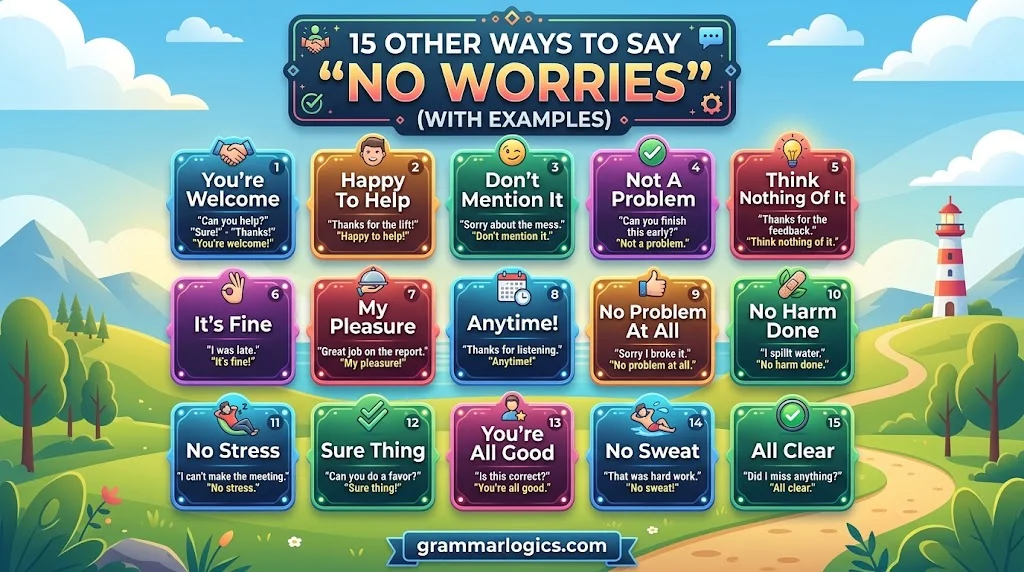
“No worries” is a friendly phrase used to express reassurance, forgiveness, and understanding. Learning alternative expressions can make your conversations sound more natural, polite, and engaging.
Whether you are responding to an apology, accepting thanks, or comforting someone, choosing the right words can make a difference. There are many useful ways to say “No Worries” in everyday conversations, professional emails, and friendly messages. Expressions such as “It’s all good,” “Don’t worry about it,” and “No problem” help you communicate with confidence while maintaining a warm and approachable tone.
Understanding different alternatives to “No worries” can also improve your English vocabulary and communication skills. Some expressions sound casual and relaxed, while others are more suitable for workplace conversations or formal situations. For example, “That’s perfectly fine” can reassure a colleague, whereas “It’s all good” works well with friends. By exploring these alternatives, you can choose words that match the situation, express genuine kindness, and avoid repeating the same phrase in every conversation. These expressions will help you sound more natural, thoughtful, and confident in both spoken and written English.
What Does “No Worries” Mean?
“No worries” is an informal expression used to reassure someone that a problem, mistake, inconvenience, or apology is not a concern. It can mean “that is okay,” “it is not a problem,” or “you do not need to apologize.” People commonly use it when responding to someone who says sorry, thanks them for a favor, or worries about causing trouble.
The meaning depends on the situation. When someone apologizes for being late, “no worries” communicates understanding. When someone says thank you, it can mean that helping them was no trouble. The phrase generally sounds relaxed, friendly, and reassuring, although it may feel too casual for certain formal communications.
Common Situations Where “No Worries” Is Used
People use “no worries” in everyday conversations, text messages, and friendly discussions to keep interactions comfortable. For example, if a friend cancels plans, you might use it to show that you understand. It is also common when responding to an apology for a small mistake or acknowledging someone’s thanks after providing assistance.
In the workplace, colleagues may use the expression when someone apologizes for a minor delay or requests a small favor. However, formal emails, customer complaints, and sensitive conversations may require more thoughtful wording. Choosing an alternative can help you communicate professionalism, empathy, or reassurance without changing your intended meaning.
Is It Professional or Polite to Say “No Worries”?
Yes, “no worries” is polite in many situations, particularly informal conversations with friends, colleagues, and familiar clients. It sounds approachable and communicates that the other person does not need to feel guilty or embarrassed. In a relaxed workplace, it can help maintain a friendly atmosphere.
However, the expression is relatively casual. In formal emails, official correspondence, or serious customer-service situations, alternatives such as “You’re welcome,” “That’s perfectly fine,” or “Please don’t be concerned” may be more suitable. The best choice depends on the relationship, the seriousness of the situation, and the message you want to convey. When responding to a serious concern, make sure your wording acknowledges the person’s feelings rather than dismissing them.
Advantages and Disadvantages of Saying “No Worries”
Advantages
The main advantage of “no worries” is its simplicity. It reassures people without making a small issue seem unnecessarily serious. The phrase also works well in quick conversations and text messages because it is short, familiar, and easy to understand. Its friendly tone can reduce awkwardness after a minor mistake or apology.
Another benefit is its flexibility. Depending on the context, it can communicate acceptance, reassurance, or a relaxed response to gratitude. It helps keep everyday communication natural and comfortable.
Disadvantages
The expression can sound too casual in formal correspondence, especially when communicating with senior professionals, unfamiliar clients, or people expecting a more formal response. It may also seem dismissive when someone is discussing a serious mistake or expressing genuine distress.
Additionally, using “no worries” too frequently can make your replies feel repetitive. In some situations, a more specific response is better because it communicates appreciation, forgiveness, understanding, or reassurance more clearly.
15 Alternatives to “No Worries”
- You’re Welcome
- No Problem
- Not a Problem at All
- That’s All Right
- It’s All Good
- Don’t Mention It
- My Pleasure
- Happy to Help
- Think Nothing of It
- It’s Okay
- No Need to Apologize
- That’s Perfectly Fine
- Please Don’t Worry
- I’m Glad I Could Help
- It’s Nothing to Worry About
1. You’re Welcome
Meaning
“You’re welcome” is a polite response to someone who thanks you. Like “no worries,” it can reassure the other person that their request or your assistance was not a burden.
Definition
A courteous expression used to acknowledge someone’s thanks.
Detailed Explanation
“You’re welcome” is one of the most widely understood responses to gratitude. Unlike “no worries,” it focuses directly on acknowledging thanks rather than dismissing a problem or accepting an apology. It works in both casual and professional conversations, making it a versatile choice. Use it when you want to sound polite without being overly formal.
Scenario Examples
Scenario: A coworker thanks you for sharing a document.
Example: “You’re welcome! I hope the notes are helpful.”
Scenario: A customer thanks you for explaining a process.
Example: “You’re welcome. Please let me know if you need anything else.”
Best Use
Use this expression in everyday conversations, emails, customer service, and workplace communication when responding to gratitude.
Tone
Tone: Polite, friendly, respectful. It acknowledges appreciation clearly and suits a wide range of relationships.
2. No Problem
Meaning
“No problem” means that something is not difficult, inconvenient, or troublesome. It is a close alternative to “no worries” when reassuring someone about a small request or mistake.
Definition
An informal expression indicating that something is easy to accept or handle.
Detailed Explanation
“No problem” is direct and conversational. It works especially well when someone apologizes for a minor inconvenience or asks you to do something manageable. Compared with “no worries,” it places slightly more emphasis on the absence of a problem. Although common at work, it can sound too casual in formal correspondence.
Scenario Examples
Scenario: A friend asks you to wait a few minutes.
Example: “No problem. I’ll grab a coffee while I wait.”
Scenario: A colleague asks you to resend an attachment.
Example: “No problem. I’ll send it again right now.”
Best Use
Choose it for casual conversations, team messages, texting, and everyday requests.
Tone
Tone: Casual, helpful, relaxed. It keeps a small issue from becoming a bigger concern.
3. Not a Problem at All
Meaning
“Not a problem at all” reassures someone that their request, mistake, or inconvenience has not caused any difficulty.
Definition
A reassuring expression emphasizing that a situation is completely acceptable.
Detailed Explanation
This phrase offers a little more reassurance than the shorter “no problem.” Adding “at all” emphasizes that you genuinely do not mind. It is useful when someone apologizes repeatedly or worries that they have inconvenienced you. The expression remains conversational, so it may not be the best choice for highly formal writing.
Scenario Examples
Scenario: A friend apologizes for changing dinner plans.
Example: “Not a problem at all. We can meet tomorrow instead.”
Scenario: A teammate asks for additional time to finish a task.
Example: “Not a problem at all; send me the revised version when it’s ready.”
Best Use
Use it in friendly professional exchanges, personal messages, and everyday conversations when you want to provide extra reassurance.
Tone
Tone: Warm, reassuring, accommodating. It emphasizes that the situation is genuinely acceptable.
4. That’s All Right
Meaning
“That’s all right” means that a mistake, apology, or inconvenience is acceptable. It can help someone feel less embarrassed about a minor problem.
Definition
A polite expression used to accept an apology or indicate that a situation is okay.
Detailed Explanation
“That’s all right” often sounds calm and considerate. It is especially suitable when someone apologizes for a small error or accidental inconvenience. Unlike “no worries,” it can sound slightly more measured and traditional. However, tone matters: if said sharply, it may sound dismissive rather than reassuring.
Scenario Examples
Scenario: A student apologizes for arriving a few minutes late.
Example: “That’s all right. Please take your seat.”
Scenario: A friend accidentally interrupts your conversation.
Example: “That’s all right; I was just finishing my point.”
Best Use
Choose this phrase for polite everyday conversations, classroom situations, and gentle responses to apologies.
Tone
Tone: Calm, polite, understanding. It accepts a minor mistake without making the other person feel worse.
5. It’s All Good
Meaning
“It’s all good” means that everything is okay and there is no need to feel concerned about a minor issue.
Definition
An informal expression indicating that a situation is acceptable or has been resolved.
Detailed Explanation
This expression has a relaxed, friendly feel. It is often used among friends, family members, and familiar coworkers after a misunderstanding or small inconvenience. Compared with “no worries,” it can suggest that the situation is settled and everyone can move on. Because it is casual, it may be unsuitable for formal emails or serious complaints.
Scenario Examples
Scenario: A friend forgets to bring a book.
Example: “It’s all good. I’ll bring mine next time.”
Scenario: A teammate apologizes for a minor scheduling mix-up.
Example: “It’s all good—we’ve sorted out the meeting time now.”
Best Use
Use it in text messages, casual conversations, and friendly workplace chats.
Tone
Tone: Relaxed, informal, upbeat. It helps make a small mistake feel less important.
6. Don’t Mention It
Meaning
“Don’t mention it” tells someone that they do not need to thank you or feel that your help deserves special attention.
Definition
A courteous expression used to downplay a favor or act of kindness.
Detailed Explanation
This phrase is most appropriate when someone thanks you for doing something helpful. It communicates modesty and suggests that you were happy to assist. Unlike “no worries,” it is primarily a response to gratitude rather than an apology. It can sound warm and natural, although some people may prefer a more direct acknowledgment of thanks.
Scenario Examples
Scenario: A neighbor thanks you for collecting a parcel.
Example: “Don’t mention it. I’m glad I could help.”
Scenario: A classmate thanks you for explaining a difficult question.
Example: “Don’t mention it; we all need a little help sometimes.”
Best Use
Use it in friendly personal conversations, small favors, and informal expressions of gratitude.
Tone
Tone: Modest, kind, considerate. It downplays the effort involved in helping someone.
7. My Pleasure
Meaning
“My pleasure” communicates that helping someone was enjoyable or satisfying rather than an inconvenience.
Definition
A polite expression showing that you were happy to provide assistance.
Detailed Explanation
“My pleasure” is particularly useful when responding to thanks after providing a service or doing a favor. It communicates a more positive feeling than simply saying that something was not a problem. The phrase can sound professional and welcoming, especially in customer-facing roles. It is less suitable when you are accepting an apology rather than responding to gratitude.
Scenario Examples
Scenario: A hotel guest thanks a staff member for arranging transportation.
Example: “My pleasure. I hope you have a wonderful evening.”
Scenario: A colleague thanks you for reviewing an important presentation.
Example: “My pleasure. The presentation looks great.”
Best Use
Choose it for customer service, professional emails, hospitality, and situations where you genuinely enjoyed helping.
Tone
Tone: Warm, polished, courteous. It presents assistance as something you were glad to provide.
8. Happy to Help
Meaning
“Happy to help” tells someone that you are willing and pleased to assist them.
Definition
A friendly expression showing readiness or willingness to provide assistance.
Detailed Explanation
This phrase emphasizes your willingness to help rather than simply stating that a problem is unimportant. It works well when a colleague asks a question, a customer needs guidance, or a friend requests assistance. Compared with “no worries,” it offers a more positive and service-oriented message. It is especially useful in professional settings because it sounds approachable without being overly casual.
Scenario Examples
Scenario: A new employee asks how to use a scheduling tool.
Example: “Happy to help. Let me show you how it works.”
Scenario: A customer thanks you for explaining the return process.
Example: “Happy to help! Feel free to contact us if you have another question.”
Best Use
Use it in workplace communication, customer support, team collaboration, and friendly personal messages.
Tone
Tone: Helpful, positive, professional. It highlights your willingness to support the other person.
9. Think Nothing of It
Meaning
“Think nothing of it” means that someone should not consider a favor or minor inconvenience a major issue.
Definition
An expression encouraging someone not to feel troubled or indebted over something small.
Detailed Explanation
This expression is a little more traditional than “no worries.” It is often used after someone apologizes or thanks you for a small favor. It suggests that the action required little effort or did not create a meaningful inconvenience. Although polite, it can sound somewhat old-fashioned in casual texting, so shorter alternatives may feel more natural with close friends.
Scenario Examples
Scenario: A neighbor apologizes for asking you to water their plants.
Example: “Think nothing of it. I was happy to do it.”
Scenario: A friend thanks you for giving them a lift.
Example: “Think nothing of it; I was heading that way anyway.”
Best Use
Choose it for polite personal conversations, thoughtful responses to gratitude, and situations involving small favors.
Tone
Tone: Considerate, gracious, slightly traditional. It reassures someone that they do not owe you anything for a small kindness.
10. It’s Okay
Meaning
“It’s okay” means that a situation is acceptable or that someone does not need to worry excessively about a mistake.
Definition
A simple expression used to reassure someone or accept a minor problem.
Detailed Explanation
“It’s okay” is versatile because it can respond to apologies, mistakes, and expressions of concern. Its meaning depends heavily on tone and context. Spoken gently, it can feel comforting and understanding; spoken abruptly, it may sound dismissive. Unlike “no worries,” it can also communicate emotional reassurance, making it useful when someone feels embarrassed or upset.
Scenario Examples
Scenario: A child accidentally spills water on the table.
Example: “It’s okay. Let’s clean it up together.”
Scenario: A friend apologizes for forgetting to reply to your message.
Example: “It’s okay; I know you’ve had a busy week.”
Best Use
Use it in personal conversations, family interactions, and everyday situations involving minor mistakes or worries.
Tone
Tone: Gentle, reassuring, adaptable. Its warmth depends on how sincerely and kindly it is delivered.
11. No Need to Apologize
Meaning
“No need to apologize” directly tells someone that an apology is unnecessary.
Definition
A reassuring expression indicating that a person’s actions do not require an apology in the situation.
Detailed Explanation
This phrase is more specific than “no worries” because it focuses directly on the other person’s apology. It is useful when someone feels guilty about a minor delay, unavoidable change, or honest mistake. The expression can sound empathetic because it addresses the person’s concern instead of merely dismissing the issue. However, use it thoughtfully when the situation involves genuine harm or responsibility.
Scenario Examples
Scenario: A coworker apologizes for taking sick leave.
Example: “There’s no need to apologize. Your health comes first.”
Scenario: A friend says sorry for canceling because of a family commitment.
Example: “No need to apologize. I completely understand.”
Best Use
Choose it for personal messages, supportive workplace conversations, and situations where someone feels unnecessarily guilty.
Tone
Tone: Empathetic, supportive, reassuring. It explicitly removes the pressure to apologize.
12. That’s Perfectly Fine
Meaning
“That’s perfectly fine” communicates that a request, change, or situation is completely acceptable.
Definition
A polite expression confirming that something is suitable or causes no objection.
Detailed Explanation
This phrase sounds a little more composed and professional than “no worries.” It is useful when agreeing to a schedule change, accepting a reasonable request, or responding to a minor inconvenience. The word “perfectly” reinforces acceptance, although it should be used sincerely rather than automatically. Unlike “no worries,” the expression focuses on whether something is acceptable rather than whether it causes concern.
Scenario Examples
Scenario: A client asks to move a meeting to the afternoon.
Example: “That’s perfectly fine. I’ll update the calendar invitation.”
Scenario: A friend asks whether they can bring another guest.
Example: “That’s perfectly fine; there’s enough room for everyone.”
Best Use
Use it in professional emails, scheduling discussions, polite conversations, and situations involving agreement or flexibility.
Tone
Tone: Polite, composed, professional. It clearly communicates acceptance without sounding overly casual.
13. Please Don’t Worry
Meaning
“Please don’t worry” encourages someone to feel less anxious about a situation.
Definition
A reassuring expression asking someone not to remain concerned or anxious.
Detailed Explanation
This phrase focuses on a person’s feelings rather than simply saying that a problem is unimportant. It can be helpful when someone is concerned about a delay, an upcoming task, or an issue that is being handled. Compared with “no worries,” it is more direct about reducing anxiety. However, when a problem is serious, it is better to acknowledge the concern and explain what steps are being taken instead of offering reassurance alone.
Scenario Examples
Scenario: A friend worries about arriving late to a gathering.
Example: “Please don’t worry. We’ll save you a seat.”
Scenario: A colleague is concerned about a minor mistake in a draft.
Example: “Please don’t worry; we can correct it before sending the final version.”
Best Use
Choose it for supportive conversations, personal messages, and situations where someone needs reassurance.
Tone
Tone: Caring, gentle, reassuring. It directly addresses another person’s worry.
14. I’m Glad I Could Help
Meaning
“I’m glad I could help” expresses happiness that your assistance was useful to someone.
Definition
A warm expression showing satisfaction that you were able to provide support.
Detailed Explanation
This expression is especially appropriate after someone thanks you for meaningful assistance. It communicates a positive feeling and recognizes that your help made a difference. Unlike “no worries,” it does not simply minimize a problem; it emphasizes the value of being helpful. It can sound sincere and professional, particularly when you want to build a positive relationship with a colleague or customer.
Scenario Examples
Scenario: A teammate thanks you for helping them prepare for a presentation.
Example: “I’m glad I could help. You did a great job presenting it.”
Scenario: A friend thanks you for helping them move into a new apartment.
Example: “I’m glad I could help. I hope you’re settling in comfortably.”
Best Use
Use it in workplace conversations, personal messages, customer communication, and situations involving meaningful support.
Tone
Tone: Sincere, warm, appreciative. It communicates genuine satisfaction that your assistance was useful.
15. It’s Nothing to Worry About
Meaning
“It’s nothing to worry about” reassures someone that a particular situation does not require excessive concern.
Definition
An expression indicating that an issue is minor, manageable, or unlikely to cause serious trouble.
Detailed Explanation
This phrase focuses on the seriousness of a concern rather than on accepting thanks or an apology. It can be useful when someone is anxious about a small error or an ordinary inconvenience. Compared with “no worries,” it is more explicitly reassuring and can sound more serious. Use it only when you have a reasonable basis for the reassurance; otherwise, it may unintentionally minimize a legitimate concern.
Scenario Examples
Scenario: A student worries about making a small formatting mistake in an assignment draft.
Example: “It’s nothing to worry about. You can fix the formatting before submitting it.”
Scenario: A friend is concerned about a minor delay in their travel plans.
Example: “It’s nothing to worry about; we have enough time to adjust our plans.”
Best Use
Choose it for reassuring conversations, practical advice, and situations where a concern is genuinely manageable.
Tone
Tone: Reassuring, calm, confident. It encourages perspective while implying that the issue is not serious.
FAQs
What is another way to say “no worries”?
Common alternatives include “no problem,” “you’re welcome,” “that’s all right,” and “not a problem at all.” The best option depends on whether you are responding to thanks, accepting an apology, or reassuring someone about a concern.
What does “no worries” mean?
“No worries” means that something is okay, does not cause a problem, or is not worth feeling concerned about. It is commonly used to accept apologies, respond to small favors, and reassure people in everyday conversations.
Is “no worries” professional?
Yes, it can be appropriate in relaxed workplaces and informal messages to colleagues. However, “that’s perfectly fine,” “happy to help,” or “you’re welcome” may be better suited to formal emails and communication with unfamiliar clients.
What is a more polite way to say “no worries”?
“That’s all right,” “you’re welcome,” and “not a problem at all” are polite alternatives. For professional communication, “That’s perfectly fine” can be particularly useful when accepting a request or schedule change.
Which alternative works best in formal communication?
“That’s perfectly fine” works well when confirming that a request or change is acceptable. “You’re welcome” is suitable when responding to thanks, while “I’m glad I could help” is useful when acknowledging appreciation for your assistance.
Conclusion
Choosing the right alternative to “no worries” can make your communication clearer, warmer, and more appropriate for different situations. While this familiar expression works well in casual conversations, other phrases may communicate appreciation, understanding, or professionalism more effectively. For example, “you’re welcome” is ideal for responding to gratitude, “no need to apologize” offers reassurance after a mistake, and “that’s perfectly fine” suits polite workplace discussions.
The important thing is to consider the other person’s feelings, your relationship, and the context before choosing your words. By learning these 15 alternatives, you can expand your vocabulary and express yourself more naturally. A thoughtful response does not need to be complicated; it simply needs to convey the right message with sincerity and respect.