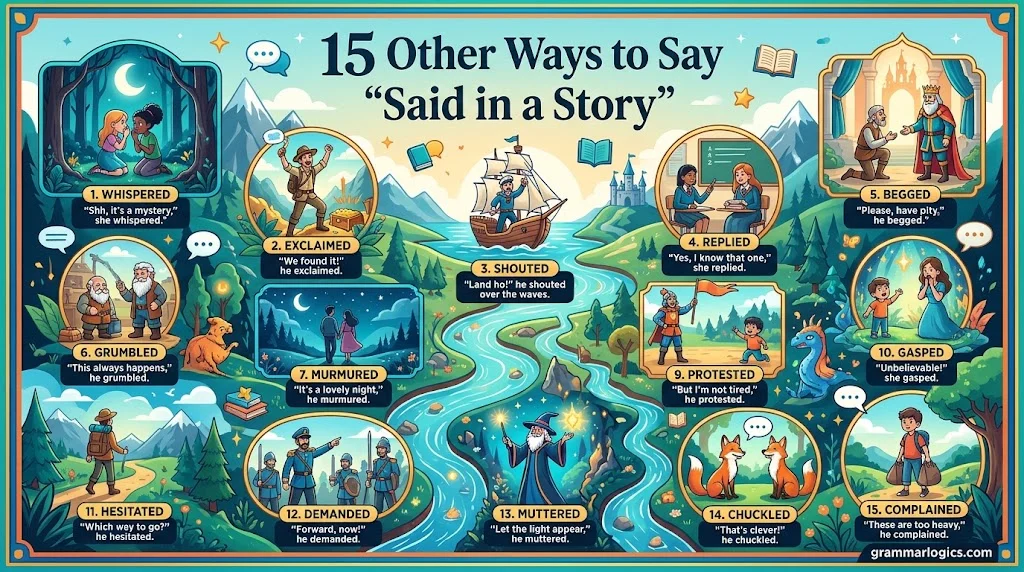
Discover 15 other ways to say “said in a story” with meanings and examples to improve your dialogue, storytelling, and creative writing skills. Choosing the right words can make storytelling more engaging, clear, and expressive.
Exploring other ways to say “said in a story” helps writers create natural dialogue and bring characters to life. Instead of repeatedly using the word “said,” writers can choose expressions that better describe a character’s emotions, reactions, or speaking style. Words such as whispered, exclaimed, replied, and murmured add variety and help readers understand how something is spoken. Whether you are writing a short story, a novel, a school assignment, or a creative blog post, using suitable dialogue alternatives can make your writing more interesting. These expressions also help establish the mood of a scene, making conversations feel more realistic and memorable.
Understanding other ways to say “said in a story” can improve your vocabulary and strengthen your storytelling skills. The right dialogue tag can reveal a character’s feelings, emphasize an important moment, or show how one person responds to another. For example, shouting can express anger or excitement, while whispering creates a quiet or secretive atmosphere. However, it is important to choose words that fit the context rather than replacing “said” unnecessarily. In this guide, you will discover useful alternatives, their meanings, and practical examples to help you write smoother dialogue, avoid repetition, and make your stories more vivid and enjoyable for readers.
What Does “Said in a Story” Mean?
“Said in a story” refers to the way a writer identifies the speaker of a line of dialogue. The word said is a common dialogue tag that tells readers which character spoke. For example, in the sentence, “I will be there tomorrow,” Maria said, the word said identifies Maria as the speaker without adding a strong emotional judgment.
Writers can sometimes replace said with a more specific verb to communicate how a character speaks. Words such as whispered, shouted, and murmured describe the manner or volume of speech, while answered and explained describe the purpose of the words. These expressions are related, but they are not always interchangeable. The best choice depends on the dialogue, the character’s intention, and the mood of the scene.
Common Situations Where “Said in a Story” Is Used
Writers use dialogue tags in short stories, novels, children’s books, screenplays, and other forms of creative writing. They help readers follow conversations and understand which character is speaking.
- Everyday dialogue: Use said, replied, or answered to keep conversations easy to follow.
- Emotional scenes: Choose whispered, murmured, or exclaimed when the manner of speaking matters.
- Arguments and conflicts: Shouted may communicate anger, urgency, or excitement when the character raises their voice.
- Explanations and discussions: Explained can introduce information, while remarked can present an observation.
- Questions and responses: Asked identifies a question, and responded introduces a reply.
- Formal or serious scenes: Stated can make a declaration sound firm or deliberate.
Choosing a suitable dialogue tag can make a scene clearer. However, writers do not need to replace every instance of said. Sometimes, the simplest word is the most natural.
Is It Professional or Polite to Say “Said in a Story”?
The phrase “said in a story” is a natural way to discuss dialogue in writing. The word said itself is neutral, simple, and appropriate for almost any genre. It does not automatically suggest a particular emotion or level of formality, which is why it works well in both casual conversations and serious scenes.
Other dialogue tags can provide additional information. For example, explained suggests that a character is making something clear, while whispered indicates quiet speech. In professional writing and editing, the important consideration is accuracy and readability. A writer should choose a tag that matches what the character actually does rather than selecting a dramatic verb simply to avoid repetition.
Advantages and Disadvantages of Saying “Said in a Story”
Advantages
Using said keeps dialogue clear, simple, and unobtrusive. Readers usually understand its purpose immediately, allowing them to concentrate on the conversation rather than the dialogue tag. It also works with almost every type of character and scene. In longer conversations, repeating a familiar tag can help maintain a smooth reading rhythm.
Disadvantages
Using said in every line can sometimes make dialogue feel repetitive, especially when several characters speak in quick succession. It may also leave the manner of speaking unclear when a scene depends on a whisper, a shout, or a particular kind of response. However, not every line needs a distinctive dialogue tag. Writers can also identify speakers through actions, gestures, and the natural flow of conversation.
15 Alternatives to “Said in a Story”
- Said
- Replied
- Answered
- Asked
- Whispered
- Shouted
- Exclaimed
- Murmured
- Muttered
- Explained
- Added
- Remarked
- Stated
- Called
- Responded
1. Said
Meaning
Said is the standard dialogue tag used to show that a character has spoken. It is often the best choice when the writer wants the words themselves to carry the meaning.
Definition
To say something means to express words aloud or communicate them verbally.
Detailed Explanation
Although said is the original expression, it deserves a place in any list of dialogue alternatives because it remains useful throughout a story. It does not tell readers whether a character is angry, happy, or nervous. This neutral quality allows readers to interpret the dialogue naturally. Writers can show emotion through the character’s words and actions instead of adding unnecessary description.
Scenario Examples
Scenario: A character makes a simple statement.
Example: “The train leaves at six,” Daniel said.
Scenario: A teacher gives an instruction.
Example: “Please open your books,” Ms. Carter said.
Best Use
Use said for ordinary dialogue, especially in long conversations where clarity matters more than dramatic emphasis.
Tone
Tone: Neutral, natural, unobtrusive. It works in nearly every type of story without distracting readers.
2. Replied
Meaning
Replied indicates that a character responds to something another person has said.
Definition
To reply means to answer someone verbally or in writing.
Detailed Explanation
Unlike said, replied connects a line of dialogue directly to an earlier statement. It helps readers follow a conversation without needing extra explanation. The word does not automatically communicate a particular emotion; a reply can be friendly, cold, or uncertain depending on the dialogue. Use it when the relationship between a statement and its response is important.
Scenario Examples
Scenario: A friend invites someone to dinner.
Example: “Would you like to join us?” Nina asked. “Of course,” Oliver replied.
Scenario: A student responds to a classmate.
Example: “I think the answer is twelve,” Ben said. “That makes sense,” Lily replied.
Best Use
Choose replied for back-and-forth conversations, particularly when several characters exchange ideas.
Tone
Tone: Conversational, neutral, clear. It highlights a response without adding unnecessary emotion.
3. Answered
Meaning
Answered shows that a character provides an answer to a question or request for information.
Definition
To answer means to respond to a question or provide the information someone needs.
Detailed Explanation
This alternative is more specific than said because it tells readers that the speaker is answering something. It works especially well in interviews, classroom discussions, mysteries, and conversations where characters seek information. Unlike replied, which can describe almost any response, answered strongly suggests that a question or problem is being addressed. It does not necessarily mean that the answer is correct.
Scenario Examples
Scenario: A detective questions a witness.
Example: “What time did you arrive?” the detective asked. “Just after nine,” the witness answered.
Scenario: A child asks a parent about a trip.
Example: “Are we going to the beach today?” Leo asked. “Yes, after lunch,” his mother answered.
Best Use
Use answered when a character responds to a direct question or supplies requested information.
Tone
Tone: Clear, direct, informative. It keeps question-and-answer exchanges easy to understand.
4. Asked
Meaning
Asked identifies dialogue that presents a question or requests information, permission, or assistance.
Definition
To ask means to put a question to someone or make a request.
Detailed Explanation
Asked is not a direct synonym for every use of said, because it identifies a particular kind of speech. It is the natural choice when a character wants information or needs someone to do something. It can express curiosity, concern, politeness, or uncertainty, depending on the wording. Writers generally do not need to add a question mark and a separate tag such as said when asked communicates the function clearly.
Scenario Examples
Scenario: A student needs clarification.
Example: “Could you explain the last question?” Maya asked.
Scenario: A character checks on a friend.
Example: “Are you feeling better today?” Ethan asked.
Best Use
Choose asked for questions and requests in fiction, dialogue exercises, and conversational scenes.
Tone
Tone: Inquisitive, neutral, adaptable. The exact feeling depends on the question and the surrounding context.
5. Whispered
Meaning
Whispered describes speech delivered in a very quiet voice, often so that other people cannot easily hear it.
Definition
To whisper means to speak very softly, usually without using a normal speaking voice.
Detailed Explanation
This word gives readers information about the volume of a character’s speech. It can create suspense, intimacy, secrecy, or concern, depending on the situation. Unlike said, it describes how the words sound rather than merely identifying the speaker. Use it when the quiet delivery matters to the scene, not simply to make ordinary dialogue sound more interesting.
Scenario Examples
Scenario: Two friends discuss a surprise party.
Example: “Don’t tell Emma about the cake,” Sophie whispered.
Scenario: A character hears a noise in a dark house.
Example: “Did you hear that?” Marcus whispered.
Best Use
Use whispered in secret conversations, suspenseful scenes, intimate moments, and situations requiring silence.
Tone
Tone: Quiet, intimate, secretive, or suspenseful. The scene determines which feeling readers are likely to perceive.
6. Shouted
Meaning
Shouted describes words spoken in a loud voice, often to be heard over distance, noise, or an intense situation.
Definition
To shout means to speak or call out at a high volume.
Detailed Explanation
Shouted emphasizes vocal volume and can communicate urgency, anger, excitement, or fear. It is more descriptive than said, but it should match the action taking place. A character might shout to warn someone about danger or to communicate across a crowded room. The word does not always mean that the character is angry; the surrounding context establishes the emotion.
Scenario Examples
Scenario: A person warns someone near a road.
Example: “Watch out for the car!” Amelia shouted.
Scenario: A coach encourages a team during a match.
Example: “Keep moving! You can do it!” the coach shouted.
Best Use
Choose shouted for urgent warnings, loud environments, heated arguments, and energetic scenes.
Tone
Tone: Loud, forceful, urgent, or excited. It communicates raised volume rather than one specific emotion.
7. Exclaimed
Meaning
Exclaimed introduces words spoken with strong emotion, such as surprise, delight, shock, or excitement.
Definition
To exclaim means to speak suddenly or emphatically because of a strong feeling.
Detailed Explanation
This dialogue tag draws attention to the emotional force of a character’s words. It can be useful when a discovery or unexpected event produces an immediate reaction. Unlike shouted, it does not necessarily mean the character is speaking loudly. It works best when the dialogue genuinely expresses a noticeable burst of emotion.
Scenario Examples
Scenario: A character discovers a birthday surprise.
Example: “You remembered my birthday!” Clara exclaimed.
Scenario: A child sees snow for the first time.
Example: “Look at all that snow!” Noah exclaimed.
Best Use
Use exclaimed for surprise, excitement, sudden joy, and emotionally charged discoveries.
Tone
Tone: Expressive, enthusiastic, surprised. It adds emphasis when a simple tag would not fully capture the reaction.
8. Murmured
Meaning
Murmured describes speech delivered in a soft, low, or subdued voice.
Definition
To murmur means to speak quietly and gently, often in a low voice.
Detailed Explanation
Murmured is often softer and less sharply defined than whispered. It can suggest tenderness, uncertainty, sadness, or a thoughtful remark. The word is useful when a character speaks quietly but is not necessarily trying to keep the words secret. Because it carries a particular sound and mood, it is best reserved for scenes where subdued delivery contributes to the atmosphere.
Scenario Examples
Scenario: A parent comforts a frightened child.
Example: “Everything will be all right,” her father murmured.
Scenario: Two characters share a quiet moment.
Example: “I missed you,” Daniel murmured.
Best Use
Choose murmured for gentle conversations, comforting moments, and quiet emotional scenes.
Tone
Tone: Soft, intimate, subdued. It often creates a gentler mood than a neutral dialogue tag.
9. Muttered
Meaning
Muttered describes words spoken quietly and often unclearly, sometimes because the character is annoyed, embarrassed, or unhappy.
Definition
To mutter means to speak in a low voice, often with the words difficult to hear.
Detailed Explanation
This expression often suggests that a character is speaking under their breath rather than addressing someone clearly. It can communicate irritation, reluctance, or dissatisfaction, although the context may give it another meaning. Unlike murmured, which can sound gentle or affectionate, muttered often carries a grumbling quality. It is especially useful when the manner of speaking reveals a character’s attitude.
Scenario Examples
Scenario: A student struggles with a difficult assignment.
Example: “Why is this question so complicated?” Jack muttered.
Scenario: Someone realizes they have missed the bus.
Example: “I should have left earlier,” Priya muttered.
Best Use
Use muttered for frustration, quiet complaints, embarrassment, or reluctant comments.
Tone
Tone: Grumbling, irritated, subdued. It often suggests dissatisfaction without requiring the character to express anger openly.
10. Explained
Meaning
Explained introduces dialogue in which a character makes information, a situation, or an idea easier to understand.
Definition
To explain means to describe something clearly so that another person can understand it.
Detailed Explanation
Explained emphasizes the purpose of the speech rather than the character’s volume or emotional state. It is especially helpful when someone provides instructions, clarifies a misunderstanding, or describes how something works. Compared with said, it tells readers that the speaker is trying to make a point understandable. Use it when the dialogue genuinely contains clarification rather than an ordinary statement.
Scenario Examples
Scenario: A teacher helps a student understand a problem.
Example: “You need to divide before multiplying in this step,” the teacher explained.
Scenario: A friend clears up a misunderstanding.
Example: “I left early because my train was delayed,” Olivia explained.
Best Use
Choose explained for instructions, clarifications, educational scenes, and conversations involving complex information.
Tone
Tone: Informative, helpful, explanatory. It focuses on making an idea clear.
11. Added
Meaning
Added indicates that a character contributes another thought or piece of information to something already said.
Definition
To add means to include an additional comment, detail, or idea.
Detailed Explanation
This word helps show that a character is continuing a point rather than starting an entirely new subject. It is useful in dialogue where someone provides extra information, makes a qualification, or remembers another detail. Unlike replied, it does not necessarily answer another speaker directly. It connects the new words to what has already been discussed.
Scenario Examples
Scenario: A colleague provides an extra reminder during a meeting.
Example: “The report is due Friday,” Sam said. “And please include the updated figures,” he added.
Scenario: A friend gives travel advice.
Example: “Take a jacket with you,” Aisha said. “It gets cold after sunset,” she added.
Best Use
Use added when a character continues a thought or introduces additional information.
Tone
Tone: Conversational, practical, connecting. It helps dialogue flow naturally from one point to the next.
12. Remarked
Meaning
Remarked introduces a comment or observation that a character makes about a situation.
Definition
To remark means to make a statement or comment about something.
Detailed Explanation
Remarked can make a character’s observation sound thoughtful, casual, or slightly formal. It works well when someone notices a detail or comments on what is happening around them. Unlike explained, it does not necessarily clarify anything, and unlike exclaimed, it does not require strong emotion. It is a useful alternative when a character makes an observation that deserves a little emphasis.
Scenario Examples
Scenario: Two friends notice the changing weather.
Example: “The sky looks unusually dark,” Helen remarked.
Scenario: A guest comments on a newly decorated room.
Example: “You’ve chosen a lovely shade of blue,” Mr. Lewis remarked.
Best Use
Choose remarked for observations, casual comments, reflective dialogue, and slightly formal conversations.
Tone
Tone: Observational, measured, sometimes formal. It gives a comment a little more weight than a plain dialogue tag.
13. Stated
Meaning
Stated introduces a clear declaration, position, or piece of information.
Definition
To state means to express something clearly and directly in words.
Detailed Explanation
Stated often sounds more formal and deliberate than said. It works when a character presents a firm position, gives official information, or makes a point without much emotional display. The word may make dialogue feel authoritative, so it can sound unnatural in a casual exchange between close friends. Choose it when the formality or firmness of the statement fits the scene.
Scenario Examples
Scenario: A manager establishes a deadline during a meeting.
Example: “All final documents must be submitted by Thursday,” the manager stated.
Scenario: A character firmly explains a personal boundary.
Example: “I will not agree to something I believe is unfair,” Elena stated.
Best Use
Use stated for formal discussions, firm declarations, official announcements, and serious conversations.
Tone
Tone: Formal, direct, firm. It presents information with a sense of certainty or authority.
14. Called
Meaning
Called describes speech directed toward someone, often to attract their attention or communicate across a distance.
Definition
To call means to speak loudly enough to get someone’s attention or reach someone who is farther away.
Detailed Explanation
Called is useful when a character addresses someone who is not immediately nearby. It can describe a cheerful greeting, a warning, or an attempt to get someone’s attention. Unlike shouted, which emphasizes loudness, called often emphasizes the act of directing speech toward someone. It may involve a raised voice, but it does not always suggest anger.
Scenario Examples
Scenario: A parent sees a child approaching the gate.
Example: “Wait for me near the entrance!” her mother called.
Scenario: A friend spots someone across a crowded station.
Example: “Liam, over here!” Sophie called.
Best Use
Choose called for distant conversations, greetings across a room, and moments when a character wants to attract attention.
Tone
Tone: Attention-seeking, energetic, sometimes urgent. It focuses on reaching another person.
15. Responded
Meaning
Responded indicates that a character reacts verbally to a question, statement, request, or situation.
Definition
To respond means to react or give an answer to something that another person has said or done.
Detailed Explanation
Responded is a flexible dialogue tag that works in both everyday and more formal situations. It can describe an answer, a reaction, or a comment that follows another person’s words. Compared with answered, it is broader because a response does not always provide a direct answer to a question. It is useful when the writer wants to show that a character is reacting without specifying the exact manner or emotion.
Scenario Examples
Scenario: A customer replies to a support representative.
Example: “Thank you for explaining the refund process,” the customer responded.
Scenario: A character reacts to criticism.
Example: “I understand your concerns, but I see the situation differently,” Marcus responded.
Best Use
Use responded for general reactions, discussions, professional exchanges, and conversations where a character addresses another person’s words.
Tone
Tone: Neutral, adaptable, slightly formal in some contexts. It emphasizes the connection between a comment and the reaction that follows.
FAQs
What is another way to say “said in a story”?
Useful alternatives include replied, answered, whispered, shouted, explained, and remarked. Each serves a different purpose, so choose the word that accurately describes the character’s speech.
What does “said in a story” mean?
It refers to the dialogue tag or wording a writer uses to identify a speaker. The word said introduces spoken dialogue, while other tags can describe a question, response, emotion, or manner of speaking.
Is “said” professional in creative writing?
Yes. Said is a standard and appropriate dialogue tag in novels, short stories, and other forms of creative writing. It is neutral, easy to understand, and rarely distracts readers from the dialogue.
What is a more descriptive way to say “said”?
Choose a word based on the situation. Use whispered for quiet speech, shouted for loud speech, explained for clarification, or exclaimed for a strong emotional reaction.
Which dialogue tag works best in formal writing?
Stated can suit firm declarations and official information, while responded and answered work well in formal exchanges. However, said remains appropriate when a simple, neutral dialogue tag is the clearest option.
Conclusion
Choosing the right dialogue tag can make a story easier to follow and help readers understand a character’s intentions. Although “said in a story” is commonly associated with the word said, alternatives such as replied, whispered, explained, and exclaimed can add useful detail when the scene calls for it. The key is to consider the meaning, tone, and context of each expression before using it.
Not every line of dialogue needs a dramatic verb, and repeating said is not necessarily a writing mistake. Instead, aim for a natural balance between clarity and variety. Let the dialogue do most of the work, and choose descriptive tags only when they genuinely help readers understand the speaker or the moment.