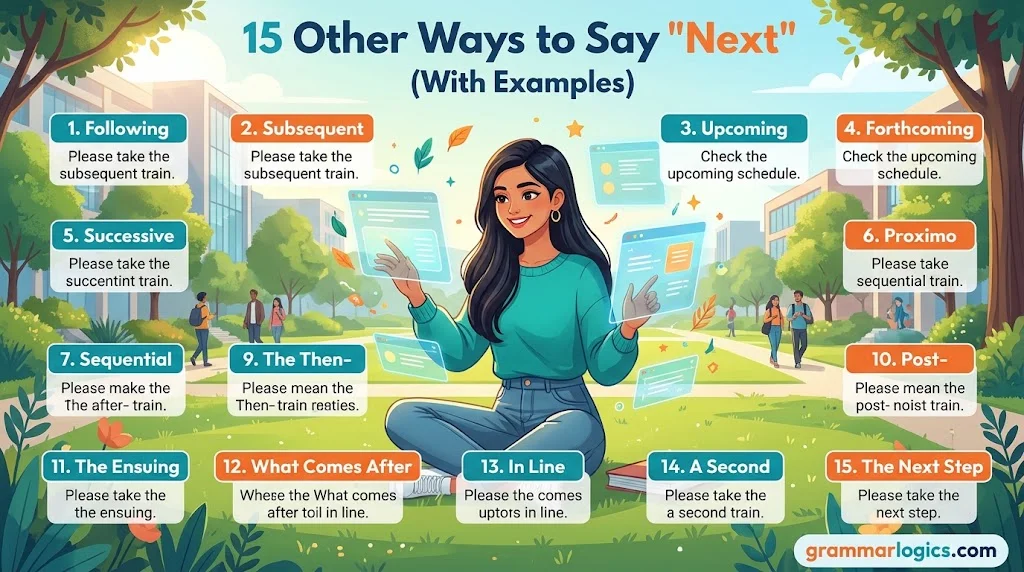
Discover 15 other ways to say “Next” with clear meanings and examples. Improve your English vocabulary and make your writing more natural, engaging, and effective in everyday and professional communication.
The word “next” is commonly used in everyday conversations, writing, and professional communication. However, using the same word repeatedly can make your sentences feel less engaging. Learning different ways to say “next” helps you express ideas more clearly and naturally. There are several alternatives to “next” that can make your writing smoother, more varied, and easier to understand. Words and phrases such as “following,” “afterward,” “coming up,” and “subsequently” can be useful in different situations. Some sound casual and friendly, while others are more formal and appropriate for professional writing. Choosing the right expression depends on your meaning, audience, and context. These alternatives can help you connect ideas, explain sequences, and guide readers through information without unnecessary repetition. They are especially helpful when writing blog posts, emails, essays, instructions, or presentations.
Understanding these expressions also improves your vocabulary and makes your communication more effective. In this guide, you will discover 15 other ways to say “next” with clear meanings and practical examples. Each alternative will help you understand when and how to use it correctly in everyday conversations and written communication. Whether you are preparing a blog post, writing an academic assignment, sending a professional email, or explaining a series of steps, the right expression can make your message more precise and natural. You will also learn which alternatives work best for formal and informal situations. By exploring these useful expressions, you can expand your English vocabulary, improve sentence flow, and make your writing more engaging while communicating your ideas with confidence and clarity.
What Does “Next” Mean?
The word “next” refers to something that comes immediately after the present item, event, person, or point in a sequence. It can describe time, order, position, or the following step in a process. For example, in the sentence “We will discuss the next topic,” the word identifies the topic that follows the current one. In everyday English, “next” can also refer to the nearest upcoming occasion, as in “See you next week.” Depending on the context, it may function as an adjective, adverb, or noun. Its exact meaning depends on what comes before or after it.
Common Situations Where “Next” Is Used
People use “next” in many everyday situations. During conversations, it helps someone move from one topic to another. In classrooms, teachers use it to introduce the following question, activity, or lesson. In workplaces, it can guide colleagues through meeting agendas, project stages, and instructions. Writers also use it to organize paragraphs, explain processes, and present information in a logical order.
The word is common in text messages, social media posts, presentations, and customer communication. For instance, a support representative might explain the next step in resolving a problem, while a presenter may use it to introduce a new slide. Choosing an alternative can make instructions sound more formal, transitions feel smoother, or a sequence easier to follow.
Is It Professional or Polite to Say “Next”?
Yes, “next” is professional, polite, and widely accepted in most communication settings. It is neutral rather than overly formal or casual, making it suitable for business emails, meetings, academic writing, instructions, and everyday conversations. For example, “Next, we will review the results” sounds clear and appropriate in a presentation.
However, repeating “next” too frequently may make longer writing feel mechanical. Expressions such as “subsequently,” “following that,” or “moving on” can provide variety when they accurately match the intended meaning. Some alternatives are more formal, while others sound conversational. The best choice depends on whether you are describing chronological order, introducing a new topic, or explaining a step. In professional communication, clarity and natural flow matter more than using complicated vocabulary.
Advantages and Disadvantages of Saying “Next”
Advantages
The word “next” is short, clear, and easy to understand. It helps readers and listeners follow a sequence without requiring additional explanation. It works well in spoken English, written instructions, schedules, and professional presentations. Because it is neutral, it rarely sounds too emotional, demanding, or overly formal. It is also flexible enough to describe upcoming events, people waiting in line, and stages in a process.
Disadvantages
Although “next” is useful, repeated use can make writing sound predictable. It may also be too general when the writer needs to explain a specific relationship between ideas, such as a consequence, continuation, or later development. In some situations, a phrase like “as a result” or “from there” communicates a more precise connection, although these expressions do not mean exactly the same thing as “next.” Choosing the right alternative helps maintain variety, accuracy, and a natural flow.
15 Synonyms and Alternatives for “Next”
- Then
- Afterward
- Following that
- Subsequently
- After that
- Moving on
- Coming up
- The following
- In the next step
- Thereafter
- Later
- Up next
- In turn
- From there
- As a next step
1. Then
Meaning
“Then” refers to what happens after something else or what should happen at the following point in a sequence. It is one of the most natural alternatives to “next” in everyday English.
Definition
Then means at that time or after that event or action.
Detailed Explanation
“Then” works especially well when explaining a series of actions or events. It often sounds conversational and straightforward, making it useful for instructions and storytelling. Unlike “next,” which can identify an item in an ordered list, “then” frequently emphasizes what happens after a particular action. The surrounding sentence determines whether it refers to time, order, or a logical consequence.
Scenario Examples
Scenario: Explaining a recipe to a friend.
Example: “Mix the ingredients, then pour the batter into the pan.”
Scenario: Describing a plan during a meeting.
Example: “We’ll review the budget, then discuss the launch date.”
Scenario: Giving someone directions.
Example: “Walk past the pharmacy, then turn left.”
Best Use
Use “then” in everyday conversation, instructions, storytelling, and step-by-step explanations. It is especially helpful when one action follows another.
Tone
Tone: Neutral, conversational, clear.
Its familiar wording makes it easy to use in both casual and many professional situations.
2. Afterward
Meaning
“Afterward” refers to something that happens after an event or activity has finished. It is useful when the timing of the later event matters more than its position in a list.
Definition
Afterward means at a later time following a particular event or action.
Detailed Explanation
“Afterward” often sounds slightly more polished than “then,” particularly when describing events rather than giving immediate instructions. It usually refers to a later point connected to something already mentioned. For example, someone might finish a meeting and afterward send a summary to the team. Unlike “next,” it does not always imply that the following event happens immediately or is the next item in a formal sequence.
Scenario Examples
Scenario: Talking about a job interview.
Example: “I felt much more relaxed afterward.”
Scenario: Planning a team lunch.
Example: “We can visit the exhibition and get coffee afterward.”
Scenario: Describing a school event.
Example: “The students performed a short play and spoke with their families afterward.”
Best Use
Use “afterward” in narratives, emails, personal conversations, and event descriptions when referring to something that happens later.
Tone
Tone: Neutral, polished, natural.
It communicates a clear time relationship without sounding overly formal.
3. Following That
Meaning
“Following that” introduces an action, event, or point that comes after something already mentioned. It is particularly useful when organizing explanations.
Definition
Following that means after the previously mentioned event, action, or step.
Detailed Explanation
This expression is useful when you want a transition that sounds organized and deliberate. It is often suitable for presentations, reports, project updates, and professional conversations. Compared with the simple word “next,” it explicitly connects the upcoming point to the one just discussed. However, it may sound unnecessarily wordy in a short, casual conversation where “then” would be enough.
Scenario Examples
Scenario: Explaining a recruitment process.
Example: “We’ll review the applications. Following that, shortlisted candidates will be invited for interviews.”
Scenario: Describing a workshop agenda.
Example: “The trainer will introduce the topic. Following that, participants will work in small groups.”
Scenario: Giving a project update.
Example: “The design team will finalize the layout. Following that, we’ll begin testing.”
Best Use
Use “following that” in professional emails, presentations, reports, and structured explanations where clear transitions are important.
Tone
Tone: Professional, organized, neutral.
Its wording gives the message a structured feel without being excessively formal.
4. Subsequently
Meaning
“Subsequently” means that something happens after an earlier event or action. It is a more formal alternative when describing a sequence of developments.
Definition
Subsequently means at a later time or after something else has occurred.
Detailed Explanation
This word is particularly useful in formal writing because it establishes a clear chronological relationship. It appears naturally in reports, academic discussions, business documents, and descriptions of events. Unlike “next,” it can suggest that a later development followed an earlier one without necessarily being the immediate next item. It may sound stiff in casual conversation, so simpler wording is often preferable when speaking with friends.
Scenario Examples
Scenario: Writing a business report.
Example: “The team identified the issue and subsequently revised the proposal.”
Scenario: Describing an application process.
Example: “Her documents were verified, and she was subsequently offered a position.”
Scenario: Summarizing an investigation.
Example: “The initial complaint was reviewed; subsequently, additional evidence was collected.”
Best Use
Use “subsequently” in formal reports, academic writing, business documents, and professional summaries.
Tone
Tone: Formal, objective, precise.
The word suits contexts where a measured and professional style is expected.
5. After That
Meaning
“After that” describes what happens after a particular action, event, or point in time. It is a straightforward expression that works in both speech and writing.
Definition
After that means following the event or action just mentioned.
Detailed Explanation
This phrase is easy to understand because it clearly connects one event to another. It is especially useful when explaining plans, describing experiences, or giving instructions to someone who needs simple wording. Unlike “subsequently,” it sounds more relaxed and conversational. It does not necessarily mean the following action happens immediately, so the surrounding context should make the intended timing clear.
Scenario Examples
Scenario: Explaining a study routine.
Example: “I’ll finish my reading, and after that, I’ll revise my notes.”
Scenario: Planning a family outing.
Example: “Let’s visit the park. After that, we can have dinner nearby.”
Scenario: Explaining an online order.
Example: “Once you confirm your address, we’ll process the payment. After that, your order can be prepared.”
Best Use
Use “after that” in casual conversations, instructions, personal messages, and simple explanations.
Tone
Tone: Friendly, neutral, accessible.
Its plain language makes it a useful choice for a wide range of readers and listeners.
6. Moving On
Meaning
“Moving on” signals that you are leaving one subject, activity, or stage and beginning another. It is often used to guide a conversation or presentation forward.
Definition
Moving on means proceeding to another topic or stage after the current one.
Detailed Explanation
This expression is more about changing focus than simply identifying the next event in time. It works well when a speaker wants to transition from one discussion point to another without dwelling on the previous subject. In meetings, it can help keep an agenda organized. However, in sensitive conversations, “moving on” may sound dismissive if someone still needs time to discuss an important concern.
Scenario Examples
Scenario: Leading a team meeting.
Example: “Moving on, let’s look at the customer feedback from last month.”
Scenario: Giving a classroom presentation.
Example: “We’ve covered the causes of pollution. Moving on, I’ll explain possible solutions.”
Scenario: Changing subjects during a conversation.
Example: “I think we’ve settled the travel arrangements. Moving on, what time should we leave?”
Best Use
Use “moving on” in presentations, meetings, lessons, and organized discussions when introducing a new topic.
Tone
Tone: Direct, conversational, organized.
It helps maintain momentum, although a gentler transition may be better for emotionally sensitive topics.
7. Coming Up
Meaning
“Coming up” refers to something that will happen soon or appear later in a program, schedule, or sequence. It often creates a sense of anticipation.
Definition
Coming up means about to happen or scheduled for a near-future time.
Detailed Explanation
This phrase is common in announcements, entertainment, event promotions, and casual conversations about upcoming plans. It is not always interchangeable with “next,” because it emphasizes what is approaching rather than simply what follows in order. For example, a presenter might use it to introduce an upcoming segment. In formal reports, a more precise expression such as “the following item” may be more appropriate.
Scenario Examples
Scenario: Introducing the next part of a livestream.
Example: “Coming up, we’ll answer your questions about the new course.”
Scenario: Talking about a school schedule.
Example: “Our science presentation is coming up on Thursday.”
Scenario: Sharing event information online.
Example: “Coming up this weekend: a free workshop for beginner writers.”
Best Use
Use “coming up” in announcements, social media posts, informal updates, and event introductions when something is approaching.
Tone
Tone: Energetic, friendly, anticipatory.
It creates interest by drawing attention to something that will happen soon.
8. The Following
Meaning
“The following” identifies the item, section, instruction, or information that comes after the current point. It is particularly common in written communication.
Definition
The following means the item or information that comes immediately after or is presented next.
Detailed Explanation
This expression works well when introducing lists, examples, instructions, or sections in a document. It can sound more precise and formal than the single word “next.” For example, “Please complete the following tasks” introduces the tasks that appear afterward. The phrase usually needs a noun or a clearly understood reference, so it cannot replace “next” in every sentence without grammatical changes.
Scenario Examples
Scenario: Writing instructions for employees.
Example: “Please review the following guidelines before submitting your report.”
Scenario: Preparing a classroom worksheet.
Example: “Read the following passage and answer the questions.”
Scenario: Sending a business email.
Example: “The following points summarize the decisions made during our meeting.”
Best Use
Use “the following” in formal writing, documents, instructions, emails, and educational materials.
Tone
Tone: Professional, precise, formal-neutral.
It helps introduce information in an orderly and easy-to-follow way.
9. In the Next Step
Meaning
“In the next step” refers to the stage that follows the current one in a process, plan, or procedure. It emphasizes progress through a sequence of actions.
Definition
In the next step means at the following stage of a process or activity.
Detailed Explanation
This expression is most useful when a task has clearly defined stages. It can guide readers through instructions, project plans, application procedures, and technical explanations. Unlike “next” on its own, it emphasizes the process rather than merely the order of events. It may be repetitive if every sentence begins with the same phrase, so varying transitions can make longer instructions easier to read.
Scenario Examples
Scenario: Explaining a website registration process.
Example: “In the next step, enter your email address and create a password.”
Scenario: Planning a marketing campaign.
Example: “In the next step, we’ll test the draft advertisements with a small audience.”
Scenario: Teaching a practical skill.
Example: “In the next step, carefully attach the handle to the frame.”
Best Use
Use “in the next step” in tutorials, technical instructions, project plans, and process explanations.
Tone
Tone: Clear, instructional, professional.
It directs attention to the next stage and helps readers understand what action is required.
10. Thereafter
Meaning
“Thereafter” means that something happens after a specified time or event. It is generally more formal than “after that.”
Definition
Thereafter means from that point onward or after the stated event.
Detailed Explanation
“Thereafter” is suitable for formal documents, policies, timelines, and descriptions of procedures. Depending on the sentence, it can refer to one later event or a period that begins after a particular point. This makes it slightly different from “next,” which often identifies the immediate following item. Because “thereafter” sounds formal, it may feel unnatural in relaxed conversation or personal text messages.
Scenario Examples
Scenario: Writing a policy document.
Example: “The agreement begins on January 1, and payments will be due monthly thereafter.”
Scenario: Explaining a training schedule.
Example: “Participants will complete the introductory course and attend advanced sessions thereafter.”
Scenario: Describing an administrative procedure.
Example: “The application will be reviewed, and applicants will receive updates thereafter.”
Best Use
Use “thereafter” in formal policies, contracts, administrative writing, and professional documentation when the timeline needs to be clear.
Tone
Tone: Formal, procedural, precise.
Its more official style suits written records better than everyday speech.
11. Later
Meaning
“Later” refers to a time after the present moment or after an earlier event. It is useful when the exact timing is not important or has not been decided.
Definition
Later means at a time after now or after the event being discussed.
Detailed Explanation
“Later” is a natural, flexible word for talking about future plans or events that occur after something else. Unlike “next,” it does not necessarily mean the immediately following item or action. For example, “I’ll call you later” indicates a future call without specifying exactly when. It can be used in professional communication as well as casual speech, although a specific time is often better when coordinating important work.
Scenario Examples
Scenario: Messaging a friend.
Example: “I’m busy right now, but I’ll reply later.”
Scenario: Arranging a work discussion.
Example: “Let’s revisit the proposal later this afternoon.”
Scenario: Describing a personal experience.
Example: “I didn’t understand the instructions at first, but they made sense later.”
Best Use
Use “later” in everyday conversation, text messages, informal planning, and general descriptions of time.
Tone
Tone: Casual, neutral, flexible.
It is natural and simple, but it may be too vague when a deadline or precise sequence matters.
12. Up Next
Meaning
“Up next” introduces the person, activity, topic, or item that is about to follow. It is especially common in programs, presentations, schedules, and announcements.
Definition
Up next means the next item or event that is scheduled to appear or happen.
Detailed Explanation
This phrase is a lively way to signal what an audience should expect. It works particularly well when introducing speakers, performances, video segments, or agenda items. Compared with “next,” it often feels more like an announcement than a simple description of order. Although it is common in spoken presentations and informal writing, it may sound too promotional for some formal documents.
Scenario Examples
Scenario: Hosting an online event.
Example: “Up next, we have a discussion about improving workplace communication.”
Scenario: Introducing a school assembly performance.
Example: “Up next is a musical performance by the senior class.”
Scenario: Sharing a video playlist.
Example: “Up next on the channel: a short guide to writing clearer emails.”
Best Use
Use “up next” in presentations, event hosting, video content, schedules, and announcements.
Tone
Tone: Energetic, engaging, informal-professional.
It builds anticipation and helps an audience follow a program.
13. In Turn
Meaning
“In turn” describes something that happens in sequence or as a result of something else. It can also mean that people act one after another.
Definition
In turn means one after another in an order, or as a consequence of an earlier action.
Detailed Explanation
“In turn” is useful when describing a chain of actions or relationships between events. For example, one decision may influence another, which then affects a later outcome. This differs from “next” because the expression can emphasize a consequence rather than just the following point in time. The intended meaning should be clear from context, especially in formal writing where the phrase may be interpreted as a cause-and-effect connection.
Scenario Examples
Scenario: Explaining teamwork.
Example: “Each team member shared an idea in turn.”
Scenario: Describing a business process.
Example: “Better planning improved delivery times, which in turn increased customer satisfaction.”
Scenario: Organizing a classroom discussion.
Example: “The students answered the questions in turn so everyone had a chance to speak.”
Best Use
Use “in turn” in formal explanations, team discussions, educational settings, and writing about cause and effect.
Tone
Tone: Organized, analytical, neutral.
It is especially effective when sequence or the relationship between events needs emphasis.
14. From There
Meaning
“From there” describes what happens or what someone does after reaching a particular point, stage, or decision. It often suggests continued progress.
Definition
From there means starting at that point and continuing to a later stage or action.
Detailed Explanation
This phrase is useful when explaining how a process develops after an initial step. It can also describe a plan that depends on what happens first. Unlike “next,” it often suggests a transition from one stage into further progress rather than simply naming the following item. It sounds natural in conversation and practical explanations, but it may be too vague for detailed technical instructions unless the starting point is clearly identified.
Scenario Examples
Scenario: Discussing a career plan.
Example: “I’ll complete the certification, and from there, I’ll apply for entry-level positions.”
Scenario: Explaining a writing process.
Example: “Start with a rough outline. From there, you can organize your main arguments.”
Scenario: Planning a family trip.
Example: “We’ll arrive in the city before noon and decide from there whether to visit the museum.”
Best Use
Use “from there” in planning conversations, project updates, tutorials, and explanations of ongoing processes.
Tone
Tone: Practical, conversational, forward-looking.
It communicates progress while leaving room for decisions at later stages.
15. As a Next Step
Meaning
“As a next step” introduces an action that should follow the current stage of a plan or process. It often emphasizes a practical action rather than a general event.
Definition
As a next step means as the following action in a plan, process, or course of work.
Detailed Explanation
This expression is particularly useful in workplace communication because it links a discussion to a clear action. It can help teams understand what needs to happen after a decision or review. Unlike “next,” which can refer to almost anything in a sequence, “as a next step” often highlights a deliberate move toward a goal. It may sound repetitive if used too frequently, so it is best reserved for points where the next action deserves emphasis.
Scenario Examples
Scenario: Writing a project update.
Example: “As a next step, we’ll gather feedback from the design team.”
Scenario: Advising a colleague.
Example: “As a next step, I suggest arranging a short meeting with the client.”
Scenario: Planning a research assignment.
Example: “As a next step, compare the findings and identify the main patterns.”
Best Use
Use “as a next step” in business emails, project planning, professional meetings, and action-oriented reports.
Tone
Tone: Professional, purposeful, constructive.
It helps turn a discussion into a clear plan of action.
FAQs
What is another way to say “next”?
Common alternatives include “then,” “afterward,” “following that,” “moving on,” and “subsequently.” The best choice depends on whether you are describing time, continuing a process, or introducing another topic.
What does “next” mean?
“Next” generally means coming immediately after something else in time, order, or position. For example, “the next chapter” refers to the chapter that follows the current one.
Is “next” professional?
Yes. “Next” is neutral and professional enough for most emails, reports, presentations, and workplace discussions. More formal alternatives may be useful when the writing requires a specific style.
What is a more polite way to say “next”?
“Next” is not inherently impolite. In a presentation or conversation, “moving on to our next topic” can sound smoother, while “following that” may suit a structured explanation. The most appropriate wording depends on the situation.
Which alternative works best in formal communication?
“Subsequently,” “thereafter,” and “following that” can work well in formal communication. Use “subsequently” for chronological developments, “thereafter” for formal timelines, and “following that” for clear transitions between steps.
Conclusion
The word “next” is a simple and effective way to communicate order, time, and progression. However, choosing a more specific expression can make your writing clearer and more engaging. Alternatives such as “then” and “after that” suit everyday conversation, while “subsequently” and “thereafter” are often better for formal documents.
Expressions like “moving on” help introduce new topics, and “as a next step” emphasizes practical action in professional settings. Remember that these phrases are related but not always interchangeable. Consider the meaning, tone, and context before selecting one. By building your vocabulary and using these 15 alternatives to “next” thoughtfully, you can communicate ideas more naturally and guide readers or listeners through information with greater clarity.