“Of course” is a common English expression used to show agreement, willingness, confidence, or politeness in everyday conversations and professional communication.
Whether you are replying to a request, offering help, or agreeing with someone, choosing the right words can make your message sound more natural, friendly, and professional. Although “of course” works well in many situations, using different expressions can help you communicate more clearly and avoid repetition. From casual conversations with friends to formal workplace emails, learning alternative phrases allows you to express agreement, reassurance, and willingness in ways that suit your audience and the situation.
Exploring other ways to say “of course” can improve your vocabulary and make your English sound more fluent and expressive. Expressions such as “certainly,” “absolutely,” “no problem,” and “my pleasure” each carry a slightly different tone. Some sound more formal and respectful, while others feel relaxed, warm, or enthusiastic. Understanding these differences helps you choose the most appropriate phrase for conversations, emails, customer service, and workplace discussions. With practical examples and clear explanations, you can learn how to respond confidently, express agreement naturally, and communicate your message with greater clarity in different situations.
What Does “Of Course” Mean?
“Of course” is an English expression that commonly means certainly, naturally, or yes, without hesitation. People use it to agree with a request, confirm information, offer assistance, or indicate that something is expected. For example, if a friend asks, “Can you help me with this?” you might respond, “Of course!” to show that you are happy to help. The expression can also communicate that something is obvious or unsurprising, as in, “Of course, the sun rises in the east.”
Its meaning depends on context and tone of voice. Said warmly, it sounds friendly and reassuring. Used in a formal email, it can communicate professional willingness. However, spoken with impatience or emphasis, it may sound sarcastic or suggest that the answer should have been obvious. Understanding these differences helps you choose wording that matches your intention.
Common Situations Where “Of Course” Is Used
People use “of course” in a variety of everyday and professional situations. In casual conversations, it is a natural response when a friend asks for help, permission, or a favor. In text messages, it can communicate support quickly, such as telling someone, “Of course, I’ll be there!” It also works in personal relationships when someone wants to reassure a partner or family member that they are willing to help.
In the workplace, “of course” can express cooperation when responding to a colleague or customer. For example, an employee might say, “Of course, I can send you the updated file.” In educational settings, students and teachers may use it to confirm requests or explain familiar facts. Depending on the situation, alternatives such as “Certainly,” “Absolutely,” or “I’d be happy to” can make a response more formal, enthusiastic, or considerate.
Is It Professional or Polite to Say “Of Course”?
Yes, “of course” is generally polite and professional when used with a friendly, respectful tone. It works well in conversations with colleagues, routine workplace emails, customer service replies, and discussions with supervisors. For example, responding with “Of course, I’ll take care of that” communicates cooperation without sounding overly formal. It is also suitable for personal messages because it feels natural and approachable.
However, context matters. If someone asks a question because they are uncertain, responding with a sharp “Of course!” may sound dismissive, as though the answer should be obvious. In formal correspondence, “Certainly” may sound more polished, while “I’d be happy to assist” emphasizes a willingness to help. The best expression depends on your relationship with the reader, the nature of the request, and the tone you want to convey.
Advantages and Disadvantages of Saying “Of Course”
Advantages
The expression “of course” is short, familiar, and easy to understand. It communicates agreement quickly and can make people feel supported when they ask for help. Its flexibility makes it suitable for casual conversations, personal messages, and many professional interactions. It can also convey confidence when confirming information or acknowledging something expected.
Disadvantages
Because “of course” is so common, repeating it frequently can make your responses sound predictable. Its meaning can also change with tone: a sincere response feels reassuring, while a sarcastic one can sound dismissive. In highly formal situations, another expression may better communicate professionalism or careful consideration. Choosing an alternative allows you to express agreement, enthusiasm, reassurance, or willingness more precisely.
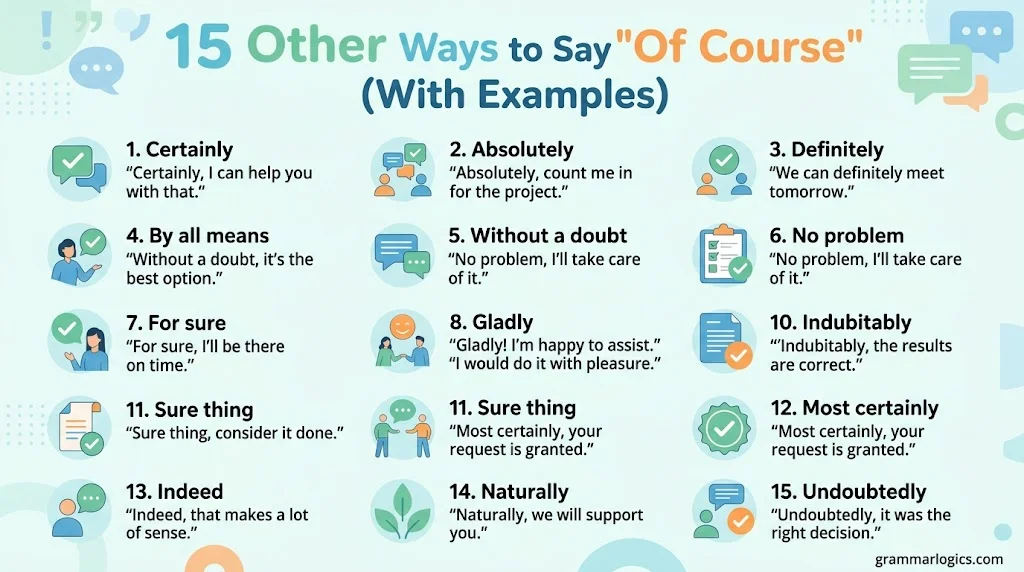
15 Synonyms for “Of Course”
- Certainly
- Absolutely
- Sure
- Definitely
- By all means
- Without a doubt
- No problem
- You bet
- Naturally
- Of course I can
- I’d be happy to
- Gladly
- It goes without saying
- Consider it done
- I’m more than happy to
1. Certainly
Meaning
Certainly means yes, definitely, or without hesitation. It expresses agreement or willingness to do something in a polite and confident way.
Definition
A polite expression used to confirm something or agree to a request.
Detailed Explanation
“Certainly” is a useful alternative when you want to sound professional, respectful, and helpful. It communicates agreement without the casual feeling that words such as “sure” or “you bet” may carry. The expression is especially useful in workplaces, customer service, and formal conversations. It can also sound warm when delivered with a friendly tone, although it is generally more reserved than “absolutely.”
Scenario Examples
Scenario 1: Workplace request
Example: “Could you send me the updated report before lunch?”
“Certainly, I’ll email it to you shortly.”
Scenario 2: Customer service
Example: “Could you explain how this feature works?”
“Certainly. Let me walk you through the process.”
Scenario 3: Everyday conversation
Example: “May I ask you a quick question?”
“Certainly, go ahead.”
Best Use
Use “certainly” in professional emails, customer communication, polite conversations, and workplace requests.
Tone
Tone: Polite, professional, confident.
It communicates cooperation while maintaining a respectful level of formality.
2. Absolutely
Meaning
Absolutely means completely, definitely, or without any doubt. It is often used to express enthusiastic agreement or strong confirmation.
Definition
An emphatic expression that shows strong agreement, certainty, or willingness.
Detailed Explanation
“Absolutely” is more energetic than a simple “yes” and often communicates genuine enthusiasm. It works especially well when you want to show that you strongly agree with someone or are eager to help. Unlike “certainly,” it usually feels more expressive and conversational. However, it can sound excessive if the situation requires only a neutral acknowledgment.
Scenario Examples
Scenario 1: Making plans
Example: “Would you like to join us for dinner tonight?”
“Absolutely! What time should I be there?”
Scenario 2: Teamwork
Example: “Do you agree that we should review the proposal once more?”
“Absolutely. A final review would be helpful.”
Scenario 3: Encouraging a friend
Example: “Do you think I can learn to play the guitar?”
“Absolutely! Just give yourself time to practice.”
Best Use
Use “absolutely” in friendly conversations, enthusiastic agreement, team discussions, and encouraging messages.
Tone
Tone: Enthusiastic, confident, supportive.
It makes your agreement sound stronger and more positive than a neutral response.
3. Sure
Meaning
Sure means yes or that you are willing to do something. It is a short, natural response commonly used in everyday English.
Definition
An informal expression of agreement, permission, or willingness.
Detailed Explanation
“Sure” is one of the easiest alternatives to use in casual conversation. It sounds relaxed and approachable, making it suitable for friends, classmates, family members, and familiar colleagues. Depending on the situation, it can express willingness without adding much emotion. However, a brief “sure” may sometimes sound indifferent in writing because readers cannot hear your tone.
Scenario Examples
Scenario 1: Texting a friend
Example: “Can you send me the address?”
“Sure, I’ll send it now.”
Scenario 2: School
Example: “Could I borrow your notes from yesterday’s lecture?”
“Sure, I’ll bring them tomorrow.”
Scenario 3: Casual workplace conversation
Example: “Can you check this spreadsheet when you have a moment?”
“Sure, I’ll take a look.”
Best Use
Use “sure” in text messages, informal emails, everyday conversations, and relaxed workplace interactions.
Tone
Tone: Casual, friendly, straightforward.
It keeps conversations simple and natural, especially when the request is routine.
4. Definitely
Meaning
Definitely means certainly or without uncertainty. It expresses a firm decision, clear agreement, or strong confirmation.
Definition
An expression used to communicate that something is certain or that you strongly agree.
Detailed Explanation
“Definitely” works well when you want to emphasize certainty rather than simply offer help. It can confirm plans, reinforce an opinion, or show that you intend to do something. Compared with “of course,” it places more emphasis on being sure about the answer. Although it is suitable for many professional and personal situations, it does not automatically communicate warmth or a willingness to help.
Scenario Examples
Scenario 1: Confirming plans
Example: “Are you coming to the workshop on Friday?”
“Definitely! I’ve already registered.”
Scenario 2: Sharing an opinion
Example: “Do you think we should update the presentation?”
“Definitely. The new figures will make it clearer.”
Scenario 3: Personal encouragement
Example: “Should I apply for that position?”
“Definitely. Your experience makes it worth considering.”
Best Use
Use “definitely” when confirming plans, expressing firm agreement, making decisions, or showing confidence.
Tone
Tone: Confident, decisive, positive.
It reassures the listener that your answer is firm rather than uncertain.
5. By All Means
Meaning
By all means is a polite expression that gives permission or warmly encourages someone to proceed with a request.
Definition
A phrase used to indicate that someone is welcome or encouraged to do something.
Detailed Explanation
This expression is especially useful when another person asks for permission. For example, if a colleague asks whether they may use your meeting room, “By all means” communicates that they are welcome to do so. It often sounds more gracious than a simple “yes.” However, it is not the best choice for every kind of agreement because it usually emphasizes permission or encouragement rather than certainty about a fact.
Scenario Examples
Scenario 1: Workplace permission
Example: “May I use the conference room for a short call?”
“By all means. It’s available until noon.”
Scenario 2: Visiting a friend
Example: “Would you mind if I opened the window?”
“By all means. The room is a little warm.”
Scenario 3: Asking a question
Example: “Can I ask you something about the assignment?”
“By all means. What would you like to know?”
Best Use
Use “by all means” when granting permission, welcoming a request, or encouraging someone to proceed politely.
Tone
Tone: Courteous, welcoming, gracious.
It makes permission sound generous and considerate rather than reluctant.
6. Without a Doubt
Meaning
Without a doubt means that you are completely certain about something. It can also express strong agreement with a statement or opinion.
Definition
A phrase used to emphasize complete confidence or the absence of uncertainty.
Detailed Explanation
“Without a doubt” is useful when you want to stress your confidence in an answer or judgment. It is often stronger than a simple “yes” because it highlights certainty. For example, it can emphasize that someone is well qualified for a position or that a decision is clearly worthwhile. Unlike “of course,” however, it does not usually serve as a direct offer to help someone.
Scenario Examples
Scenario 1: Discussing someone’s skills
Example: “Is Maya qualified to lead this project?”
“Without a doubt. She has the experience we need.”
Scenario 2: Sharing a recommendation
Example: “Would you recommend this book to new writers?”
“Without a doubt. It explains the basics clearly.”
Scenario 3: Personal conversation
Example: “Was that one of the best trips you’ve taken?”
“Without a doubt. I loved every minute of it.”
Best Use
Use this expression when confirming a judgment, emphasizing confidence, or expressing strong agreement.
Tone
Tone: Assured, emphatic, persuasive.
It conveys conviction and leaves little room for uncertainty.
7. No Problem
Meaning
No problem means that a request, favor, or situation is not difficult or troublesome for you. It is commonly used to reassure someone that you do not mind helping.
Definition
An informal expression that communicates willingness and indicates that a request is not an inconvenience.
Detailed Explanation
“No problem” is a natural alternative when someone thanks you or asks for a small favor. It reassures the other person that you are happy to help without making the situation feel formal. The phrase is especially common in everyday conversation and friendly workplace exchanges. In a sensitive or highly formal situation, however, “you’re very welcome” or “I’d be happy to assist” may feel more appropriate.
Scenario Examples
Scenario 1: Helping a colleague
Example: “Thanks for printing those documents for me.”
“No problem! I was already at the printer.”
Scenario 2: Texting a friend
Example: “Can you pick up some bread on your way home?”
“No problem. I’ll grab it.”
Scenario 3: Customer interaction
Example: “Could you show me where the returns desk is?”
“No problem. It’s just around the corner.”
Best Use
Use “no problem” for everyday favors, casual customer interactions, friendly messages, and routine requests.
Tone
Tone: Relaxed, helpful, reassuring.
It emphasizes that helping is not an inconvenience.
8. You Bet
Meaning
You bet is an informal expression that means yes, certainly, or absolutely. It often communicates enthusiasm and friendly confidence.
Definition
A casual phrase used to give an enthusiastic yes or confirm willingness.
Detailed Explanation
“You bet” is particularly common in relaxed conversations where people feel comfortable with one another. It can make a response sound lively and friendly, especially when someone asks for a favor or checks whether you agree. Unlike “certainly,” it is not especially formal and may sound out of place in a serious business email. Its naturalness depends on the relationship between the speakers and the conversational setting.
Scenario Examples
Scenario 1: Friends making plans
Example: “Can you save me a seat at the concert?”
“You bet! I’ll get there early.”
Scenario 2: Casual encouragement
Example: “Will you help me practice my presentation?”
“You bet. Let’s run through it together.”
Scenario 3: Informal conversation
Example: “Are you excited about the weekend trip?”
“You bet! I’ve been looking forward to it.”
Best Use
Use “you bet” in friendly conversations, informal text messages, and relaxed exchanges with people you know well.
Tone
Tone: Cheerful, informal, enthusiastic.
It makes agreement feel easygoing and personable.
9. Naturally
Meaning
Naturally means in a way that is expected, normal, or unsurprising. As a response, it can indicate that something is an obvious or reasonable choice.
Definition
An expression used to communicate that something follows logically or can reasonably be expected.
Detailed Explanation
“Naturally” is close to “of course” when the speaker wants to emphasize that something is expected or makes sense. For instance, saying “Naturally, we checked the figures before publishing the report” suggests that checking them was the reasonable thing to do. It is less suitable when you simply want to accept a favor or respond warmly to a request. Depending on emphasis, it can sound thoughtful, confident, or slightly sarcastic.
Scenario Examples
Scenario 1: Workplace explanation
Example: “Did you verify the numbers before sending the report?”
“Naturally, we checked every figure.”
Scenario 2: Everyday conversation
Example: “Did your family want to see your new apartment?”
“Naturally, they were excited to visit.”
Scenario 3: Discussing a decision
Example: “Did the team consider customer feedback?”
“Naturally, it was an important part of the discussion.”
Best Use
Use “naturally” when describing expected actions, confirming reasonable assumptions, or explaining a logical outcome.
Tone
Tone: Matter-of-fact, confident, sometimes formal.
It works best when the expected nature of something is more important than enthusiasm.
10. Of Course I Can
Meaning
Of course I can is a direct expression of willingness or ability. It confirms that you can do something and usually communicates that you are happy to agree.
Definition
A response used to affirm that you are able and willing to carry out a requested action.
Detailed Explanation
This expression is particularly useful when someone asks whether you can help or complete a task. It gives a clearer answer than “of course” alone because it directly refers to your ability. The phrase can sound reassuring and supportive, especially in personal conversations. However, it is less suitable when you cannot genuinely commit to the request or when the question requires a more carefully qualified answer.
Scenario Examples
Scenario 1: Helping a family member
Example: “Can you help me move these boxes?”
“Of course I can. Let’s start with the lighter ones.”
Scenario 2: Workplace request
Example: “Can you prepare a short summary of the meeting?”
“Of course I can. I’ll send it this afternoon.”
Scenario 3: Supporting a friend
Example: “Can you listen while I talk through a difficult decision?”
“Of course I can. Take your time.”
Best Use
Use this phrase when confirming your ability to help, accepting a task, or reassuring someone that you are available.
Tone
Tone: Reassuring, supportive, direct.
It combines a clear confirmation with a personal sense of willingness.
11. I’d Be Happy To
Meaning
I’d be happy to means that you are willing and pleased to do something. It emphasizes a positive attitude toward helping rather than simply agreeing.
Definition
A polite expression that communicates willingness and a pleasant attitude toward fulfilling a request.
Detailed Explanation
This phrase is especially useful when you want your response to sound considerate and welcoming. It communicates that you are not merely agreeing out of obligation; you are willing to help. In professional communication, it often sounds warmer than “certainly” while remaining appropriately respectful. It is usually followed by a verb, such as “I’d be happy to explain” or “I’d be happy to review the document.”
Scenario Examples
Scenario 1: Professional email
Example: “Would you be able to review my proposal?”
“I’d be happy to review it and share my feedback.”
Scenario 2: Helping a customer
Example: “Could you explain the payment options?”
“I’d be happy to walk you through them.”
Scenario 3: Supporting a classmate
Example: “Could you help me understand this question?”
“I’d be happy to. Let’s work through it together.”
Best Use
Use this expression in professional emails, customer service, helpful conversations, and polite responses to requests.
Tone
Tone: Warm, professional, considerate.
It shows willingness while making the other person feel welcome to ask for assistance.
12. Gladly
Meaning
Gladly means willingly and with pleasure. It communicates that you are happy to do something rather than doing it reluctantly.
Definition
An adverb used to show that an action is performed willingly or with pleasure.
Detailed Explanation
“Gladly” is a concise way to express willingness, particularly when someone asks for help or a favor. It adds a sense of genuine pleasure to the response without requiring a long explanation. Compared with “sure,” it sounds slightly more deliberate and warm. However, it is not a universal substitute for “of course,” because it describes willingness to act rather than certainty about a fact.
Scenario Examples
Scenario 1: Helping a neighbor
Example: “Could you water my plants while I’m away?”
“Gladly. Just tell me how often they need watering.”
Scenario 2: Offering support
Example: “Would you explain that step one more time?”
“Gladly. Let’s go through it again.”
Scenario 3: Volunteering
Example: “Can someone help organize the community event?”
“I’d gladly help with the arrangements.”
Best Use
Use “gladly” when accepting a favor, offering assistance, volunteering, or showing genuine willingness.
Tone
Tone: Warm, willing, courteous.
It focuses on the pleasure of helping rather than merely confirming a request.
13. It Goes Without Saying
Meaning
It goes without saying means that something is so obvious, expected, or accepted that it does not need to be stated explicitly.
Definition
An expression used to indicate that a fact or idea is understood without needing further explanation.
Detailed Explanation
This phrase is related to “of course” when the speaker wants to emphasize an obvious point or shared understanding. For example, saying that safety goes without saying suggests that everyone should already understand its importance. It is not generally used as a direct, friendly answer to a request for help. In some situations, it may also sound dismissive if the listener genuinely needs reassurance or clarification.
Scenario Examples
Scenario 1: Team expectations
Example: “We should protect the customer’s private information.”
“It goes without saying that confidentiality is essential.”
Scenario 2: Personal relationship
Example: “You can always talk to me when something is wrong.”
“It goes without saying that I’ll support you.”
Scenario 3: Planning an event
Example: “We need to clean up after the gathering.”
“It goes without saying that we’ll leave the venue tidy.”
Best Use
Use this expression when emphasizing shared expectations, established principles, or facts that need little explanation.
Tone
Tone: Assured, reflective, sometimes emphatic.
It suggests that the point is already understood, so use it carefully when speaking to someone who may need reassurance.
14. Consider It Done
Meaning
Consider it done means that you accept a task and intend to complete it. It communicates confidence that the requested action will be taken care of.
Definition
An expression used to confirm that you have accepted responsibility for completing a task.
Detailed Explanation
“Consider it done” is a confident alternative when someone assigns you a task or asks you to handle a specific responsibility. It sounds more action-oriented than a simple “of course” because it implies that the work is under control. The phrase is common in informal professional conversations and friendly exchanges. However, it should only be used when you can reasonably commit to completing the task.
Scenario Examples
Scenario 1: Workplace assignment
Example: “Please make sure the presentation is ready for tomorrow’s meeting.”
“Consider it done. I’ll finalize the slides this afternoon.”
Scenario 2: Helping a friend
Example: “Could you pick up the birthday cake on your way?”
“Consider it done. I’ll collect it before heading over.”
Scenario 3: Organizing an event
Example: “Can you reserve a table for six people?”
“Consider it done. I’ll confirm the reservation shortly.”
Best Use
Use “consider it done” when accepting responsibilities, confirming practical tasks, or reassuring someone that an action will be completed.
Tone
Tone: Confident, capable, reassuring.
It communicates commitment, so avoid using it if you are uncertain that you can deliver.
15. I’m More Than Happy To
Meaning
I’m more than happy to means that you are very willing and pleased to help or do something. It expresses extra warmth and enthusiasm.
Definition
A friendly expression that emphasizes a strong willingness to assist or fulfill a request.
Detailed Explanation
This phrase is especially useful when you want to communicate generosity, encouragement, or a sincere willingness to help. It sounds warmer and more enthusiastic than “I’d be happy to,” making it suitable for supportive personal messages and considerate professional communication. The expression is not usually necessary for very small or routine exchanges, where a short “sure” may sound more natural. In formal writing, use it when the warmer tone fits the relationship and situation.
Scenario Examples
Scenario 1: Professional support
Example: “Would you be willing to mentor our new team member?”
“I’m more than happy to help them settle into the role.”
Scenario 2: Supporting a friend
Example: “Could you come with me to the appointment?”
“I’m more than happy to come along.”
Scenario 3: Customer communication
Example: “Could you provide some additional information about the service?”
“I’m more than happy to explain the available options.”
Best Use
Use this expression in supportive messages, professional assistance, customer communication, and situations where extra warmth is appropriate.
Tone
Tone: Warm, enthusiastic, generous.
It reassures the other person that your willingness is genuine and not merely a matter of obligation.
FAQs
What is another way to say “of course”?
You can say “certainly,” “absolutely,” “sure,” “definitely,” or “I’d be happy to.” The best choice depends on whether you want to sound casual, enthusiastic, professional, or especially helpful.
What does “of course” mean?
“Of course” usually means certainly, naturally, or yes, without hesitation. It can express agreement, confirm information, grant permission, or show willingness to help. Its exact meaning depends on the context and tone.
Is “of course” professional?
Yes, “of course” is generally professional enough for everyday workplace communication. In formal emails or customer service, “certainly” and “I’d be happy to assist” may sound more polished, depending on the situation.
What is a more polite way to say “of course”?
“Certainly” is a polite and versatile choice. If you want to sound warmer, use “I’d be happy to help.” When granting permission, “by all means” can sound especially gracious.
Which alternative works best in formal communication?
“Certainly” is a strong general choice for formal communication because it is clear, respectful, and professional. For requests involving assistance, “I’d be happy to assist” communicates both courtesy and willingness.
Conclusion
Choosing the right alternative to “of course” can make your communication more natural, thoughtful, and effective. While the original expression works well in many everyday situations, different phrases communicate different levels of enthusiasm, certainty, politeness, and commitment. “Certainly” suits professional conversations, “absolutely” emphasizes strong agreement, and “I’d be happy to” expresses a warm willingness to help.
Meanwhile, expressions such as “no problem” and “you bet” fit relaxed conversations with friends and familiar colleagues. The key is to consider your audience, purpose, and relationship before choosing your words. Rather than relying on one expression every time, build a flexible vocabulary that helps you respond clearly and sincerely. The most effective phrase is the one that reflects what you genuinely mean.