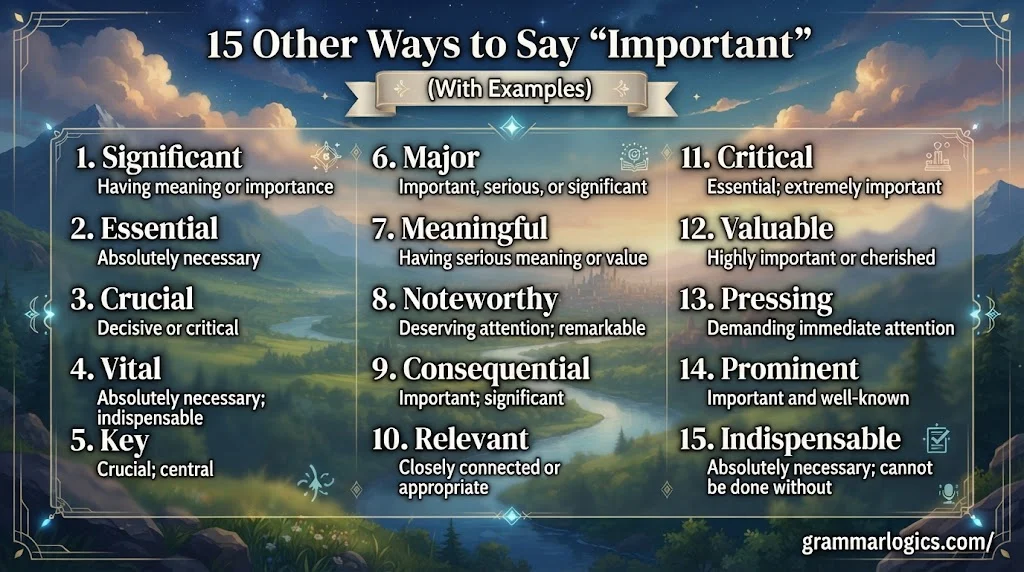
Finding the right words can make your communication more clear, natural, and meaningful.
While “important” is useful, choosing a suitable alternative can add more precision and impact to your message. Whether you are writing an email, essay, professional message, or everyday conversation, using different expressions for “important” can help you communicate your ideas more effectively. Words such as essential, significant, valuable, crucial, and meaningful can express different levels and types of importance depending on the context. Understanding these alternatives also helps you avoid repetition and make your writing sound more polished and engaging. In this guide, you will discover 15 other ways to say “important,” along with clear meanings and natural examples to help you choose the right expression for every situation.
Using the right alternative to “important” can also improve your professional and personal communication. A thoughtful choice of wording can make your writing sound more confident without making it overly formal. From casual conversations to business writing, academic work, and professional emails, these alternatives give you more flexibility when expressing priority, value, or significance. Each expression has its own tone and context, so knowing when to use it can make your message clearer and more effective.
What Does “Important” Mean?
Important describes something that has considerable value, significance, influence, or effect. When something is important, it deserves attention, consideration, or priority because it matters in a particular situation. For example, an important meeting may affect a project, while an important decision may have meaningful consequences for the people involved. The word can describe people, ideas, events, responsibilities, information, relationships, or tasks. Its exact meaning depends on context, so an alternative such as essential, significant, or urgent may communicate a more specific idea.
Common Situations Where “Important” Is Used
“Important” is common in everyday conversation, workplace communication, education, personal messages, formal writing, and customer communication. You might call an assignment important because it affects your grade, describe feedback as important because it helps you improve, or tell a colleague that a deadline is important because the project depends on it.
The word is useful because it is broad and easy to understand. However, its general nature can sometimes make a message less precise. In professional writing, for example, “essential” can show necessity more clearly, while “significant” may be better when discussing impact or meaning. In personal communication, “meaningful” or “valuable” may express emotional importance more naturally.
Is It Professional or Polite to Say “Important”?
Yes, “important” is both professional and polite in most situations. It is a neutral word that works well in emails, reports, presentations, conversations, and academic writing. For example, saying “It is important to review the document before submitting it” sounds clear and professional.
However, the word can sometimes be too broad. If something must happen, “essential” or “critical” may be more precise. If something deserves immediate attention, “pressing” may communicate urgency more effectively. In a personal context, “meaningful” can sound warmer than the straightforward “important.” The best choice depends on the context, relationship, and exact idea you want to express.
Advantages and Disadvantages of Saying “Important”
Advantages
The main advantage of “important” is its flexibility. Almost everyone understands it immediately, and it can describe different kinds of value or significance without sounding overly formal. It also works in both spoken and written English, making it a reliable choice for everyday and professional communication.
Disadvantages
Because “important” is so general, it may not always communicate the exact reason something matters. It does not necessarily tell the reader whether something is necessary, urgent, influential, valuable, or emotionally meaningful. Repeating it too often can also make writing feel less precise. Choosing a more specific alternative can make your message stronger and easier to understand.
Synonyms for “Important”
- Significant
- Essential
- Crucial
- Vital
- Key
- Major
- Meaningful
- Noteworthy
- Consequential
- Relevant
- Critical
- Valuable
- Pressing
- Prominent
- Indispensable
1. Significant
Meaning
Significant means important because something has considerable meaning, influence, size, or effect. It often emphasizes that something stands out or has a noticeable impact.
Definition
Significant: Having considerable importance, meaning, influence, or effect.
Detailed Explanation
“Significant” is a useful alternative when you want to emphasize the impact or meaning of something. It is common in professional, academic, and formal writing and usually sounds more precise than “important.” Unlike “essential,” it does not necessarily mean something is required. It simply indicates that something deserves attention because it has meaningful consequences or value.
Scenario Examples
Scenario: You are discussing a major change in a business.
Example: The company made a significant change to its customer service policy.
Scenario: You are describing someone’s progress.
Example: She has made significant progress since joining the training program.
Scenario: You are discussing a historical event.
Example: The agreement was a significant moment in the country’s history.
Best Use
Best for professional writing, academic discussions, reports, presentations, and formal conversations when you want to emphasize impact or meaning.
Tone
Tone: Professional, formal, precise
It sounds thoughtful and measured, especially when discussing effects, developments, or achievements.
2. Essential
Meaning
Essential means extremely important because something is necessary or required. It suggests that without the person, thing, or action, a desired result may not be possible.
Definition
Essential: Absolutely necessary or required for something to work, happen, or succeed.
Detailed Explanation
“Essential” is stronger and more specific than “important.” It indicates necessity, rather than simply saying that something deserves attention. For example, clean water is essential for life, while a particular suggestion may merely be important. Use this word when removing something would create a serious problem or prevent a goal from being achieved.
Scenario Examples
Scenario: You are giving instructions to a new employee.
Example: It is essential to back up your files before updating the system.
Scenario: You are talking about teamwork.
Example: Clear communication is essential for a successful project.
Scenario: You are giving travel advice.
Example: Carrying a valid passport is essential when traveling internationally.
Best Use
Best for instructions, professional communication, academic writing, advice, procedures, and situations involving necessity.
Tone
Tone: Strong, professional, direct
It clearly communicates that something should not be overlooked.
3. Crucial
Meaning
Crucial means extremely important to the success, outcome, or development of something.
Definition
Crucial: Having a decisive effect on an outcome or being extremely important.
Detailed Explanation
“Crucial” suggests that something can strongly influence the final result. It is often used when a particular decision, action, or piece of information can determine what happens next. Compared with “important,” it carries greater weight. It is especially useful when explaining why a particular step or factor should receive close attention.
Scenario Examples
Scenario: A manager is discussing a project deadline.
Example: Meeting the Friday deadline is crucial to keeping the client satisfied.
Scenario: A student is preparing for an examination.
Example: Reviewing your mistakes is crucial if you want to improve your score.
Scenario: A team is making a business decision.
Example: Accurate market research will be crucial to our decision.
Best Use
Best for decisions, deadlines, goals, projects, problem-solving, and situations where the outcome matters greatly.
Tone
Tone: Strong, serious, professional
It signals that something deserves particularly close attention.
4. Vital
Meaning
Vital means extremely important or necessary for the continued success, functioning, or well-being of something.
Definition
Vital: Absolutely necessary or extremely important to the existence or success of something.
Detailed Explanation
“Vital” is stronger than ordinary “important” and often suggests that something is necessary for survival, functioning, or success. It can be used literally, as in matters related to life, or more generally, as in business and teamwork. The word gives a message a sense of importance without necessarily sounding emotional. It works particularly well when describing something that cannot safely be ignored.
Scenario Examples
Scenario: A team is discussing communication.
Example: Regular communication is vital to keeping the project on track.
Scenario: Someone is giving safety advice.
Example: Wearing protective equipment is vital in this work environment.
Scenario: A business is discussing customer feedback.
Example: Customer feedback is vital to improving our services.
Best Use
Best for safety, health-related general statements, business, teamwork, procedures, and success-related discussions.
Tone
Tone: Strong, serious, professional
It communicates that something has a very high level of necessity or importance.
5. Key
Meaning
Key means particularly important to achieving an objective, understanding an issue, or making something successful.
Definition
Key: Especially important or central to a particular situation or outcome.
Detailed Explanation
“Key” is a concise and natural alternative when you want to identify something as a central factor. It is common in both professional and everyday English and usually sounds less intense than “crucial.” For example, you can describe a key reason, key point, key factor, or key step. It is especially useful when you want your writing to be clear without sounding overly formal.
Scenario Examples
Scenario: A teacher explains what students should focus on.
Example: Practice is a key part of learning a new language.
Scenario: A manager discusses a successful project.
Example: Good planning was a key factor in completing the project early.
Scenario: You are summarizing a meeting.
Example: The key point is that we need more time.
Best Use
Best for workplace communication, presentations, summaries, teaching, emails, and everyday conversation.
Tone
Tone: Clear, practical, professional
It highlights central information without sounding overly dramatic.
6. Major
Meaning
Major means very important, large in effect, or significant compared with other things in the same situation.
Definition
Major: Greater in importance, size, effect, or seriousness than other things of the same kind.
Detailed Explanation
“Major” works well when something is important because it represents a large change, serious issue, or substantial development. It is not always interchangeable with “important,” because it can also describe size or scale. In communication, it is particularly useful for discussing changes, problems, decisions, achievements, or events. The word often suggests that something is substantial rather than merely noteworthy.
Scenario Examples
Scenario: A company announces a change.
Example: The company is planning a major update to its website.
Scenario: A student discusses an academic challenge.
Example: Time management became a major issue during the final semester.
Scenario: A city completes a large development project.
Example: The new transportation system is a major improvement for commuters.
Best Use
Best for business, news-style writing, reports, projects, changes, problems, and significant developments.
Tone
Tone: Serious, confident, professional
It suggests substantial importance or scale.
7. Meaningful
Meaning
Meaningful describes something that has personal, emotional, or lasting significance.
Definition
Meaningful: Having special value, purpose, or significance, especially on a personal or emotional level.
Detailed Explanation
“Meaningful” is a warmer alternative to “important” when you are talking about feelings, relationships, experiences, words, or memories. It focuses less on practical necessity and more on personal significance. A meaningful conversation may not be essential, but it can matter deeply to someone. This makes the word particularly useful in personal and emotional communication.
Scenario Examples
Scenario: You are thanking a friend for their support.
Example: Your message was really meaningful to me.
Scenario: Someone receives a thoughtful gift.
Example: It was a simple gift, but it was incredibly meaningful.
Scenario: You are reflecting on a conversation.
Example: We had a meaningful conversation about our future.
Best Use
Best for personal messages, relationships, emotional conversations, memories, gifts, experiences, and reflective writing.
Tone
Tone: Warm, personal, sincere
It emphasizes emotional or personal value rather than practical importance.
8. Noteworthy
Meaning
Noteworthy means deserving attention because something is interesting, unusual, impressive, or significant.
Definition
Noteworthy: Worth noticing, remembering, or mentioning because of its significance or distinctive quality.
Detailed Explanation
“Noteworthy” is useful when something deserves to be noticed or mentioned but you do not necessarily mean that it is essential. It can make writing sound polished without exaggerating the level of importance. The word is often appropriate for achievements, developments, observations, or details that stand out. It is therefore more selective than the broad word “important.”
Scenario Examples
Scenario: You are writing an employee review.
Example: Her noteworthy improvement in communication has helped the entire team.
Scenario: You are summarizing a report.
Example: One noteworthy finding was the increase in customer satisfaction.
Scenario: You are discussing an achievement.
Example: His noteworthy performance earned praise from the entire department.
Best Use
Best for reports, reviews, articles, professional writing, academic discussions, and formal observations.
Tone
Tone: Formal, positive, observant
It draws attention to something that deserves recognition or notice.
9. Consequential
Meaning
Consequential describes something that produces significant results or has serious effects.
Definition
Consequential: Likely to have important or significant consequences.
Detailed Explanation
“Consequential” focuses on the results or effects of something rather than simply its value. It is especially useful when discussing decisions, actions, events, or choices that may influence what happens later. The word is more formal than “important” and is not usually used for simple everyday objects or minor matters. Use it when the consequences themselves are central to your point.
Scenario Examples
Scenario: A company is considering a major decision.
Example: This could be one of the most consequential decisions the company makes this year.
Scenario: A student chooses a career path.
Example: Choosing a field of study can be a consequential decision.
Scenario: A team evaluates a policy change.
Example: The new policy could have consequential effects on smaller departments.
Best Use
Best for formal writing, decisions, policies, business discussions, analysis, and situations involving significant consequences.
Tone
Tone: Formal, serious, analytical
It emphasizes the effects that may follow from an action or decision.
10. Relevant
Meaning
Relevant means directly connected to the subject, situation, or problem being discussed.
Definition
Relevant: Closely related or applicable to the matter being considered.
Detailed Explanation
“Relevant” is not a direct synonym for every use of “important.” Instead, it is appropriate when something matters because it is connected to the current topic or decision. This distinction is important: information can be relevant without being especially important, and something can be important without being directly relevant to the current discussion. Use it when you want to emphasize usefulness or connection.
Scenario Examples
Scenario: A teacher asks students to support an argument.
Example: Please include only information that is relevant to your main argument.
Scenario: A manager reviews applications.
Example: We need candidates with relevant experience in customer service.
Scenario: Someone changes the subject during a discussion.
Example: That point is interesting, but it isn’t relevant to the issue we’re discussing.
Best Use
Best for academic writing, workplace discussions, research, customer communication, meetings, and decision-making.
Tone
Tone: Neutral, practical, professional
It emphasizes connection and usefulness rather than emotional or overall importance.
11. Critical
Meaning
Critical can mean extremely important, especially when something directly affects success, safety, or an outcome.
Definition
Critical: Extremely important to the success, safety, or proper functioning of something.
Detailed Explanation
“Critical” communicates a very high level of importance and often suggests that failure to address something could cause a serious problem. It is common in professional, technical, business, and safety-related communication. In some contexts, “critical” can also mean expressing criticism, so the surrounding wording matters. When used to describe importance, it is stronger than ordinary “important.”
Scenario Examples
Scenario: A software team discusses system security.
Example: Protecting customer data is critical to maintaining trust.
Scenario: A project manager discusses a deadline.
Example: Completing this stage on time is critical to the overall schedule.
Scenario: A workplace discusses emergency procedures.
Example: Knowing the evacuation route is critical during an emergency.
Best Use
Best for business, technology, safety, deadlines, risk management, technical writing, and serious decisions.
Tone
Tone: Serious, urgent, professional
It signals that overlooking something could have significant consequences.
12. Valuable
Meaning
Valuable describes something that provides substantial benefit, usefulness, worth, or personal value.
Definition
Valuable: Having considerable worth, usefulness, benefit, or importance.
Detailed Explanation
“Valuable” shifts the focus from general importance to worth or benefit. It works especially well for skills, advice, information, contributions, experiences, and relationships. Something can be valuable because it helps someone, teaches something, saves time, or provides emotional support. The word often sounds warmer and more appreciative than a simple statement that something is important.
Scenario Examples
Scenario: A manager praises an employee.
Example: Your feedback has been valuable throughout this project.
Scenario: A student receives advice from a teacher.
Example: Her advice was incredibly valuable when I was choosing my course.
Scenario: A team shares information.
Example: The survey provided valuable information about customer preferences.
Best Use
Best for appreciation, workplace communication, feedback, education, relationships, advice, and discussions of benefits.
Tone
Tone: Positive, appreciative, warm
It emphasizes the useful or meaningful value something provides.
13. Pressing
Meaning
Pressing means requiring immediate attention because a matter is urgent or cannot reasonably be delayed.
Definition
Pressing: Urgent and requiring attention or action soon.
Detailed Explanation
“Pressing” is useful when “important” is not strong enough to express urgency. A pressing issue is not merely significant; it needs to be dealt with promptly. This makes it particularly useful for problems, requests, deadlines, concerns, and decisions that cannot wait. It should not be used for every important matter because importance and urgency are different concepts.
Scenario Examples
Scenario: A manager discusses an unresolved problem.
Example: We need to address this pressing issue before the next meeting.
Scenario: A customer contacts a support team.
Example: I have a pressing question about my account.
Scenario: A team is prioritizing tasks.
Example: Let’s deal with the most pressing concerns first.
Best Use
Best for urgent emails, workplace issues, deadlines, customer concerns, requests, and time-sensitive matters.
Tone
Tone: Urgent, direct, professional
It clearly communicates that something needs attention without delay.
14. Prominent
Meaning
Prominent describes someone or something that is especially noticeable, well-known, visible, or important within a particular group or area.
Definition
Prominent: Noticeable, distinguished, or important in a particular position, field, or context.
Detailed Explanation
“Prominent” is more specialized than “important.” It is often used for people, positions, features, locations, ideas, or organizations that stand out or hold a recognized position. It can refer to importance because of status or visibility rather than necessity. Because of this, it should not replace “important” in every sentence.
Scenario Examples
Scenario: You are describing someone in a professional field.
Example: She is a prominent researcher in environmental science.
Scenario: You are describing a feature of a building.
Example: The entrance has a prominent position at the front of the building.
Scenario: You are writing about an organization.
Example: The organization has become a prominent voice in the industry.
Best Use
Best for formal writing, professional profiles, academic contexts, organizations, public figures, positions, and noticeable features.
Tone
Tone: Formal, distinguished, descriptive
It suggests visibility, status, or recognized importance.
15. Indispensable
Meaning
Indispensable means so important or useful that something cannot reasonably be done without it.
Definition
Indispensable: Absolutely necessary and impossible or extremely difficult to replace.
Detailed Explanation
“Indispensable” is one of the strongest alternatives in this list because it suggests that something is irreplaceable or absolutely necessary. It goes beyond simply being important or useful. The word is often used for people, skills, resources, tools, or qualities that are essential to achieving a particular result. Because it is strong, it should be reserved for situations where something genuinely cannot be easily replaced.
Scenario Examples
Scenario: A manager praises a team member.
Example: Her organizational skills have become indispensable to the team.
Scenario: A professional discusses technology.
Example: Reliable internet access is indispensable for my remote work.
Scenario: A student discusses a study habit.
Example: Regular revision became indispensable during exam preparation.
Best Use
Best for professional communication, formal writing, teamwork, skills, resources, tools, and situations involving necessity or irreplaceability.
Tone
Tone: Strong, formal, appreciative
It conveys exceptionally high importance and suggests that something is difficult to replace.
FAQs
1. What are some other ways to say “important”?
Some useful alternatives to important include significant, essential, crucial, valuable, meaningful, and necessary. The best choice depends on the context, tone, and level of importance you want to express.
2. What is a professional way to say “important”?
In professional writing, you can use words such as significant, essential, critical, key, or high-priority. These alternatives can make emails, reports, and workplace communication sound more precise and professional.
3. What is a polite way to say “important”?
For a polite and natural tone, expressions such as meaningful, valuable, worthwhile, and of great significance can work well. Your choice should match whether you are talking about a person, idea, task, decision, or situation.
4. Can I use “crucial” instead of “important”?
Yes, crucial can replace important when something has a particularly strong effect on an outcome. However, crucial usually suggests a higher level of importance, so it should be used when something is truly necessary or decisive.
5. Why should I use alternatives to “important”?
Using alternatives to important can make your writing more specific, engaging, and expressive. Different words can show whether something is essential, valuable, meaningful, urgent, or highly significant, helping you communicate your exact meaning more clearly.
Conclusion
Knowing other ways to say “important” can make your communication more natural, precise, and effective. Instead of repeating the same word, you can choose alternatives such as significant, essential, crucial, valuable, meaningful, or necessary, depending on the situation. Each expression carries a slightly different tone and meaning, so choosing the right one can help your message sound more polished and purposeful.
Whether you are writing a professional email, academic assignment, business report, conversation, or personal message, the right alternative can add clarity and variety to your language. Understanding these synonyms and expressions also helps you communicate the exact level of importance you want to express.