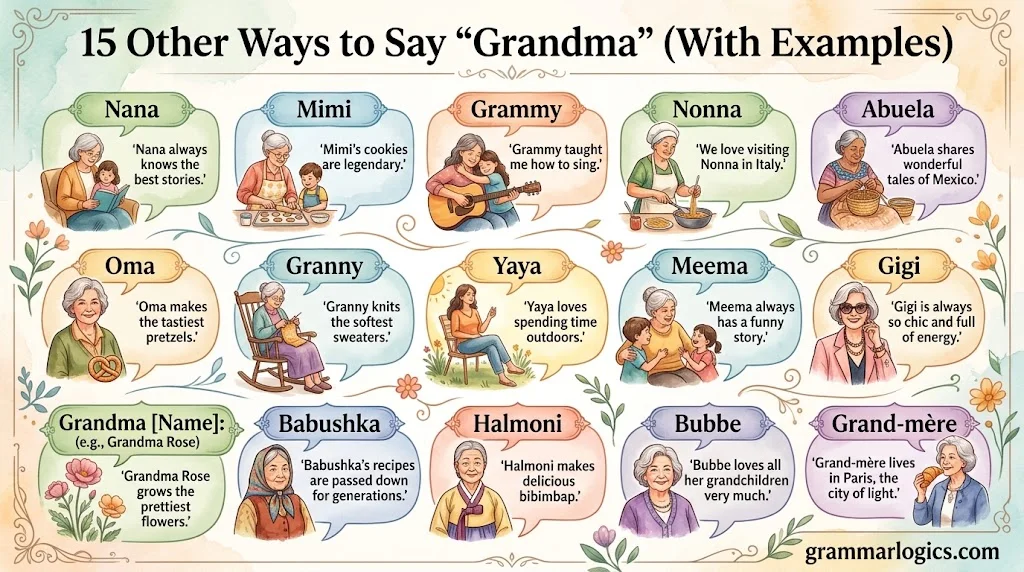
Family relationships often carry a warmth that few words can fully express, and “Grandma” is one of the most affectionate examples.
Calling someone “Grandma” can feel warm, personal, and deeply connected to family memories. However, different families and cultures use different names and expressions for the same beloved person. Words such as Grandmother, Granny, Nana, or Nanna can add their own sense of closeness, respect, or affection. The right choice often depends on family tradition, age, culture, and personal preference. Whether you are writing a heartfelt message, talking about a family member, or choosing a special nickname, knowing different ways to say “Grandma” can help your words sound more natural and meaningful. These alternatives can also make your writing feel more personal, warm, and expressive.
Exploring different ways to say “Grandma” can be useful when you want to express affection while matching a particular tone or relationship. Some alternatives sound traditional and respectful, while others feel casual, playful, or especially tender. For example, Grandmother is often used in more formal or descriptive writing, whereas Nana or Granny may sound more familiar and affectionate. In some families, unique names develop naturally from childhood, creating a special connection between grandparents and grandchildren. Understanding these differences can help you choose an expression that fits the situation without sounding forced. Whether you are writing a card, family story, social media post, conversation, or personal message, the right alternative can make your words feel more genuine and memorable.
What Does “Grandma” Mean?
Grandma is a familiar and affectionate word for a grandmother, meaning the mother of someone’s parent. It is commonly used by children and adults when speaking directly about or to their grandmother. Compared with the more formal word grandmother, Grandma usually sounds warmer, more personal, and more conversational. Families may also use different names such as Granny, Nana, or Oma depending on their traditions, language, or individual preferences.
Common Situations Where “Grandma” Is Used
Grandma is common in everyday conversation, family messages, cards, social media posts, and personal writing. Someone might say, “I’m visiting Grandma this weekend,” or write, “Happy birthday, Grandma!” It is especially natural when talking about a close family relationship.
People may choose another expression when their family already uses a particular nickname, when they want to reflect their cultural background, or when they simply prefer a different family name. In formal writing, grandmother is generally more neutral, while affectionate alternatives are better suited to personal communication.
Is It Professional or Polite to Say “Grandma”?
Grandma is polite and perfectly natural, but it is generally informal and personal rather than professional. There is nothing rude about the word; its casual quality comes from the fact that it is a familiar family term. In a formal document, biography, legal context, or academic piece, grandmother may sound more appropriate because it identifies the relationship in a neutral way. In conversation, emails to family members, greetings, and personal stories, Grandma can sound warm and natural.
Advantages and Disadvantages of Saying “Grandma”
Advantages
Grandma is simple, familiar, and affectionate. It immediately communicates a family relationship without sounding stiff or overly formal. It also feels natural in everyday speech and is easy for children to say. For many families, Grandma is a cherished name that carries a sense of closeness and affection.
Disadvantages
The main limitation is that Grandma may not reflect a family’s preferred nickname or cultural tradition. Some families use Nana, Oma, Nonna, or another name instead. It can also be less suitable than grandmother in formal writing where a neutral description is preferred. In addition, different family members may use different names for different grandmothers, so context can sometimes matter.
Synonyms for “Grandma”
- Grandmother
- Granny
- Nana
- Gran
- Grandma
- Grandmom
- Grammy
- Grams
- Oma
- Nonna
- Nanny
- Meemaw
- Mimi
- Gigi
- Grandma [Name]
1. Grandmother
Meaning
Grandmother is the standard, neutral term for the mother of your mother or father. It is the direct relationship term behind the more familiar word Grandma.
Definition
Grandmother means the mother of one of your parents.
Detailed Explanation
Grandmother is more formal and neutral than Grandma. It works particularly well when you need to explain a family relationship clearly rather than use a family nickname. Unlike many alternatives in this list, grandmother is broadly understood in English regardless of regional or family traditions.
Scenario Examples
Scenario: Writing a formal family biography.
Example: “Her grandmother played an important role in her childhood.”
Scenario: Explaining a family relationship to someone you do not know well.
Example: “My grandmother lives in another city.”
Best Use
Best for formal writing, introductions, biographies, school assignments, and neutral conversation.
Tone
Tone: Neutral, respectful, slightly formal. It describes the relationship clearly without the extra informality of a nickname.
2. Granny
Meaning
Granny is an affectionate name for a grandmother. It has a warm, familiar quality and is especially common in British and other varieties of English.
Definition
Granny is an informal and affectionate term for grandmother.
Detailed Explanation
Granny often feels a little more traditional or homely than Grandma. Its use varies by family and region, so it should not be assumed that every grandmother will want to be called Granny. It is particularly natural when it is the established name within a family.
Scenario Examples
Scenario: Talking about a beloved family member.
Example: “We’re having lunch with Granny on Sunday.”
Scenario: A child talking about a family visit.
Example: “I can’t wait to see Granny during the holidays.”
Best Use
Best for family conversations, children’s speech, personal messages, and affectionate writing.
Tone
Tone: Warm, affectionate, traditional. It often has a cozy family feeling.
3. Nana
Meaning
Nana is a common affectionate name for a grandmother. It is widely used by families in different English-speaking communities.
Definition
Nana is a familiar family name for a grandmother.
Detailed Explanation
Nana is not simply a formal synonym for grandmother; it is usually a personal family title. Many children learn Nana as their grandmother’s name from an early age. Because usage varies between families, it works best when that is the name the grandmother actually uses or prefers.
Scenario Examples
Scenario: Sending a family text.
Example: “Nana said she’d bring dessert tonight.”
Scenario: Writing about a childhood memory.
Example: “Some of my happiest memories are weekends at Nana’s house.”
Best Use
Best for family conversations, texts, cards, childhood stories, and personal messages.
Tone
Tone: Affectionate, familiar, warm. It emphasizes closeness rather than formality.
4. Gran
Meaning
Gran is a shortened form of grandmother used as a familiar family name. It is especially associated with British English and some other English-speaking communities.
Definition
Gran is an informal shortened name for grandmother.
Detailed Explanation
Gran is concise and natural in families that use it. It is less formal than grandmother but can sound slightly more understated than highly affectionate names such as Grammy or Mimi. As with other family names, the best choice depends on what the person and family normally use.
Scenario Examples
Scenario: Talking casually about a family visit.
Example: “I’m staying with Gran this weekend.”
Scenario: Writing a personal memory.
Example: “Gran always made us feel welcome at her house.”
Best Use
Best for casual conversation, family writing, texts, and personal stories.
Tone
Tone: Casual, affectionate, understated. It sounds natural without being overly sentimental.
5. Grandma
Meaning
Grandma is itself one of the most common affectionate alternatives to the formal term grandmother.
Definition
Grandma is an informal, familiar name for a grandmother.
Detailed Explanation
If you are looking for another way to say Grandma, it is worth remembering that the word itself is already a family-style alternative to grandmother. Its strength is its simplicity: almost anyone familiar with English understands it immediately. It is especially natural when speaking directly to a grandmother or discussing her with family.
Scenario Examples
Scenario: Writing a birthday card.
Example: “Happy birthday, Grandma! I hope you have a wonderful day.”
Scenario: Talking with a friend.
Example: “My Grandma taught me how to bake when I was little.”
Best Use
Best for everyday conversation, family messages, cards, texting, and social media.
Tone
Tone: Warm, familiar, affectionate. It is personal without sounding unusual or overly elaborate.
6. Grandmom
Meaning
Grandmom is an informal family term for grandmother. It is used in some English-speaking regions and families instead of Grandma.
Definition
Grandmom means grandmother in an informal family context.
Detailed Explanation
Grandmom has the same basic family meaning as Grandma but reflects a different regional or family preference. It can sound especially natural when that is the established name within a household. It should not be treated as a universal replacement, because many speakers use Grandma or another family name instead.
Scenario Examples
Scenario: Talking about a family tradition.
Example: “Grandmom taught all of us how to make her famous pie.”
Scenario: Sending a personal message.
Example: “I’ll call Grandmom after dinner.”
Best Use
Best for family conversations, personal messages, and regional or family-specific usage.
Tone
Tone: Casual, affectionate, familiar. It sounds like a personal family title rather than a formal relationship term.
7. Grammy
Meaning
Grammy is a playful and affectionate name that some families use for a grandmother.
Definition
Grammy is an informal nickname for grandmother.
Detailed Explanation
Grammy has a distinctly affectionate and sometimes playful quality. It can sound especially natural when it is a name a grandmother has used with her grandchildren for years. Because it is a nickname rather than a standard formal term, it is best used when the person or family actually prefers it.
Scenario Examples
Scenario: A grandchild writing a birthday message.
Example: “Happy birthday to the best Grammy ever!”
Scenario: Talking about family plans.
Example: “We’re spending Saturday afternoon with Grammy.”
Best Use
Best for family conversations, birthday cards, social media posts, and affectionate messages.
Tone
Tone: Playful, loving, affectionate. It often feels especially personal and cheerful.
8. Grams
Meaning
Grams is a shortened, informal nickname that some families use for a grandmother.
Definition
Grams is a casual family nickname for grandmother.
Detailed Explanation
Grams is highly informal and is not a standard term every English speaker uses. It can feel relaxed and modern when it is an established family nickname. Because the word has other meanings in English, including a unit of weight, context makes the intended meaning clear.
Scenario Examples
Scenario: Talking with a sibling.
Example: “Are you going over to Grams’ house tonight?”
Scenario: Sharing a family memory online.
Example: “Grams always knew how to make everyone laugh.”
Best Use
Best for casual family conversation, texting, social media, and personal writing.
Tone
Tone: Casual, warm, relaxed. It has an easygoing family feel.
9. Oma
Meaning
Oma is a term for grandmother used in German and in some families influenced by German-speaking traditions.
Definition
Oma means grandmother in German and is also used as a family name in some English-speaking households.
Detailed Explanation
Oma can reflect a family’s language, heritage, or cultural tradition. When used naturally within a family, it can preserve an important cultural connection while remaining easy to use in everyday conversation.
Scenario Examples
Scenario: A child discussing a family visit.
Example: “We’re going to Oma’s house for dinner.”
Scenario: Describing a multicultural family tradition.
Example: “Oma taught us several recipes from her childhood.”
Best Use
Best for multicultural families, family conversations, personal writing, and contexts influenced by German-speaking traditions.
Tone
Tone: Warm, familial, cultural. It can express both affection and a connection to family heritage.
10. Nonna
Meaning
Nonna is the Italian word commonly used for grandmother. It is also used as a personal family name in families with Italian connections.
Definition
Nonna means grandmother in Italian.
Detailed Explanation
Nonna can be used instead of an English grandmother nickname when a family maintains an Italian linguistic or cultural tradition. It communicates the same family relationship while adding a clear cultural element. As with Oma, it is best understood as a language-specific family term, rather than a universal English synonym.
Scenario Examples
Scenario: Talking about an Italian family tradition.
Example: “Nonna makes the pasta by hand every Sunday.”
Scenario: Writing a family tribute.
Example: “My Nonna taught me that food is one of the best ways to bring people together.”
Best Use
Best for Italian-speaking families, multicultural households, family stories, and personal messages.
Tone
Tone: Affectionate, familial, culturally connected. It often carries a strong sense of family tradition.
11. Nanny
Meaning
Nanny can be used as a family name for a grandmother in some families and regions. However, it can also mean a childcare worker, so context matters.
Definition
Nanny can be an informal grandmother nickname, although it also commonly refers to someone employed to care for children.
Detailed Explanation
When Nanny is a grandmother’s established family name, it can be warm and completely natural within that family. Outside the family, however, listeners may initially interpret Nanny as a professional childcare provider. This makes the term more context-dependent than Grandma or grandmother.
Scenario Examples
Scenario: Speaking within a family that uses Nanny as a grandmother’s name.
Example: “Nanny is coming to watch the school play tonight.”
Scenario: Explaining the relationship to someone unfamiliar with the family.
Example: “Nanny is my grandmother; that’s what all the grandchildren call her.”
Best Use
Best for family conversation and personal communication when the grandmother uses this established nickname.
Tone
Tone: Affectionate, familiar, family-specific. Its meaning may require context outside the family.
12. Meemaw
Meaning
Meemaw is a familiar grandmother nickname used by some families, particularly in parts of the United States.
Definition
Meemaw is an informal and affectionate name for grandmother.
Detailed Explanation
Meemaw is much more distinctive than Grandma or grandmother and may suggest a particular regional or family tradition. It is not something every English-speaking family uses. When it is a family’s established name, however, it can feel deeply personal and affectionate.
Scenario Examples
Scenario: Talking about a close family tradition.
Example: “Meemaw always makes her special cookies for Christmas.”
Scenario: Sharing a childhood memory.
Example: “I spent every summer at Meemaw’s house.”
Best Use
Best for family stories, informal conversation, personal writing, and families that traditionally use the nickname.
Tone
Tone: Warm, homespun, affectionate. It often has a strong sense of family tradition.
13. Mimi
Meaning
Mimi is a short, affectionate grandmother nickname used by some families.
Definition
Mimi is a personal and informal nickname for a grandmother.
Detailed Explanation
Mimi is not a universal synonym for grandmother because it is usually a chosen or family-specific name. It can sound especially sweet and approachable, which makes it common in affectionate family settings. The exact use varies considerably between families.
Scenario Examples
Scenario: A grandchild sending a message.
Example: “Mimi, can you come to my school concert?”
Scenario: Talking about a family celebration.
Example: “We’re having dinner at Mimi’s house tonight.”
Best Use
Best for family conversations, texts, cards, children’s speech, and personal messages.
Tone
Tone: Sweet, affectionate, intimate. It has a distinctly personal nickname quality.
14. Gigi
Meaning
Gigi is a modern-sounding nickname that some grandmothers choose or receive from their grandchildren.
Definition
Gigi is an informal personal nickname sometimes used for a grandmother.
Detailed Explanation
Gigi is more of a chosen family nickname than a direct dictionary synonym for grandmother. Its short, memorable form can feel playful and contemporary. Since it is not universally understood as meaning grandmother, context is important when speaking to people outside the family.
Scenario Examples
Scenario: Introducing a grandmother using her family nickname.
Example: “This is my grandmother, but everyone calls her Gigi.”
Scenario: Writing a birthday post.
Example: “Happy birthday, Gigi! We love celebrating with you.”
Best Use
Best for family communication, social media, birthday messages, and informal personal writing.
Tone
Tone: Playful, affectionate, modern. It feels more like a distinctive nickname than a formal family title.
15. Grandma [Name]
Meaning
Grandma [Name] combines the familiar family title Grandma with a person’s name or another identifying word. Families may use this to distinguish between two grandmothers.
Definition
Grandma [Name] is a personalized family form of address used to identify a particular grandmother.
Detailed Explanation
This expression is useful when someone has more than one grandmother or when a family naturally distinguishes relatives by name. For example, Grandma Rose and Grandma Linda can make it immediately clear which person is being discussed. It keeps the warmth of Grandma while adding clarity and individuality.
Scenario Examples
Scenario: A child has two grandmothers with the same family title.
Example: “We’re having dinner with Grandma Sarah tonight.”
Scenario: Talking about a family member to avoid confusion.
Example: “Grandma Maria lives near the coast, while Grandma Anne lives in the city.”
Best Use
Best for family conversation, introductions, personal writing, cards, and situations where two or more grandmothers need to be distinguished.
Tone
Tone: Warm, personal, clear. It combines affection with useful identification.
FAQs
1. What is another way to say “Grandma”?
Common alternatives to “Grandma” include Grandmother, Granny, Nana, Nanna, and Gran. The best choice depends on family tradition, culture, and personal preference.
2. What is a more formal word for “Grandma”?
Grandmother is the most common formal alternative to “Grandma.” It works well in formal writing, family histories, biographies, and other situations where a more traditional term is appropriate.
3. What are some cute names for “Grandma”?
Cute and affectionate names include Nana, Nanny, Granny, Mimi, and Gigi. Some families also create unique nicknames based on a child’s pronunciation or a grandmother’s personality.
4. Is “Nana” another word for “Grandma”?
Yes, Nana is commonly used as an affectionate name for a grandmother. Its use varies by family, region, and culture, but it generally has a warm and familiar tone.
5. What is the difference between “Grandma” and “Grandmother”?
The main difference is tone and formality. “Grandma” sounds more casual, affectionate, and conversational, while “Grandmother” sounds more formal, traditional, and descriptive. Both refer to the same family relationship.
Conclusion
There are many meaningful ways to say “Grandma,” and each expression can bring a slightly different feeling to your words. Whether you choose Grandmother, Granny, Nana, Nanna, or another affectionate name, the best option depends on your family’s traditions, personal preferences, and the tone you want to create.
A formal term may work well in writing, while a familiar nickname can make everyday conversations feel warmer and more personal. Understanding these alternatives gives you more flexibility when writing messages, family stories, cards, captions, or everyday conversations. Ultimately, the most meaningful name is often the one that reflects the love, closeness, and special bond you share with your grandmother.