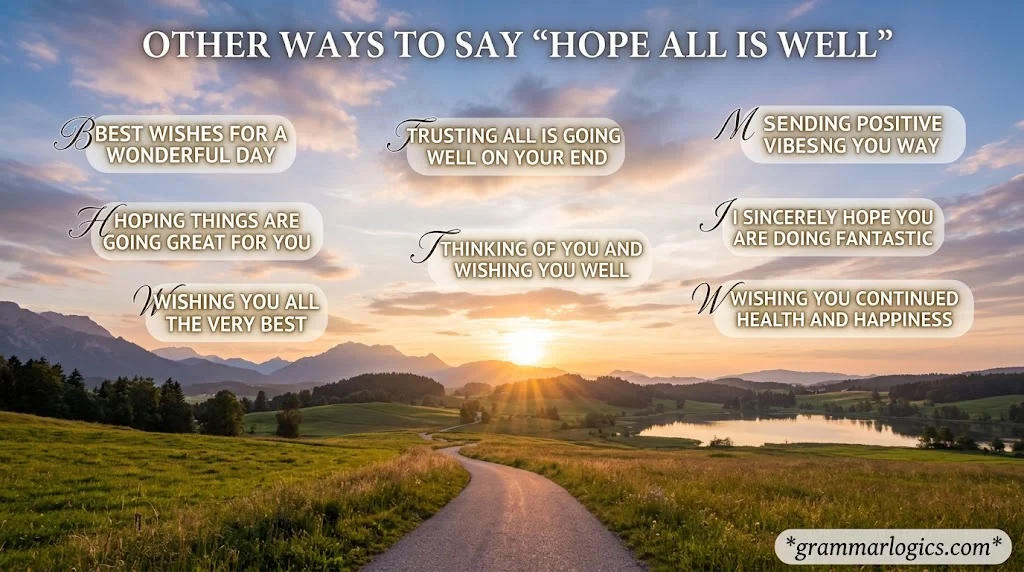
A thoughtful greeting can make any conversation feel warmer, especially when you want to ask about someone’s well-being.
Sometimes, saying “Hope All Is Well” can feel a little repetitive, particularly in emails, messages, or professional conversations. Using different greetings and expressions can help your message sound more natural, personal, and appropriate for the situation. Whether you are reconnecting with a friend, starting a business email, or checking in with a colleague, the right wording can make a noticeable difference. There are plenty of polite alternatives that express the same good wishes while adding warmth, friendliness, professionalism, or a more conversational tone to your message.
In this guide, you’ll discover 15 other ways to say “Hope All Is Well”, along with clear meanings and practical examples. Each alternative can suit a different context, from casual conversations and friendly messages to formal emails and workplace communication. Choosing the right expression helps you avoid repetitive wording and makes your communication feel more genuine. You’ll also learn how each phrase differs in tone, when it works best, and how to use it naturally in a sentence. This makes it easier to choose an expression that matches your relationship, purpose, and overall style.
What Does “Hope All Is Well” Mean?
“Hope all is well” is a friendly expression used to show that you are thinking about someone and hope they are doing well. It is commonly used at the beginning of an email, message, or conversation, especially when you have not spoken to the person recently. The phrase communicates goodwill, politeness, and general concern without asking for personal details. It can refer broadly to someone’s life, work, family, or circumstances, so its meaning is intentionally general. In many cases, “Hope all is well” is simply a pleasant way to open communication before moving to the main purpose of a message.
Common Situations Where “Hope All Is Well” Is Used
People use “Hope all is well” in many everyday and professional situations. It is common in emails to colleagues, messages to friends, professional follow-ups, and personal communication when some time has passed since the last conversation. For example, someone might begin a work email with the phrase before asking about a project, or send it to an old friend before catching up.
The expression is particularly useful because it is friendly without being overly personal. However, its general nature can also make it feel routine when used repeatedly. Choosing a more specific alternative can make your message sound more thoughtful. If you know the person has recently started a new job, taken a trip, or completed an important project, referring to that situation can create a stronger personal connection.
Is It Professional or Polite to Say “Hope All Is Well”?
Yes, “Hope all is well” is generally polite and professional, particularly in emails and other written communication. It has a friendly but relatively neutral tone, which makes it suitable for colleagues, clients, acquaintances, and professional contacts. It is not highly formal, but it is rarely considered inappropriate in ordinary workplace communication.
The main consideration is context and frequency. If you use the same phrase in every email, it can eventually sound formulaic. A more specific greeting may feel more genuine when you have relevant information about the recipient. For highly formal correspondence, a direct opening may sometimes be more appropriate than a conversational greeting, while personal messages may benefit from something warmer.
Advantages and Disadvantages of Saying “Hope All Is Well”
Advantages
The biggest advantage of “Hope all is well” is its versatility. It is short, polite, and easy to use with people you know well or only professionally. It expresses goodwill without making assumptions about someone’s circumstances. Because it is broad and non-intrusive, it works particularly well when you want to begin a conversation without immediately getting to the main point.
Disadvantages
Its greatest limitation is that it can sometimes sound generic or habitual. If you use it frequently, the recipient may read it as a standard email opener rather than a genuinely personal sentiment. It also does not communicate much specific emotion. When you want to show stronger warmth, acknowledge someone’s recent experience, or reconnect after a long absence, a more tailored expression may be more effective.
Synonyms for “Hope All Is Well”
- I hope you’re doing well
- I hope things are going well
- I hope you’re keeping well
- I hope you’re doing okay
- How have you been?
- I hope life has been treating you well
- I hope everything is going smoothly
- I trust you’re doing well
- I hope you’re having a good week
- I hope things are going well for you
- How are things with you?
- I hope you’re doing great
- I hope all is going smoothly for you
- Wishing you well
- I hope you’re keeping happy and healthy
1. I Hope You’re Doing Well
Meaning
“I hope you’re doing well” expresses a friendly wish that the other person is in a good situation. It is one of the closest natural alternatives to “Hope all is well.”
Definition
A polite expression used to say that you hope someone is well, happy, or generally doing fine.
Detailed Explanation
This expression focuses directly on the person rather than their circumstances as a whole. It sounds natural in both professional and personal communication and is slightly more conversational than the original phrase. It can work particularly well when you want a straightforward greeting that does not sound overly formal. Because it is so versatile, it is useful when you are unsure which level of warmth to choose.
Scenario Examples
Scenario: You are emailing a former colleague after several months.
Example: “Hi Daniel, I hope you’re doing well. I wanted to ask about the conference we discussed.”
Scenario: You are checking in with a friend.
Example: “Hey! I hope you’re doing well. It’s been a while since we caught up.”
Best Use
Best for emails, professional messages, personal messages, and everyday conversation.
Tone
Tone: Warm, polite, neutral. It sounds friendly without being too familiar or emotional.
2. I Hope Things Are Going Well
Meaning
“I hope things are going well” expresses the hope that someone’s current circumstances are positive.
Definition
A friendly expression wishing that a person’s life, work, or current situation is progressing positively.
Detailed Explanation
Unlike “I hope you’re doing well,” this version puts slightly more attention on the person’s circumstances. That makes it useful when you know someone has been dealing with a project, transition, or busy period. It can sound especially natural in workplace communication. The phrase remains broad enough that you do not have to ask about private matters.
Scenario Examples
Scenario: A colleague recently moved to a new department.
Example: “Hi Maya, I hope things are going well in your new role.”
Scenario: You are contacting a client after a previous meeting.
Example: “I hope things are going well on your end. I wanted to follow up on our conversation.”
Best Use
Best for professional emails, workplace communication, and friendly check-ins.
Tone
Tone: Polite, supportive, professional. It shows goodwill while keeping the focus broad.
3. I Hope You’re Keeping Well
Meaning
“I hope you’re keeping well” is a polite way to express the hope that someone remains healthy and well.
Definition
A courteous expression meaning that you hope someone is continuing to be well.
Detailed Explanation
This expression is especially common in British and Irish English and can sound slightly more traditional than “I hope you’re doing well.” It is appropriate when you want a warm but restrained greeting. The word “keeping” suggests continuing in a good state rather than simply asking how someone feels at this moment. It can therefore work nicely in correspondence with someone you have not contacted for a while.
Scenario Examples
Scenario: You are writing a formal email to an older professional contact.
Example: “Dear Mr. Harris, I hope you’re keeping well. I’m writing regarding our upcoming meeting.”
Scenario: You are sending a message to a family acquaintance.
Example: “Hello Margaret, I hope you’re keeping well. We were talking about you the other day.”
Best Use
Best for polite emails, British English, professional correspondence, and respectful personal messages.
Tone
Tone: Warm, courteous, slightly traditional. It has a gentle and respectful quality.
4. I Hope You’re Doing Okay
Meaning
“I hope you’re doing okay” expresses concern about someone’s wellbeing and hopes that they are managing.
Definition
A supportive expression meaning that you hope someone is alright or coping well.
Detailed Explanation
This phrase can carry more emotional weight than “Hope all is well.” The word “okay” may suggest that you recognize the person could be dealing with something difficult, although it can also be used casually. For that reason, context matters. It is often more appropriate for a personal message than a routine professional email unless you know the recipient is facing a particular challenge.
Scenario Examples
Scenario: A friend has recently experienced a difficult change.
Example: “I heard about what happened. I hope you’re doing okay.”
Scenario: You are checking on someone after a stressful week.
Example: “Just wanted to check in and see how you’re doing. I hope you’re doing okay.”
Best Use
Best for personal messages, supportive conversations, and sensitive situations.
Tone
Tone: Caring, supportive, personal. It suggests a little more concern than a general greeting.
5. How Have You Been?
Meaning
“How have you been?” asks directly about someone’s wellbeing since you last spoke.
Definition
A conversational question used to ask how someone has been doing over a period of time.
Detailed Explanation
This is less of a wish and more of an invitation to start a genuine conversation. It works especially well when you have not spoken to someone for a while. Unlike “Hope all is well,” it encourages the other person to provide an update. Because it is an actual question, it feels more engaging and personal.
Scenario Examples
Scenario: You reconnect with an old classmate.
Example: “Hey Sarah! How have you been? It feels like forever since we talked.”
Scenario: You call a relative you have not seen recently.
Example: “Hi Uncle James, how have you been? How is everything at home?”
Best Use
Best for friends, relatives, former colleagues, acquaintances, and casual conversations.
Tone
Tone: Friendly, conversational, interested. It invites a response and naturally opens a longer conversation.
6. I Hope Life Has Been Treating You Well
Meaning
“I hope life has been treating you well” expresses a warm wish that someone’s experiences and circumstances have been positive.
Definition
A thoughtful expression wishing that someone’s recent life experiences have been good.
Detailed Explanation
This alternative is more expressive and personal than the standard “Hope all is well.” It has a slightly reflective quality and works particularly well when reconnecting with someone after a significant amount of time. Because it sounds more heartfelt, it may feel less natural in a routine business email. It is best when the relationship allows for some warmth and personality.
Scenario Examples
Scenario: You reconnect with a university friend after several years.
Example: “It was wonderful hearing from you. I hope life has been treating you well.”
Scenario: You send a message to someone you used to work with.
Example: “I saw your recent update and thought I’d say hello. I hope life has been treating you well.”
Best Use
Best for personal messages, reconnections, friendly emails, and heartfelt communication.
Tone
Tone: Warm, reflective, heartfelt. It sounds more personal than a routine professional greeting.
7. I Hope Everything Is Going Smoothly
Meaning
“I hope everything is going smoothly” expresses the hope that a person’s current affairs or plans are progressing without problems.
Definition
A polite expression wishing that nothing is causing difficulty or disruption.
Detailed Explanation
This phrase is useful when there is a known process, project, event, or transition involved. It does not simply ask whether someone feels well; it suggests that you hope their current situation is progressing without complications. That makes it especially useful in professional settings. It can also work personally when someone is preparing for a major event.
Scenario Examples
Scenario: A client is preparing for a product launch.
Example: “I hope everything is going smoothly with the launch.”
Scenario: A friend is moving to a new city.
Example: “I hope everything is going smoothly with the move.”
Best Use
Best for work emails, project updates, customer communication, and situation-specific messages.
Tone
Tone: Professional, supportive, practical. It communicates concern about circumstances without becoming overly personal.
Read More: 15 Other Ways to Say “Keep Up the Good Work” (With Examples)
8. I Trust You’re Doing Well
Meaning
“I trust you’re doing well” expresses confidence or expectation that the recipient is well.
Definition
A formal expression indicating that you expect someone to be doing well.
Detailed Explanation
This wording is more formal than “I hope you’re doing well.” The verb “trust” gives it a polished business tone and can sound appropriate in established professional correspondence. However, it may feel somewhat formal or traditional in a casual conversation. It is best used when the surrounding message also has a professional style.
Scenario Examples
Scenario: You are writing to a business contact.
Example: “Dear Ms. Patel, I trust you’re doing well. I’m following up regarding the proposal.”
Scenario: You are contacting a professional acquaintance after some time.
Example: “I trust you’re doing well and that the new position has been going smoothly.”
Best Use
Best for formal emails, business correspondence, and professional communication.
Tone
Tone: Formal, respectful, polished. It creates a more businesslike impression than most alternatives.
9. I Hope You’re Having a Good Week
Meaning
“I hope you’re having a good week” wishes someone a pleasant and successful week.
Definition
A friendly greeting expressing the hope that someone’s current week is going positively.
Detailed Explanation
This alternative is more specific and timely than “Hope all is well.” It works especially well when you are contacting someone during the workweek and want a light, upbeat opening. Because it refers specifically to the week, it is not as suitable for every situation. Still, it can make a routine message feel more conversational.
Scenario Examples
Scenario: You are emailing a coworker on Wednesday.
Example: “Hi Alex, I hope you’re having a good week. Could we discuss the schedule?”
Scenario: You are sending a casual message to an acquaintance.
Example: “Hope you’re having a good week! I wanted to share something with you.”
Best Use
Best for work emails, casual emails, weekday messages, and friendly communication.
Tone
Tone: Light, upbeat, friendly. It feels more immediate and cheerful than a general wellbeing greeting.
10. I Hope Things Are Going Well for You
Meaning
“I hope things are going well for you” expresses a personal wish that the recipient’s circumstances are positive.
Definition
A warm expression wishing someone positive experiences and circumstances.
Detailed Explanation
The addition of “for you” gives this phrase a slightly more personal feel. It can acknowledge that someone has their own circumstances without asking intrusive questions. It is useful when you want something warmer than a routine business greeting but still fairly neutral. The expression works naturally in both personal and professional communication.
Scenario Examples
Scenario: You are contacting a former coworker.
Example: “Hi Tom, I hope things are going well for you. How are you finding your new company?”
Scenario: You are writing to a friend who moved away.
Example: “I hope things are going well for you in your new city.”
Best Use
Best for friendly emails, personal messages, former colleagues, and professional contacts.
Tone
Tone: Warm, considerate, neutral. It feels personal without being overly intimate.
11. How Are Things With You?
Meaning
“How are things with you?” is a casual way to ask about someone’s current situation.
Definition
A conversational question asking how someone’s life or circumstances are going.
Detailed Explanation
This expression is more relaxed than “I trust you’re doing well” and more interactive than “Hope all is well.” It naturally encourages the recipient to share an update. The word “things” keeps the question broad, so the person can choose what they want to discuss. It works best when the relationship is reasonably familiar.
Scenario Examples
Scenario: You message an old friend.
Example: “Hey Mark, how are things with you? We haven’t caught up in ages.”
Scenario: You speak with a former coworker.
Example: “Good to hear from you! How are things with you these days?”
Best Use
Best for casual conversation, texting, friends, acquaintances, and informal professional relationships.
Tone
Tone: Casual, friendly, conversational. It feels natural and encourages an informal exchange.
12. I Hope You’re Doing Great
Meaning
“I hope you’re doing great” expresses a particularly positive wish about someone’s wellbeing.
Definition
A friendly expression hoping that someone is doing very well and having positive experiences.
Detailed Explanation
This phrase is slightly more enthusiastic than “I hope you’re doing well.” The word “great” creates a brighter, more upbeat tone. It is suitable for people you have a friendly relationship with, although it can also appear in relatively informal professional communication. If the situation is serious or sensitive, the stronger positivity may not be the best fit.
Scenario Examples
Scenario: You congratulate a former colleague on a new opportunity.
Example: “Hi Nina, I hope you’re doing great in your new role!”
Scenario: You reconnect with a friend online.
Example: “It’s been so long! I hope you’re doing great.”
Best Use
Best for friendly emails, personal messages, congratulations, and informal communication.
Tone
Tone: Upbeat, warm, enthusiastic. It communicates more positive energy than a neutral wellbeing greeting.
13. I Hope All Is Going Smoothly for You
Meaning
“I hope all is going smoothly for you” expresses a wish that someone’s current circumstances are progressing without problems.
Definition
A considerate expression hoping that the important parts of someone’s current situation are going well.
Detailed Explanation
This is particularly useful when you have some context about what the recipient is dealing with. It can refer to work, studies, travel, a move, a project, or another ongoing situation. Compared with the original phrase, it focuses more strongly on progress and the absence of difficulties. It therefore feels more purposeful when you know the person is in the middle of something.
Scenario Examples
Scenario: A student is preparing for final exams.
Example: “I know exams are coming up, so I hope all is going smoothly for you.”
Scenario: A colleague is coordinating an event.
Example: “I hope all is going smoothly for you with the preparations.”
Best Use
Best for professional communication, supportive personal messages, ongoing projects, and situation-specific check-ins.
Tone
Tone: Supportive, thoughtful, polite. It shows awareness that the person may have something important underway.
14. Wishing You Well
Meaning
“Wishing you well” expresses a sincere wish for someone’s future or general wellbeing.
Definition
A concise expression offering someone good wishes and positive thoughts.
Detailed Explanation
This phrase differs from “Hope all is well” because it can sound more like a good wish or closing sentiment than an opening greeting. It is useful when you want to convey warmth without asking a question. Depending on the context, it can sound sincere, formal, or even slightly final, so it should be chosen carefully. It works particularly well when sending encouragement or good wishes during a transition.
Scenario Examples
Scenario: A colleague is leaving the company.
Example: “It has been a pleasure working with you. Wishing you well in your next chapter.”
Scenario: You send encouragement to someone starting something new.
Example: “I know you have a lot ahead of you. Wishing you well with everything.”
Best Use
Best for farewell messages, supportive notes, professional transitions, and thoughtful personal communication.
Tone
Tone: Sincere, warm, respectful. It emphasizes goodwill rather than inviting a detailed response.
15. I Hope You’re Keeping Happy and Healthy
Meaning
“I hope you’re keeping happy and healthy” expresses a direct wish for someone’s emotional and physical wellbeing.
Definition
A warm expression hoping that someone is both healthy and happy.
Detailed Explanation
This alternative is more specific than “Hope all is well” because it names two important aspects of wellbeing. It can feel especially thoughtful in a personal message or when checking in with someone you care about. However, mentioning health can make the phrase more personal than a neutral professional greeting. In a workplace context, a simpler expression may sometimes sound more natural.
Scenario Examples
Scenario: You are writing to a relative who lives far away.
Example: “It’s lovely to hear from you. I hope you’re keeping happy and healthy.”
Scenario: You send a message to an old friend around the holidays.
Example: “Thinking of you and hoping you’re keeping happy and healthy.”
Best Use
Best for personal messages, family communication, long-distance friendships, and caring check-ins.
Tone
Tone: Caring, affectionate, warm. It expresses more personal concern than a generic professional greeting.
FAQs
1. What is another way to say “Hope All Is Well”?
You can say “I hope you’re doing well,” “I hope everything is going well,” or “I hope things are going smoothly.” The best alternative depends on whether you are writing a casual message, friendly email, or professional communication.
2. Is “Hope All Is Well” professional?
Yes, “Hope All Is Well” is generally polite and professional. It is commonly used in emails and workplace communication. However, using an alternative can make your message feel more personal and natural, especially when you communicate with someone regularly.
3. How can I say “Hope All Is Well” in a friendly way?
For a friendly tone, you can use expressions such as “Hope you’re doing great,” “How have you been?” or “I hope things are going well for you.” These phrases sound warm and conversational.
4. What can I say instead of “Hope All Is Well” in an email?
In a professional email, try “I hope you’re doing well,” “I hope your week is going well,” or “I hope everything is going smoothly.” These alternatives are polite without sounding overly formal.
5. Why should I use alternatives to “Hope All Is Well”?
Using different expressions and greetings can prevent repetitive communication. It also allows you to match your wording to the relationship, context, and tone, making your emails and messages sound more thoughtful and engaging.
Conclusion
Knowing different ways to say “Hope All Is Well” can make your everyday communication more natural and meaningful. While the original phrase is polite and widely accepted, choosing another expression can help you sound more friendly, professional, warm, or conversational, depending on the situation. From simple greetings to thoughtful check-ins, each alternative gives you another way to connect with someone.
The key is to choose wording that fits your relationship and purpose. Whether you are writing a professional email, sending a message to a friend, or reconnecting with someone, the right greeting can create a positive impression. Use these 15 alternatives to keep your communication fresh, genuine, and appropriate for every situation.













1 thought on “15 Other Ways to Say “Hope All Is Well” (With Examples)”