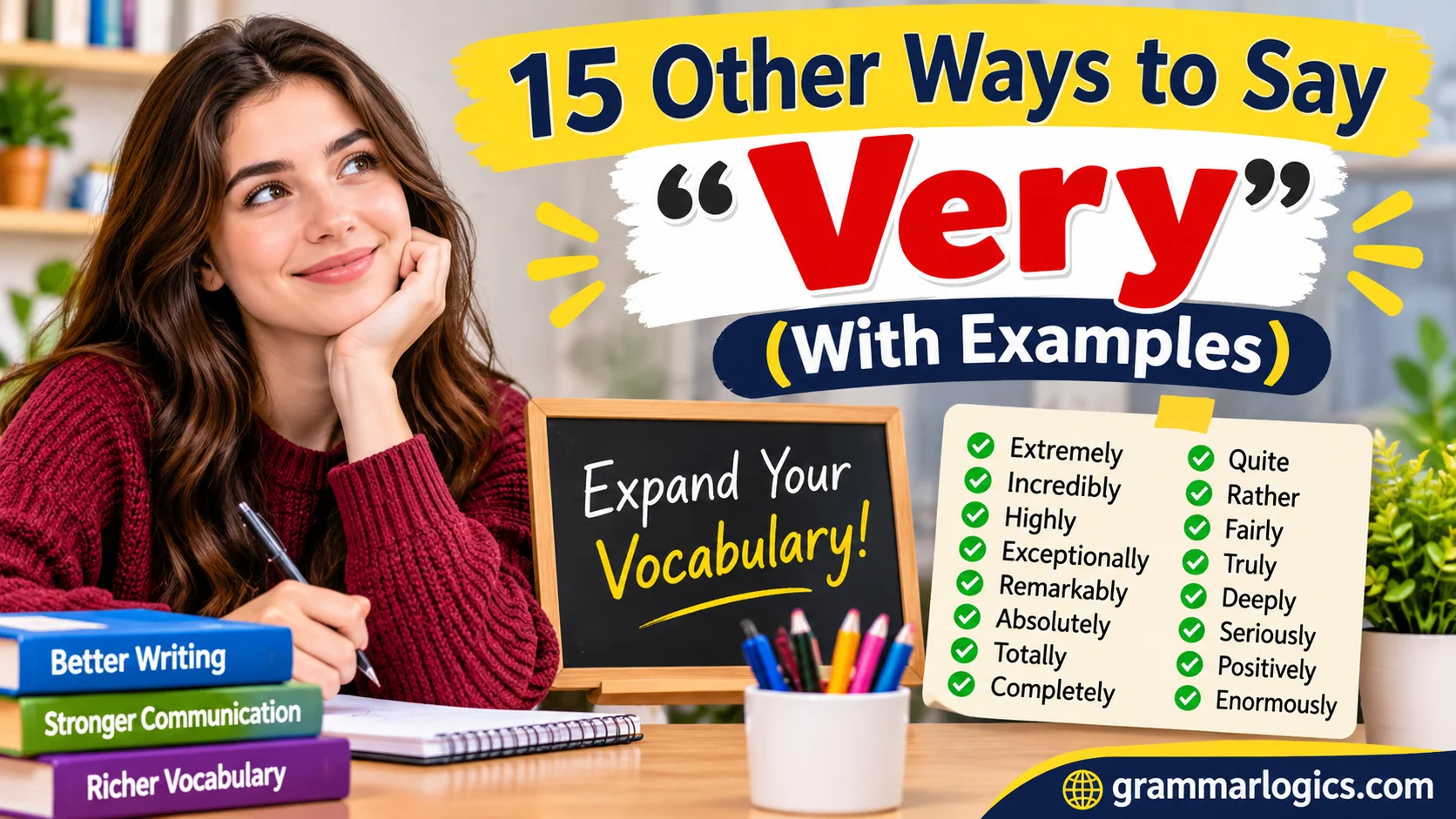
Finding the right words can make your writing more clear, expressive, and engaging. The word “very” is commonly used to add emphasis, but repeating it too often can make sentences sound ordinary.
Learning other ways to say “very” helps you express your thoughts more naturally and make everyday conversations and written communication more interesting. Using alternative words for “very” can improve your vocabulary and make your writing sound more polished. Whether you are writing an email, creating a blog post, preparing an academic assignment, or having a casual conversation, choosing stronger and more descriptive expressions can help you communicate effectively. Words such as extremely, incredibly, highly, exceptionally, and remarkably can add emphasis while making your sentences more meaningful. The best choice depends on the context, tone, and message you want to convey.
Exploring 15 other ways to say “very” will give you practical alternatives for different situations. Some expressions are suitable for professional writing, while others work better in friendly conversations, creative writing, and everyday communication. Understanding their meanings and examples will help you avoid unnecessary repetition and choose words that fit your intended message. Instead of relying on “very” in every sentence, you can use more precise and powerful vocabulary to express feelings, describe situations, and emphasize important details. These alternatives will also help make your English writing more natural, confident, and engaging.
What Does “Very” Mean?
“Very” is an adverb used to emphasize an adjective or another adverb. It usually means to a high degree or to a great extent. For example, in the sentence “The room is very clean,” the word “very” emphasizes how clean the room is. Similarly, “She speaks very clearly” means that she speaks with a high level of clarity. In everyday English, “very” adds strength to descriptions without changing their basic meaning. It can express positive qualities, negative conditions, emotions, or physical experiences. Although it is useful in both spoken and written English, choosing a more specific word can sometimes communicate the intended meaning more effectively.
Common Situations Where “Very” Is Used
People use “very” in everyday conversations, text messages, social media posts, school assignments, professional emails, and personal communication. It commonly strengthens descriptions such as “very happy,” “very tired,” “very important,” and “very difficult.” At work, someone might write, “This task is very important,” while a friend might say, “I’m very excited about the trip.” The word fits many situations because it is simple, familiar, and easy to understand. However, repeating it too often can make writing less varied. Alternatives such as “extremely,” “highly,” or “incredibly” can add variety, while words such as “essential” or “exhausted” can express a more precise meaning.
Is It Professional or Polite to Say “Very”?
Yes, “very” is both professional and polite when used appropriately. It is a standard English word that works well in emails, reports, presentations, academic writing, and everyday conversation. For example, “Your feedback is very helpful” sounds courteous and natural. However, frequent use of “very” may make formal writing feel repetitive or less precise. In professional communication, alternatives such as “highly,” “particularly,” and “exceptionally” may suit certain contexts better. Sometimes, replacing “very” and its adjective with a stronger word creates a cleaner sentence, such as changing “very tired” to “exhausted.” The best choice depends on the intended meaning, audience, and level of emphasis.
Advantages and Disadvantages of Saying “Very”
Advantages
The main advantage of “very” is its simplicity. Most English speakers understand it immediately, so it helps communicate emphasis without requiring complicated vocabulary. It works with many adjectives and adverbs, making it useful in casual conversations and formal writing alike. It can also make a description sound more expressive, as in “very kind,” “very useful,” or “very carefully.” For English learners, it is an accessible way to strengthen descriptions while building vocabulary.
Disadvantages
Although “very” is versatile, overusing it can make writing repetitive. Phrases such as “very good,” “very bad,” and “very nice” may sound less specific than alternatives such as “excellent,” “terrible,” and “lovely.” In some situations, the word adds emphasis without explaining exactly how strong a quality is. It can also weaken otherwise direct writing when a stronger adjective would be more effective. Choosing a precise alternative helps make communication more engaging, varied, and meaningful.
15 Synonyms and Alternatives for “Very”
- Extremely
- Highly
- Incredibly
- Exceptionally
- Remarkably
- Exceedingly
- Intensely
- Particularly
- Especially
- Really
- Absolutely
- Utterly
- Terribly
- Deeply
- Tremendously
1. Extremely
Meaning
Extremely means to a very high degree. It adds strong emphasis to an adjective or adverb and often communicates that something is far beyond an ordinary level.
Definition
Extremely is an adverb used to describe a quality, condition, or action that exists to a great extent.
Detailed Explanation
“Extremely” is a strong alternative to “very,” particularly when you want to emphasize the intensity of a quality. It often sounds slightly more formal and precise than “very,” making it useful in reports, explanations, and serious conversations. For example, “extremely difficult” communicates a high level of difficulty. It can describe both positive and negative situations without changing the underlying meaning.
Scenario Examples
- Scenario: A student describes a challenging examination.
Example: The final mathematics exam was extremely difficult. - Scenario: A colleague explains a deadline.
Example: We are extremely busy this week, so we need to prioritize the urgent tasks. - Scenario: Someone talks about the weather.
Example: It was extremely cold when we left the house.
Best Use
Use “extremely” in professional writing, academic work, everyday conversation, and detailed descriptions when strong emphasis is appropriate.
Tone
Tone: Strong, clear, and slightly formal. It communicates a high degree of intensity without sounding overly emotional.
2. Highly
Meaning
Highly means to a great degree or at a high level. It is particularly natural when describing ability, quality, importance, or the degree of someone’s approval.
Definition
Highly is an adverb that emphasizes a significant level of quality, achievement, importance, or evaluation.
Detailed Explanation
“Highly” works well when discussing professional qualities, performance, recommendations, and abstract ideas. Unlike “very,” it does not fit naturally with every adjective. Expressions such as “highly effective,” “highly skilled,” and “highly recommended” are common, while “highly hungry” sounds unnatural in ordinary English. Choosing this alternative requires attention to the words that normally accompany it. It is especially useful when you want your writing to sound polished and professional.
Scenario Examples
- Scenario: A manager praises an employee’s abilities.
Example: She is a highly skilled designer with excellent attention to detail. - Scenario: A team discusses a new strategy.
Example: This approach is highly effective for reducing unnecessary delays. - Scenario: A customer recommends a service.
Example: I would highly recommend this company to anyone looking for reliable support.
Best Use
Use “highly” in business communication, reviews, reports, recommendations, and formal descriptions involving quality or performance.
Tone
Tone: Professional, positive, and evaluative. It often suggests a considered judgment rather than simple emotional emphasis.
3. Incredibly
Meaning
Incredibly means to an unusually high degree. It often communicates strong emphasis, admiration, surprise, or amazement.
Definition
Incredibly is an adverb used to emphasize a quality or situation that seems remarkable or difficult to believe.
Detailed Explanation
“Incredibly” is a lively alternative to “very” when a description deserves extra emphasis. It often conveys more emotion than “extremely,” particularly when describing impressive achievements, enjoyable experiences, or surprising events. For example, “incredibly beautiful” suggests that something is strikingly beautiful. It is common in conversation and informal writing, although it can also appear in polished descriptive prose. Because it is expressive, using it too frequently may make writing feel exaggerated.
Scenario Examples
- Scenario: A traveler describes a memorable landscape.
Example: The mountains looked incredibly beautiful at sunrise. - Scenario: A friend praises someone’s cooking.
Example: Your homemade pasta is incredibly delicious. - Scenario: A teacher recognizes a student’s progress.
Example: You have made incredibly impressive progress this semester.
Best Use
Use “incredibly” in personal messages, storytelling, reviews, friendly conversations, and enthusiastic descriptions.
Tone
Tone: Enthusiastic, expressive, and sometimes emotional. It adds a sense of surprise or admiration.
4. Exceptionally
Meaning
Exceptionally means unusually well or to a degree that is above what is normal or expected. It highlights a quality that stands out from the ordinary.
Definition
Exceptionally is an adverb used to describe something that is remarkably high in quality, ability, or degree.
Detailed Explanation
“Exceptionally” is useful when you want to show that a person, result, or object goes beyond typical standards. Compared with “very,” it often suggests that the quality is unusual rather than simply strong. For example, an “exceptionally talented musician” demonstrates a level of talent that stands out. The word is particularly suitable for professional evaluations and carefully written descriptions. It is less natural for routine physical states when no unusual degree is intended.
Scenario Examples
- Scenario: A supervisor evaluates a team member.
Example: Daniel delivered an exceptionally strong presentation. - Scenario: A customer describes a restaurant.
Example: The service was exceptionally good, and the staff were attentive throughout the evening. - Scenario: A teacher comments on a student’s work.
Example: Your essay shows exceptionally clear reasoning.
Best Use
Use “exceptionally” in performance reviews, academic feedback, formal descriptions, and professional recommendations.
Tone
Tone: Polished, appreciative, and evaluative. It suggests that a quality is notably above the usual standard.
5. Remarkably
Meaning
Remarkably means in a way that deserves attention or notice. It emphasizes a quality, change, or result that stands out as unusual or impressive.
Definition
Remarkably is an adverb used to highlight something noteworthy or surprising.
Detailed Explanation
“Remarkably” is a good choice when you want readers to notice something special about a person, event, or result. Unlike “very,” it often carries the additional idea that the quality is worth mentioning. For example, “remarkably calm” suggests that someone remained calm despite circumstances that might normally cause stress. The word can suit both positive and neutral observations. It works particularly well in descriptive, analytical, and professional writing.
Scenario Examples
- Scenario: A colleague handles a stressful situation.
Example: She remained remarkably calm during the unexpected system failure. - Scenario: A student reflects on personal improvement.
Example: His writing has become remarkably clear since the beginning of the term. - Scenario: A visitor comments on an old building.
Example: The historic library is remarkably well preserved.
Best Use
Use “remarkably” in descriptive writing, reports, observations, storytelling, and professional feedback when something deserves special attention.
Tone
Tone: Thoughtful, observant, and appreciative. It emphasizes what makes a quality noteworthy.
6. Exceedingly
Meaning
Exceedingly means to an unusually great degree. It adds strong emphasis and often sounds more formal or literary than “very.”
Definition
Exceedingly is an adverb that indicates an unusually high level of a quality or condition.
Detailed Explanation
“Exceedingly” is suitable when you want to emphasize a quality in a formal or carefully composed sentence. Expressions such as “exceedingly useful,” “exceedingly difficult,” and “exceedingly rare” communicate a high degree. It can sound old-fashioned or overly formal in casual conversation, so “extremely” may be more natural when speaking with friends. The word is especially effective in descriptive prose where a measured, formal tone is appropriate. Use it selectively to avoid making ordinary statements sound unnecessarily elaborate.
Scenario Examples
- Scenario: A researcher describes a rare discovery.
Example: The mineral is exceedingly rare in this region. - Scenario: A formal letter acknowledges assistance.
Example: Your guidance has been exceedingly helpful throughout this process. - Scenario: A student explains a demanding assignment.
Example: The final research project proved exceedingly challenging.
Best Use
Use “exceedingly” in formal correspondence, literary writing, detailed reports, and serious descriptions.
Tone
Tone: Formal, emphatic, and somewhat traditional. It conveys a high degree without the conversational energy of “incredibly.”
7. Intensely
Meaning
Intensely means with great strength, concentration, or emotional force. It is most natural when describing feelings, sensations, activities, or experiences that are powerful.
Definition
Intensely is an adverb that describes something experienced or expressed with a high level of strength or focus.
Detailed Explanation
“Intensely” is not a universal replacement for “very” because it focuses on strength or depth rather than degree alone. For example, “intensely interested” suggests concentrated interest, while “intensely painful” emphasizes the severity of a sensation. It is particularly effective for emotional descriptions, demanding activities, and vivid storytelling. Using it with an unsuitable adjective can sound unnatural, so context matters. Choose it when the strength of a feeling or experience is more important than simply saying that something is extreme.
Scenario Examples
- Scenario: A student concentrates on an important examination.
Example: She studied intensely for several hours before the test. - Scenario: A friend describes a difficult emotional experience.
Example: He felt intensely disappointed when the event was canceled. - Scenario: A journalist describes a competitive match.
Example: Both teams competed intensely until the final whistle.
Best Use
Use “intensely” in emotional writing, sports descriptions, personal reflections, and discussions of concentration or strong sensations.
Tone
Tone: Powerful, focused, and emotionally charged. It highlights strength or depth rather than ordinary emphasis.
8. Particularly
Meaning
Particularly means especially or more than usual in a specific respect. It draws attention to one quality, person, situation, or detail.
Definition
Particularly is an adverb used to emphasize a specific feature or identify something as especially relevant.
Detailed Explanation
“Particularly” is useful when you want to highlight one aspect of a broader subject. It can replace “very” in certain sentences, but it often adds the idea of selectivity or special relevance. For instance, “particularly helpful” emphasizes that something is helpful in a notable way, while “particularly important” draws attention to its importance. It works well in professional communication because it can sound measured rather than exaggerated. However, it is not interchangeable with “very” in every sentence.
Scenario Examples
- Scenario: A manager identifies the main priority.
Example: Clear communication is particularly important during a major project. - Scenario: A student discusses a difficult subject.
Example: I found the final chapter particularly challenging. - Scenario: A customer praises one feature of a product.
Example: The long battery life is particularly useful when traveling.
Best Use
Use “particularly” in work emails, academic writing, explanations, comparisons, and situations where one detail deserves emphasis.
Tone
Tone: Measured, thoughtful, and professional. It draws attention to a specific point without necessarily sounding emotional.
9. Especially
Meaning
Especially means more than others or to a greater extent in a particular case. It highlights something that deserves special attention.
Definition
Especially is an adverb used to emphasize a person, thing, or situation within a broader group or context.
Detailed Explanation
“Especially” often works when you want to identify what matters most or what stands out among several things. It is common in everyday English and fits naturally into both spoken and written communication. For example, “especially helpful” highlights usefulness in a particular situation or for a particular person. Unlike “very,” it can suggest a comparison or a special focus rather than simply a high degree. It is a flexible choice when you want your emphasis to feel natural and conversational.
Scenario Examples
- Scenario: A teacher gives advice before an exam.
Example: Review your class notes, especially the topics we covered last week. - Scenario: Someone recommends a travel destination.
Example: The coastal path is especially beautiful in the early morning. - Scenario: A team leader thanks colleagues.
Example: Your support was especially helpful during the busiest part of the project.
Best Use
Use “especially” in everyday conversation, advice, friendly emails, explanations, and descriptions that highlight a particular detail.
Tone
Tone: Natural, friendly, and explanatory. It emphasizes a specific point without sounding overly formal.
10. Really
Meaning
Really means genuinely or to a high degree, depending on the sentence. In casual English, it often strengthens adjectives and expresses feelings or opinions.
Definition
Really is an adverb used to emphasize a quality, confirm something, or indicate that something is genuine.
Detailed Explanation
“Really” is one of the most common conversational alternatives to “very.” It fits naturally into spoken English and informal messages, as in “really nice” or “really difficult.” Depending on context, it can also express sincerity, as in “I really appreciate your help.” Although it sounds friendly and natural, it may be less suitable than “highly” or “particularly” in some formal reports. Its meaning also changes slightly when used to ask for confirmation, so the surrounding sentence matters.
Scenario Examples
- Scenario: A friend asks about a new café.
Example: The coffee there is really good, and the atmosphere is relaxing. - Scenario: Someone thanks a coworker.
Example: I really appreciate your help with the presentation. - Scenario: A student shares an opinion about a lesson.
Example: Today’s science lesson was really interesting.
Best Use
Use “really” in casual conversations, text messages, friendly emails, and personal communication. In formal writing, choose a more precise alternative when appropriate.
Tone
Tone: Casual, warm, and conversational. It feels familiar and sincere in everyday interactions.
11. Absolutely
Meaning
Absolutely means completely, entirely, or without any doubt. It can express strong agreement, certainty, or a complete degree of a quality.
Definition
Absolutely is an adverb used to communicate completeness, certainty, or strong emphasis.
Detailed Explanation
“Absolutely” is especially natural with words and expressions that allow a complete or categorical meaning, such as “absolutely certain,” “absolutely necessary,” and “absolutely right.” It can also serve as a confident response to a request, as in “Absolutely, I can help.” However, it does not fit every adjective: “absolutely tired” is less natural than “extremely tired” in ordinary English. Use it when the idea of certainty or completeness matters, rather than as a general substitute for every use of “very.”
Scenario Examples
- Scenario: A colleague confirms an important requirement.
Example: A backup copy is absolutely necessary before we update the system. - Scenario: A friend asks whether you can help.
Example: “Could you help me move these boxes?” “Absolutely!” - Scenario: Someone checks a meeting detail.
Example: I am absolutely certain that the appointment is scheduled for Monday.
Best Use
Use “absolutely” in confident statements, enthusiastic agreement, important instructions, and descriptions involving certainty or completeness.
Tone
Tone: Confident, decisive, and emphatic. It communicates strong assurance or an all-or-nothing degree.
12. Utterly
Meaning
Utterly means completely or entirely. It emphasizes that a quality or condition is present to its fullest extent.
Definition
Utterly is an adverb used to express complete or total intensity, often with strong emotional force.
Detailed Explanation
“Utterly” is stronger and more dramatic than ordinary “very” in many contexts. It frequently appears with words such as “exhausted,” “confused,” “ridiculous,” or “impossible.” For example, “utterly exhausted” suggests complete depletion of energy rather than ordinary tiredness. The word often carries a negative or dramatic tone, although it can also be used positively in expressions such as “utterly delightful.” Because of its intensity, it should be reserved for situations where complete emphasis is intended.
Scenario Examples
- Scenario: A traveler describes a long journey.
Example: After the overnight flight, I was utterly exhausted. - Scenario: A student explains a confusing instruction.
Example: The last paragraph left me utterly confused. - Scenario: A guest describes a wonderful experience.
Example: The surprise celebration was utterly delightful.
Best Use
Use “utterly” in creative writing, vivid descriptions, emotional conversations, and situations that call for a sense of completeness.
Tone
Tone: Strong, dramatic, and emphatic. It can sound intense or literary, depending on the adjective it modifies.
13. Terribly
Meaning
Terribly can mean extremely, especially in informal expressions such as “terribly sorry” or “terribly important.” It can also mean in a bad or unpleasant way.
Definition
Terribly is an adverb used either to intensify a quality or to describe something as very bad, depending on context.
Detailed Explanation
“Terribly” is a useful alternative to “very” in certain established expressions, but it is not suitable for every situation. Phrases such as “terribly sorry,” “terribly worried,” and “terribly difficult” are natural in many varieties of English. In other sentences, the word may emphasize a negative outcome rather than simply increase intensity. For example, “The room was terribly designed” suggests that the design was poor. Pay attention to the adjective and context so the intended meaning remains clear.
Scenario Examples
- Scenario: Someone apologizes for arriving late.
Example: I’m terribly sorry for keeping you waiting. - Scenario: A parent explains a child’s concern.
Example: She was terribly worried about her first day at school. - Scenario: A team discusses a demanding assignment.
Example: The instructions were terribly confusing, so we asked for clarification.
Best Use
Use “terribly” in apologies, informal descriptions, emotional conversations, and familiar expressions where it sounds natural.
Tone
Tone: Expressive, conversational, and sometimes apologetic. It can intensify feelings or communicate a negative judgment.
14. Deeply
Meaning
Deeply means strongly or profoundly, particularly when describing emotions, beliefs, concern, or personal impact.
Definition
Deeply is an adverb that expresses a strong degree of feeling, thought, commitment, or influence.
Detailed Explanation
“Deeply” is not a general replacement for “very” because it emphasizes emotional depth or significance rather than simple intensity. Expressions such as “deeply grateful,” “deeply concerned,” and “deeply committed” sound natural and meaningful. It is especially useful when a feeling is sincere, lasting, or personally important. In contrast, phrases such as “deeply hungry” are generally unnatural in everyday English. Choose this word when you want to communicate the depth of an emotion, belief, or commitment.
Scenario Examples
- Scenario: An employee thanks a mentor.
Example: I am deeply grateful for the advice you shared with me. - Scenario: A community leader addresses a local problem.
Example: Residents are deeply concerned about the loss of green spaces. - Scenario: A volunteer explains a personal commitment.
Example: Our team is deeply committed to supporting local families.
Best Use
Use “deeply” in personal messages, formal statements, emotional writing, professional commitments, and expressions of gratitude or concern.
Tone
Tone: Sincere, thoughtful, and emotionally meaningful. It emphasizes depth of feeling rather than merely a high degree.
15. Tremendously
Meaning
Tremendously means to a very great degree or extent. It often emphasizes a substantial effect, amount, improvement, or level of success.
Definition
Tremendously is an adverb used to describe something that is exceptionally large, strong, significant, or extensive in degree.
Detailed Explanation
“Tremendously” adds strong emphasis and often suggests a noticeable impact or substantial scale. It works naturally with words such as “helpful,” “successful,” “popular,” and “important.” Compared with “very,” it can make a sentence feel more energetic and can highlight the size of an effect. However, it may sound excessive when describing minor or routine situations. Use it when the degree or impact is genuinely substantial.
Scenario Examples
- Scenario: A business owner describes recent progress.
Example: Our customer support process has improved tremendously over the past year. - Scenario: A student thanks a classmate for assistance.
Example: Your notes helped me tremendously while preparing for the exam. - Scenario: A coach reflects on a team’s performance.
Example: The players have grown tremendously as a team this season.
Best Use
Use “tremendously” in progress reports, appreciative messages, descriptions of major changes, and conversations about significant results.
Tone
Tone: Positive, energetic, and emphatic. It highlights a substantial degree of improvement, usefulness, or impact.
FAQs
What is another way to say “very”?
Common alternatives include extremely, highly, incredibly, exceptionally, and remarkably. The best option depends on the sentence. For example, “very tired” can become “extremely tired,” while “very skilled” may sound more natural as “highly skilled.”
What does “very” mean?
“Very” means to a high degree or extent. It strengthens an adjective or adverb, as in “very happy,” “very carefully,” or “very important.”
Is “very” professional?
Yes. “Very” is appropriate in professional communication when used naturally. However, varying your vocabulary and choosing more precise expressions can improve the clarity and style of reports, presentations, and business emails.
What is a more formal alternative to “very”?
“Exceedingly,” “exceptionally,” “highly,” and “particularly” can be suitable formal alternatives, depending on the sentence. For example, “very effective” may become “highly effective” in a professional report.
How can I avoid using “very” too often?
Replace it with a more precise adjective or an appropriate adverb. For example, write “exhausted” instead of “very tired,” “essential” instead of “very important,” or “incredibly useful” instead of “very useful” when the context supports that emphasis. Read each sentence aloud to check whether the replacement sounds natural.
Conclusion
Choosing alternatives to “very” can make your English more precise, expressive, and engaging. Words such as “extremely,” “incredibly,” “highly,” and “remarkably” add emphasis in different ways, while expressions such as “deeply” and “utterly” communicate stronger emotional or complete meanings. The key is to understand each word’s context rather than replacing “very” automatically.
Some alternatives work best in professional writing, while others sound more natural in casual conversations or personal messages. You can also improve your writing by replacing “very” plus an adjective with a more specific word, such as “exhausted” or “essential.” By choosing vocabulary that matches your purpose, audience, and tone, you can communicate your ideas more clearly and confidently.