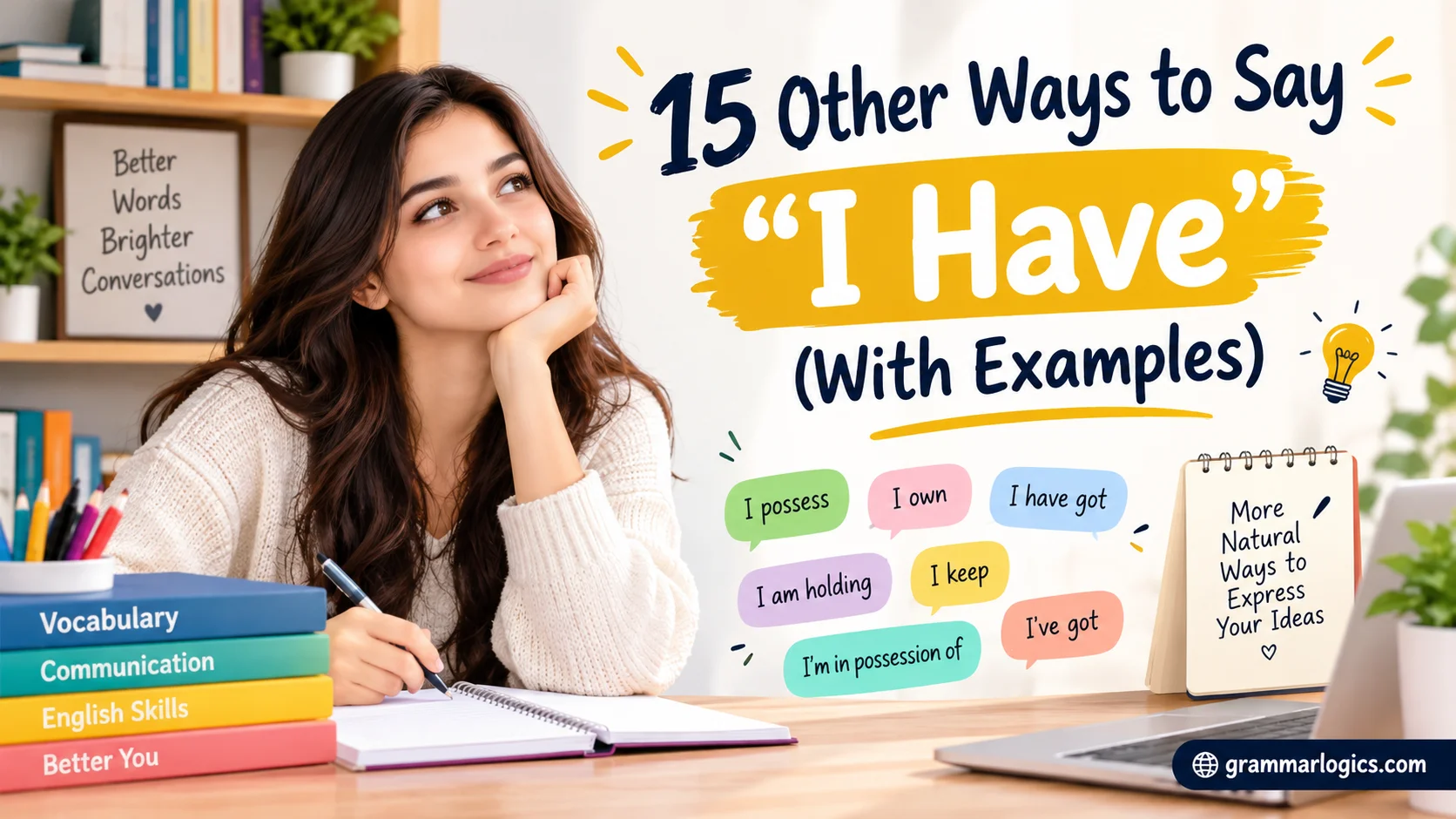
Finding the right words can make everyday English communication clearer, more natural, and engaging in both casual and professional situations.
The phrase “I have” is one of the most common expressions in English, but repeating it too often can make your writing or conversation sound simple or less engaging. Depending on the context, there are many natural alternatives to “I have” that can help you express possession, experiences, responsibilities, relationships, or personal situations more effectively. Choosing the right expression can also make your English sound more fluent and polished. Whether you are writing an email, preparing a message, speaking with someone, or improving your vocabulary, learning different ways to say “I have” gives you greater flexibility and confidence when expressing yourself.
Understanding alternative phrases for “I have” can significantly improve your vocabulary and help you communicate ideas with greater precision. Some alternatives are suitable for formal writing, while others work better in friendly conversations or everyday speech. For example, depending on the meaning, you might use expressions that show ownership, possession, experience, responsibility, or a current situation. Learning these variations also helps you avoid unnecessary repetition and develop a more natural English style. In this guide, you will discover useful ways to replace “I have,” along with examples that show how each expression can be used correctly in real-life communication.
What Does “I Have” Mean?
“I have” is a common English expression used to show possession, describe experiences, identify responsibilities, and communicate certain situations or conditions. For example, “I have a car” means that you own or possess a car, while “I have a question” means that you want to ask something. The exact meaning depends on the noun or phrase that follows it.
The expression also appears in different grammatical structures. In “I have finished my work,” it functions as an auxiliary verb in the present perfect tense. In “I have to leave,” it communicates necessity or obligation. Understanding these differences is important because alternatives to “I have” are not always interchangeable. A suitable replacement must match the meaning, grammar, and context of the original sentence.
Common Situations Where “I Have” Is Used
People use “I have” in everyday conversations, text messages, emails, academic writing, and professional communication. It can describe possessions, such as “I have a new laptop,” or communicate responsibilities, such as “I have a meeting at noon.” It can also introduce experiences, questions, ideas, opportunities, and completed actions.
In workplace communication, someone might write, “I have a suggestion,” while a student might say, “I have a question about the assignment.” In personal conversations, the phrase can describe feelings, experiences, or plans. Although the expression works in most of these situations, choosing more specific wording can make your message clearer and more engaging. For instance, “I possess” may fit certain formal contexts, while “I’ve got” often sounds more conversational.
Is It Professional or Polite to Say “I Have”?
Yes, “I have” is both professional and polite when used appropriately. It is grammatically correct, neutral, and suitable for workplace emails, business meetings, academic writing, and everyday conversations. For example, “I have a question regarding the report” sounds professional without being overly formal.
The phrase itself is not rude or impolite. However, it can become repetitive if you use it frequently in the same message. More specific expressions may communicate your intention more clearly. “I would like to raise a concern” sounds more diplomatic in a formal discussion, while “I’ve got an idea” feels more relaxed among colleagues. The right choice depends on your audience, intended meaning, and level of formality.
Advantages and Disadvantages of Saying “I Have”
Advantages
The main advantage of “I have” is its simplicity and versatility. It works in many grammatical structures and allows speakers to communicate possession, responsibilities, experiences, and information without complicated wording. It is also suitable for formal and informal situations, making it a reliable choice for English learners and fluent speakers alike.
Disadvantages
The expression can sound repetitive when it appears several times in a short paragraph or conversation. It may also be too general when a more precise verb would communicate the intended meaning better. For example, “I have a concern” is clear, but “I would like to raise a concern” can sound more tactful in a professional discussion. In addition, some alternatives only work with specific meanings or grammatical structures, so replacing the phrase without considering the context can make a sentence unnatural.
15 Synonyms and Alternatives for “I Have”
The following expressions can replace “I have” in appropriate contexts. Some communicate possession, while others express experiences, responsibilities, or intentions. They are context-specific alternatives, not universal synonyms.
- I’ve Got
- I Own
- I Possess
- I Hold
- I Keep
- I’m Carrying
- I’m in Possession of
- I Have Access to
- I’m Experiencing
- I’ve Been Given
- I Received
- I’m Responsible for
- I Need to
- I’d Like to Share
- I’d Like to Raise
1. I’ve Got
Meaning
“I’ve got” is an informal alternative to “I have” that commonly expresses possession, availability, or a situation someone is dealing with.
Definition
A conversational expression meaning to have, own, or possess something.
Detailed Explanation
“I’ve got” is especially common in spoken English and casual messages. It often sounds more relaxed than “I have,” although both can communicate the same thing. The expression can also introduce responsibilities or problems, as in “I’ve got a lot of work today.” In formal writing, “I have” is usually the simpler choice.
Scenario Examples
– Scenario: A friend asks whether you have time.
Example: “I’ve got a few minutes before my next meeting.”
– Scenario: Someone asks whether you own a bicycle.
Example: “I’ve got an old bicycle in the garage.”
– Scenario: A colleague asks about your workload.
Example: “I’ve got three reports to finish today.”
Best Use
Use this expression in casual conversations, text messages, and friendly workplace discussions. Avoid relying on it repeatedly in highly formal writing.
Tone
Tone: Casual, friendly, conversational. It sounds natural and relaxed in everyday English.
2. I Own
Meaning
“I own” specifically indicates ownership of something. It is useful when “I have” refers to property, belongings, a business, or another asset.
Definition
To own something means to have legal or recognized ownership of it.
Detailed Explanation
“I own” is more precise than “I have” when you want to emphasize that something belongs to you. For example, “I have a house” can describe your living situation, whereas “I own a house” explicitly states ownership. However, it does not naturally replace “I have” in sentences about questions, experiences, or completed actions. It is best used when ownership is the intended meaning.
Scenario Examples
– Scenario: Introducing yourself to a potential business partner.
Example: “I own a small printing business near the city center.”
– Scenario: Discussing your living arrangements.
Example: “I own my apartment, so I don’t pay monthly rent.”
– Scenario: Explaining who owns a vehicle.
Example: “I own a motorcycle, but I usually take the bus to work.”
Best Use
Choose this expression when discussing property, vehicles, businesses, or valuable possessions and ownership matters.
Tone
Tone: Direct, confident, neutral. It communicates ownership clearly without sounding unnecessarily formal.
3. I Possess
Meaning
“I possess” means that something is in your possession or that you have a particular quality, skill, or ability.
Definition
To possess means to have or hold something, often with emphasis on ownership or a particular attribute.
Detailed Explanation
This expression is more formal than “I have” and can sound stiff in everyday conversation. It is useful in legal, academic, descriptive, or carefully written contexts where precision matters. It can also describe qualities, as in “I possess strong analytical skills.” Unlike “I own,” it does not always suggest legal ownership. The surrounding sentence determines whether it refers to control, possession, or a personal quality.
Scenario Examples
– Scenario: Describing qualifications in a formal application.
Example: “I possess the technical skills required for this position.”
– Scenario: Discussing an item in your custody.
Example: “I possess documents that confirm the original agreement.”
Best Use
Use “I possess” in formal documents, legal contexts, academic writing, and professional descriptions of skills. In everyday conversation, “I have” often sounds more natural.
Tone
Tone: Formal, precise, authoritative. Its formality makes it suitable for carefully worded statements rather than relaxed chats.
4. I Hold
Meaning
“I hold” can express possession of a position, qualification, official document, or certain rights. It emphasizes a recognized status or something formally held.
Definition
To hold something means to possess, maintain, or officially have a particular status, position, or qualification.
Detailed Explanation
“I hold” is especially useful when the object is a professional title, degree, license, office, or formal responsibility. For instance, “I hold a master’s degree” sounds natural in a résumé or professional biography. It is not a general replacement for “I have,” because it does not fit every object or experience. Use it when the noun naturally connects with status, authority, or formal possession.
Scenario Examples
– Scenario: Applying for a professional position.
Example: “I hold a valid teaching certificate.”
– Scenario: Writing a professional biography.
Example: “I hold a master’s degree in environmental science.”
– Scenario: Describing a position in an organization.
Example: “I hold the position of department coordinator.”
Best Use
This expression works best in résumés, formal biographies, applications, and professional communication.
Tone
Tone: Professional, factual, formal. It emphasizes recognized qualifications or positions.
5. I Keep
Meaning
“I keep” describes something you retain, store, maintain, or continue to have available.
Definition
To keep something means to retain it rather than give it away, lose it, or discard it.
Detailed Explanation
Unlike “I have,” this expression often emphasizes what you do with an item over time. “I have a spare key” simply states that the key is available to you, while “I keep a spare key in my desk” explains where you store it. It can also describe habits, such as keeping records. Because it highlights retention or storage, it cannot replace “I have” in every sentence about possession.
Scenario Examples
– Scenario: Explaining how you organize important documents.
Example: “I keep copies of all my receipts in a folder.”
– Scenario: Helping a family member who needs access to your home.
Example: “I keep a spare key with my sister.”
Best Use
Use “I keep” when describing storage, routines, retained belongings, or items you maintain for future use.
Tone
Tone: Practical, neutral, everyday. It focuses on how something is stored or retained.
6. I’m Carrying
Meaning
“I’m carrying” describes something you are physically transporting or have with you at the moment.
Definition
To carry something means to hold or transport it from one place to another.
Detailed Explanation
This phrase is useful when “I have” refers to an item you are physically bringing or holding. For example, “I have my passport” describes possession, while “I’m carrying my passport” emphasizes that it is with you. The continuous form generally describes an action happening now or around the present time. It should not be used for ordinary ownership unless the physical act of carrying is relevant.
Scenario Examples
– Scenario: A friend asks whether you brought the tickets.
Example: “I’m carrying the tickets in my jacket pocket.”
– Scenario: Explaining why you cannot lift another bag.
Example: “I’m already carrying two heavy shopping bags.”
Best Use
Choose this expression for travel, shopping, everyday errands, and situations involving physical items.
Tone
Tone: Casual, descriptive, immediate. It highlights what you are transporting right now.
7. I’m in Possession of
Meaning
“I’m in possession of” emphasizes that something is currently under your control or in your custody.
Definition
An expression meaning to have something in your possession or control.
Detailed Explanation
This wording is more formal than “I have” and is often used when custody or control matters. It may refer to documents, keys, evidence, equipment, or other items. Unlike “I own,” it does not necessarily mean that the item legally belongs to you. Because it sounds official, it can feel unnecessarily complicated in casual conversation.
Scenario Examples
– Scenario: Confirming that you received confidential paperwork.
Example: “I’m in possession of the signed agreement.”
– Scenario: Explaining who currently has a set of keys.
Example: “I’m in possession of the office keys until Friday.”
Best Use
Use this expression in formal reports, legal discussions, official correspondence, or situations involving custody and control.
Tone
Tone: Formal, official, precise. It stresses possession rather than ownership.
8. I Have Access to
Meaning
“I have access to” means that you are able to use, enter, view, or obtain something. It does not necessarily mean that you own it.
Definition
To have access to something means to have permission or the ability to reach or use it.
Detailed Explanation
This expression is more accurate than “I have” when discussing shared resources, digital systems, facilities, or information. For example, “I have the report” suggests that the report is available to you, while “I have access to the report” emphasizes your ability to view it. Access may depend on permission, credentials, or availability. It is especially useful in workplace communication because it avoids implying ownership where none exists.
Scenario Examples
– Scenario: Explaining your responsibilities on a project.
Example: “I have access to the team’s shared project folder.”
– Scenario: Describing available research resources.
Example: “I have access to the university’s online journal collection.”
– Scenario: Discussing a software account.
Example: “I have access to the customer dashboard, but I can’t change account settings.”
Best Use
Use this phrase in technology, education, research, business communication, and discussions about permissions or resources.
Tone
Tone: Professional, clear, practical. It describes availability without claiming ownership.
9. I’m Experiencing
Meaning
“I’m experiencing” describes something happening to you, particularly a feeling, difficulty, change, or ongoing situation.
Definition
To experience something means to go through or be affected by an event, condition, or feeling.
Detailed Explanation
This phrase is useful when “I have” describes a problem or an ongoing experience rather than possession. “I have difficulties with the software” and “I’m experiencing difficulties with the software” communicate similar ideas, but the second emphasizes the current situation. It can sound more measured and professional when discussing delays, technical problems, or service issues. However, it is not suitable for objects you own or actions you have completed.
Scenario Examples
– Scenario: Reporting a technical issue to a support team.
Example: “I’m experiencing intermittent connection problems.”
– Scenario: Updating a manager about a project.
Example: “I’m experiencing some delays because a supplier hasn’t delivered the materials.”
– Scenario: Describing an emotional moment to a trusted friend.
Example: “I’m experiencing a lot of stress as the exam date approaches.”
Best Use
Choose this expression for ongoing problems, feelings, difficulties, and professional status updates.
Tone
Tone: Measured, descriptive, professional when appropriate. It focuses on what is happening to you.
10. I’ve Been Given
Meaning
“I’ve been given” indicates that someone has provided you with something, such as a task, opportunity, gift, responsibility, or instruction.
Definition
A passive expression meaning someone has provided or assigned something to you.
Detailed Explanation
This phrase differs from “I have” because it highlights how something came to you rather than simply stating that you possess it. “I have a new assignment” identifies the assignment, while “I’ve been given a new assignment” emphasizes that someone assigned it to you. It is useful when the person who provided something is less important than the fact that it was provided. It does not necessarily mean you own the item permanently.
Scenario Examples
– Scenario: Updating a classmate about schoolwork.
Example: “I’ve been given an extra assignment to complete this week.”
– Scenario: Telling a colleague about a new responsibility.
Example: “I’ve been given the opportunity to lead the next training session.”
Best Use
Use it when discussing assigned duties, opportunities, instructions, gifts, or things provided by another person.
Tone
Tone: Neutral, explanatory, occasionally appreciative. It emphasizes receiving something from someone else.
11. I Received
Meaning
“I received” describes something that came to you from another person or source, including a message, payment, document, invitation, or item.
Definition
To receive means to be given, sent, or presented with something.
Detailed Explanation
“I received” is especially appropriate when the act of receiving is important. For example, “I have your email” indicates that the message is available to you, whereas “I received your email” confirms that it arrived. The simple past tense usually refers to a completed event, while “I have received” connects the event to the present. Choosing the correct tense helps make your message precise and natural.
Scenario Examples
– Scenario: Confirming a customer’s payment.
Example: “I received your payment this morning. Thank you.”
– Scenario: Responding to a job applicant.
Example: “I received your application and will review it shortly.”
– Scenario: Thanking a friend for a present.
Example: “I received your package yesterday. I love the book!”
Best Use
Use “I received” in emails, customer service, business updates, personal messages, and situations involving deliveries or communications.
Tone
Tone: Neutral, courteous, informative. It works well when confirming that something arrived.
12. I’m Responsible for
Meaning
“I’m responsible for” communicates that you are accountable for a task, duty, decision, or outcome.
Definition
To be responsible for something means to have a duty to manage it or answer for it.
Detailed Explanation
This expression is more specific than “I have” when discussing work or obligations. “I have several tasks” tells someone that the tasks exist on your workload, whereas “I’m responsible for several tasks” emphasizes your accountability. It can also identify who manages a process or looks after a particular area. Because it can imply formal responsibility, use it only when you genuinely have that duty.
Scenario Examples
– Scenario: Introducing your role during a team meeting.
Example: “I’m responsible for preparing the monthly sales report.”
– Scenario: Explaining a school group project.
Example: “I’m responsible for collecting everyone’s research notes.”
– Scenario: Clarifying duties at home.
Example: “I’m responsible for taking care of the plants while my parents are away.”
Best Use
Choose this expression for job descriptions, project updates, team meetings, academic assignments, and discussions about accountability.
Tone
Tone: Professional, responsible, direct. It clearly identifies your duties.
13. I Need to
Meaning
“I need to” expresses necessity or a task that must be completed. It can replace “I have to” when discussing obligations, but it does not replace “I have” in every context.
Definition
An expression meaning something is necessary or required.
Detailed Explanation
This wording is useful when the intended meaning of “I have” involves an obligation, as in “I have to finish this report.” Saying “I need to finish this report” communicates a similar necessity while focusing on what must be done. Depending on context, the reason may be an external requirement or your own judgment about what is important. Remember that “I need to” cannot replace a possession statement such as “I have a laptop.”
Scenario Examples
– Scenario: Explaining your plans to a friend.
Example: “I need to stop by the pharmacy before it closes.”
– Scenario: Discussing a work deadline.
Example: “I need to send the revised proposal before noon.”
– Scenario: Preparing for an exam.
Example: “I need to review the last two chapters tonight.”
Best Use
Use this expression for plans, tasks, personal obligations, work deadlines, and everyday responsibilities.
Tone
Tone: Direct, practical, purposeful. It communicates a clear need without sounding overly formal.
14. I’d Like to Share
Meaning
“I’d like to share” introduces information, an idea, an experience, or feedback that you want other people to hear.
Definition
A polite expression meaning you wish to communicate or offer something to others.
Detailed Explanation
This phrase can replace “I have” when you want to introduce a thought or piece of information. “I have an idea” states that an idea exists, while “I’d like to share an idea” politely invites others to consider it. The wording sounds more collaborative because it focuses on communication rather than possession. It does not mean that you literally own something, so it is best reserved for sharing information or perspectives.
Scenario Examples
– Scenario: Contributing during a team meeting.
Example: “I’d like to share an idea that could simplify our approval process.”
– Scenario: Writing a personal post.
Example: “I’d like to share a lesson I learned from my first year at university.”
– Scenario: Giving constructive feedback to a colleague.
Example: “I’d like to share a few observations before we finalize the presentation.”
Best Use
Use this phrase in meetings, presentations, thoughtful personal messages, collaborative discussions, and professional emails.
Tone
Tone: Polite, collaborative, considerate. It introduces information without demanding attention.
15. I’d Like to Raise
Meaning
“I’d like to raise” is a professional expression used to introduce a question, concern, issue, or point for discussion.
Definition
To raise a topic means to bring it to people’s attention for consideration or discussion.
Detailed Explanation
This expression works when “I have” introduces a concern, question, or issue that needs attention. “I have a concern about the schedule” is straightforward, while “I’d like to raise a concern about the schedule” sounds more deliberate and diplomatic. It is particularly useful in meetings and formal correspondence. Because it implies that a subject deserves discussion, it is not suitable for describing ordinary possessions or experiences.
Scenario Examples
– Scenario: Discussing a possible problem during a business meeting.
Example: “I’d like to raise a concern about the proposed delivery timeline.”
– Scenario: Asking a teacher to address an issue.
Example: “I’d like to raise a question about the grading criteria.”
– Scenario: Contributing to a project review.
Example: “I’d like to raise one point about the way customer feedback is collected.”
Best Use
Choose this expression for formal meetings, workplace discussions, academic settings, and professional emails when you need to bring up a subject respectfully.
Tone
Tone: Professional, diplomatic, respectful. It makes an issue sound appropriate for thoughtful discussion.
FAQs
What is another way to say “I have”?
Depending on the context, you can say “I possess,” “I own,” “I’ve got,” “I hold,” or “I currently have.” The best alternative depends on whether you are talking about possession, experience, responsibility, or a current situation.
How can I say “I have” professionally?
In formal or professional writing, alternatives such as “I possess,” “I am responsible for,” “I currently hold,” or “I have access to” may sound more precise and polished. Choose the phrase according to the intended meaning.
What is a casual way to say “I have”?
In everyday conversation, “I’ve got” is a common and natural alternative to “I have.” For example, “I’ve got a meeting at three” sounds friendly and conversational.
Can “I’ve got” replace “I have”?
Yes, in many informal situations, “I’ve got” can replace “I have,” especially when talking about possession, relationships, or current situations. However, “I have” is generally more versatile and suitable for both formal and informal contexts.
Why should I use alternatives to “I have”?
Using different expressions can help you avoid repetition, improve your vocabulary, and make your English sound more natural, varied, and confident. The key is selecting an alternative that matches the context.
Conclusion
Knowing different ways to say “I have” can make your English more flexible, expressive, and natural. While “I have” is perfectly correct, using suitable alternatives can help you communicate more precisely and avoid repetitive wording.
Whether you are writing professionally, chatting with friends, or improving your everyday English vocabulary, these expressions give you more choices. Practice using them in different contexts, and you will become more confident in choosing the right phrase for your message.