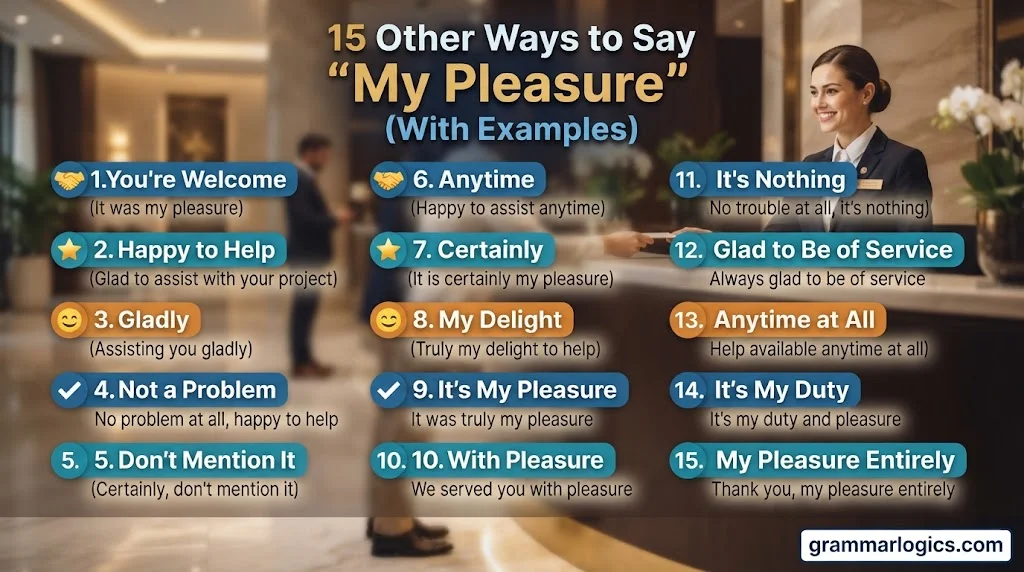
Saying “My Pleasure” is a warm way to respond when someone thanks you for your help, kindness, or support.
Finding the right alternative to “My Pleasure” can make your conversations sound more natural, friendly, and thoughtful. While this phrase is polite and commonly used after someone says “thank you,” different situations may call for different expressions. Whether you are speaking with a friend, coworker, customer, client, teacher, or professional contact, choosing the right response can help you communicate warmth and confidence. Some alternatives sound casual and friendly, while others are more professional, respectful, or sincere. Learning these expressions gives you more flexibility and helps you avoid repeating the same phrase in every conversation.
Using different ways to say “My Pleasure” can also help you express gratitude and kindness more naturally. A simple response such as “You’re welcome,” “Happy to help,” or “Glad I could help” may fit everyday conversations, while more polished expressions can work well in professional or formal settings. The best alternative depends on your relationship with the other person, the situation, and the tone you want to create. In this guide, you will discover natural alternatives to “My Pleasure”, along with examples that show how to use each expression appropriately in real conversations.
What Does “My Pleasure” Mean?
“My pleasure” is a polite expression used in response to someone who says “thank you.” It communicates that you were happy or willing to help and that the other person’s thanks are appreciated but not necessary. For example, if someone thanks you for helping them with a task, saying “My pleasure” shows that you were glad to assist. The expression is generally warm, courteous, and positive, and it can be used in both personal and professional conversations. Depending on the context and tone of voice, it can sound friendly, sincere, polished, or slightly formal.
Common Situations Where “My Pleasure” Is Used
People commonly use “my pleasure” after receiving thanks in everyday conversations, professional interactions, customer service, emails, and personal messages. A friend might say it after helping with a small favor, while an employee may use it when responding to a customer or colleague. It is also common in hospitality and service situations because it communicates willingness to help without making the assistance feel like a burden.
In writing, “my pleasure” can work well in emails and messages when the tone is courteous and friendly. However, people sometimes want an alternative because repeating the same phrase can feel predictable. A different expression can also make the response sound more casual, warmer, more personal, or more formal, depending on the relationship and situation.
Is It Professional or Polite to Say “My Pleasure”?
Yes, “my pleasure” is both polite and professional in many situations. It is especially appropriate when responding to thanks from a customer, colleague, client, manager, or professional contact. Compared with a very casual response, it can sound polished while still remaining friendly. It also communicates that helping someone was not an inconvenience.
The expression is not restricted to professional settings, however. It can be used with friends, family members, classmates, and acquaintances as well. Its exact tone depends on the situation, the relationship between the speakers, and the speaker’s delivery. In a relaxed conversation, another expression may feel more natural or conversational.
Advantages and Disadvantages of Saying “My Pleasure”
Advantages
The main advantage of “my pleasure” is that it communicates genuine willingness to help. It is short, easy to understand, and naturally polite. It can make a response feel warm and respectful without being overly emotional. The phrase is also versatile enough for both everyday interactions and many professional situations. Because it focuses on the speaker’s positive attitude toward helping, it can make the exchange feel gracious rather than transactional.
Disadvantages
Although “my pleasure” is useful, it can sometimes sound slightly formal or polished in very casual conversations. If someone uses it repeatedly, the expression may also feel routine rather than personal. In some relationships, a simpler response may sound more relaxed and natural. The phrase can also be less suitable when you want to express a stronger emotional connection or acknowledge someone’s gratitude in a more personal way.
15 Synonyms and Alternatives for “My Pleasure”
- You’re welcome
- Glad to help
- Happy to help
- Anytime
- No problem
- Of course
- Not at all
- Don’t mention it
- It was my pleasure
- The pleasure is mine
- I’m happy I could help
- Glad I could help
- It was nothing
- Happy to be of assistance
- You’re very welcome
1. You’re Welcome
Meaning
“You’re welcome” is one of the most common responses to “thank you.” It tells the other person that their gratitude is accepted and that they do not need to feel indebted to you.
Definition
You’re welcome is a polite response used after someone expresses thanks.
Detailed Explanation
This expression is a straightforward alternative to “my pleasure” and works in a wide range of situations. It is generally neutral, polite, and natural, making it suitable for both casual and professional communication. Unlike “my pleasure,” it does not specifically emphasize that you enjoyed helping. Instead, it simply acknowledges the person’s thanks. Its familiarity makes it especially useful when you want a safe, universally understood response.
Scenario Examples
Scenario: A classmate thanks you for sharing your notes.
Example: “Thanks for sending those notes.” “You’re welcome. I hope they help.”
Scenario: A customer thanks you after you answer a question.
Example: “Thank you for explaining that.” “You’re welcome.”
Best Use
Best for everyday conversation, professional communication, emails, customer service, and polite messages.
Tone
Tone: Polite, neutral, friendly. It has a balanced tone and rarely sounds out of place.
2. Glad to Help
Meaning
“Glad to help” communicates that you are pleased that your assistance was useful.
Definition
Glad to help means that you are happy you were able to assist someone.
Detailed Explanation
This expression feels a little more personal than “you’re welcome” because it directly expresses positive feelings about helping. It is usually warmer and more conversational than “my pleasure.” The phrase works particularly well when the person genuinely made use of your assistance. It can also make professional communication feel friendly without becoming overly casual.
Scenario Examples
Scenario: A coworker thanks you for helping prepare a presentation.
Example: “Thanks for staying late to help with the slides.” “Glad to help.”
Scenario: A friend appreciates your advice.
Example: “Thanks for listening when I needed someone.” “Glad to help. Anytime.”
Best Use
Best for workplace conversations, friendships, casual messages, and supportive interactions.
Tone
Tone: Warm, friendly, helpful. It emphasizes your positive attitude toward providing assistance.
3. Happy to Help
Meaning
“Happy to help” tells someone that you were willing and pleased to provide assistance.
Definition
Happy to help means that you were pleased to assist someone with their need or request.
Detailed Explanation
This phrase is highly versatile and is particularly common in professional communication and customer service. It sounds positive without being overly formal. Compared with “my pleasure,” it can feel more direct and contemporary in workplace settings. It also works well when someone thanks you for completing a task or solving a problem.
Scenario Examples
Scenario: A customer thanks an employee for resolving an issue.
Example: “Thank you for sorting that out so quickly.” “Happy to help.”
Scenario: A colleague appreciates your assistance with a report.
Example: “I really appreciate your help with the report.” “Happy to help.”
Best Use
Best for work emails, customer communication, workplace conversations, and everyday interactions.
Tone
Tone: Professional, warm, cooperative. It communicates willingness without sounding excessively formal.
4. Anytime
Meaning
“Anytime” suggests that you are always willing to help again if needed.
Definition
Anytime is an informal response meaning that the person can ask for your help again whenever necessary.
Detailed Explanation
This alternative focuses less on the current favor and more on future willingness to help. It often feels relaxed and friendly, making it especially natural among people who know each other well. It may sound too casual for some formal situations. The expression works particularly well when you want to reassure someone that asking for help was not an inconvenience.
Scenario Examples
Scenario: A friend thanks you for helping them move.
Example: “Thanks for helping me with all those boxes.” “Anytime!”
Scenario: A teammate thanks you for explaining a difficult task.
Example: “I appreciate you walking me through it.” “Anytime. Just let me know if you need anything else.”
Best Use
Best for friends, family, teammates, casual conversations, and informal messages.
Tone
Tone: Casual, warm, reassuring. It creates a sense of openness and continued willingness to help.
5. No Problem
Meaning
“No problem” communicates that helping someone was not difficult or inconvenient.
Definition
No problem means that something was not troublesome and that the person does not need to worry about it.
Detailed Explanation
This is a very common casual response to thanks. It reassures the other person that their request did not create a burden. Compared with “my pleasure,” it is more informal and focuses on the absence of inconvenience rather than the enjoyment of helping. While natural in everyday speech, it may be less polished in highly formal correspondence.
Scenario Examples
Scenario: A friend thanks you for picking something up.
Example: “Thanks for grabbing that for me.” “No problem.”
Scenario: A coworker apologizes for asking for a small favor.
Example: “Thanks for sending that file.” “No problem.”
Best Use
Best for casual conversations, texting, friendly workplace interactions, and everyday favors.
Tone
Tone: Casual, relaxed, reassuring. It makes the interaction feel easy and uncomplicated.
6. Of Course
Meaning
“Of course” communicates that helping was natural, expected, or something you were happy to do.
Definition
Of course is a polite response indicating that the requested help was readily given and was not a burden.
Detailed Explanation
This expression can be warmer than a simple acknowledgment because it suggests that helping the person was completely natural. It is especially useful when someone thanks you for doing something that you would willingly do again. Depending on delivery, it can sound friendly, reassuring, or professional. In some contexts, however, a flat tone can make it sound dismissive, so delivery matters.
Scenario Examples
Scenario: A colleague thanks you for answering a quick question.
Example: “Thanks for clarifying that.” “Of course.”
Scenario: A family member thanks you for helping with a task.
Example: “Thank you for taking care of this.” “Of course. I was happy to help.”
Best Use
Best for personal conversations, workplace communication, and polite everyday interactions.
Tone
Tone: Warm, confident, courteous. It suggests that assisting was a natural choice.
7. Not at All
Meaning
“Not at all” indicates that the favor was no inconvenience and that the person has no reason to feel they caused trouble.
Definition
Not at all is a polite expression used to reassure someone that their request or thanks caused no inconvenience.
Detailed Explanation
This expression can sound somewhat more formal or traditional than “no problem.” It is useful when you want to respond graciously without making the interaction overly emotional. It often works particularly well in polite spoken English and certain professional contexts. Because it has a slightly refined quality, it may feel less natural in very casual texting.
Scenario Examples
Scenario: A visitor thanks you for helping them find a room.
Example: “Thank you for showing me where to go.” “Not at all.”
Scenario: A colleague thanks you for handling a small request.
Example: “I appreciate you taking care of that.” “Not at all. It was easy to sort out.”
Best Use
Best for polite conversations, professional settings, formal interactions, and courteous spoken English.
Tone
Tone: Polite, refined, respectful. It reassures the listener that their request caused no trouble.
8. Don’t Mention It
Meaning
“Don’t mention it” tells someone that the favor was small enough that they do not need to keep thanking you.
Definition
Don’t mention it means that the person does not need to talk further about the favor or express additional thanks.
Detailed Explanation
This expression has a friendly and modest quality. It can make the speaker sound humble because they are minimizing the importance of what they did. It is generally more conversational than “my pleasure” and can work naturally after small favors. Depending on tone, it may sound slightly old-fashioned in some settings, but it remains understandable and polite.
Scenario Examples
Scenario: A neighbor thanks you for holding a door.
Example: “Thanks for holding that open.” “Don’t mention it.”
Scenario: A friend thanks you for bringing them something.
Example: “I really appreciate you bringing this over.” “Don’t mention it. It was on my way.”
Best Use
Best for friendly conversations, small favors, and polite everyday interactions.
Tone
Tone: Modest, friendly, courteous. It downplays the favor and keeps the exchange comfortable.
9. It Was My Pleasure
Meaning
“It was my pleasure” emphasizes that you genuinely enjoyed helping the person.
Definition
It was my pleasure means that you were pleased to provide assistance and considered the experience positive.
Detailed Explanation
This expression is closely related to “my pleasure” but is often slightly more complete and deliberate. It can sound polished and gracious, especially after a meaningful interaction or professional service. The wording places stronger emphasis on the speaker’s satisfaction in helping. It is useful when you want to sound especially courteous without becoming overly formal.
Scenario Examples
Scenario: A guest thanks a host after receiving thoughtful assistance.
Example: “Thank you for making our visit so comfortable.” “It was my pleasure.”
Scenario: A professional thanks a client after assisting them.
Example: “I appreciate everything you did to help us.” “It was my pleasure. I’m glad we could assist.”
Best Use
Best for professional interactions, hospitality, formal conversations, and thoughtful personal exchanges.
Tone
Tone: Warm, gracious, polished. It conveys sincere satisfaction in having helped.
10. The Pleasure Is Mine
Meaning
“The pleasure is mine” turns the expression of gratitude into a statement that you also benefited from or enjoyed the interaction.
Definition
The pleasure is mine means that you feel you received something positive from the interaction and were happy to participate.
Detailed Explanation
This phrase is more elegant and formal than many everyday alternatives. It can be particularly appropriate after an introduction, meeting, conversation, or meaningful exchange rather than only after a simple favor. It does not always mean exactly the same thing as “my pleasure,” so context matters. When used naturally, it communicates warmth, respect, and appreciation.
Scenario Examples
Scenario: Someone thanks you after a pleasant professional meeting.
Example: “It was wonderful speaking with you.” “The pleasure is mine.”
Scenario: A guest thanks a host for an enjoyable evening.
Example: “Thank you for having me.” “The pleasure is mine.”
Best Use
Best for formal conversations, professional meetings, introductions, hospitality, and respectful social interactions.
Tone
Tone: Elegant, warm, formal. It carries a polished quality and can sound especially gracious.
11. I’m Happy I Could Help
Meaning
“I’m happy I could help” directly expresses satisfaction that your assistance was useful.
Definition
I’m happy I could help means that you feel pleased your assistance benefited the other person.
Detailed Explanation
This expression is more personal than a simple “you’re welcome.” It focuses on the result of your assistance, showing that you are glad it made a difference. It can feel sincere and supportive without being excessively emotional. The wording is particularly useful when the person had a genuine problem and your help contributed to solving it.
Scenario Examples
Scenario: A friend thanks you for helping them prepare for an interview.
Example: “Your advice really helped me feel prepared.” “I’m happy I could help.”
Scenario: A coworker thanks you after resolving a work issue.
Example: “Thanks for helping me figure that out.” “I’m happy I could help.”
Best Use
Best for supportive conversations, workplace communication, personal messages, and situations involving meaningful assistance.
Tone
Tone: Sincere, supportive, warm. It highlights the positive outcome of your help.
12. Glad I Could Help
Meaning
“Glad I could help” expresses satisfaction that you were able to provide useful assistance.
Definition
Glad I could help means that you are pleased your assistance was useful to someone.
Detailed Explanation
This phrase is very similar to “I’m happy I could help,” but it often sounds more concise and conversational. It is a natural choice when someone thanks you after you have solved a problem or completed a useful task. The expression feels friendly while still being appropriate in many workplace settings. It emphasizes usefulness rather than simply acknowledging gratitude.
Scenario Examples
Scenario: A coworker thanks you for fixing a spreadsheet problem.
Example: “Thanks for catching that error.” “Glad I could help.”
Scenario: Someone thanks you for giving directions.
Example: “Thanks for pointing me toward the station.” “Glad I could help.”
Best Use
Best for workplace conversations, everyday interactions, helpful messages, and practical situations.
Tone
Tone: Friendly, positive, practical. It sounds natural and focuses on the usefulness of your assistance.
13. It Was Nothing
Meaning
“It was nothing” minimizes the effort involved and reassures the other person that the favor was small.
Definition
It was nothing means that the assistance required little effort and was not considered a significant burden.
Detailed Explanation
This expression is often used when someone is thanking you for a small favor. It has a modest quality because the speaker is saying that the assistance was not important enough to require much appreciation. It is more casual than “my pleasure” and may not be appropriate when the favor involved substantial effort. The tone and context are important because, in some situations, it could unintentionally sound as though the other person’s gratitude is unnecessary.
Scenario Examples
Scenario: A friend thanks you for lending them a pen.
Example: “Thanks for lending me your pen.” “It was nothing.”
Scenario: A colleague thanks you for forwarding a message.
Example: “Thanks for passing that along.” “It was nothing.”
Best Use
Best for small favors, casual conversations, friends, and familiar coworkers.
Tone
Tone: Modest, casual, understated. It deliberately makes the favor sound small and uncomplicated.
14. Happy to Be of Assistance
Meaning
“Happy to be of assistance” expresses willingness and satisfaction in providing help.
Definition
Happy to be of assistance means that you are pleased to have provided useful support.
Detailed Explanation
This is one of the more formal and professional alternatives in the list. It is particularly suitable when communicating with customers, clients, guests, or professional contacts. Compared with “happy to help,” it sounds more polished and service-oriented. It may feel unnecessarily formal among close friends, so the relationship and setting should guide your choice.
Scenario Examples
Scenario: A customer thanks a support representative for resolving an issue.
Example: “Thank you for helping me resolve the problem.” “Happy to be of assistance.”
Scenario: A visitor thanks an employee for providing information.
Example: “I appreciate you explaining the process.” “Happy to be of assistance.”
Best Use
Best for customer service, business communication, formal emails, professional settings, and hospitality.
Tone
Tone: Professional, courteous, service-oriented. It creates a polished impression and emphasizes helpfulness.
15. You’re Very Welcome
Meaning
“You’re very welcome” is a warmer and more emphatic version of “you’re welcome.”
Definition
You’re very welcome is a polite response that strongly communicates that the speaker was pleased to help.
Detailed Explanation
Adding “very” gives the expression extra warmth and emphasis. It can sound more gracious than the standard “you’re welcome” while remaining familiar and easy to understand. It works in both personal and professional settings, although the exact tone depends on delivery. It is particularly useful when you want to make your response feel a little more welcoming and sincere.
Scenario Examples
Scenario: A guest thanks you for helping them find their seat.
Example: “Thank you for showing me where to sit.” “You’re very welcome.”
Scenario: A friend expresses appreciation after receiving a thoughtful favor.
Example: “Thank you so much for helping me today.” “You’re very welcome. I was glad to help.”
Best Use
Best for polite conversations, customer interactions, personal messages, hospitality, and professional communication.
Tone
Tone: Warm, gracious, polite. It adds extra friendliness without becoming overly emotional.
FAQs
1. What can I say instead of “My Pleasure”?
You can say “You’re welcome,” “Happy to help,” “Glad I could help,” “Anytime,” or “It was my pleasure.” The best choice depends on the situation and level of formality.
2. Is “My Pleasure” professional?
Yes, “My Pleasure” is professional, polite, and friendly. It works especially well in customer service, workplace conversations, emails, and other situations where you want to sound helpful and respectful.
3. What is a casual way to say “My Pleasure”?
For casual conversations, you can use “No problem,” “Anytime,” “Sure thing,” “Happy to help,” or “Of course.” These expressions sound relaxed and natural with friends, family, and colleagues.
4. What is a formal alternative to “My Pleasure”?
Formal alternatives include “You’re most welcome,” “It was my pleasure,” “I’m happy to assist,” and “I’m glad I could be of assistance.” These are suitable for professional or formal communication.
5. Can I say “My Pleasure” after someone says thank you?
Yes. “My Pleasure” is a natural response when someone thanks you. It shows that you were happy to help and that their request was not an inconvenience.
Conclusion
Knowing other ways to say “My Pleasure” can help you communicate with greater warmth, confidence, and flexibility. Whether you are speaking with a friend, coworker, customer, or professional contact, choosing the right expression can make your response sound more natural and thoughtful. Phrases like “You’re welcome,” “Happy to help,” “Glad I could help,” and “Anytime” are useful alternatives for different situations and tones.
Ultimately, the best alternative to “My Pleasure” depends on the context and relationship you have with the other person. Casual expressions work well in everyday conversations, while more polished phrases are ideal for professional settings. By learning and using these alternatives, you can avoid repetition, make your conversations more engaging, and respond to thank-you messages in a polite and appropriate way.