Finding the right way to say “Lastly” can make your writing clearer, smoother, and more engaging, especially when presenting final points, ideas, or conclusions.
The word “Lastly” is commonly used to introduce the final point in a list, discussion, presentation, or written explanation. While it is clear and grammatically correct, using the same expression repeatedly can make your writing feel predictable or repetitive. Learning different ways to say “Lastly” can help you create more natural, polished, and engaging sentences. Whether you are writing an essay, email, report, speech, blog post, or professional message, choosing the right alternative can improve your communication and make your ideas flow more smoothly from one point to the next.
There are many useful alternatives to “Lastly”, including expressions that sound formal, conversational, professional, or academic. The best choice depends on your audience, writing style, and the context in which you are presenting your final idea. For example, phrases such as “Finally,” “To conclude,” “As a final point,” and “Last but not least” can each create a slightly different tone. In this guide, you will discover practical alternatives to “Lastly”, along with examples that show how to use them naturally in different situations and improve your overall writing style.
What Does “Lastly” Mean?
“Lastly” is an adverb used to introduce the final point, item, reason, or idea in a sequence. It tells the reader or listener that what follows is the last thing being mentioned. For example, someone might say, “Lastly, we need to review the budget,” after discussing several other topics. The word is especially common when presenting ordered information, such as arguments, instructions, lists, speeches, essays, or presentations. It generally signals that the speaker or writer is reaching the end of a series, rather than necessarily bringing the entire conversation or piece of writing to a complete conclusion.
Common Situations Where “Lastly” Is Used
People commonly use “lastly” when they have already discussed several points and want to introduce the final one. It works naturally in essays, presentations, reports, speeches, meetings, and organized explanations. For example, a student may use it to introduce the final argument in an essay, while a manager might say, “Lastly, let’s discuss next month’s schedule,” during a meeting.
The word can also appear in everyday communication, although alternatives such as “finally” or “one last thing” may sound more conversational. Choosing an alternative can help your wording feel more natural, varied, formal, or personal, depending on the situation.
Is It Professional or Polite to Say “Lastly”?
Yes, “lastly” is professional and polite in most appropriate contexts. It has a relatively formal and organized tone, which makes it suitable for business writing, academic work, presentations, reports, and structured discussions. It is not rude or overly direct, but it can sound somewhat more formal than everyday alternatives such as “finally” or “one last thing.”
The best alternative depends on your purpose. In a formal report, “as a final point” may sound polished, while “to wrap things up” is more conversational. If you are actually introducing the final item in a sequence, “finally” is usually a very natural choice. If you are concluding an entire discussion, however, expressions such as “in conclusion” may be more appropriate.
Advantages and Disadvantages of Saying “Lastly”
Advantages
The main advantage of “lastly” is its clarity. It immediately tells readers that the following point is the final item in a sequence. It is concise, grammatically straightforward, and useful when organizing several ideas. It also gives writing a structured and professional feel, particularly in academic and business contexts.
Disadvantages
The main limitation is that “lastly” can sound somewhat formal or repetitive if it is used frequently. It may also be less natural in casual conversation, where “finally,” “one last thing,” or “to finish” can feel more relaxed. In addition, “lastly” indicates the final point in a sequence, but it does not always mean that the entire discussion is concluding. Using a phrase such as “in conclusion” when you only mean “the final item” can therefore change the meaning.
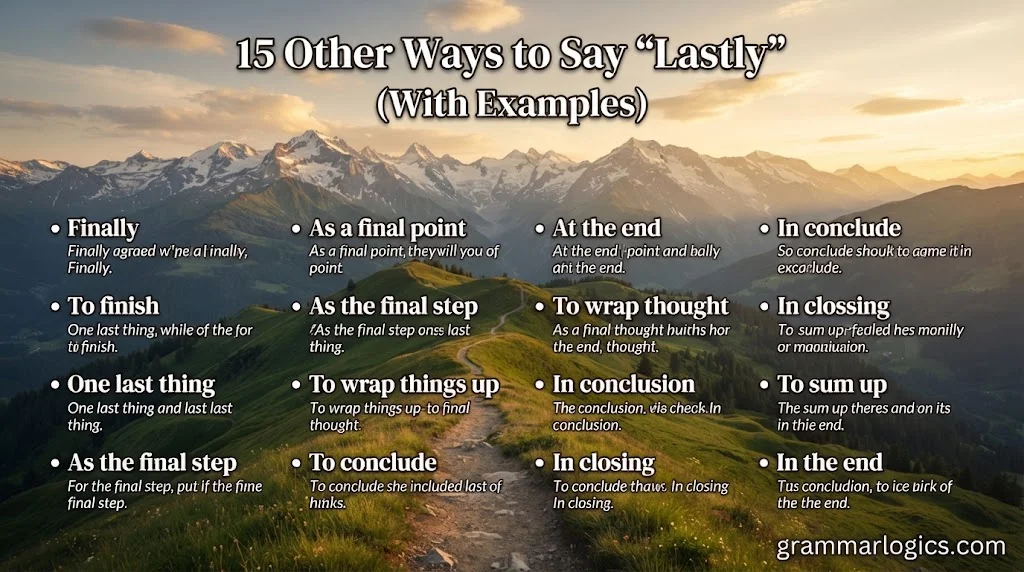
15 Alternatives to “Lastly”
- Finally
- As a final point
- Last of all
- To finish
- One last thing
- As the final step
- For the final point
- At the end
- As a final thought
- To wrap things up
- In conclusion
- To conclude
- In closing
- To sum up
- In the end
1. Finally
Meaning
“Finally” introduces the last point or item in a sequence. It is one of the most natural alternatives to “lastly.”
Definition
Finally means at the last stage, point, or position in a sequence.
Detailed Explanation
“Finally” is highly versatile and usually sounds more natural than “lastly” in everyday English. It can introduce the final item in a list, the last step in a process, or the final idea in an explanation. It works in both professional and casual communication. Unlike some alternatives, it can also describe something that happens after a long wait, so its exact meaning depends on context.
Scenario Examples
Scenario: You are giving the final instruction in a presentation. Example: “Finally, save the document before closing the program.”
Scenario: You are explaining several reasons for your decision. Example: “Finally, I believe this option gives us more flexibility.”
Best Use
Best for everyday conversation, presentations, essays, emails, instructions, and professional communication.
Tone
Tone: Neutral, clear, versatile
It sounds natural without being excessively formal.
2. As a Final Point
Meaning
“As a final point” introduces the last idea or argument in a discussion.
Definition
As a final point means before moving on from the discussion, here is the last important point.
Detailed Explanation
This expression is particularly useful when presenting arguments, observations, or discussion points. It clearly signals that the speaker has reached the final idea without necessarily suggesting that the entire piece is ending. Compared with “lastly,” it can sound slightly more deliberate and polished. It is especially effective when the final point deserves attention.
Scenario Examples
Scenario: A manager is speaking during a team meeting. Example: “As a final point, I want everyone to review the updated safety guidelines.”
Scenario: A student is presenting an argument. Example: “As a final point, we should consider the long-term environmental impact.”
Best Use
Best for meetings, presentations, academic discussions, and formal explanations.
Tone
Tone: Professional, organized, deliberate
The wording emphasizes that the final point is meaningful.
3. Last of All
Meaning
“Last of all” means as the final item in a sequence.
Definition
Last of all refers to something that comes after everything else has been mentioned.
Detailed Explanation
“Last of all” is a straightforward expression that closely matches the sequencing function of “lastly.” It can sound slightly more conversational and traditional than “as a final point.” It works well when you are moving through several items and want to clearly identify the final one. It is less common in highly formal writing but remains understandable and natural.
Scenario Examples
Scenario: You are listing things to pack. Example: “Last of all, remember to bring your phone charger.”
Scenario: You are explaining a recipe. Example: “Last of all, add the fresh herbs before serving.”
Best Use
Best for instructions, spoken explanations, lists, and everyday communication.
Tone
Tone: Clear, conversational, straightforward
It feels accessible and easy to understand.
4. To Finish
Meaning
“To finish” introduces something that comes at the end of an activity, explanation, or sequence.
Definition
To finish means as the final part of what is being said or done.
Detailed Explanation
“To finish” is a simple alternative that works particularly well in spoken English. It can introduce a final comment, activity, or point without sounding overly formal. It is less explicitly numbered than “lastly,” so it can feel more natural when transitioning toward the end of a discussion. The expression does not always indicate that the point is part of a numbered list.
Scenario Examples
Scenario: You are ending a presentation. Example: “To finish, I’d like to thank everyone for their time.”
Scenario: A teacher is ending a lesson. Example: “To finish, let’s review the three main ideas from today.”
Best Use
Best for speeches, presentations, lessons, meetings, and spoken communication.
Tone
Tone: Natural, friendly, moderately formal
It creates a smooth transition toward the ending.
5. One Last Thing
Meaning
“One last thing” introduces one final item or thought.
Definition
One last thing means there is one more thing to mention before finishing.
Detailed Explanation
This expression is much more conversational than “lastly.” It is useful when you want to add a final reminder, request, question, or thought. It does not necessarily imply a formal list or carefully structured argument. Because it sounds personal and direct, it works especially well in messages and conversations.
Scenario Examples
Scenario: You are texting a friend before ending a conversation. Example: “One last thing—please send me the address when you get a chance.”
Scenario: A supervisor has finished giving instructions. Example: “One last thing: remember to lock the office before you leave.”
Best Use
Best for texting, casual conversations, friendly messages, and informal workplace communication.
Tone
Tone: Casual, friendly, direct
It sounds personal rather than academic or formal.
6. As the Final Step
Meaning
“As the final step” refers specifically to the last action in a process.
Definition
As the final step means as the last action that needs to be completed.
Detailed Explanation
This expression is more specific than “lastly” because it usually describes an action or stage in a process. It is not a general replacement for every use of “lastly.” It works particularly well in instructions, procedures, tutorials, and explanations involving a series of actions. Using it in the right context makes instructions clearer and more precise.
Scenario Examples
Scenario: You are explaining how to submit an online form. Example: “As the final step, click the confirmation button.”
Scenario: A technician is explaining an installation process. Example: “As the final step, reconnect the power supply.”
Best Use
Best for instructions, procedures, tutorials, technical communication, and how-to writing.
Tone
Tone: Precise, instructional, professional
It clearly identifies the final action in a process.
7. For the Final Point
Meaning
“For the final point” introduces the last idea being discussed.
Definition
For the final point means when presenting the last point in a discussion or argument.
Detailed Explanation
This expression is useful when your focus is specifically on the content of an argument or discussion. It can sound more formal and intentional than “lastly.” It is not usually the best choice for a physical sequence or set of instructions. When used in an argument, however, it makes the structure easy for the audience to follow.
Scenario Examples
Scenario: You are presenting a business proposal. Example: “For the final point, I’d like to discuss the expected timeline.”
Scenario: A student is defending an opinion in class. Example: “For the final point, we should consider how this decision affects students.”
Best Use
Best for arguments, presentations, meetings, debates, and academic communication.
Tone
Tone: Formal, structured, focused
It clearly signals the final argument or discussion point.
8. At the End
Meaning
“At the end” refers to something that occurs or appears at the final part of a sequence, event, or period.
Definition
At the end means during or at the final part of something.
Detailed Explanation
“At the end” is broader than “lastly” and should not automatically replace it. It can describe time, position, events, or sequences, rather than simply introducing the final point in a list. It is therefore useful when your meaning concerns where or when something occurs. Context is important because it may sound unnatural if used as a direct transition before a final argument.
Scenario Examples
Scenario: You are explaining when to submit an assignment. Example: “At the end of the lesson, please hand in your worksheet.”
Scenario: You are describing a story. Example: “At the end, the main character decides to return home.”
Best Use
Best for narratives, explanations of timing, instructions, and general conversation.
Tone
Tone: Neutral, natural, flexible
It is an everyday expression that works across many situations.
9. As a Final Thought
Meaning
“As a final thought” introduces a last reflection, idea, or personal observation.
Definition
As a final thought means before finishing, here is one last idea to consider.
Detailed Explanation
This phrase is warmer and more reflective than “lastly.” It works especially well when the final statement is not simply another item in a list but something the audience should think about or remember. It is common in speeches, articles, personal messages, and thoughtful discussions. It can make the ending feel more meaningful without sounding overly dramatic.
Scenario Examples
Scenario: You are ending a motivational speech. Example: “As a final thought, remember that small improvements can lead to lasting change.”
Scenario: You are writing a reflective article. Example: “As a final thought, we should consider what this experience taught us.”
Best Use
Best for speeches, articles, reflective writing, personal communication, and presentations.
Tone
Tone: Thoughtful, warm, reflective
It gives the final statement a sense of importance.
10. To Wrap Things Up
Meaning
“To wrap things up” means to bring a discussion, activity, or explanation toward its end.
Definition
To wrap things up means to finish or summarize what has been discussed.
Detailed Explanation
This is a distinctly conversational expression. Unlike “lastly,” it often suggests that the speaker is bringing the broader discussion to an end rather than simply introducing the final item in a numbered sequence. It can therefore be a better choice when you want a relaxed transition into a summary or closing statement. It is generally unsuitable for highly formal academic writing.
Scenario Examples
Scenario: A team leader is ending a meeting. Example: “To wrap things up, let’s confirm who is responsible for each task.”
Scenario: A friend is ending a long conversation. Example: “To wrap things up, we agreed to meet again next weekend.”
Best Use
Best for casual conversations, meetings, presentations, podcasts, and friendly communication.
Tone
Tone: Casual, friendly, conversational
It creates a relaxed sense of closure.
11. In Conclusion
Meaning
“In conclusion” signals the final conclusion or overall takeaway of a discussion or piece of writing.
Definition
In conclusion means to state the final judgment, summary, or main takeaway.
Detailed Explanation
“In conclusion” is not always an exact substitute for “lastly.” While “lastly” introduces the final point, “in conclusion” generally signals that the entire argument or discussion is ending. It is particularly common in essays, reports, speeches, and formal presentations. Use it when you are summarizing or drawing a final conclusion rather than simply adding one more item.
Scenario Examples
Scenario: You are finishing an academic essay. Example: “In conclusion, the evidence supports a balanced approach.”
Scenario: You are ending a formal presentation. Example: “In conclusion, our results suggest that the new strategy is worth pursuing.”
Best Use
Best for academic writing, reports, formal presentations, essays, and speeches.
Tone
Tone: Formal, polished, conclusive
It clearly signals that the broader discussion is coming to an end.
12. To Conclude
Meaning
“To conclude” introduces a final statement, judgment, or summary.
Definition
To conclude means to bring a discussion to its final point or judgment.
Detailed Explanation
“To conclude” is similar to “in conclusion,” but it can sound slightly more direct and active. It is useful when you are preparing the reader or audience for a final statement. Because it usually implies broader closure, it should not be used when you simply want to introduce the last item in a list. It is particularly effective in formal or organized communication.
Scenario Examples
Scenario: A speaker is finishing a formal presentation. Example: “To conclude, the project has achieved its primary objectives.”
Scenario: A student is ending an argumentative response. Example: “To conclude, both approaches have advantages, but the second is more practical.”
Best Use
Best for formal writing, speeches, presentations, essays, and professional reports.
Tone
Tone: Formal, direct, conclusive
It gives the ending a clear and purposeful structure.
13. In Closing
Meaning
“In closing” introduces the final remarks of a speech, message, letter, or discussion.
Definition
In closing means as the final part of a communication.
Detailed Explanation
“In closing” is especially useful when you want to offer final remarks rather than another numbered point. It has a polished tone and often appears in speeches, formal correspondence, and professional communication. Compared with “lastly,” it focuses more on bringing the communication to a close. It can therefore sound warmer and more intentional when used for final remarks.
Scenario Examples
Scenario: A speaker is ending a conference presentation. Example: “In closing, I want to thank everyone who contributed to this project.”
Scenario: A professional message is ending. Example: “In closing, we appreciate your continued support.”
Best Use
Best for formal speeches, business communication, professional letters, and presentations.
Tone
Tone: Polished, respectful, formal
It creates a clear sense of closure.
14. To Sum Up
Meaning
“To sum up” introduces a brief summary of the main ideas.
Definition
To sum up means to briefly state the most important points that have already been discussed.
Detailed Explanation
“To sum up” differs from “lastly” because it usually reviews previous information rather than introducing a completely new final point. It is useful when you want to remind readers or listeners of the central message. The expression works in both spoken and written English, although “to summarize” may sound more formal. It should not be treated as a direct synonym when the final point has not already been discussed.
Scenario Examples
Scenario: A teacher is reviewing a lesson. Example: “To sum up, we learned three ways to improve the quality of our writing.”
Scenario: A manager is summarizing a meeting. Example: “To sum up, we will launch the campaign next Monday.”
Best Use
Best for meetings, lessons, presentations, articles, and everyday explanations.
Tone
Tone: Clear, practical, moderately conversational
It makes the main takeaway easy to identify.
15. In the End
Meaning
“In the end” refers to what ultimately happens or becomes true after everything has happened.
Definition
In the end means ultimately or after everything has been considered or completed.
Detailed Explanation
“In the end” is related to finality, but it is not an exact substitute for “lastly.” It often describes the final outcome of a situation rather than the final item in a list. It can also suggest that events, choices, or circumstances led to a particular result. Because of this difference, it is best used when discussing an ultimate outcome or result.
Scenario Examples
Scenario: You are describing a difficult decision. Example: “In the end, we decided to postpone the trip.”
Scenario: You are discussing the outcome of a disagreement. Example: “In the end, both sides agreed on a reasonable solution.”
Best Use
Best for stories, personal conversations, explanations of outcomes, and everyday writing.
Tone
Tone: Natural, reflective, neutral
It focuses on the final result rather than simply the final point.
FAQs:
What is another way to say “Lastly”?
Some common alternatives to “Lastly” include “Finally,” “To conclude,” “In conclusion,” “As a final point,” and “Last but not least.” The best option depends on the context and tone of your writing.
Is “Finally” a good alternative to “Lastly”?
Yes, “Finally” is one of the most natural and widely used alternatives to “Lastly.” It works well in essays, speeches, presentations, emails, and everyday communication.
What is a formal way to say “Lastly”?
For formal writing, you can use expressions such as “As a final point,” “In conclusion,” “To conclude,” or “Finally.” These alternatives work particularly well in academic, professional, and business writing.
Can I use “Last but not least” instead of “Lastly”?
Yes, but “Last but not least” has a slightly different meaning. It suggests that the final item is important and should not be considered less valuable than the previous points.
How can I avoid repeating “Lastly” in my writing?
You can improve variety by using different transition phrases based on the situation. Alternatives such as “Finally,” “To wrap up,” “As a final consideration,” and “In closing” can make your writing more natural and engaging.
Conclusion
Knowing different ways to say “Lastly” can make your writing more varied, polished, and engaging. While “Lastly” is useful for introducing the final point, alternatives such as “Finally,” “To conclude,” “As a final point,” and “Last but not least” can help you match different tones and situations. Whether you are writing an essay, email, report, presentation, or blog post, choosing the right transition can improve the flow of your ideas and make your message easier for readers to follow.
Ultimately, the best alternative to “Lastly” depends on your purpose, audience, and writing style. Use formal expressions when writing professionally or academically, and choose more conversational phrases for casual communication. By expanding your vocabulary with these useful alternatives, you can avoid repetition, strengthen your writing, and communicate your final thoughts more naturally. Experiment with different expressions to find the ones that best fit your sentences and make your writing more effective and confident.