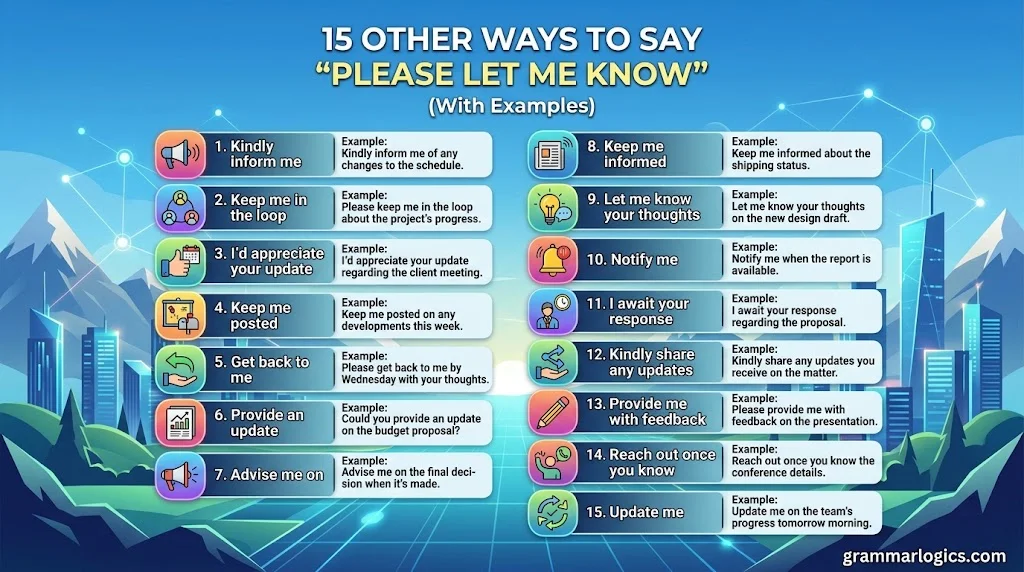
Finding the right words can make your communication more clear, polite, and professional. Learning other ways to say “Please Let Me Know” helps you express yourself naturally in different situations.
Whether you are writing an email, sending a message, or having a professional conversation, using the same phrase repeatedly can make your communication sound less engaging. Exploring alternative expressions allows you to adjust your tone according to the person you are speaking with and the situation. For example, you might choose a formal expression when contacting a manager, a friendly phrase when talking to a colleague, or a casual alternative when messaging a friend. These small changes can make your writing feel more natural and thoughtful. They also help you communicate your expectations without sounding too demanding. By understanding different expressions and their meanings, you can improve your English vocabulary, strengthen your writing skills, and make everyday conversations more effective.
In this article, we will explore 15 other ways to say “Please Let Me Know”, complete with clear explanations and practical examples. Each alternative will help you understand when and how to use the expression in emails, text messages, workplace conversations, and everyday communication. You will discover professional phrases such as “Please Keep Me Updated” and “I Would Appreciate Your Feedback,” along with friendly options like “Let Me Know What You Think” and “Keep Me Posted.” These expressions can help you sound more confident while maintaining a polite and respectful tone. Whether you are a student, professional, blogger, or English learner, this guide will help you choose the best alternative phrase for your needs. By the end, you will have several useful expressions to make your communication more varied, natural, and effective.
What Does “Please Let Me Know” Mean?
“Please let me know” is a polite expression used to ask someone to share information, provide an answer, give an update, or communicate a decision. It usually means that you would appreciate hearing from the other person when they have something relevant to tell you. For example, you might write, “Please let me know if you can attend the meeting,” when asking a colleague to confirm their availability.
The phrase is generally considered polite, clear, and professional, although its tone depends on the surrounding message and relationship. It can express a simple request, invite feedback, or encourage someone to contact you when necessary. In formal emails, it helps maintain a respectful tone, while in personal conversations, it can sound friendly and considerate. The wording does not usually demand an immediate response; instead, it gives the other person an opportunity to reply when appropriate.
Common Situations Where “Please Let Me Know” Is Used
People use this expression in many everyday and professional situations. At work, it can help request project updates, confirm meeting times, or ask colleagues to clarify information. In emails, it often appears at the end of a message to invite questions or encourage a response. Students may use it when communicating with teachers, while customers and service providers may use it to discuss appointments, orders, or requests.
The phrase is also common in text messages and personal conversations. Someone might say, “Please let me know when you get home,” to show concern, or “Please let me know what you think” when asking a friend for an opinion. Although the expression works in many contexts, alternatives can make a message feel more personal, less repetitive, more direct, or better suited to a particular relationship.
Is It Professional or Polite to Say “Please Let Me Know”?
Yes, “Please let me know” is both polite and professional in most situations. It is especially suitable for workplace emails, business correspondence, academic communication, and conversations where you need information without sounding demanding. The word “please” softens the request, while “let me know” clearly explains that you would appreciate a response.
However, the phrase can become repetitive when used in every email or message. In a formal setting, “I would appreciate your confirmation” may sound more precise when requesting a decision, while “Could you share an update?” may be more appropriate when asking about progress. In friendly conversations, expressions such as “Keep me posted” can feel more relaxed. The best wording depends on the urgency of the request, your relationship with the reader, and the information you need.
Advantages and Disadvantages of Saying “Please Let Me Know”
Advantages
- Polite and respectful: It asks for information without sounding like an order.
- Versatile: It works in professional emails, casual messages, and personal conversations.
- Clear and direct: The reader understands that a response or update would be helpful.
- Flexible: It can be used for questions, decisions, feedback, and future updates.
- Easy to understand: Its simple wording is suitable for both native speakers and English learners.
Disadvantages
- Can become repetitive: Using it in every email may make your writing feel formulaic.
- Sometimes lacks specificity: The reader may not know what information you need or when you need it.
- May sound impersonal: In an emotional conversation, a warmer expression may communicate more care.
- Does not always convey urgency: If you need an answer by a particular time, you may need to state a deadline clearly.
15 Synonyms and Alternatives for “Please Let Me Know”
- Could You Let Me Know?
- Please Keep Me Updated
- Keep Me Posted
- I’d Appreciate Your Feedback
- Let Me Know What You Think
- Please Inform Me
- I Look Forward to Hearing From You
- Could You Confirm?
- Please Share an Update
- Feel Free to Reach Out
- Let Me Know When You Can
- I’d Be Grateful if You Could Tell Me
- Please Keep Me Informed
- Could You Get Back to Me?
- I’d Love to Hear From You
1. Could You Let Me Know?
Meaning
“Could you let me know?” is a polite way to ask someone to provide information, answer a question, or confirm something. It communicates the same basic request as “Please let me know,” but its question format can make the wording feel more conversational.
Definition
A courteous request asking someone to share specific information or provide an answer.
Detailed Explanation
This expression is useful when you want to ask for information without sounding demanding. Starting with “could you” makes the request feel considerate because it acknowledges the other person’s choice and availability. It works well in professional correspondence as well as everyday conversations. For the clearest message, mention exactly what you want the other person to tell you.
Scenario Examples
– Scenario: Asking a colleague about a meeting time.
Example: “Could you let me know what time the client meeting starts?”
– Scenario: Messaging a friend about weekend plans.
Example: “Could you let me know if you’re free on Saturday?”
– Scenario: Following up with a service provider.
Example: “Could you let me know when the replacement item will arrive?”
Best Use
Use this expression in emails, workplace conversations, customer inquiries, and polite text messages when requesting specific information.
Tone
Tone: Polite, conversational, respectful.
The question format makes the request sound considerate without becoming overly formal.
2. Please Keep Me Updated
Meaning
“Please keep me updated” asks someone to share new information as a situation develops. Unlike the original phrase, which may refer to one answer, this expression usually suggests that you want to receive updates over time.
Definition
A request to receive ongoing information about a situation, task, or development.
Detailed Explanation
This wording is especially helpful when a project or decision is still in progress. It lets the other person know that future changes are relevant to you. For instance, a manager may ask a team member to provide updates about a deadline or an unresolved problem. If you only need one quick answer, however, “Could you let me know?” may be more precise.
Scenario Examples
– Scenario: Monitoring a workplace project.
Example: “Please keep me updated on the progress of the website redesign.”
– Scenario: Waiting for news about a repair.
Example: “Please keep me updated if the technician finds anything else.”
– Scenario: Coordinating a family event.
Example: “Please keep me updated about the venue arrangements.”
Best Use
Use it for ongoing projects, changing plans, business matters, and situations requiring regular communication.
Tone
Tone: Professional, clear, cooperative.
It communicates continued interest and encourages consistent communication.
3. Keep Me Posted
Meaning
“Keep me posted” is an informal expression that asks someone to share news or updates as they become available. It has a similar purpose to the original phrase but sounds more relaxed and familiar.
Definition
A casual request to tell someone about new developments.
Detailed Explanation
This phrase is common in everyday spoken English and friendly workplace conversations. It works particularly well when you already have an easy relationship with the person you are addressing. Although it can be appropriate among colleagues, it may sound too casual for certain formal letters or official requests. It usually suggests future updates rather than just one specific response.
Scenario Examples
– Scenario: Talking to a friend about a job application.
Example: “Keep me posted on how your interview goes!”
– Scenario: Discussing a changing work schedule.
Example: “Keep me posted if the delivery time changes.”
– Scenario: Checking on someone’s travel plans.
Example: “Keep me posted when you decide which flight to book.”
Best Use
Choose this phrase for casual emails, text messages, friendly conversations, and relaxed professional settings.
Tone
Tone: Casual, friendly, approachable.
Its informal wording creates a natural feeling of familiarity.
4. I’d Appreciate Your Feedback
Meaning
“I’d appreciate your feedback” asks someone to share their opinion, evaluation, or suggestions. It is more specific than “Please let me know” because it focuses on receiving a response that helps you assess or improve something.
Definition
A polite request for someone’s thoughts, comments, or constructive suggestions.
Detailed Explanation
This expression is particularly useful when sharing work, requesting a review, or asking for an informed opinion. It shows that you value the other person’s perspective rather than merely expecting a reply. The wording is professional without being stiff, making it suitable for colleagues, supervisors, teachers, and clients. For simple factual questions, a more direct request may be clearer.
Scenario Examples
– Scenario: Sending a draft to a manager.
Example: “I’d appreciate your feedback on the proposal before Friday.”
– Scenario: Asking a teacher to review an assignment.
Example: “I’d appreciate your feedback on my introduction.”
– Scenario: Sharing a new design with a client.
Example: “I’d appreciate your feedback on the updated layout.”
Best Use
Use it in professional emails, academic work, creative projects, presentations, and requests for constructive criticism.
Tone
Tone: Respectful, professional, collaborative.
It demonstrates that you welcome another person’s judgment and ideas.
5. Let Me Know What You Think
Meaning
“Let me know what you think” invites someone to express an opinion, reaction, or personal preference. It is more focused than the original phrase because it specifically asks for thoughts rather than any type of information.
Definition
A friendly request for another person’s opinion or reaction.
Detailed Explanation
This expression works naturally when you want to start a conversation or encourage an honest response. It is especially useful after sharing an idea, recommendation, photograph, plan, or piece of writing. The wording feels less formal than “I’d appreciate your feedback,” so it is often suitable for friends and familiar colleagues. If you need a factual confirmation rather than an opinion, choose a more specific phrase.
Scenario Examples
– Scenario: Sharing a holiday itinerary with friends.
Example: “Here’s the plan for our trip. Let me know what you think!”
– Scenario: Showing a new logo to a colleague.
Example: “I’ve attached two logo options. Let me know what you think.”
– Scenario: Asking a partner about a dinner plan.
Example: “I was thinking of trying that new restaurant. Let me know what you think.”
Best Use
Use this expression for opinions, personal decisions, creative ideas, suggestions, and informal feedback requests.
Tone
Tone: Friendly, open, collaborative.
It encourages the other person to share an honest opinion without feeling pressured.
6. Please Inform Me
Meaning
“Please inform me” asks someone to provide information about a matter. It is more formal and direct than the original expression and often suits official communication.
Definition
A formal request for information, notification, or clarification.
Detailed Explanation
This phrase can be appropriate in administrative correspondence, official notices, and situations where precise wording matters. It places greater emphasis on delivering information than on having a friendly conversation. Although it is grammatically correct, it may sound stiff in a casual message or a warm personal exchange. In professional writing, “Please inform me” works best when the subject is clear and the tone is appropriately formal.
Scenario Examples
– Scenario: Communicating with an administrative office.
Example: “Please inform me of any changes to the application requirements.”
– Scenario: Asking a school office about a schedule.
Example: “Please inform me if the examination date is revised.”
– Scenario: Requesting notice of a policy change.
Example: “Please inform me of any updates to the current procedure.”
Best Use
Choose it for formal letters, administrative requests, official correspondence, and structured business communication.
Tone
Tone: Formal, direct, authoritative.
Its formal wording suits official settings, but it can feel distant in personal communication.
7. I Look Forward to Hearing From You
Meaning
“I look forward to hearing from you” expresses the expectation or hope that someone will respond. Rather than directly asking for information, it politely closes a message by indicating that you welcome a reply.
Definition
A courteous closing expression that communicates an expectation of future communication.
Detailed Explanation
This phrase is common in professional emails, applications, business inquiries, and formal correspondence. It sounds polished because it expresses interest in a response without making a direct demand. However, it is not always interchangeable with “Please let me know.” If you need a specific answer or confirmation, stating the request directly is usually clearer. In a very casual conversation, the expression may sound unnecessarily formal.
Scenario Examples
– Scenario: Applying for a job.
Example: “Thank you for considering my application. I look forward to hearing from you.”
– Scenario: Contacting a potential business partner.
Example: “I’ve attached our service details and look forward to hearing from you.”
– Scenario: Asking about a collaboration opportunity.
Example: “I’d be happy to discuss the project further and look forward to hearing from you.”
Best Use
Use it as a closing in professional emails, job applications, business proposals, and formal inquiries.
Tone
Tone: Professional, courteous, expectant.
It closes a message gracefully while signaling that a response would be welcome.
8. Could You Confirm?
Meaning
“Could you confirm?” asks someone to verify information or establish that something is correct. It is more precise than the original phrase because it focuses on confirmation rather than a broad range of possible responses.
Definition
A polite request to verify a fact, arrangement, decision, or detail.
Detailed Explanation
This expression is useful when accuracy matters. You might use it to check an appointment, confirm receipt of a document, or verify a booking. The question format keeps the request polite, while the verb “confirm” makes the desired action clear. It is not the best choice when you want creative suggestions, personal opinions, or an open-ended update.
Scenario Examples
– Scenario: Checking an appointment.
Example: “Could you confirm that my appointment is booked for Tuesday at 10 a.m.?”
– Scenario: Coordinating a business meeting.
Example: “Could you confirm whether the conference room is available?”
– Scenario: Verifying a document submission.
Example: “Could you confirm that you received the signed agreement?”
Best Use
Choose it for appointments, bookings, deadlines, schedules, document receipts, and other matters requiring verification.
Tone
Tone: Polite, precise, professional.
It is effective when you need a definite answer rather than a general update.
9. Please Share an Update
Meaning
“Please share an update” asks someone to communicate the latest information about a situation. It is especially useful when you want a progress report or new details about something already underway.
Definition
A request for the latest information about an ongoing task, event, or issue.
Detailed Explanation
This expression is common in team communication and project management. It encourages the recipient to explain what has changed, what has been completed, or what remains unresolved. Compared with “Please keep me updated,” it often requests an update at the present moment rather than ongoing reports. In casual conversations, it may sound slightly businesslike, so a simpler phrase may feel more natural with friends.
Scenario Examples
– Scenario: Checking progress on a team assignment.
Example: “Please share an update on the research before our afternoon meeting.”
– Scenario: Asking a contractor about renovations.
Example: “Please share an update on the kitchen repairs when you have a chance.”
– Scenario: Following up on a customer support issue.
Example: “Please share an update on the status of my support request.”
Best Use
Use it in project emails, team meetings, customer support, service requests, and progress reports.
Tone
Tone: Professional, direct, task-focused.
It emphasizes the need for useful information about current progress.
10. Feel Free to Reach Out
Meaning
“Feel free to reach out” invites someone to contact you if they have questions, need help, or want to discuss something. Unlike the original phrase, it generally encourages the other person to initiate communication rather than asking them to send a particular update.
Definition
A friendly invitation for someone to contact you whenever they need assistance or further discussion.
Detailed Explanation
This expression is useful when you want to appear approachable and available. It is common in professional emails, customer service messages, networking conversations, and friendly exchanges. It does not necessarily mean that you expect a response to your current message. Instead, it lets the recipient know that communication is welcome. If you need a specific answer, include a direct question as well.
Scenario Examples
– Scenario: Helping a new colleague settle in.
Example: “Feel free to reach out if you need help getting started.”
– Scenario: Finishing a customer service email.
Example: “Feel free to reach out if you have any questions about your order.”
– Scenario: Offering support to a friend.
Example: “Feel free to reach out whenever you want to talk.”
Best Use
Choose it for professional email closings, customer communication, networking, and supportive personal messages.
Tone
Tone: Warm, welcoming, supportive.
It makes the recipient feel comfortable contacting you without creating an obligation to reply immediately.
11. Let Me Know When You Can
Meaning
“Let me know when you can” asks someone to respond when they have the opportunity. It communicates flexibility and can soften a request by recognizing that the other person may be busy.
Definition
A request for information or a response whenever the recipient has a suitable opportunity.
Detailed Explanation
This expression is helpful when the matter is not urgent and you do not want to pressure someone into replying immediately. It sounds natural in personal messages and everyday workplace communication. However, it does not establish a specific deadline, so it may be unsuitable when a decision is time-sensitive. If timing matters, state the required date or time clearly.
Scenario Examples
– Scenario: Arranging a casual meeting.
Example: “Let me know when you can, and we’ll find a time for coffee.”
– Scenario: Asking a colleague a nonurgent question.
Example: “Let me know when you can if the new schedule works for you.”
– Scenario: Checking on a family member.
Example: “Let me know when you can so I can call you later.”
Best Use
Use it in casual texts, flexible scheduling, nonurgent requests, and conversations with busy friends or colleagues.
Tone
Tone: Relaxed, considerate, flexible.
It signals that a reply is welcome but does not need to be immediate.
12. I’d Be Grateful if You Could Tell Me
Meaning
“I’d be grateful if you could tell me” is a courteous way to request information. It places extra emphasis on appreciation, making it particularly suitable when the request requires someone’s time or assistance.
Definition
A polite expression asking someone to provide information while explicitly acknowledging that their help would be appreciated.
Detailed Explanation
This phrase is useful when you want to sound especially respectful. It works well in formal correspondence, academic requests, and professional situations involving someone whose time you value. Compared with the original expression, it is longer and more formal, so it may feel unnecessarily elaborate in a quick text. For a natural result, follow it with a specific question or subject.
Scenario Examples
– Scenario: Asking an academic adviser about course requirements.
Example: “I’d be grateful if you could tell me which documents I need to submit.”
– Scenario: Requesting details from a business contact.
Example: “I’d be grateful if you could tell me when the revised quotation will be ready.”
– Scenario: Asking about an event’s accessibility.
Example: “I’d be grateful if you could tell me whether wheelchair access is available.”
Best Use
Choose it for formal emails, academic correspondence, business inquiries, and requests that benefit from extra courtesy.
Tone
Tone: Respectful, formal, appreciative.
It emphasizes gratitude and makes the request sound thoughtful rather than abrupt.
13. Please Keep Me Informed
Meaning
“Please keep me informed” asks someone to make sure you receive relevant information as a matter develops. It is similar to “Please keep me updated,” but it can sound more formal and may emphasize staying aware of important developments.
Definition
A request to receive relevant information about a situation, decision, or change.
Detailed Explanation
This expression is useful when you need to remain aware of decisions or developments that affect your responsibilities. For example, a supervisor might ask to be informed about changes to a project, or a customer might request information about a delayed order. It generally suggests ongoing communication rather than a single answer. In a personal conversation, it can sound somewhat serious, so a more relaxed expression may fit better.
Scenario Examples
– Scenario: Supervising a business project.
Example: “Please keep me informed of any changes to the launch schedule.”
– Scenario: Following a service complaint.
Example: “Please keep me informed about the investigation into my missing package.”
– Scenario: Coordinating a school event.
Example: “Please keep me informed if the venue arrangements change.”
Best Use
Use it for formal workplace communication, administrative matters, ongoing issues, and situations involving important decisions.
Tone
Tone: Professional, serious, composed.
It suggests that receiving relevant information is important for staying aware of the situation.
14. Could You Get Back to Me?
Meaning
“Could you get back to me?” asks someone to respond after reviewing a question, checking information, or considering a request. It often implies that the person may need time before providing an answer.
Definition
A polite request for someone to respond later with information or a decision.
Detailed Explanation
This expression is common in workplace communication and everyday conversations. It is especially helpful when the other person cannot answer immediately and needs to check something first. The wording can sometimes sound more direct than “Please let me know,” particularly when used without a polite opening or context. When a deadline matters, specify when you need the response rather than relying on the phrase alone.
Scenario Examples
– Scenario: Waiting for a manager’s decision.
Example: “Could you get back to me once you’ve discussed the proposal with the team?”
– Scenario: Asking a supplier about stock availability.
Example: “Could you get back to me after checking whether the item is in stock?”
– Scenario: Discussing possible plans with a friend.
Example: “Could you get back to me tonight so I can book the tickets?”
Best Use
Choose it for follow-up emails, business decisions, inquiries requiring research, and plans that depend on a later response.
Tone
Tone: Direct, polite, practical.
It communicates that you expect a response after the recipient has had time to consider the matter.
15. I’d Love to Hear From You
Meaning
“I’d love to hear from you” expresses genuine interest in receiving a message, opinion, or response. It is warmer and more personal than the original phrase, making it suitable when building a connection matters as much as obtaining information.
Definition
A friendly expression showing that you would welcome communication from another person.
Detailed Explanation
This phrase works well when you want to encourage a response without making the request feel transactional. It is especially suitable for personal messages, networking, creative communities, and friendly professional communication. Unlike “Could you confirm?” it does not specify exactly what information you need, so it works best when the context already makes the purpose clear. In highly formal correspondence, a more neutral closing may be preferable.
Scenario Examples
– Scenario: Reconnecting with an old friend.
Example: “It’s been ages since we last spoke. I’d love to hear from you!”
– Scenario: Inviting readers to share their thoughts.
Example: “If you’ve tried this recipe, I’d love to hear from you.”
– Scenario: Contacting a potential collaborator.
Example: “Your work sounds fascinating, and I’d love to hear from you about possible collaboration.”
Best Use
Use it in personal emails, friendly professional messages, networking, creative projects, and invitations to continue a conversation.
Tone
Tone: Warm, enthusiastic, personable.
It conveys sincere interest and makes communication feel welcome rather than obligatory.
FAQs
1. What is another way to say “Please Let Me Know”?
Some natural alternatives are “Could you let me know?”, “Please keep me updated,” “Keep me posted,” and “Could you confirm?” The best choice depends on your purpose. Use “Could you confirm?” for verification, “Keep me posted” for casual updates, and “I’d appreciate your feedback” when requesting someone’s opinion.
2. What does “Please Let Me Know” mean?
“Please let me know” means you are politely asking someone to share information, provide an answer, or give you an update. It is commonly used in emails, text messages, workplace conversations, and personal communication. The phrase is flexible and generally respectful.
3. Is “Please Let Me Know” professional?
Yes, “Please let me know” is professional and polite in most workplace situations. It works well in business emails, customer inquiries, and conversations with colleagues. For more specific requests, expressions such as “Could you confirm?” or “Please share an update” may communicate your needs more clearly.
4. What is a more polite way to say “Please Let Me Know”?
You can say “I’d be grateful if you could tell me” or “I’d appreciate your feedback” when you want to sound especially considerate. For a simple, polite question, “Could you let me know?” is also an excellent choice. Select the expression that fits your relationship with the recipient and the type of information you need.
5. Which alternative works best in formal communication?
“Please inform me” is suitable for formal or administrative communication, while “I’d be grateful if you could tell me” adds a more appreciative tone. For professional emails requesting confirmation, “Could you confirm?” is often more precise. The best option depends on whether you need information, verification, feedback, or an ongoing update.
Conclusion
Choosing the right alternative to “Please Let Me Know” can make your communication clearer, more natural, and better suited to your audience. Whether you are writing a professional email, sending a friendly text, requesting feedback, or following up on an important matter, the words you choose can influence how your message is received.
Expressions such as “Could you confirm?” work well for specific questions, while “Keep me posted” suits casual conversations and “I’d love to hear from you” adds warmth. Remember that these phrases are not always interchangeable; each has its own meaning, tone, and purpose. Consider your relationship with the recipient, the information you need, and how quickly you expect a response. With the right wording, you can communicate politely, confidently, and effectively in almost any situation.