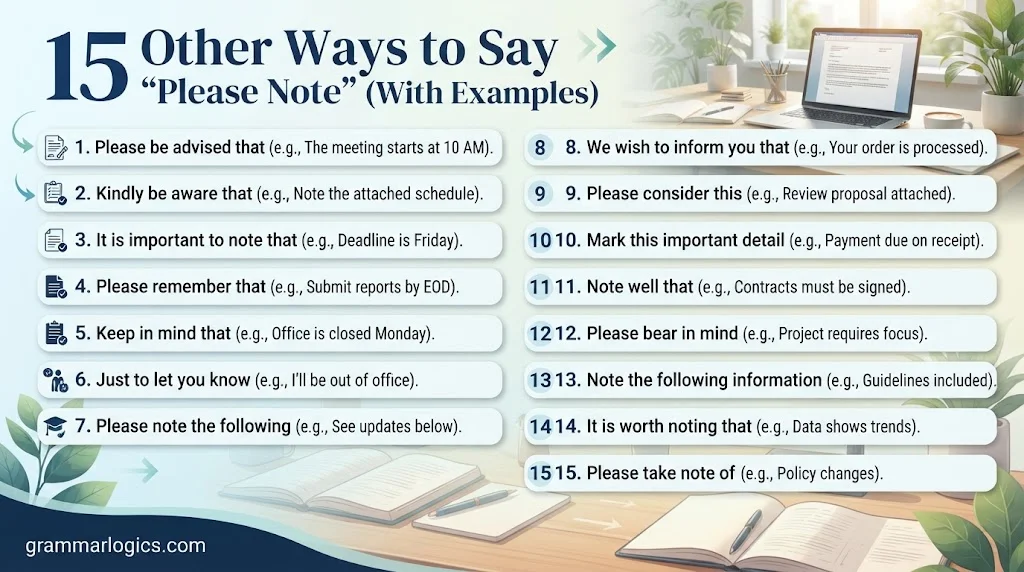
When you need to highlight important information, “Please Note” is a simple and polite phrase that helps readers focus on something essential.
In everyday communication, “Please Note” is commonly used to draw attention to important details, instructions, reminders, or changes. However, repeating the same phrase can sometimes make your writing feel predictable or formal. Using different expressions can make your emails, notices, articles, and professional messages sound more natural, engaging, and effective. Whether you are writing for work, school, customer communication, or online content, choosing the right alternative depends on your audience and tone. Understanding other ways to say “Please Note” can help you communicate key information clearly while keeping your writing polished and reader-friendly.
There are many useful alternatives to “Please Note” that can fit different writing situations and communication styles. Expressions such as “Keep in Mind,” “Be Aware,” “Take Notice,” and “It Is Important to Remember” can emphasize information without sounding repetitive. Some alternatives feel more professional and formal, while others are friendly, direct, or conversational. Learning these phrases can improve your vocabulary and communication skills, especially when writing emails, reports, announcements, instructions, and blog content. By choosing an expression that matches your context, you can make important information easier to notice, understand, and remember.
What Does “Please Note” Mean?
“Please note” is a polite expression used to ask someone to pay attention to or remember important information. It commonly introduces a detail, instruction, warning, change, or fact that the reader should not overlook. For example, “Please note that the office will close at 3 p.m.” asks the reader to pay particular attention to the closing time. The phrase is generally polite, direct, and professional, although its tone can vary depending on the surrounding message. It does not necessarily mean that the information is negative or urgent; it simply signals that the following information deserves attention.
Common Situations Where “Please Note” Is Used
“Please note” appears frequently in professional emails, workplace notices, announcements, instructions, school communications, customer messages, and formal writing. A company might use it to highlight a change in business hours, while a teacher may use it before an important assignment instruction. It can also appear in everyday messages when someone wants to make sure an important detail is noticed.
People often look for alternatives when they want their wording to sound less repetitive, more conversational, more formal, or more specific to the situation. For example, “Just so you know” can feel friendly in a personal message, while “Please be advised” may sound more official in a formal notice.
Is It Professional or Polite to Say “Please Note”?
Yes, “please note” is both polite and professional in most appropriate contexts. It is especially common in emails, announcements, instructions, policies, and workplace communication. The word “please” softens the directive, while “note” clearly tells the reader that the following information deserves attention.
However, the expression can sometimes sound formal or slightly impersonal, particularly in casual conversations. If you are messaging a close friend, “Just so you know” or “Keep in mind” may feel more natural. In a formal notice, however, “Please note” remains a clear and dependable choice.
Advantages and Disadvantages of Saying “Please Note”
Advantages
The main advantage of “please note” is its clarity. It immediately signals that the reader should pay attention to the information that follows. It is also polite without being overly wordy, making it useful in professional emails, notices, instructions, and announcements. Because most English speakers understand the expression easily, it works well across many communication settings.
Disadvantages
Although useful, “please note” can become repetitive or formulaic when used frequently. In some casual situations, it may sound more formal than necessary. It also does not always communicate the exact reason something matters. Depending on your purpose, an alternative may sound warmer, more conversational, more urgent, or more precise.
15 Synonyms for “Please Note”
- Kindly Note
- Please Be Aware
- Take Note
- Keep in Mind
- Please Remember
- Note That
- Please Be Advised
- For Your Information
- Just So You Know
- It Is Worth Noting
- Please Bear in Mind
- A Reminder
- We Would Like to Point Out
- Please Take Into Account
- Kindly Be Aware
1. Kindly Note
Meaning
“Kindly note” asks someone to pay attention to important information in a polite and somewhat formal way. It is very close in meaning to “please note.”
Definition
Kindly note means to politely ask someone to notice, remember, or consider the information that follows.
Detailed Explanation
“Kindly note” is a useful alternative when you want your message to sound courteous and professional. It works especially well in written communication, including business emails, notices, and official correspondence. Compared with “please note,” it can sound slightly more formal in some varieties of English. It is best used when the information is important but does not necessarily require urgent action.
Scenario Examples
Scenario: A company is informing customers about changed opening hours.
Example: “Kindly note that our customer service team will close at 5 p.m. on Friday.”
Scenario: A manager sends an internal update.
Example: “Kindly note the revised deadline for submitting your reports.”
Best Use
Best for professional emails, notices, business communication, and formal messages.
Tone
Tone: Polite, professional, formal
The word “kindly” gives the expression a courteous quality while maintaining a businesslike tone.
2. Please Be Aware
Meaning
“Please be aware” tells someone that they should know about or pay attention to a particular fact or circumstance.
Definition
Please be aware means to politely ask someone to recognize or keep an important fact in mind.
Detailed Explanation
This expression emphasizes awareness rather than simply asking someone to notice a sentence. It can be especially useful when the information may affect someone’s decision, expectations, or actions. It sounds professional but is also natural in everyday communication. Compared with “please note,” it can sometimes feel more explanatory and less like a formal notice.
Scenario Examples
Scenario: A website informs visitors about a service limitation.
Example: “Please be aware that delivery times may be longer during public holidays.”
Scenario: A colleague needs to know about a scheduling issue.
Example: “Please be aware that the meeting room will be unavailable tomorrow morning.”
Best Use
Best for workplace communication, customer messages, notices, emails, and practical warnings.
Tone
Tone: Polite, informative, professional
It sounds respectful while drawing attention to information that could affect the reader.
3. Take Note
Meaning
“Take note” asks someone to pay attention to and remember something important.
Definition
Take note means to notice, remember, or give particular attention to information.
Detailed Explanation
“Take note” is a direct expression that can sound more active than “please note.” It is useful when you want the reader or listener to remember a particular detail. Depending on the surrounding words, it can sound formal, instructional, or conversational. Adding “please” can make it softer: “Please take note of the following changes.”
Scenario Examples
Scenario: A teacher gives students an important instruction.
Example: “Please take note of the new submission requirements.”
Scenario: A team discusses an upcoming deadline.
Example: “Take note of the final deadline before planning your tasks.”
Best Use
Best for instructions, education, workplace communication, announcements, and important reminders.
Tone
Tone: Direct, instructional, attentive
It encourages active attention and suggests that the information should be remembered.
4. Keep in Mind
Meaning
“Keep in mind” asks someone to remember or consider something while thinking about a situation.
Definition
Keep in mind means to remember or consider a particular fact when making a decision or forming an opinion.
Detailed Explanation
This phrase is more conversational than “please note.” It does not simply draw attention to information; it often suggests that the information should influence what someone does or thinks next. It works naturally in both spoken and written English. Because of its flexible tone, it is useful when you want communication to feel friendly rather than overly formal.
Scenario Examples
Scenario: A friend is planning an outdoor event.
Example: “Keep in mind that the weather may change in the evening.”
Scenario: A manager gives advice to an employee.
Example: “Keep in mind that the client prefers shorter presentations.”
Best Use
Best for everyday conversation, advice, workplace discussions, emails, and friendly communication.
Tone
Tone: Friendly, practical, conversational
It sounds natural and approachable while still highlighting important information.
5. Please Remember
Meaning
“Please remember” directly asks someone not to forget a particular fact, instruction, appointment, or responsibility.
Definition
Please remember means to politely ask someone to keep something in their memory or not forget it.
Detailed Explanation
This expression focuses more strongly on memory and responsibility than “please note.” It is particularly useful when someone needs to remember an action, deadline, rule, or commitment. It can be used with friends, family members, students, customers, or colleagues. In formal situations, the surrounding wording determines whether it feels gentle or directive.
Scenario Examples
Scenario: A parent reminds a child about an appointment.
Example: “Please remember to bring your permission form tomorrow.”
Scenario: A workplace email reminds employees about a deadline.
Example: “Please remember that all expense reports are due on Friday.”
Best Use
Best for reminders, instructions, personal communication, school, and workplace emails.
Tone
Tone: Polite, clear, reminder-focused
The expression is gentle but makes the importance of remembering something clear.
6. Note That
Meaning
“Note that” introduces information that the reader should notice or consider.
Definition
Note that means pay attention to or recognize the fact that something is true or important.
Detailed Explanation
“Note that” is shorter and more direct than “please note.” It is common in instructions, educational material, technical writing, and professional documents. Because it does not contain “please,” it can sound more authoritative or instructional. It is therefore useful when clarity and efficiency matter more than conversational warmth.
Scenario Examples
Scenario: A guide explains an important condition.
Example: “Note that this option is available only to registered users.”
Scenario: A teacher explains an assignment.
Example: “Note that the final section requires two examples.”
Best Use
Best for instructions, guides, educational writing, technical documents, and formal information.
Tone
Tone: Direct, formal, instructional
It gets the reader’s attention efficiently without adding unnecessary wording.
7. Please Be Advised
Meaning
“Please be advised” tells someone that they should be aware of specific information, often information related to a rule, change, decision, or policy.
Definition
Please be advised means to politely inform someone that they should be aware of something important.
Detailed Explanation
This expression is more formal than many alternatives and is frequently associated with official or business communication. It can introduce information about policies, procedures, deadlines, changes, or restrictions. In casual conversation, it may sound unnecessarily formal. For everyday messages, “please be aware” or “just so you know” is often more natural.
Scenario Examples
Scenario: A company announces a policy change.
Example: “Please be advised that the updated return policy takes effect next month.”
Scenario: A service provider informs a customer about a scheduled interruption.
Example: “Please be advised that maintenance may temporarily affect access to the service.”
Best Use
Best for formal notices, official correspondence, business communication, and policy-related messages.
Tone
Tone: Formal, professional, official
Its formal wording makes it suitable when communication needs an authoritative but courteous tone.
8. For Your Information
Meaning
“For your information” introduces information that may be useful or relevant to the person receiving it.
Definition
For your information means that something is being provided so the recipient knows about it or can refer to it.
Detailed Explanation
This phrase differs slightly from “please note” because it does not necessarily ask the reader to take special action. Instead, it provides information that may be useful. It is common in professional emails and workplace communication, although its tone depends heavily on context. In some situations, a short “FYI” may be more casual, while the full phrase can sound formal.
Scenario Examples
Scenario: A colleague shares an updated document.
Example: “For your information, I have attached the latest version of the schedule.”
Scenario: An employee updates a manager.
Example: “For your information, the client has confirmed tomorrow’s meeting.”
Best Use
Best for emails, workplace updates, reports, and informational messages.
Tone
Tone: Informative, professional, neutral
It focuses on sharing useful information rather than directly instructing the recipient.
9. Just So You Know
Meaning
“Just so you know” is a friendly way to tell someone about information they may want or need to know.
Definition
Just so you know means I am telling you this so you are aware of it.
Detailed Explanation
This expression is considerably more conversational than “please note.” It works well when communicating with friends, family, classmates, coworkers, or people with whom you have a relatively relaxed relationship. It can introduce a simple fact, update, explanation, or warning without sounding formal. Because it is casual, it is usually not the best choice for highly formal notices.
Scenario Examples
Scenario: A friend explains a change in plans.
Example: “Just so you know, I might arrive a little later than expected.”
Scenario: A coworker gives an informal update.
Example: “Just so you know, the meeting has been moved to Room 4.”
Best Use
Best for texting, casual emails, conversations, friendly messages, and informal workplace communication.
Tone
Tone: Casual, friendly, conversational
It sounds natural because it resembles everyday spoken English.
10. It Is Worth Noting
Meaning
“It is worth noting” indicates that a particular fact deserves attention or consideration.
Definition
It is worth noting means that a fact is important or useful enough to mention and consider.
Detailed Explanation
This expression is different from “please note” because it does not directly tell the reader what to do. Instead, it signals that the writer considers a particular point significant or relevant. It works especially well in analytical, professional, academic, and explanatory writing. It can make an observation sound thoughtful rather than directive.
Scenario Examples
Scenario: A report discusses a change in results.
Example: “It is worth noting that customer satisfaction improved during the final quarter.”
Scenario: Someone explains an important detail about a project.
Example: “It is worth noting that the revised plan requires fewer resources.”
Best Use
Best for reports, essays, professional writing, analysis, presentations, and explanatory content.
Tone
Tone: Thoughtful, formal, analytical
The expression draws attention to significance without directly instructing the reader.
11. Please Bear in Mind
Meaning
“Please bear in mind” politely asks someone to remember or consider something when making a judgment or decision.
Definition
Please bear in mind means please remember or consider this important fact.
Detailed Explanation
This phrase is close to “keep in mind,” but it generally has a more polished or formal feel. It is useful when a particular circumstance should influence how someone understands a situation. The phrase can introduce limitations, conditions, practical considerations, or relevant background information. It is especially useful when you want to encourage thoughtful consideration rather than simply attract attention.
Scenario Examples
Scenario: A manager discusses a challenging project.
Example: “Please bear in mind that the team is working with a limited budget.”
Scenario: A customer receives advice about delivery.
Example: “Please bear in mind that international deliveries may take additional time.”
Best Use
Best for professional emails, advice, customer communication, formal conversations, and explanatory writing.
Tone
Tone: Polite, considerate, professional
It encourages the reader to think about an important circumstance before making a decision.
12. A Reminder
Meaning
“A reminder” introduces information that someone has probably heard before but may need to remember again.
Definition
A reminder is a message or statement intended to help someone remember an important detail, task, date, or requirement.
Detailed Explanation
Unlike “please note,” this expression specifically suggests that the information is being repeated for memory purposes. It is excellent for deadlines, appointments, scheduled events, payments, meetings, and responsibilities. It can be used as a heading or as part of a sentence. Because it implies prior awareness, it may be less appropriate when introducing completely new information.
Scenario Examples
Scenario: A school reminds students about an assignment.
Example: “A reminder: your final project is due on Monday.”
Scenario: A company sends a meeting reminder.
Example: “A reminder that tomorrow’s training session begins at 9 a.m.”
Best Use
Best for emails, announcements, school communication, workplace reminders, and scheduled events.
Tone
Tone: Neutral, practical, helpful
It clearly signals that the message is intended to prevent someone from forgetting something.
13. We Would Like to Point Out
Meaning
“We would like to point out” politely draws attention to a particular fact, detail, issue, or distinction.
Definition
We would like to point out means we want to draw your attention to something important or relevant.
Detailed Explanation
This expression is more elaborate than “please note” and is often suitable for formal organizational communication. It allows the writer to highlight a detail without sounding as direct as “note that.” It can be useful when a company, institution, or team wants to clarify something for customers or readers. Because of its length, it may feel unnecessarily formal for a short personal message.
Scenario Examples
Scenario: A company clarifies a service condition.
Example: “We would like to point out that additional charges may apply to international orders.”
Scenario: An organization explains a policy.
Example: “We would like to point out that applications submitted after the deadline cannot be considered.”
Best Use
Best for formal emails, customer communication, institutional notices, business writing, and official explanations.
Tone
Tone: Formal, respectful, explanatory
It sounds measured and courteous while clearly directing attention to an important detail.
14. Please Take Into Account
Meaning
“Please take into account” asks someone to consider particular information when making a decision or judgment.
Definition
Please take into account means please consider a specific fact or circumstance before deciding something.
Detailed Explanation
This expression is not an exact substitute for every use of “please note.” It is more appropriate when the information should actively influence a decision or evaluation. It can be especially useful when discussing circumstances, limitations, costs, responsibilities, or individual needs. The phrase sounds professional and thoughtful rather than simply attention-seeking.
Scenario Examples
Scenario: A manager evaluates a project proposal.
Example: “Please take into account the additional training costs when reviewing the proposal.”
Scenario: A teacher considers a student’s circumstances.
Example: “Please take into account the time required to complete each section.”
Best Use
Best for professional communication, formal requests, evaluations, decisions, and written explanations.
Tone
Tone: Polite, thoughtful, professional
It encourages careful consideration rather than merely asking someone to notice information.
15. Kindly Be Aware
Meaning
“Kindly be aware” politely tells someone that they should recognize or remember an important fact.
Definition
Kindly be aware means please recognize or keep an important fact in mind.
Detailed Explanation
This expression is useful when you want to combine courtesy with clear informational guidance. It is particularly suitable for professional or customer-facing communication. Compared with “just so you know,” it is much more formal, while compared with “please be advised,” it can feel slightly less official. As with other “kindly” expressions, its naturalness can vary by region and communication style.
Scenario Examples
Scenario: A business informs customers about a service condition.
Example: “Kindly be aware that processing times may vary during peak periods.”
Scenario: An office communicates a building rule.
Example: “Kindly be aware that visitors must sign in at reception.”
Best Use
Best for customer service, workplace notices, formal emails, and professional communication.
Tone
Tone: Polite, formal, respectful
It maintains courtesy while making the importance of the information clear.
FAQs
What is another way to say “Please Note”?
Some common alternatives include “Keep in mind,” “Please be aware,” “It is important to note,” “Take note,” and “Please remember.” The best choice depends on your tone and audience.
What is a professional way to say “Please Note”?
For professional writing, you can use “Please be advised,” “Please be aware,” “It is important to note,” or “Kindly note.” These phrases work well in emails, reports, notices, and workplace communication.
What is a polite alternative to “Please Note”?
“Please be aware” and “Kindly note” are polite alternatives. They draw attention to important information without sounding overly demanding.
Can I use “Keep in Mind” instead of “Please Note”?
Yes. “Keep in mind” is a natural and friendly alternative, especially in conversational writing. However, “Please Note” may sound more formal in official communication.
Why should I use alternatives to “Please Note”?
Using different expressions can make your writing more natural, engaging, and varied. It also allows you to choose wording that better matches the context, tone, and audience.
Conclusion
Knowing different ways to say “Please Note” can make your writing more natural, professional, and engaging. Whether you are writing an email, announcement, report, article, or everyday message, alternatives such as “Keep in mind,” “Please be aware,” and “It is important to note” can help you highlight essential information effectively.
Choosing the right expression depends on your audience, purpose, and tone. Formal situations may require a more professional phrase, while casual communication can benefit from a friendly alternative. By using these expressions thoughtfully, you can avoid repetition, strengthen your communication skills, and make important details clearer and easier for readers to understand.