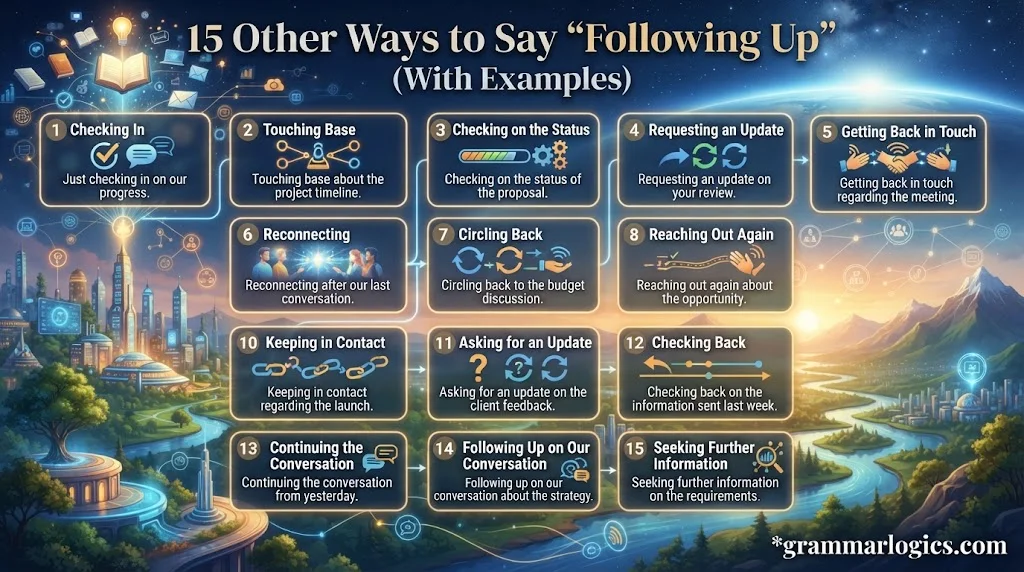
When you want to follow up, the right words can make your message feel clear, polite, and professional without sounding pushy.
Whether you’re checking on an email, request, application, project, or conversation, the phrase you choose can shape how your message is received. While “following up” is common and professional, using different expressions can help you sound more natural, thoughtful, and appropriate for the situation. In some cases, you may want to be friendly and casual, while in others, a more formal or respectful tone works better. Learning the best alternatives to “following up” can make your emails and everyday communication more effective while helping you avoid repetitive wording.
The phrase “following up” is widely used in workplace and personal communication, but it is not always the only suitable choice. Depending on your purpose and relationship with the recipient, alternatives such as “checking in,” “touching base,” “circling back,” or “reaching out” may sound more natural. Choosing the right expression helps you communicate your intention clearly while maintaining the appropriate tone and level of professionalism. These alternatives are especially useful when writing professional emails, business messages, reminders, and polite requests.
What Does “Following Up” Mean?
“Following up” generally means taking another action after an earlier conversation, request, message, meeting, or event. Most commonly, it means contacting someone again to check on progress, ask for an update, obtain information, or continue a previous discussion. For example, if you sent a proposal last week and email the recipient today to ask whether they have reviewed it, you are following up.
The expression can also mean making sure something previously discussed is completed. In professional communication, “following up” is often neutral and practical: it signals that there was an earlier interaction and that you are now returning to the subject. The exact meaning depends on context, so alternatives such as checking in, touching base, or requesting an update may be more appropriate when you want a particular tone.
Common Situations Where “Following Up” Is Used
People commonly use “following up” in emails, workplace conversations, customer service, sales communication, and everyday messages. A manager might follow up on an unfinished task, a job applicant might follow up after an interview, or a customer might follow up about an unresolved issue.
The phrase is especially useful when there is already some shared context. You are not introducing a completely new subject; you are returning to something that has already been discussed. However, repeating “just following up” in several emails can sometimes feel formulaic. A more specific expression can make your purpose clearer—for example, checking on the status of a request or asking for an update.
Is It Professional or Polite to Say “Following Up”?
Yes. “Following up” is generally professional, polite, and widely accepted, especially in workplace emails and other business communication. It is relatively neutral, which makes it useful when you want to remind someone about a previous conversation without sounding overly demanding.
The tone can change depending on the wording around it. “I’m following up to see whether you have an update” sounds courteous, while “I’m following up because I haven’t received anything” is more direct. In a very formal situation, a more precise expression such as “I’m writing to request an update” may sound more polished. In a friendly conversation, “checking in” or “touching base” may feel more natural.
Advantages and Disadvantages of Saying “Following Up”
Advantages
The main advantage of “following up” is its versatility. It works in professional emails, customer communication, meetings, applications, and many everyday situations. It also makes the connection to a previous interaction clear without requiring a long explanation. Because it is familiar and neutral, most readers understand the intention immediately.
Disadvantages
The phrase can sometimes sound generic or repetitive, particularly when used at the beginning of many emails. “Just following up” may also leave the recipient wondering exactly what you want from them. If your purpose is to request a status update, confirm a decision, or remind someone about a deadline, more specific wording can make your message clearer and more purposeful.
Synonyms for “Following Up”
- Checking In
- Touching Base
- Checking on the Status
- Requesting an Update
- Getting Back in Touch
- Reconnecting
- Circling Back
- Reaching Out Again
- Following Through
- Keeping in Contact
- Asking for an Update
- Checking Back
- Continuing the Conversation
- Following Up on Our Conversation
- Seeking Further Information
1. Checking In
Meaning
“Checking in” means contacting someone to see how things are going or whether there is any news. It is often a softer and warmer alternative to “following up.”
Definition
Checking in means making contact again to ask about someone’s situation, progress, or response.
Detailed Explanation
This expression is useful when you want your message to feel friendly rather than demanding. Unlike “following up,” it does not necessarily focus on getting a specific task completed. It can simply show that you are interested in how something is progressing. That makes it particularly natural in personal communication and friendly professional relationships.
Scenario Examples
Scenario: You want to ask a colleague about a project without putting pressure on them.
Example: “Hi Maya, just checking in to see how the presentation is coming along.”
Scenario: A friend mentioned that they were dealing with a difficult situation.
Example: “I wanted to check in and see how you’re doing.”
Best Use
Best for friendly emails, workplace messages, personal communication, and supportive conversations.
Tone
Tone: Warm, friendly, considerate
It sounds less formal and less transactional than many business-focused alternatives.
2. Touching Base
Meaning
“Touching base” means contacting someone again to discuss something or make sure you are both up to date.
Definition
Touching base means briefly reconnecting with someone about a shared matter.
Detailed Explanation
This is a common expression in workplace communication. It often suggests a brief conversation rather than a formal request for information. It is especially useful when you want to maintain communication or discuss next steps. It does not always mean that you are waiting for a specific response.
Scenario Examples
Scenario: You want to arrange a short conversation with a coworker.
Example: “I’d like to touch base about the timeline before Friday.”
Scenario: You want to reconnect with a client after a meeting.
Example: “I’m touching base to see if you have any questions about the proposal.”
Best Use
Best for professional emails, meetings, project communication, and business relationships.
Tone
Tone: Professional, friendly, collaborative
It has a relaxed business tone, although some readers may consider it somewhat corporate.
3. Checking on the Status
Meaning
“Checking on the status” means asking about the current progress or condition of something.
Definition
It means requesting information about where a task, request, application, or process currently stands.
Detailed Explanation
This phrase is more specific than “following up.” It clearly tells the recipient that you want a progress update. It works particularly well when there is a process already underway and you need to know what has happened so far. Because the wording focuses on status rather than blame, it can remain polite while being direct.
Scenario Examples
Scenario: You submitted a job application and want to know whether there has been progress.
Example: “I’m writing to check on the status of my application.”
Scenario: A customer is waiting for an order.
Example: “Could you help me check on the status of my delivery?”
Best Use
Best for applications, orders, projects, requests, and formal workplace communication.
Tone
Tone: Clear, professional, direct
The wording is useful when you want the purpose of your message to be immediately obvious.
4. Requesting an Update
Meaning
“Requesting an update” means asking someone to provide new information about something previously discussed.
Definition
It means politely asking for current information about progress, decisions, or developments.
Detailed Explanation
This is one of the clearest alternatives when your main goal is to receive new information. It is more explicit than “following up,” so the recipient does not have to guess why you are contacting them. The phrase works especially well in professional settings where clarity matters.
Scenario Examples
Scenario: You are waiting for a project decision.
Example: “I’m writing to request an update on the project timeline.”
Scenario: You need information from a colleague before completing your work.
Example: “Could you please provide an update when you have a moment?”
Best Use
Best for professional emails, project management, formal requests, and business communication.
Tone
Tone: Professional, respectful, straightforward
It communicates a specific purpose without sounding unnecessarily forceful.
5. Getting Back in Touch
Meaning
“Getting back in touch” means contacting someone again after a period without communication.
Definition
It means re-establishing contact with someone you have previously communicated with.
Detailed Explanation
This expression focuses more on reconnecting with a person than checking the progress of a particular task. It works well when some time has passed and you want to reopen communication. It can be personal or professional, depending on the surrounding message.
Scenario Examples
Scenario: You want to contact a former colleague about a professional opportunity.
Example: “I’m getting back in touch to see whether you’d be interested in discussing the position.”
Scenario: You have not spoken to a friend for several months.
Example: “It’s been a while, so I wanted to get back in touch.”
Best Use
Best for reconnecting with former colleagues, clients, acquaintances, and friends.
Tone
Tone: Friendly, warm, personal
It feels more relationship-focused than “requesting an update.”
6. Reconnecting
Meaning
“Reconnecting” means establishing communication again with someone after time apart.
Definition
Reconnecting means renewing contact or communication with someone you already know.
Detailed Explanation
This word emphasizes the relationship between people, rather than a pending task or request. It is therefore not an exact substitute for “following up” in every professional email. Use it when the main purpose is to restore or renew communication. It can sound particularly natural when a significant amount of time has passed.
Scenario Examples
Scenario: You want to contact a former business contact.
Example: “I’d love to reconnect and hear what you’ve been working on.”
Scenario: You are contacting an old friend.
Example: “It was great seeing your post—I thought it might be nice to reconnect.”
Best Use
Best for personal relationships, networking, former colleagues, and professional contacts.
Tone
Tone: Warm, personable, positive
It emphasizes human connection rather than administrative progress.
7. Circling Back
Meaning
“Circling back” means returning to a topic, question, or discussion that was previously raised.
Definition
It means returning to an earlier subject to continue the discussion or address an outstanding point.
Detailed Explanation
“Circling back” is common in modern workplace English, especially in emails and business conversations. It is similar to “following up,” but it often suggests that you are returning to a previous discussion rather than simply asking for a status update. Because it is somewhat corporate, it may not be the best choice for every audience.
Scenario Examples
Scenario: You discussed pricing during a meeting and now want to revisit it.
Example: “I’m circling back on the pricing question we discussed yesterday.”
Scenario: You want to return to an unanswered email point.
Example: “Just circling back to see if you’ve had a chance to review the document.”
Best Use
Best for work emails, meetings, projects, and business discussions.
Tone
Tone: Professional, direct, businesslike
It is natural in many workplaces but can sound more corporate than “checking in.”
8. Reaching Out Again
Meaning
“Reaching out again” means contacting someone for another time after having communicated previously.
Definition
It means making another attempt to communicate with someone about a previous or continuing matter.
Detailed Explanation
This wording is useful when you want to acknowledge that you have already contacted the person. It can be softer than saying that someone has failed to respond. Depending on the context, it can introduce a request, reminder, or continuation of an earlier conversation.
Scenario Examples
Scenario: You sent a message to a potential client but have not heard back.
Example: “I’m reaching out again to see whether you’re still interested in discussing the project.”
Scenario: You need clarification from a colleague.
Example: “I’m reaching out again because I had one quick question about the report.”
Best Use
Best for professional emails, networking, customer communication, and polite reminders.
Tone
Tone: Polite, professional, persistent
It acknowledges the previous contact while keeping the language courteous.
9. Following Through
Meaning
“Following through” means completing an action or doing what was previously promised or agreed.
Definition
It means carrying an intended action through to completion.
Detailed Explanation
This expression is related to “following up,” but the two are not interchangeable in every situation. “Following up” usually describes contacting someone again, whereas “following through” focuses on actually completing an obligation or plan. Use it when the emphasis is on action and completion rather than communication alone.
Scenario Examples
Scenario: A team member promised to send information.
Example: “Thanks for following through and sending the documents so quickly.”
Scenario: You want to encourage yourself to complete a plan.
Example: “I need to follow through on the commitments I made during the meeting.”
Best Use
Best for tasks, commitments, promises, responsibilities, and action-oriented communication.
Tone
Tone: Direct, responsible, action-focused
It emphasizes completion rather than simply making contact.
10. Keeping in Contact
Meaning
“Keeping in contact” means maintaining communication with someone over time.
Definition
It means continuing to communicate with a person rather than allowing contact to stop.
Detailed Explanation
This phrase is broader than “following up.” It does not necessarily involve a specific unanswered question or pending task. Instead, it emphasizes ongoing communication and connection. It is useful when maintaining a relationship is more important than obtaining an immediate update.
Scenario Examples
Scenario: You want to stay connected with a former coworker.
Example: “It was great working with you, and I hope we can keep in contact.”
Scenario: You are maintaining a relationship with a client.
Example: “We’ll keep in contact as the project develops.”
Best Use
Best for professional relationships, networking, friendships, and ongoing communication.
Tone
Tone: Friendly, warm, relationship-focused
It suggests continued communication rather than a single follow-up message.
11. Asking for an Update
Meaning
“Asking for an update” means directly requesting the latest information about something.
Definition
It means asking someone to tell you about the current progress or latest developments.
Detailed Explanation
This expression is very clear and natural when you genuinely need new information. It can be slightly more direct than “checking in,” but it remains polite when phrased appropriately. Unlike “touching base,” it clearly signals that an update is expected.
Scenario Examples
Scenario: You are waiting for a response from a department.
Example: “I wanted to ask for an update on my request.”
Scenario: A colleague is handling a task you need for your work.
Example: “Could I ask for an update on the figures when you have time?”
Best Use
Best for work emails, customer service, applications, requests, and project communication.
Tone
Tone: Clear, polite, practical
It is particularly useful when you want to avoid vague wording.
12. Checking Back
Meaning
“Checking back” means contacting someone again after an earlier conversation or request.
Definition
It means returning to a matter later to see whether there is new information or progress.
Detailed Explanation
“Checking back” has a straightforward meaning and is often less formal than “requesting an update.” It can work when you previously agreed to reconnect at a later point. The expression is especially natural when the timing of the second contact is part of the situation.
Scenario Examples
Scenario: A customer service representative asked you to wait several days.
Example: “I’m checking back to see whether there’s been any progress.”
Scenario: You told a colleague you would contact them after their meeting.
Example: “I’m checking back now that your meeting is over.”
Best Use
Best for customer service, workplace communication, informal professional emails, and follow-up conversations.
Tone
Tone: Neutral, polite, conversational
It sounds natural without being especially formal.
13. Continuing the Conversation
Meaning
“Continuing the conversation” means returning to an existing discussion rather than starting a completely new one.
Definition
It means keeping an earlier discussion going by adding information, questions, or ideas.
Detailed Explanation
This expression is useful when there is no problem or delay to address. Instead, you simply want to move an existing conversation forward. It can feel more collaborative and positive than “following up,” especially when discussing ideas or building a relationship.
Scenario Examples
Scenario: You had an introductory conversation with a potential partner.
Example: “I’d be happy to continue the conversation whenever you’re available.”
Scenario: You want to respond to an interesting discussion.
Example: “I wanted to continue the conversation we started at the conference.”
Best Use
Best for networking, professional discussions, personal conversations, interviews, and collaborative projects.
Tone
Tone: Open, collaborative, conversational
It focuses on dialogue rather than simply requesting a response.
14. Following Up on Our Conversation
Meaning
“Following up on our conversation” means returning to something discussed during an earlier conversation.
Definition
It means contacting someone again about a subject previously discussed together.
Detailed Explanation
This is a more specific version of “following up.” It immediately provides context by reminding the recipient that the subject was discussed before. It is especially helpful in professional emails because it sounds organized and purposeful without being overly formal.
Scenario Examples
Scenario: You discussed a proposal during a meeting.
Example: “I’m following up on our conversation about the revised proposal.”
Scenario: You spoke with a recruiter about a position.
Example: “I’m following up on our conversation last week regarding the position.”
Best Use
Best for professional emails, interviews, meetings, sales communication, and formal correspondence.
Tone
Tone: Professional, clear, respectful
It is more precise than simply saying “following up.”
15. Seeking Further Information
Meaning
“Seeking further information” means asking for additional details that you do not yet have.
Definition
It means requesting more information to clarify or better understand a subject.
Detailed Explanation
This expression is not an exact synonym for every use of “following up.” It is appropriate when the purpose of your second communication is specifically to obtain additional information. It sounds more formal and deliberate than “checking in,” making it useful in formal correspondence and official requests.
Scenario Examples
Scenario: You received an incomplete explanation about a service.
Example: “I’m writing to seek further information about the cancellation process.”
Scenario: You need additional details before making a business decision.
Example: “We are seeking further information about the proposed changes.”
Best Use
Best for formal emails, business correspondence, customer inquiries, applications, and official communication.
Tone
Tone: Formal, respectful, information-focused
It clearly communicates that you need more details without sounding confrontational.
FAQs
1. What are some other ways to say “following up”?
Some common alternatives to “following up” include checking in, touching base, checking back, reaching out, and circling back. The best expression depends on the context, tone, and relationship with the person you are contacting.
2. What is a professional way to say “following up”?
For professional communication, you can say “I’m checking in regarding…”, “I wanted to follow up on…”, “I’m reaching out regarding…”, or “I’m checking on the status of…”. These phrases sound polite, clear, and appropriate for work emails and business communication.
3. Is “checking in” the same as “following up”?
Checking in and following up have similar meanings, but they can have slightly different tones. “Following up” often refers to contacting someone about a previous conversation, request, or action, while “checking in” can sound more casual and friendly.
4. How can I politely follow up without sounding pushy?
Use polite and considerate wording that gives the other person room to respond. Phrases such as “I wanted to check in,” “Just following up on my previous message,” or “When you have a chance, I’d appreciate an update” can help your message sound professional without creating unnecessary pressure.
5. What is a good alternative to “following up” in an email?
A good alternative depends on your purpose. You might use “checking in,” “touching base,” “reaching out,” “checking on the status,” or “circling back.” For formal emails, choose wording that clearly explains why you are contacting the recipient while maintaining a polite and professional tone.
Conclusion
Knowing other ways to say “following up” can make your communication sound more natural, thoughtful, and professional. Instead of repeating the same phrase in every email or conversation, you can choose alternatives such as checking in, touching base, reaching out, checking back, or circling back based on the situation. Each expression carries a slightly different tone and level of formality, so choosing the right wording can make your message clearer and more effective.
Whether you are writing a professional email, sending a friendly message, or asking for an update, the right alternative can help you communicate without sounding repetitive or demanding. By considering the context, relationship, and purpose of your message, you can use these expressions naturally and make your follow-up communication more polite, confident, and engaging.