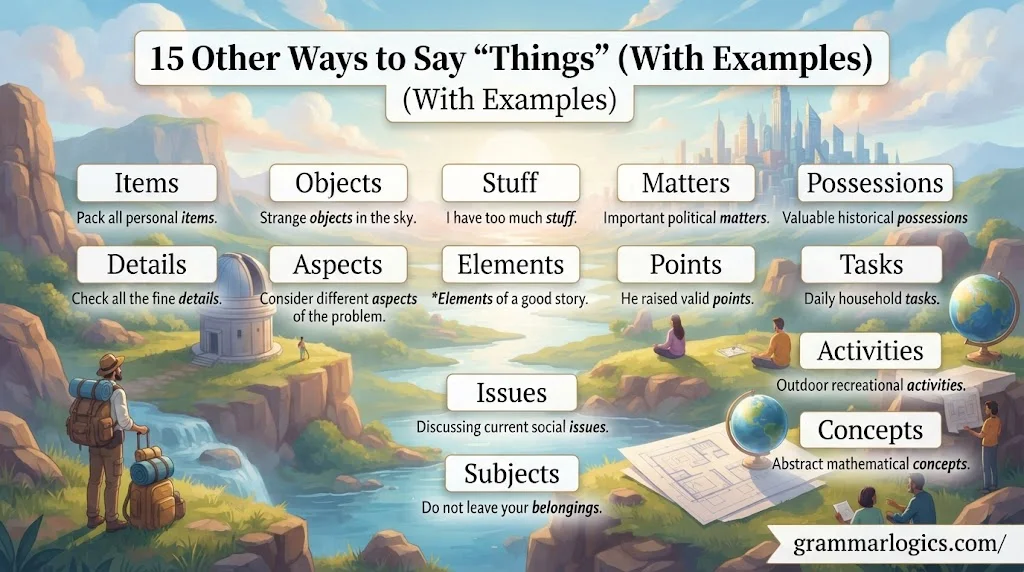
Things is one of the most common words in everyday English, but repeating it too often can make your writing sound vague or repetitive.
Whether you’re writing a blog post, email, message, or conversation, choosing a more specific word can make your communication clearer and more natural. Sometimes, alternatives to “things” can help you explain an idea, describe objects, or express thoughts with greater clarity and precision. The right wording also depends on the context, tone, and audience you are speaking or writing to.
In this guide, you’ll discover 15 other ways to say “things”, along with practical examples to help you understand when each alternative works best. From casual expressions to more professional and precise choices, these alternatives can help you expand your vocabulary and make your English sound more polished. Learning different ways to replace “things” can also help you avoid unnecessary repetition and choose words that communicate your exact meaning. Whether you’re writing professionally, academically, or casually, these useful alternatives can make your sentences more engaging and effective.
What Does “Things” Mean?
“Things” is the plural of “thing” and is a broad word used to refer to people, objects, ideas, events, activities, situations, matters, or other unspecified subjects. Its exact meaning depends heavily on context. For example, “I bought some things” usually refers to physical items, while “We need to discuss a few things” can refer to topics, issues, or matters. Similarly, “I have things to do” refers to tasks or activities. Because “things” is so general, speakers often use it when the exact identity or category is obvious, unimportant, or not worth specifying.
Common Situations Where “Things” Is Used
People use “things” constantly in everyday conversation because it is flexible and informal. You might say, “I need to pack my things” when referring to your belongings, “There are a few things we need to change” when discussing work, or “I have a lot of things to do” when talking about responsibilities.
The word also appears frequently in text messages, personal conversations, social media, school, and workplace communication. In casual settings, its vagueness is usually perfectly natural. However, in formal writing or professional communication, replacing “things” with a more precise word can make your meaning easier to understand. For example, “Please review these items” is more specific than “Please review these things” when discussing entries on a list.
Is It Professional or Polite to Say “Things”?
Yes. “Things” is polite and grammatically correct, but it is generally broad and somewhat informal. It works well when the context makes the meaning clear, such as “I have a few things to discuss with you.”
In professional or formal writing, however, a more precise word can often sound clearer. Depending on the context, “items,” “matters,” “issues,” “details,” or “aspects” may communicate the intended meaning more effectively. The original word is not inherently unprofessional; the main consideration is whether its general meaning provides enough information for the reader.
Advantages and Disadvantages of Saying “Things”
Advantages
The biggest advantage of “things” is flexibility. It can refer to many different types of subjects without forcing the speaker to identify a precise category. It is also natural, familiar, and easy to understand, making it particularly useful in everyday speech. When the details are obvious from context, “things” can keep a sentence short and conversational.
Disadvantages
Its broad meaning can also be a limitation. “Things” may sound vague when the reader needs specific information. In professional, academic, or formal writing, repeatedly using the word can make your language less precise. For example, “We need to improve several things” leaves the reader wondering exactly what needs improvement, whereas “We need to improve several processes” communicates a clearer idea.
Synonyms for “Things”
- Items
- Objects
- Stuff
- Matters
- Details
- Aspects
- Elements
- Points
- Issues
- Subjects
- Belongings
- Possessions
- Tasks
- Activities
- Concepts
1. Items
Meaning
“Items” refers to individual objects, entries, or units that can be identified separately.
Definition
An item is a single object, entry, product, or part of a collection or list.
Detailed Explanation
“Items” is a more specific and organized alternative to “things,” especially when you are referring to objects or entries on a list. It is common in shopping, business, inventories, instructions, and everyday conversation. Unlike “things,” it usually suggests that each object or entry can be identified individually.
Scenario Examples
Scenario: You are checking what you bought at a store. Example: “I only need to put these items in the kitchen.”
Scenario: A manager discusses a meeting agenda. Example: “There are three items on the agenda for today.”
Best Use
Use “items” for shopping, lists, products, documents, inventories, and organized collections.
Tone
Tone: Neutral, clear, professional
It sounds precise without being overly formal.
2. Objects
Meaning
“Objects” refers specifically to physical things or material entities.
Definition
An object is a physical entity that can generally be seen or touched.
Detailed Explanation
“Objects” is narrower than “things” because it normally describes physical entities, rather than ideas, tasks, or situations. It is useful when you want to emphasize the material nature of something. The word is common in educational, scientific, technical, and descriptive contexts.
Scenario Examples
Scenario: A teacher explains shapes to students. Example: “Look around the room and identify three round objects.”
Scenario: You are describing items in an old room. Example: “Several unusual objects were displayed on the shelves.”
Best Use
Use “objects” when talking about physical items, especially in educational, technical, or descriptive contexts.
Tone
Tone: Neutral, precise, slightly formal
It sounds more exact than the casual word “things.”
3. Stuff
Meaning
“Stuff” is an informal word for a collection of unspecified things, possessions, materials, or objects.
Definition
Stuff means a group or quantity of things that are not individually identified.
Detailed Explanation
“Stuff” is one of the closest casual alternatives to “things,” but it is less formal. It often refers to belongings, miscellaneous objects, materials, or an unspecified collection. Unlike “items,” it usually treats the collection as a whole rather than focusing on each individual object.
Scenario Examples
Scenario: You are asking a friend to move your belongings. Example: “Could you move my stuff into the other room?”
Scenario: You are preparing for a trip. Example: “I still have some stuff to pack.”
Best Use
Use “stuff” in casual conversation, texting, and friendly personal communication.
Tone
Tone: Casual, relaxed, conversational
It feels natural between friends but is usually unsuitable for formal documents.
4. Matters
Meaning
“Matters” refers to subjects, situations, concerns, or affairs that deserve attention or discussion.
Definition
A matter is a subject or situation that someone needs to consider, discuss, or deal with.
Detailed Explanation
“Matters” works especially well when “things” refers to concerns, affairs, or subjects rather than physical objects. It can make a sentence sound more serious or professional. For example, “We need to discuss a few matters” suggests meaningful subjects that require attention rather than miscellaneous objects.
Scenario Examples
Scenario: A supervisor wants to discuss workplace concerns. Example: “I’d like to speak with you about a few matters.”
Scenario: Someone handles an important personal issue. Example: “She needs some time to take care of personal matters.”
Best Use
Use “matters” for professional communication, serious discussions, personal affairs, and formal writing.
Tone
Tone: Professional, respectful, somewhat formal
It gives the subject more importance than the casual “things.”
5. Details
Meaning
“Details” refers to specific pieces of information about something.
Definition
A detail is a particular fact, feature, or piece of information about a subject.
Detailed Explanation
“Details” is appropriate when “things” means specific information or smaller points that explain something. It is not a general replacement for every use of “things,” because it specifically concerns information. Choosing it can make your meaning considerably clearer when discussing plans, instructions, events, or documents.
Scenario Examples
Scenario: You are explaining an upcoming event. Example: “I’ll send you the details this evening.”
Scenario: A colleague asks what needs to be corrected. Example: “Let’s go over the details before we submit the report.”
Best Use
Use “details” for information, instructions, plans, arrangements, documents, and explanations.
Tone
Tone: Clear, neutral, professional
It sounds more precise because it tells the reader that you mean information.
6. Aspects
Meaning
“Aspects” refers to particular parts, features, or sides of a subject.
Definition
An aspect is one particular part or feature of something larger.
Detailed Explanation
“Aspects” is useful when “things” means different parts or dimensions of a larger subject. It is common when discussing projects, experiences, ideas, systems, or situations. It is not normally used for miscellaneous physical objects, so context matters.
Scenario Examples
Scenario: You are evaluating a new project. Example: “We need to consider the financial and practical aspects of the plan.”
Scenario: Someone reflects on a new job. Example: “I enjoy many aspects of my new role.”
Best Use
Use “aspects” in professional, academic, analytical, and thoughtful discussions.
Tone
Tone: Analytical, professional, thoughtful
It suggests that you are examining different parts of a broader subject.
7. Elements
Meaning
“Elements” refers to individual parts that contribute to a larger whole.
Definition
An element is a distinct component or part of something.
Detailed Explanation
“Elements” is useful when the “things” being discussed are components of a system, plan, design, story, or larger structure. It emphasizes how separate parts contribute to the whole. Because of this, it is often more technical or analytical than “things.”
Scenario Examples
Scenario: A designer discusses a website. Example: “The visual elements should work together more consistently.”
Scenario: A teacher discusses a story. Example: “The story contains several important elements of mystery.”
Best Use
Use “elements” for components, designs, systems, plans, stories, and structured subjects.
Tone
Tone: Precise, professional, analytical
It works particularly well when discussing how separate parts fit together.
8. Points
Meaning
“Points” refers to individual ideas, facts, arguments, or subjects within a discussion.
Definition
A point is a particular idea, fact, argument, or item of discussion.
Detailed Explanation
“Points” works well when “things” means specific ideas or subjects that someone wants to mention or discuss. It is especially natural in meetings, presentations, debates, explanations, and written arguments. It can make vague language more structured and easier to follow.
Scenario Examples
Scenario: You are discussing a presentation. Example: “I have a few points I’d like to add.”
Scenario: A teacher gives feedback on an essay. Example: “You make several strong points in your conclusion.”
Best Use
Use “points” for discussions, presentations, arguments, meetings, feedback, and written ideas.
Tone
Tone: Neutral, organized, direct
It helps identify individual ideas without making the language unnecessarily formal.
9. Issues
Meaning
“Issues” refers to problems, concerns, or subjects that require attention or discussion.
Definition
An issue is a problem, concern, or important subject that needs consideration.
Detailed Explanation
“Issues” should be used when “things” refers specifically to problems or concerns, not ordinary objects or neutral subjects. It can communicate that something needs to be addressed. Because the word often carries a problem-related meaning, replacing “things” with “issues” can make a statement sound more serious.
Scenario Examples
Scenario: A team discusses problems with a project. Example: “We need to resolve several issues before launch.”
Scenario: A customer explains a problem with an order. Example: “I’m contacting you because there are a few issues with my order.”
Best Use
Use “issues” for problems, concerns, complaints, disputes, and matters requiring attention.
Tone
Tone: Direct, serious, professional
It clearly signals that something may need to be solved or addressed.
10. Subjects
Meaning
“Subjects” refers to topics or areas being discussed, studied, or considered.
Definition
A subject is a particular topic or area of discussion, study, or attention.
Detailed Explanation
“Subjects” is a useful alternative when “things” refers to topics rather than objects. It is common in education, conversation, writing, and formal discussions. However, it does not work naturally when referring to ordinary possessions or physical objects.
Scenario Examples
Scenario: Two colleagues are discussing meeting topics. Example: “We covered several important subjects during the meeting.”
Scenario: A student chooses what to study. Example: “Science and history are my favorite subjects.”
Best Use
Use “subjects” for academic areas, topics of conversation, and areas of discussion.
Tone
Tone: Neutral, educational, formal
It clearly identifies something as a topic rather than a physical object.
11. Belongings
Meaning
“Belongings” refers to personal possessions that belong to someone.
Definition
A person’s belongings are the personal things they own or carry.
Detailed Explanation
“Belongings” is a more specific alternative when “things” means personal possessions. It often refers to clothes, bags, books, electronics, and other objects owned by an individual. Unlike “stuff,” it has a more polished and neutral sound.
Scenario Examples
Scenario: Someone is moving to a new apartment. Example: “I’ve packed most of my belongings already.”
Scenario: A hotel guest leaves something behind. Example: “Please check the room carefully for any belongings.”
Best Use
Use “belongings” for personal possessions, travel, moving, hotels, schools, and everyday situations involving someone’s property.
Tone
Tone: Neutral, polite, respectful
It is more precise than “stuff” while remaining natural in everyday English.
12. Possessions
Meaning
“Possessions” refers to things that someone owns.
Definition
A possession is something that belongs to or is owned by a person.
Detailed Explanation
“Possessions” is similar to “belongings,” but it can sound slightly more formal or deliberate. It focuses on ownership rather than simply the personal nature of the objects. The word can describe ordinary property, valuable objects, or a person’s material belongings.
Scenario Examples
Scenario: Someone is preparing for a long-distance move. Example: “He decided to sell some of his possessions before moving.”
Scenario: A security notice addresses property. Example: “Visitors are responsible for their personal possessions.”
Best Use
Use “possessions” for property, personal ownership, formal notices, moving, and discussions about material belongings.
Tone
Tone: Neutral, formal, slightly serious
It places more emphasis on ownership than the word “things.”
13. Tasks
Meaning
“Tasks” refers to specific pieces of work or duties that need to be completed.
Definition
A task is a particular piece of work that someone needs to do.
Detailed Explanation
“Tasks” is appropriate when “things” means jobs, duties, or responsibilities. It is not a general synonym for physical objects or ideas. Using “tasks” makes a sentence much clearer when discussing work that needs to be completed.
Scenario Examples
Scenario: A manager assigns work to an employee. Example: “I have a few tasks to finish before lunch.”
Scenario: You organize your weekend. Example: “I’m making a list of household tasks for Saturday.”
Best Use
Use “tasks” for work, responsibilities, assignments, chores, and duties.
Tone
Tone: Practical, direct, professional
It clearly communicates that the “things” involve actions that need to be completed.
14. Activities
Meaning
“Activities” refers to actions, events, or things people do.
Definition
An activity is something that a person or group does, often for a particular purpose.
Detailed Explanation
“Activities” is a good alternative when “things” refers to actions or organized pursuits rather than objects. It is commonly used for hobbies, events, school programs, recreation, and group plans. The word sounds more specific because it identifies the “things” as actions or pursuits.
Scenario Examples
Scenario: A school prepares a program for students. Example: “The children will take part in several outdoor activities.”
Scenario: A hotel describes what guests can do. Example: “There are plenty of activities available during your stay.”
Best Use
Use “activities” for hobbies, events, recreation, school programs, travel, and planned actions.
Tone
Tone: Friendly, neutral, informative
It is broad enough for everyday use while clearly referring to actions or pursuits.
15. Concepts
Meaning
“Concepts” refers to ideas, principles, or general notions.
Definition
A concept is an abstract idea or principle that helps explain or represent something.
Detailed Explanation
“Concepts” is appropriate when “things” refers to abstract ideas rather than physical objects or practical tasks. It is particularly useful in education, business, design, science, and intellectual discussions. Because it specifically refers to ideas, it should not be used as a general replacement for every meaning of “things.”
Scenario Examples
Scenario: A teacher explains a difficult lesson. Example: “The students are learning several new mathematical concepts.”
Scenario: A designer discusses a creative project. Example: “We explored several different concepts before choosing the final design.”
Best Use
Use “concepts” for ideas, principles, theories, designs, and abstract subjects.
Tone
Tone: Intellectual, professional, academic
It is more precise than “things” when discussing abstract ideas.
FAQs
1. What are other ways to say “things”?
Some useful alternatives to “things” include items, objects, belongings, details, matters, aspects, points, and stuff. The best alternative depends on the context and what you are actually referring to.
2. What is a more professional word for “things”?
For professional communication, words such as items, details, matters, aspects, points, or topics can sound more precise. Choosing a specific word makes your writing clearer, more polished, and easier to understand.
3. What can I say instead of “things” in formal writing?
Instead of “things,” you can use words like factors, elements, aspects, issues, matters, or considerations. These alternatives can make formal writing more precise while helping you avoid vague language.
4. Is “things” a formal word?
“Things” is a common and grammatically correct word, but it can sometimes sound vague or informal when the reader needs specific information. In business, academic, or professional writing, a more precise alternative may communicate your meaning better.
5. How do I choose the right alternative to “things”?
Choose an alternative based on what you mean and the situation. Use items for physical objects, details for specific information, matters for subjects or concerns, and aspects for different parts of a topic. The right word makes your communication more natural and precise.
Conclusion
Knowing other ways to say “things” can make your communication more specific, natural, and engaging. Although “things” is useful in everyday conversation, using alternatives such as items, details, matters, aspects, factors, and points can help you express your meaning more clearly. The best choice depends on the context, audience, tone, and purpose of your message.
Whether you are writing an email, article, academic assignment, business message, or casual conversation, replacing vague wording with a more precise expression can make your writing stronger. By learning these alternatives to “things,” you can expand your vocabulary, improve your English communication skills, and choose words that fit each situation naturally.