Finding the right words for “as soon as possible” can make your communication clearer, more professional, and more effective in everyday conversations and workplace messages.
The phrase “as soon as possible” is widely used in emails, business communication, text messages, and daily conversations to express urgency. However, repeating the same expression can sometimes make your writing sound less natural or overly demanding. Learning different ways to say “as soon as possible” helps you communicate your needs with greater clarity and confidence. Whether you are writing a professional email, requesting a quick response, or asking someone to complete a task promptly, choosing the right alternative can make your message more polite, friendly, or direct, depending on the situation.
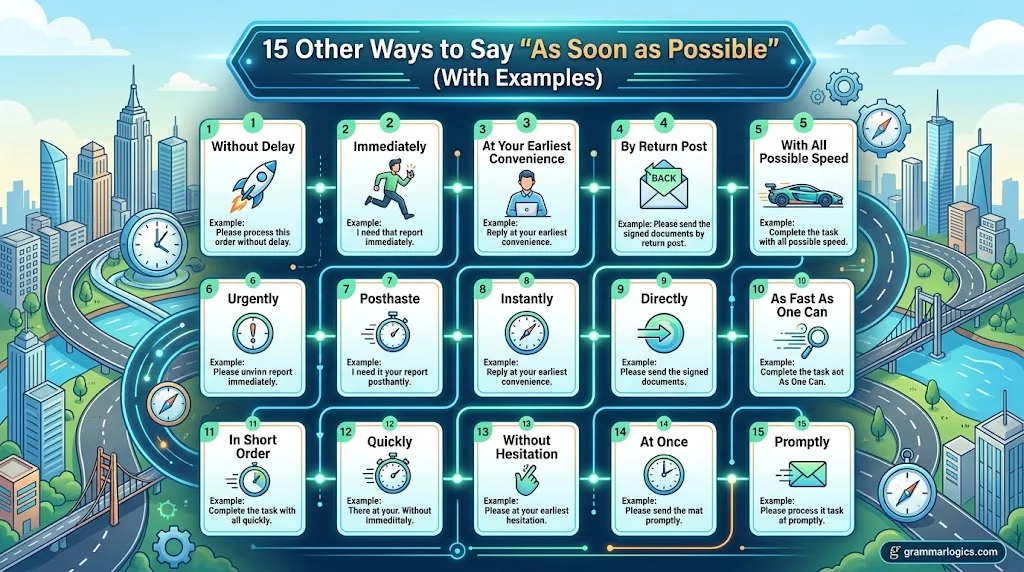
In this guide, you will discover 15 other ways to say “as soon as possible”, along with clear explanations and practical examples. These alternatives will help you choose the most appropriate expression for different situations, from formal workplace requests to casual conversations with friends and family. Some phrases communicate urgency, while others sound more polite, professional, or conversational. Understanding these small differences can improve your vocabulary and make your writing more engaging. Whether you are a student, employee, blogger, or English learner, these useful expressions will help you avoid repetition, strengthen your communication skills, and express urgency naturally without sounding unnecessarily demanding or impatient.
What Does “As Soon as Possible” Mean?
“As soon as possible” means doing something at the earliest practical opportunity. It communicates that a task, response, or action should happen quickly, without necessarily specifying an exact deadline. For example, “Please send me the report as soon as possible” means that the sender wants the report promptly, as soon as the recipient can reasonably provide it.
The phrase is commonly abbreviated as ASAP, especially in workplace messages and informal communication. Although it expresses urgency, it does not automatically mean “immediately.” The amount of urgency depends on the context, the relationship between the people communicating, and the importance of the task. If a precise deadline matters, providing a date or time is usually clearer than relying on this phrase alone.
Common Situations Where “As Soon as Possible” Is Used
People use this expression when they need something done quickly but may not have a fixed deadline. At work, it can refer to completing assignments, sending documents, responding to emails, or resolving problems. In customer service, it may communicate a desire for a prompt response or quick resolution. Students may use it when requesting information from a teacher, while friends and family members may use it to arrange plans or ask for assistance.
The phrase also appears in text messages, business correspondence, and formal requests. However, it can sound demanding if the urgency is unexplained or the recipient has competing responsibilities. Alternatives can help you communicate whether a task is genuinely urgent, simply time-sensitive, or important but flexible. Choosing precise wording makes expectations clearer and can reduce unnecessary pressure.
Is It Professional or Polite to Say “As Soon as Possible”?
Yes, “as soon as possible” is generally professional and acceptable, particularly when a task needs prompt attention. It is common in emails, project discussions, customer requests, and workplace instructions. However, the phrase can sound forceful when used without context, especially if the recipient does not know why the task is urgent or what deadline applies.
For a softer request, “At your earliest convenience” may sound more considerate, although it can also be less urgent. In a time-sensitive situation, “Please prioritize this task” communicates importance more directly. If a specific deadline is essential, stating the exact time or date is usually the clearest approach. The best expression depends on urgency, politeness, and the recipient’s responsibilities.
Advantages and Disadvantages of Saying “As Soon as Possible”
Advantages
- Communicates urgency: It signals that a task should not be unnecessarily delayed.
- Offers flexibility: It requests prompt action without automatically setting an exact deadline.
- Works in many settings: It is suitable for professional emails, personal messages, and everyday requests.
- Is widely understood: Most English speakers recognize the phrase and its common abbreviation, ASAP.
- Keeps messages concise: It communicates a need for speed without requiring a lengthy explanation.
Disadvantages
- Can sound demanding: Some readers may interpret it as pressure, particularly in workplace communication.
- Lacks a precise deadline: Different people may have different ideas about what counts as soon as possible.
- May create confusion: The recipient might not know whether the task is urgent or simply preferred sooner.
- Can be overused: Repeated urgent requests may make it harder to distinguish genuine priorities.
- Does not explain priority: The phrase does not communicate why the task needs to be completed quickly.
15 Synonyms and Alternatives for “As Soon as Possible”
- As Quickly as Possible
- At Your Earliest Convenience
- At the Earliest Opportunity
- As Soon as You Can
- Without Delay
- Immediately
- Right Away
- Promptly
- At the Earliest Possible Time
- As a Matter of Urgency
- At Your Earliest Availability
- As Soon as Circumstances Allow
- With All Due Speed
- Please Prioritize This
- At the First Available Opportunity
1. As Quickly as Possible
Meaning
“As quickly as possible” means completing an action with as little delay as practical. It emphasizes the speed of completing a task rather than simply asking for it to happen soon.
Definition
A request to perform an action at the fastest reasonable speed.
Detailed Explanation
This expression is very close in meaning to the original phrase and works in both spoken and written English. It emphasizes how quickly someone should act while still allowing for practical limitations. It can be useful when speed matters, such as finishing a task or fixing a problem. However, it does not remove the need to maintain quality or follow necessary procedures.
Scenario Examples
– Scenario: Asking a colleague to prepare a document.
Example: “Please complete the revised document as quickly as possible.”
– Scenario: Requesting help with a technical problem.
Example: “Could you restore access as quickly as possible? The team cannot log in.”
– Scenario: Arranging transportation.
Example: “We need to get to the station as quickly as possible.”
Best Use
Use this expression for time-sensitive tasks, practical requests, problem-solving, and situations where speed is important.
Tone
Tone: Direct, practical, urgent.
It communicates a clear need for speed without necessarily suggesting that the action must happen instantly.
2. At Your Earliest Convenience
Meaning
“At your earliest convenience” asks someone to do something when they can reasonably find time to complete it. It is generally softer and more considerate than “As Soon as Possible.”
Definition
A polite request for someone to act at the earliest suitable time within their schedule.
Detailed Explanation
This expression is especially useful when you want to respect another person’s workload or availability. It appears frequently in professional correspondence and formal requests. However, it can sound less urgent than the original phrase, so it may not be appropriate for emergencies or strict deadlines. If the task must be finished by a particular time, state that deadline clearly.
Scenario Examples
– Scenario: Requesting a review from a manager.
Example: “Please review the attached proposal at your earliest convenience.”
– Scenario: Asking an administrator for information.
Example: “Could you send me the updated registration details at your earliest convenience?”
– Scenario: Following up with a colleague.
Example: “I’d appreciate it if you could look over these notes at your earliest convenience.”
Best Use
Choose it for formal emails, professional requests, administrative communication, and nonurgent follow-ups.
Tone
Tone: Polite, respectful, professional.
It acknowledges that the recipient has other responsibilities and avoids placing unnecessary pressure on them.
3. At the Earliest Opportunity
Meaning
“At the earliest opportunity” means doing something at the first suitable chance. It suggests prompt action while recognizing that the person may need to wait until circumstances allow.
Definition
At the first available or appropriate moment when an action can be completed.
Detailed Explanation
This phrase works well when an action depends on an opening in someone’s schedule or a particular situation. It is slightly more formal than everyday expressions such as “as soon as you can.” It communicates that the task should not be postponed unnecessarily, but it does not always suggest an emergency. The phrase is particularly useful when you want to emphasize timing without specifying a deadline.
Scenario Examples
– Scenario: Asking an employee to report a workplace issue.
Example: “Please inform the supervisor at the earliest opportunity.”
– Scenario: Requesting a follow-up after a meeting.
Example: “Send the client the revised figures at the earliest opportunity.”
– Scenario: Asking someone to return a borrowed item.
Example: “Please return the equipment at the earliest opportunity.”
Best Use
Use it in professional instructions, formal correspondence, workplace procedures, and situations where action depends on availability.
Tone
Tone: Formal, measured, purposeful.
It expresses urgency without implying that the task must interrupt everything else.
4. As Soon as You Can
Meaning
“As soon as you can” asks someone to act quickly when they have the ability or opportunity to do so. It sounds more personal and conversational than the original phrase.
Definition
A request for someone to complete an action promptly when their circumstances allow.
Detailed Explanation
This expression is especially natural in conversations with friends, family members, and familiar colleagues. It recognizes that the recipient may have other commitments while still communicating that the matter should be handled soon. Depending on the context, it can sound gentler than “As Soon as Possible.” However, it does not establish a definite deadline, so it may need clarification for important work.
Scenario Examples
– Scenario: Asking a friend to call you.
Example: “Call me as soon as you can; I have some news to share.”
– Scenario: Requesting a missing file from a coworker.
Example: “Could you send me the spreadsheet as soon as you can?”
– Scenario: Asking a family member to check on something.
Example: “Please check whether the front door is locked as soon as you can.”
Best Use
Choose it for text messages, everyday conversation, friendly workplace requests, and personal communication.
Tone
Tone: Friendly, considerate, direct.
It balances urgency with an awareness of the other person’s availability.
5. Without Delay
Meaning
“Without delay” means that an action should happen promptly, with no unnecessary waiting. It sounds firmer than the original phrase and often appears in instructions or formal communication.
Definition
Immediately or promptly, without avoidable postponement.
Detailed Explanation
This expression is useful when a task needs to begin or be completed without unnecessary interruption. It can sound authoritative, particularly when used by a manager, administrator, or person responsible for a process. Unlike “At Your Earliest Convenience,” it leaves less room for flexible scheduling. It is best reserved for situations where postponement could cause a problem or where prompt action is clearly expected.
Scenario Examples
– Scenario: Addressing a safety concern at work.
Example: “Please report any damaged safety equipment without delay.”
– Scenario: Following up on an incorrect invoice.
Example: “The billing error should be corrected without delay.”
– Scenario: Giving an important administrative instruction.
Example: “Submit the missing paperwork without delay to avoid further processing issues.”
Best Use
Use it for formal instructions, important administrative tasks, safety matters, and issues requiring prompt attention.
Tone
Tone: Firm, formal, urgent.
It makes clear that unnecessary postponement is not acceptable.
6. Immediately
Meaning
“Immediately” means doing something at once, with virtually no waiting. It generally communicates a stronger sense of urgency than “As Soon as Possible.”
Definition
At once or with no intentional delay.
Detailed Explanation
This word is appropriate when an action must happen right now rather than at some later convenient moment. It is common in urgent instructions, emergency situations, and time-critical communication. Because it can sound commanding, using it for routine tasks may create unnecessary pressure. If a request is important but not genuinely immediate, a softer expression may be more appropriate.
Scenario Examples
– Scenario: Responding to a safety problem.
Example: “Leave the affected area immediately if you notice a gas leak.”
– Scenario: Giving an urgent technical instruction.
Example: “Please disconnect the malfunctioning device immediately.”
– Scenario: Correcting a critical mistake.
Example: “The incorrect announcement must be removed immediately.”
Best Use
Choose it for emergencies, safety instructions, critical problems, and tasks that cannot wait.
Tone
Tone: Strong, urgent, commanding.
Its intensity makes it suitable when immediate action matters, but it can sound too forceful for routine requests.
7. Right Away
Meaning
“Right away” means doing something immediately or very shortly after the request. It is a natural, everyday alternative to the original phrase.
Definition
At once or with very little delay.
Detailed Explanation
This expression is common in spoken English, text messages, and informal workplace conversations. It can communicate urgency without sounding as formal as “Without Delay.” Depending on the situation, it may also be used to reassure someone that you will act quickly. In formal reports or official instructions, “promptly” or “immediately” may fit better.
Scenario Examples
– Scenario: Responding to a customer’s request.
Example: “I’ll check your order status right away.”
– Scenario: Asking a family member to help.
Example: “Please bring the keys right away; we’re ready to leave.”
– Scenario: Handling a small office task.
Example: “I’ll send you the updated file right away.”
Best Use
Use it in everyday conversations, customer service, informal emails, and quick workplace exchanges.
Tone
Tone: Conversational, responsive, direct.
It sounds natural and approachable while making prompt action clear.
8. Promptly
Meaning
“Promptly” means doing something quickly and without unnecessary delay. It is a concise alternative that fits naturally into professional writing and business communication.
Definition
In a timely manner, with little or no unnecessary delay.
Detailed Explanation
This word is useful when you want to describe or request efficient action without sounding overly forceful. It often appears in instructions, customer service messages, workplace policies, and formal correspondence. Compared with “Immediately,” it allows some reasonable time for the action to be completed. It can also describe a response that arrives in a timely manner rather than demanding an instant reply.
Scenario Examples
– Scenario: Asking a team to handle a customer concern.
Example: “Please respond to customer complaints promptly.”
– Scenario: Explaining how an invoice should be handled.
Example: “Kindly process the invoice promptly to avoid payment delays.”
– Scenario: Describing an employee’s response.
Example: “The support team responded promptly to my request.”
Best Use
Choose it for business emails, customer service, formal instructions, workplace policies, and professional writing.
Tone
Tone: Professional, efficient, neutral.
It emphasizes timely action without adding the strong pressure associated with commands such as “Immediately.”
9. At the Earliest Possible Time
Meaning
“At the earliest possible time” means completing something at the first time that circumstances realistically permit. It emphasizes the earliest feasible timing rather than simply asking for a quick response.
Definition
At the earliest time that an action can realistically be carried out.
Detailed Explanation
This expression can be useful when an action depends on scheduling, resources, or other practical conditions. It is relatively formal and may sound more precise than casual alternatives. However, it can be wordier than necessary in everyday communication. When a firm deadline is important, an exact date and time will usually communicate expectations more effectively.
Scenario Examples
– Scenario: Scheduling a maintenance visit.
Example: “Please arrange an inspection at the earliest possible time.”
– Scenario: Requesting an appointment with an adviser.
Example: “I’d like to discuss this matter at the earliest possible time.”
– Scenario: Organizing a replacement delivery.
Example: “Please schedule the replacement shipment for the earliest possible time.”
Best Use
Use it for formal requests, scheduling, service arrangements, and tasks that depend on practical availability.
Tone
Tone: Formal, careful, time-conscious.
It stresses the earliest feasible opportunity while acknowledging that immediate action may not be possible.
10. As a Matter of Urgency
Meaning
“As a matter of urgency” signals that something needs to be treated as urgent and given prompt attention. It places emphasis on the importance and priority of the matter, not just the speed of completing it.
Definition
In a way that recognizes a task or issue as requiring urgent attention.
Detailed Explanation
This expression is often used in formal workplace communication, administrative correspondence, and situations involving important problems. It tells the recipient that the issue should receive serious attention rather than being treated as routine. Compared with the original phrase, it sounds more formal and can communicate a stronger sense of priority. It is best used when the circumstances genuinely justify urgency.
Scenario Examples
– Scenario: Reporting an important technical issue.
Example: “Please investigate the repeated system failures as a matter of urgency.”
– Scenario: Requesting attention to a serious customer complaint.
Example: “This complaint should be reviewed as a matter of urgency.”
– Scenario: Addressing an overdue administrative issue.
Example: “We need to resolve the outstanding payment matter as a matter of urgency.”
Best Use
Choose it for serious business issues, formal correspondence, significant complaints, and matters requiring priority attention.
Tone
Tone: Formal, serious, assertive.
It highlights the importance of a matter and signals that ordinary scheduling may not be sufficient.
11. At Your Earliest Availability
Meaning
“At your earliest availability” asks someone to act or make time at the first opportunity their schedule permits. It emphasizes the recipient’s availability more than the urgency of the task itself.
Definition
At the first time someone is available to respond, meet, or complete a task.
Detailed Explanation
This expression can work when arranging a meeting, requesting a conversation, or coordinating with someone who has a busy schedule. It sounds considerate because it recognizes the other person’s existing commitments. However, “at your earliest convenience” is generally the more established phrase for polite requests, while “at your earliest availability” is especially understandable when discussing schedules. Neither phrase guarantees an immediate response.
Scenario Examples
– Scenario: Arranging a meeting with a supervisor.
Example: “Could we schedule a brief discussion at your earliest availability?”
– Scenario: Requesting a consultation.
Example: “I’d appreciate an appointment at your earliest availability.”
– Scenario: Coordinating with a colleague in another department.
Example: “Please review the document at your earliest availability.”
Best Use
Use it for meeting requests, scheduling, consultations, and professional communication involving availability.
Tone
Tone: Courteous, professional, flexible.
It recognizes the recipient’s schedule while expressing a preference for an early opportunity.
12. As Soon as Circumstances Allow
Meaning
“As soon as circumstances allow” means doing something as quickly as the situation reasonably permits. It recognizes that external conditions may prevent immediate action.
Definition
At the earliest feasible time once the surrounding conditions make an action possible.
Detailed Explanation
This expression is useful when a task depends on circumstances beyond someone’s direct control. For example, travel disruptions, technical problems, weather, or pending approvals may affect when an action can take place. It sounds more understanding than a strict demand for immediate completion. Because it is relatively formal, a simpler expression may work better in a casual conversation.
Scenario Examples
– Scenario: Explaining when a delayed delivery can be completed.
Example: “We’ll arrange the delivery as soon as circumstances allow.”
– Scenario: Rescheduling work after a technical outage.
Example: “The team will resume testing as soon as circumstances allow.”
– Scenario: Discussing a visit during difficult travel conditions.
Example: “I’ll come to see you as soon as circumstances allow.”
Best Use
Choose it for formal updates, delayed plans, operational disruptions, and situations affected by external conditions.
Tone
Tone: Understanding, measured, formal.
It communicates a desire to act promptly without ignoring practical limitations.
13. With All Due Speed
Meaning
“With all due speed” means proceeding as quickly as the situation reasonably requires. It is a relatively formal expression that emphasizes prompt action.
Definition
With the speed appropriate to the urgency and circumstances of a task.
Detailed Explanation
This phrase can appear in formal instructions, official communication, and carefully worded requests. It conveys urgency while suggesting that the speed of action should be appropriate to the situation. However, it is less conversational than many everyday alternatives and may sound old-fashioned or overly elaborate in a casual email. For modern business writing, “promptly” is often a simpler choice.
Scenario Examples
– Scenario: Requesting the handling of an important document.
Example: “Please forward the signed documents with all due speed.”
– Scenario: Giving a formal instruction about an unresolved matter.
Example: “The outstanding issue should be addressed with all due speed.”
Best Use
Use it sparingly in formal correspondence, official instructions, or writing where a deliberately formal tone is appropriate.
Tone
Tone: Formal, emphatic, somewhat traditional.
It emphasizes speed but may sound less natural than contemporary alternatives in everyday conversation.
14. Please Prioritize This
Meaning
“Please prioritize this” asks someone to treat a task as more important than other work competing for their attention. Unlike the original phrase, it explicitly addresses priority, not just speed.
Definition
A request to give a particular task greater importance or attention than competing tasks.
Detailed Explanation
This expression is useful when a task needs to move higher on someone’s to-do list. It is common in workplaces where people manage several responsibilities at once. However, prioritizing something does not necessarily mean completing it immediately; the person may still need time to finish it properly. If you have a deadline, explain when the task is needed so the recipient can plan accordingly.
Scenario Examples
– Scenario: Asking a team to focus on a client issue.
Example: “Please prioritize this client request so we can provide an update today.”
– Scenario: Managing a software problem before a launch.
Example: “Please prioritize this bug because it affects the checkout process.”
– Scenario: Requesting a review before a scheduled presentation.
Example: “Please prioritize this document review ahead of tomorrow’s presentation.”
Best Use
Choose it for project management, workplace coordination, competing deadlines, and tasks that need special attention.
Tone
Tone: Direct, managerial, purposeful.
It makes the relative importance of the task clear without automatically requiring an immediate finish.
15. At the First Available Opportunity
Meaning
“At the first available opportunity” means taking action at the first suitable chance. It is close in meaning to “At the Earliest Opportunity,” with particular emphasis on the first opportunity that becomes available.
Definition
At the first suitable moment when an action can be carried out.
Detailed Explanation
This expression is useful when timing depends on an opening in a schedule or a suitable moment to act. It works well in workplace instructions, formal messages, and practical arrangements. It does not necessarily communicate an emergency; rather, it asks the recipient to avoid putting the task off once an opportunity arises. In casual conversation, a shorter phrase such as “as soon as you can” will often sound more natural.
Scenario Examples
– Scenario: Asking a colleague to pass on a message.
Example: “Please share the revised instructions at the first available opportunity.”
– Scenario: Requesting a follow-up after an appointment.
Example: “Contact the office at the first available opportunity to confirm your next visit.”
Best Use
Use it for formal instructions, scheduling, follow-ups, and tasks that depend on a suitable opening.
Tone
Tone: Formal, practical, measured.
It communicates prompt action while recognizing that the right opportunity may not exist immediately.
FAQs
1. What is another way to say “As Soon as Possible”?
Some common alternatives are “as quickly as possible,” “promptly,” “right away,” and “at the earliest opportunity.” Choose based on how urgent the task is and how formal you want to sound. For a softer request, “at your earliest convenience” is often suitable.
2. What does “As Soon as Possible” mean?
“As Soon as Possible” means completing a task or taking action at the earliest practical opportunity. It communicates urgency without necessarily setting an exact deadline. The intended timing depends on the situation, so providing a specific deadline can prevent misunderstandings.
3. Is “As Soon as Possible” professional?
Yes, it is widely used in professional emails, workplace instructions, and business communication. However, it can sound demanding if the urgency is unclear. Expressions such as “promptly” or “at your earliest convenience” may be more suitable when you want a different level of formality or pressure.
4. What is a more polite way to say “As Soon as Possible”?
“At your earliest convenience” is a common polite alternative when the request is not urgent enough to require immediate action. You can also say “as soon as you can” for a more conversational tone. If the task has a strict deadline, politely state the deadline rather than leaving the timing open to interpretation.
5. Which alternative works best in formal communication?
“Promptly,” “at the earliest opportunity,” and “without delay” can all work in formal communication. “Promptly” is generally neutral and professional, while “without delay” sounds firmer. For a request that needs special attention, “Please prioritize this” may be more effective because it communicates the task’s importance.
Conclusion
Choosing the right alternative to “As Soon as Possible” helps you communicate urgency without sounding unnecessarily demanding. Expressions such as “promptly” and “at the earliest opportunity” work well in professional settings, while “right away” and “as soon as you can” sound more natural in everyday conversations.
When a task is genuinely urgent, stronger wording may be appropriate; when you want to respect someone’s schedule, a softer expression can be more considerate. Remember that speed, priority, and deadlines are not always the same thing. If timing is important, explain what needs to be done and when you need it completed. By matching your wording to the situation, you can make your requests clearer, more respectful, and easier for others to understand.