Finding the right words for “talks about” can make your writing clearer, more natural, and more engaging for readers.
Whether you are writing a blog post, preparing an essay, or having a conversation, using different expressions for “talks about” can improve your vocabulary and communication skills. Common alternatives include discusses, mentions, explains, describes, and addresses. Each phrase has a slightly different meaning and works best in a particular context. For example, “discusses” suits a detailed conversation, while “mentions” is better for a brief reference. Learning these alternatives helps you express ideas more precisely and avoid repeating the same words. It also makes your writing sound more professional and interesting. In this guide, you will discover useful alternatives to “talks about” with clear explanations and practical examples to help you choose the right expression for everyday conversations, academic writing, and professional communication.
Choosing the best alternative depends on your audience, purpose, and writing style. In formal documents, expressions such as “examines,” “addresses,” and “elaborates on” can communicate ideas more professionally. In casual conversations, phrases like “speaks about,” “brings up,” and “goes over” may sound more natural. Understanding these differences allows you to select words that fit your message without changing its intended meaning. For bloggers and content writers, using varied vocabulary can improve readability and create a smoother experience for readers. However, every alternative should fit the context naturally rather than being added just to avoid repetition. Throughout this article, you will find 15 other ways to say “talks about,” along with useful examples that show how each expression works in real situations. These alternatives will help you write with greater confidence, communicate your ideas effectively, and make your content more engaging for different audiences.
What Does “Talks About” Mean?
The phrase “talks about” means to speak about, discuss, mention, or explain a particular subject, person, event, or idea. It is the third-person singular form of the verb phrase “talk about,” as in “She talks about her favorite books.” The expression is widely used in everyday conversations, academic writing, workplace discussions, and descriptions of books, films, or presentations. Depending on the context, it can refer to a brief mention of something or a longer conversation that explores a topic in detail. Choosing an alternative depends on whether you want to emphasize a simple mention, a detailed discussion, or a formal explanation.
Common Situations Where “Talks About” Is Used
People use “talks about” in many everyday and professional situations. In casual conversations, someone might talk about their weekend, hobbies, or personal experiences. At school, a student might describe what an essay or presentation talks about. In the workplace, a colleague may explain what a meeting, report, or proposal covers.
The expression also appears in book reviews, news reports, social media posts, and academic writing. For example, a reviewer might say that a novel talks about friendship, while a teacher might explain that a lesson discusses environmental protection. In more formal situations, alternatives such as “discusses,” “examines,” or “addresses” can sound more precise and polished.
Is It Professional or Polite to Say “Talks About”?
Yes, “talks about” is both polite and acceptable in professional communication. It is a straightforward expression that works well in conversations, presentations, and informal writing. However, in formal reports, academic essays, or business documents, a more specific verb may communicate your meaning more clearly. For example, “The report discusses customer feedback” sounds more professional than “The report talks about customer feedback.” Similarly, “The article examines the causes of climate change” suggests a more detailed analysis. The best choice depends on the subject and purpose of your message. You do not need to avoid “talks about”; simply choose an alternative when it better matches your intended tone.
Advantages and Disadvantages of Saying “Talks About”
Advantages
- Easy to understand: The phrase uses familiar words that English learners and native speakers recognize.
- Versatile: It works in casual conversations, presentations, and general descriptions.
- Natural and friendly: It sounds approachable rather than overly formal.
- Flexible: It can describe a wide range of subjects, from personal experiences to academic topics.
Disadvantages
- Sometimes too general: It does not always explain whether someone is mentioning, analyzing, or explaining a subject.
- Can sound repetitive: Using it repeatedly in an essay or article may make the writing less varied.
- Less precise in formal writing: More specific verbs can better communicate the depth or purpose of a discussion.
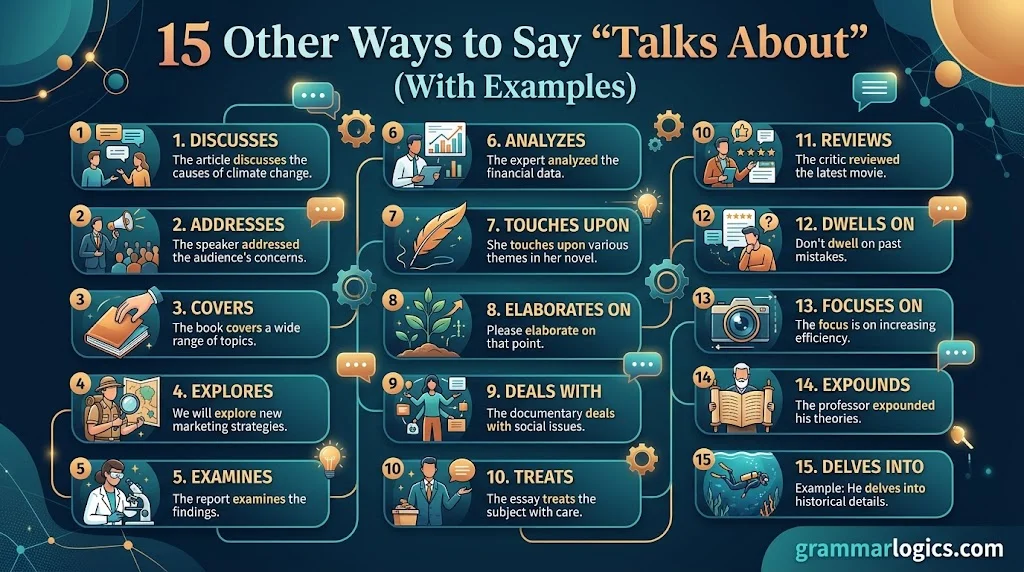
15 Synonyms for “Talks About”
- Discusses
- Mentions
- Covers
- Explains
- Addresses
- Describes
- Explores
- Examines
- Refers to
- Focuses on
- Deals with
- Elaborates on
- Comments on
- Presents
- Highlights
1. Discusses
Meaning
“Discusses” means talking about a subject in some detail, often by sharing ideas, opinions, facts, or different viewpoints. It is one of the closest alternatives to “talks about.”
Definition
To discuss something means to consider or talk about a topic with attention and detail.
Detailed Explanation
“Discusses” is especially useful when the subject receives more than a passing mention. It sounds slightly more formal and precise than “talks about,” making it suitable for professional, academic, and everyday contexts. The word does not necessarily mean that several people are involved; a writer or speaker can discuss a subject independently. Choose it when you want to communicate that a topic receives meaningful attention.
Scenario Examples
– Scenario: Describing an article. Example: The article discusses the benefits of learning a second language.
– Scenario: Explaining a meeting agenda. Example: Our manager discusses the new project requirements during Monday’s meeting.
– Scenario: Talking about a class assignment. Example: My essay discusses the importance of healthy eating habits.
Best Use
Use “discusses” in essays, reports, meetings, presentations, and conversations involving ideas or opinions.
Tone
Tone: Professional, clear, and neutral. It communicates that the subject deserves attention.
2. Mentions
Meaning
“Mentions” means referring to something briefly without necessarily explaining it in detail. It is useful when someone brings up a topic as one small part of a larger conversation.
Definition
To mention something means to refer to it briefly in speech or writing.
Detailed Explanation
Unlike “discusses,” “mentions” usually suggests limited detail. Someone may mention a new policy without explaining how it works. This expression is natural when you want to emphasize that a person, document, or conversation includes a brief reference to something. It is not a perfect substitute when the original meaning involves a detailed conversation.
Scenario Examples
– Scenario: Describing a book. Example: The author mentions climate change in the final chapter.
– Scenario: Recalling a conversation. Example: She mentions your suggestion during our lunch break.
– Scenario: Writing a professional email. Example: The report mentions several possible improvements to the current process.
Best Use
Choose “mentions” when describing brief references in emails, conversations, books, articles, or presentations.
Tone
Tone: Neutral, simple, and direct. It suggests that a subject is brought up without necessarily receiving much attention.
3. Covers
Meaning
“Covers” means including or dealing with a particular subject, often as part of a larger piece of content. It is especially common when describing reports, lessons, articles, and presentations.
Definition
To cover a topic means to include it or provide information about it.
Detailed Explanation
“Covers” focuses on the range of information included rather than the act of speaking itself. For example, a course might cover grammar, pronunciation, and vocabulary. The word is often more natural than “talks about” when describing the contents of a document or lesson. However, it does not always imply an in-depth analysis; the amount of detail depends on the context.
Scenario Examples
– Scenario: Describing a training session. Example: Today’s workshop covers basic communication skills.
– Scenario: Reviewing a report. Example: The report covers sales trends from the past six months.
– Scenario: Recommending a book. Example: This book covers everything you need to know about starting a small garden.
Best Use
Use “covers” for courses, reports, articles, presentations, books, and other content that includes several topics.
Tone
Tone: Informative, practical, and professional. It emphasizes the material included.
4. Explains
Meaning
“Explains” means making an idea, process, or situation easier to understand. It is appropriate when someone does more than mention a subject and helps the audience understand it.
Definition
To explain something means to make its meaning, reasons, or workings clear.
Detailed Explanation
“Explains” is more specific than “talks about” because it emphasizes clarity and understanding. A teacher explains a difficult concept, while a guide explains how a machine works. It is a good choice when the speaker provides reasons, instructions, or supporting details. However, if someone simply shares an opinion without clarifying anything, “explains” may not accurately describe the situation.
Scenario Examples
– Scenario: A teacher helping students. Example: The teacher explains how fractions work.
– Scenario: Describing an instruction manual. Example: This guide explains the steps for installing the software.
– Scenario: Discussing a decision. Example: He explains why the team changed its original plan.
Best Use
Choose “explains” for teaching, instructions, presentations, reports, and situations where clarity is important.
Tone
Tone: Helpful, informative, and clear. It suggests that the audience gains a better understanding.
5. Addresses
Meaning
“Addresses” means dealing with a particular issue, question, concern, or problem. It is often used when someone responds to an important matter rather than simply mentioning it.
Definition
To address a topic means to consider, respond to, or deal with it directly.
Detailed Explanation
“Addresses” is particularly useful in professional, academic, and public communication. A report may address customer complaints, or a manager may address concerns about a new policy. The word often implies that the subject requires attention or a response. It is less suitable for every casual topic, such as describing what someone talks about during a relaxed conversation with a friend.
Scenario Examples
– Scenario: Writing a business report. Example: The report addresses the main challenges facing the company.
– Scenario: Discussing a classroom issue. Example: The teacher addresses students’ concerns about the upcoming exam.
– Scenario: Describing a public speech. Example: Her speech addresses the need for better public transportation.
Best Use
Use “addresses” in reports, formal discussions, policy documents, presentations, and conversations about concerns or problems.
Tone
Tone: Professional, direct, and purposeful. It indicates that a matter is being dealt with intentionally.
6. Describes
Meaning
“Describes” means explaining what someone or something is like by providing details, characteristics, or observations.
Definition
To describe something means to give information about its appearance, nature, qualities, or features.
Detailed Explanation
“Describes” works well when the focus is on providing details rather than discussing opinions or debating an issue. For example, a writer may describe a character’s personality or a traveler may describe a memorable place. It can replace “talks about” when the speaker is explaining what something looks like or what it is like. It is not interchangeable with “discusses” in every context because description does not necessarily involve analysis.
Scenario Examples
– Scenario: Reviewing a novel. Example: The author describes a small village surrounded by mountains.
– Scenario: Sharing a travel experience. Example: She describes the local market as colorful and lively.
– Scenario: Explaining a person in a story. Example: The article describes the scientist as patient and curious.
Best Use
Choose “describes” for storytelling, reviews, reports, personal experiences, and writing that presents characteristics or details.
Tone
Tone: Clear, descriptive, and neutral. It helps readers form a picture of the subject.
7. Explores
Meaning
“Explores” means examining a topic, idea, or experience to understand it more deeply. It often suggests curiosity, discovery, or consideration of different perspectives.
Definition
To explore a subject means to investigate or consider it in detail.
Detailed Explanation
“Explores” can make writing sound more engaging because it suggests that the subject contains ideas worth discovering. Authors explore themes, researchers explore questions, and speakers explore possible solutions. Compared with “talks about,” it often implies a deeper or more open-ended examination. Use it when the discussion goes beyond basic information and considers different aspects of a subject.
Scenario Examples
– Scenario: Reviewing a novel. Example: The novel explores the relationship between memory and identity.
– Scenario: Introducing a research project. Example: Our study explores how sleep affects concentration.
– Scenario: Describing a podcast episode. Example: This episode explores different approaches to managing stress.
Best Use
Use “explores” in academic writing, reviews, documentaries, podcasts, research descriptions, and creative discussions.
Tone
Tone: Thoughtful, curious, and analytical. It suggests an interest in discovering more about a topic.
8. Examines
Meaning
“Examines” means looking at a subject carefully to understand its details, causes, effects, or significance.
Definition
To examine something means to study or inspect it closely.
Detailed Explanation
“Examines” is stronger and more analytical than “talks about.” It suggests careful attention to evidence, details, or different parts of an issue. Researchers examine data, students examine arguments, and reports examine possible risks. The expression is particularly useful when a piece of writing or a presentation evaluates a subject rather than simply providing general information.
Scenario Examples
– Scenario: Describing a research paper. Example: The paper examines the effects of air pollution on urban communities.
– Scenario: Discussing a historical event. Example: The documentary examines the causes of the economic crisis.
– Scenario: Reviewing a proposal. Example: The committee examines each application before making a decision.
Best Use
Choose “examines” for research papers, analytical essays, formal reports, investigations, and detailed evaluations.
Tone
Tone: Analytical, formal, and precise. It suggests a careful review of the subject.
9. Refers to
Meaning
“Refers to” means mentioning, identifying, or pointing toward a particular person, thing, concept, or subject. It can also clarify what a word or expression means in a specific context.
Definition
To refer to something means to mention it or indicate what it relates to.
Detailed Explanation
This expression is useful when a speaker or writer points toward a particular subject without necessarily explaining it fully. For instance, a sentence may refer to a previous discussion, or a technical term may refer to a specific process. Unlike “discusses,” the phrase does not automatically suggest an extended conversation. The surrounding sentence determines whether it means a brief mention or a more specific connection.
Scenario Examples
– Scenario: Explaining a document. Example: The final paragraph refers to the recommendations made earlier.
– Scenario: Clarifying a term. Example: In this report, the term “growth” refers to an increase in annual revenue.
– Scenario: Speaking about a previous conversation. Example: She refers to the issue we discussed last week.
Best Use
Use “refers to” in explanations, academic writing, technical documents, and conversations involving specific people, ideas, or earlier information.
Tone
Tone: Precise, neutral, and explanatory. It establishes a connection between the statement and its subject.
10. Focuses On
Meaning
“Focuses on” means giving particular attention to one subject, issue, or aspect rather than covering everything equally.
Definition
To focus on something means to direct attention toward it.
Detailed Explanation
“Focuses on” is a strong choice when you want to identify the main subject of a discussion, article, lesson, or project. It tells readers what receives the most attention. For example, a documentary may focus on wildlife conservation rather than environmental issues in general. The phrase does not necessarily mean that other subjects are absent; it simply identifies the central emphasis.
Scenario Examples
– Scenario: Describing a school assignment. Example: My presentation focuses on the causes of water pollution.
– Scenario: Introducing a business meeting. Example: Today’s meeting focuses on improving customer service.
– Scenario: Reviewing a documentary. Example: The documentary focuses on the daily lives of rural communities.
Best Use
Choose “focuses on” when describing the main subject of a presentation, article, lesson, project, or meeting.
Tone
Tone: Clear, purposeful, and professional. It highlights the central point.
11. Deals With
Meaning
“Deals with” means addressing, handling, or discussing a particular subject or problem. Its meaning depends on whether the context concerns a topic or a practical situation.
Definition
To deal with something means to address a subject or manage a situation.
Detailed Explanation
When describing a book or article, “deals with” often means that the content concerns a particular subject. In everyday conversation, it can also mean handling a challenge or responsibility. For example, a report deals with workplace safety, while a manager deals with a customer complaint. Because the phrase has several uses, make sure the surrounding sentence makes your intended meaning clear.
Scenario Examples
– Scenario: Describing an article. Example: The article deals with the challenges of remote learning.
– Scenario: Talking about a workplace issue. Example: Our supervisor deals with employee concerns fairly.
– Scenario: Explaining a book’s subject. Example: The book deals with family relationships and personal change.
Best Use
Use “deals with” in everyday conversations, general descriptions, articles, and discussions about practical challenges.
Tone
Tone: Straightforward, conversational, and sometimes practical. It can sound less formal than “examines” or “addresses.”
12. Elaborates On
Meaning
“Elaborates on” means providing additional details or expanding on something that has already been mentioned.
Definition
To elaborate on a subject means to explain it more fully by adding information.
Detailed Explanation
“Elaborates on” is useful when a person develops an idea beyond a brief statement. A speaker might introduce a proposal and then elaborate on its benefits, or a writer might provide further details about a key argument. Unlike “talks about,” this expression usually suggests that some information has already been introduced. It is therefore a good choice when the goal is to add depth, clarification, or supporting details.
Scenario Examples
– Scenario: A speaker answering a question. Example: The presenter elaborates on the reasons behind the proposed changes.
– Scenario: Writing a report. Example: The second section elaborates on the findings introduced earlier.
– Scenario: A teacher explaining a lesson. Example: Our instructor elaborates on the topic with additional examples.
Best Use
Choose “elaborates on” for presentations, reports, academic writing, interviews, and explanations that expand on existing information.
Tone
Tone: Detailed, informative, and moderately formal. It signals that further explanation is being provided.
13. Comments On
Meaning
“Comments on” means expressing an opinion, observation, or reaction about a particular subject.
Definition
To comment on something means to give an opinion or make a statement about it.
Detailed Explanation
“Comments on” is appropriate when the speaker offers a response or viewpoint rather than simply presenting facts. A journalist may comment on a recent event, while a colleague may comment on a proposed change. The phrase can sound neutral, but the actual tone depends on the opinion being expressed. It is not an exact substitute for “talks about” when the person provides a full explanation without giving a particular reaction.
Scenario Examples
– Scenario: Discussing a public event. Example: The analyst comments on the latest economic developments.
– Scenario: Giving workplace feedback. Example: Our manager comments on the team’s progress during the review.
– Scenario: Reviewing a film. Example: The critic comments on the film’s pacing and character development.
Best Use
Use “comments on” in reviews, interviews, meetings, news discussions, and situations where someone shares an observation or opinion.
Tone
Tone: Observational, neutral, or opinion-based. It emphasizes the speaker’s response to a subject.
14. Presents
Meaning
“Presents” means introducing or delivering information, ideas, arguments, or findings to an audience.
Definition
To present something means to show, explain, or communicate it in an organized way.
Detailed Explanation
“Presents” is especially helpful when describing formal communication, such as a speech, report, lecture, or research paper. It emphasizes how information is delivered rather than merely stating that someone talks about a topic. A report may present evidence, while a speaker may present a new proposal to colleagues. Use this expression when the subject is shared in a structured or purposeful way.
Scenario Examples
– Scenario: Describing a presentation. Example: The speaker presents three practical solutions to the problem.
– Scenario: Discussing research findings. Example: The paper presents evidence supporting the proposed approach.
– Scenario: Introducing a business proposal. Example: She presents her marketing plan to the leadership team.
Best Use
Choose “presents” for speeches, presentations, research papers, proposals, reports, and organized delivery of information.
Tone
Tone: Professional, structured, and confident. It suggests that information is being delivered purposefully.
15. Highlights
Meaning
“Highlights” means drawing attention to the most important, interesting, or noticeable parts of a subject.
Definition
To highlight something means to emphasize it so that people notice its significance.
Detailed Explanation
“Highlights” is useful when a speaker or writer wants to emphasize key points rather than discuss every detail. A report might highlight important findings, while a presentation might highlight the main benefits of a proposal. The expression suggests emphasis and importance, which makes it different from the more general “talks about.” It works best when the information being shared includes notable points that deserve special attention.
Scenario Examples
– Scenario: Summarizing a report. Example: The report highlights three areas where the company can improve.
– Scenario: Describing a presentation. Example: Her presentation highlights the importance of teamwork.
– Scenario: Writing a travel article. Example: The guide highlights several attractions worth visiting in the city.
Best Use
Use “highlights” in summaries, reports, presentations, articles, reviews, and other content that emphasizes key information.
Tone
Tone: Positive, focused, and informative. It directs attention toward the most significant details.
FAQs
1. What is another word for “talks about”?
Some common alternatives to “talks about” include discusses, mentions, explains, describes, addresses, and covers. The best choice depends on the context and the message you want to communicate.
2. What is a formal way to say “talks about”?
Formal alternatives include discusses, examines, addresses, explores, and elaborates on. These expressions work well in academic essays, professional reports, business documents, and formal presentations.
3. What is a simple way to say “talks about”?
You can use simple expressions such as speaks about, mentions, discusses, or brings up. These phrases are easy to understand and suitable for everyday conversations and informal writing.
4. Can I use “discusses” instead of “talks about”?
Yes, “discusses” is a common alternative to “talks about.” However, “discusses” often suggests a more detailed conversation or examination of a topic, while “talks about” can be more general.
5. How can I avoid repeating “talks about” in writing?
To avoid repetition, choose alternatives such as explains, describes, mentions, examines, and covers. Always consider the context and intended meaning to ensure your writing remains clear, natural, and engaging.
Conclusion
Learning other ways to say “talks about” can help you improve your vocabulary, strengthen your writing, and communicate more effectively. Words and phrases such as discusses, mentions, explains, addresses, and explores offer useful alternatives for different situations. Whether you are writing a blog post, preparing an academic assignment, creating professional content, or having a casual conversation, choosing the right expression makes your message clearer and more natural.
Remember that not every alternative has exactly the same meaning. Some phrases work better in formal writing, while others are more suitable for everyday communication. By understanding these differences and practicing them in your sentences, you can avoid unnecessary repetition and make your writing more engaging. Use these 15 alternatives to “talks about” to express your ideas with greater clarity and confidence.