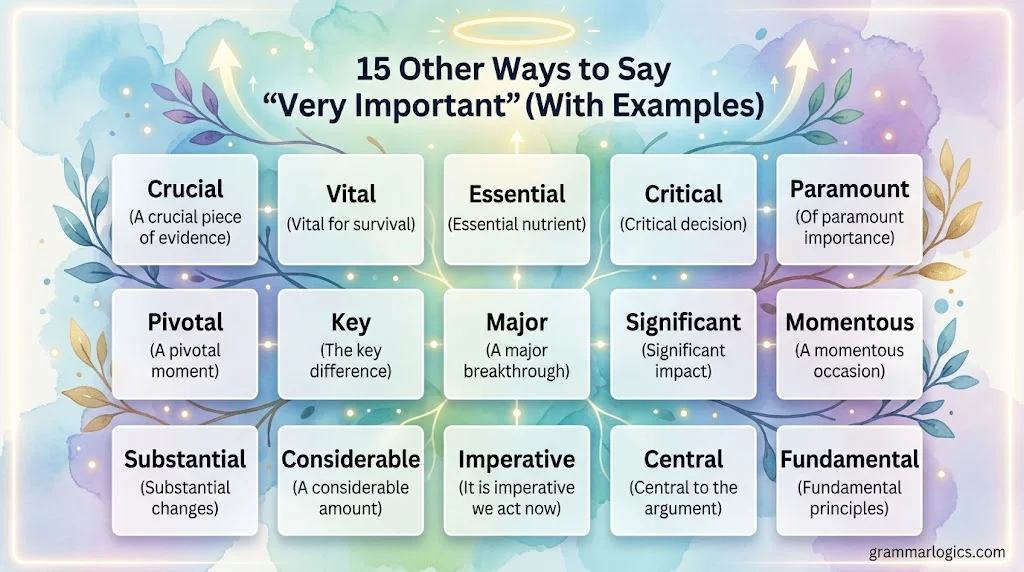
Finding the right words for “very important” can make your writing clearer, stronger, and more professional.
Whether you are writing a blog post, email, essay, or everyday message, using suitable synonyms for very important helps you express the value of something more effectively. Although “very important” is common and easy to understand, repeating it too often can make your writing sound less engaging. Choosing alternative expressions allows you to communicate your message with greater precision and confidence. From formal phrases like “of great significance” to simple expressions like “really matters,” there are many options for different situations. The best choice depends on your audience, purpose, and tone.
In this guide, you will discover 15 other ways to say “very important”, along with clear explanations and practical examples to help you use each phrase naturally. These alternatives can improve your vocabulary, writing style, and communication skills while making your sentences more interesting and meaningful. Whether you need professional language for workplace emails, academic expressions for essays, or conversational phrases for daily communication, you will find useful options here. Each alternative offers a slightly different meaning or level of emphasis, helping you choose the most appropriate words for your context. By learning these expressions, you can avoid repetition, strengthen your message, and make your writing more effective for readers.
What Does “Very Important” Mean?
The phrase “very important” means that something has a high level of significance, value, priority, or influence. It describes a person, idea, task, decision, event, or piece of information that deserves special attention. For example, saying “Your health is very important” emphasizes the value of staying healthy, while “This meeting is very important” suggests that the meeting deserves serious attention or preparation. The phrase can communicate different levels of urgency depending on the context. In everyday English, it is a straightforward expression that helps speakers emphasize what matters most without using complicated vocabulary.
Common Situations Where “Very Important” Is Used
People use “very important” in many situations where they need to highlight something that deserves attention. In everyday conversations, it can describe personal values, family relationships, or meaningful decisions. In workplaces, it may emphasize deadlines, business goals, responsibilities, and instructions. Students use it when discussing key lessons, examination topics, and academic concepts. In emails and formal writing, the phrase can draw attention to essential information or explain why a particular action matters.
Although the expression is clear and widely understood, choosing a more specific alternative can make communication more effective. For instance, “essential” emphasizes necessity, while “critical” can communicate urgency or serious consequences. Understanding these differences helps you select wording that suits your audience and purpose.
Is It Professional or Polite to Say “Very Important”?
Yes, “very important” is both professional and polite when used appropriately. It is a neutral expression that works well in emails, reports, presentations, meetings, and academic writing. For example, “It is very important that we meet the deadline” communicates a clear expectation without sounding rude. However, repeating the phrase throughout a document may make the writing less precise or persuasive. In formal communication, alternatives such as “essential,” “significant,” and “of great importance” may sound more polished. When urgency matters, “critical” or “imperative” can communicate stronger emphasis. The best choice depends on whether you want to highlight necessity, value, urgency, or overall significance.
Advantages and Disadvantages of Saying “Very Important”
Advantages
The main advantage of “very important” is its simplicity. Almost everyone understands what it means, making it useful in conversations, emails, presentations, and educational materials. It emphasizes significance without requiring advanced vocabulary. The phrase is also flexible because it can describe tasks, decisions, relationships, information, and responsibilities. Its neutral tone makes it suitable for both casual and professional settings.
Disadvantages
The phrase can become repetitive when used frequently in the same article, report, or conversation. It may also lack precision because it does not explain why something matters. For example, calling a task “very important” does not necessarily tell the reader whether it is essential, urgent, valuable, or influential. Choosing a more specific expression can communicate the intended meaning more clearly and help readers understand the situation.
15 Synonyms for “Very Important”
- Crucial
- Essential
- Extremely Significant
- Critical
- Vital
- Of Great Importance
- Paramount
- Indispensable
- High-Priority
- Fundamental
- Consequential
- Imperative
- Meaningful
- Key
- Of Utmost Importance
1. Crucial
Meaning
Crucial describes something that is extremely important to the success, outcome, or continuation of a situation. It often suggests that the result depends heavily on it.
Definition
Crucial means essential to a particular outcome or decision.
Detailed Explanation
The word crucial is stronger and more focused than the general phrase “very important.” It is especially useful when a decision, action, or piece of information can significantly affect the final result. Unlike a phrase that simply describes value, crucial often suggests that something must not be overlooked. It works naturally in professional, academic, and everyday communication. Use it when you want to highlight the direct influence something has on what happens next.
Scenario Examples
– Scenario: A team is preparing a major presentation.
Example: “Your feedback is crucial to the success of this presentation.”
– Scenario: A student is preparing for an examination.
Example: “Reviewing your notes is crucial before the final exam.”
– Scenario: A family is making a financial decision.
Example: “Having an emergency fund is crucial when planning for unexpected expenses.”
Best Use
Use crucial in business reports, planning discussions, academic writing, decision-making, and situations where the outcome depends on a particular factor.
Tone
Tone: Strong, direct, professional.
It emphasizes the significant effect something may have on a result.
2. Essential
Meaning
Essential describes something that is necessary or required for a particular purpose. It emphasizes need rather than importance alone.
Definition
Essential means absolutely necessary or fundamental to achieving something.
Detailed Explanation
While “very important” can describe something valuable, essential indicates that something is needed. It is a particularly useful choice when discussing requirements, instructions, skills, or resources. The word sounds clear and professional without being overly dramatic. It is not always interchangeable with the original phrase because something can be important without being strictly necessary. Choose essential when you want readers to understand that something cannot reasonably be omitted.
Scenario Examples
– Scenario: A manager explains the requirements for a project.
Example: “Clear communication is essential for completing this project successfully.”
– Scenario: A student prepares a research assignment.
Example: “Accurate sources are essential for a reliable research paper.”
– Scenario: Someone is preparing for a hiking trip.
Example: “Carrying enough water is essential during a long hike.”
Best Use
Use essential in instructions, workplace communication, educational materials, checklists, and discussions about necessary resources or conditions.
Tone
Tone: Practical, professional, authoritative.
It communicates necessity in a clear and uncomplicated way.
3. Extremely Significant
Meaning
Extremely significant describes something that has exceptional importance, meaning, or influence. It is particularly suitable when discussing major events, findings, or changes.
Definition
Extremely significant means having a very high degree of importance or consequence.
Detailed Explanation
This expression emphasizes the degree of significance rather than simply stating that something matters. It can describe a major discovery, a meaningful development, or an event with lasting effects. Compared with “very important,” it sounds more analytical and is often useful in formal writing. However, significant sometimes refers to measurable or meaningful differences, so the surrounding context should make the intended meaning clear. Avoid using it for ordinary matters that do not warrant such strong emphasis.
Scenario Examples
– Scenario: A researcher discusses a major finding.
Example: “The study revealed an extremely significant change in the results.”
– Scenario: A company reaches an important milestone.
Example: “Opening our second office was an extremely significant achievement for the business.”
– Scenario: A family celebrates a special occasion.
Example: “This anniversary is extremely significant to our family.”
Best Use
Use extremely significant in research discussions, reports, historical writing, formal presentations, and situations involving major developments.
Tone
Tone: Formal, analytical, emphatic.
It gives an idea greater weight and emphasizes its significance.
4. Critical
Meaning
Critical describes something that is extremely important, especially when success, safety, or a decision depends on it. It can also suggest urgency.
Definition
Critical means having a decisive effect on a situation or requiring immediate attention.
Detailed Explanation
The word critical can communicate greater urgency than “very important.” In workplaces, it often describes deadlines, system problems, decisions, and responsibilities that need prompt attention. In other contexts, it may refer to a factor that strongly influences an outcome. However, critical can sound alarming when used unnecessarily, particularly in messages about problems or risks. Choose it when the situation genuinely calls for serious attention, rather than simply describing something valuable or interesting.
Scenario Examples
– Scenario: A team discovers a technical issue before launch.
Example: “Fixing this security flaw is critical before the software goes live.”
– Scenario: A colleague discusses a project deadline.
Example: “It is critical that we submit the proposal by Friday.”
– Scenario: Someone explains emergency preparedness.
Example: “Keeping emergency contact numbers available is critical during a crisis.”
Best Use
Use critical in urgent workplace messages, risk assessments, technical discussions, safety instructions, and time-sensitive decisions.
Tone
Tone: Serious, urgent, direct.
It signals that overlooking the issue could have meaningful consequences.
5. Vital
Meaning
Vital describes something extremely important to the existence, health, success, or proper functioning of a person or system.
Definition
Vital means necessary for life, continued functioning, or successful results.
Detailed Explanation
Vital is especially effective when describing something that plays a central role in keeping a person, organization, or process functioning. It can sound more forceful than “very important,” particularly in discussions about health, safety, and essential operations. The word also works in broader contexts, such as teamwork and communication. Unlike essential, which often focuses on requirements, vital can emphasize how strongly something supports an important outcome. Select it when the relationship between something and its result deserves emphasis.
Scenario Examples
– Scenario: A doctor explains the value of rest.
Example: “Adequate sleep is vital for maintaining good health.”
– Scenario: A business reviews its customer service process.
Example: “Customer feedback is vital to improving our services.”
– Scenario: A group organizes a community event.
Example: “Volunteers play a vital role in making the event possible.”
Best Use
Use vital in discussions about health, essential operations, teamwork, community support, and the factors that sustain success.
Tone
Tone: Strong, sincere, purposeful.
It conveys that something plays a necessary or deeply influential role.
6. Of Great Importance
Meaning
Of great importance means that something deserves considerable attention, respect, or consideration.
Definition
Of great importance is a formal expression used to emphasize the significance of something.
Detailed Explanation
This phrase is a polished alternative to “very important,” especially when you want a formal or measured tone. It works well in reports, announcements, speeches, and professional correspondence. Unlike critical, it does not necessarily suggest urgency or danger. Instead, it emphasizes the value or significance of a subject. Because it is somewhat formal, it may sound unnecessarily elaborate in a casual text message, where a simpler expression would feel more natural.
Scenario Examples
– Scenario: A school principal addresses students.
Example: “Respect for others is of great importance in our school community.”
– Scenario: A business prepares an official report.
Example: “Employee training is of great importance to our long-term development.”
– Scenario: A speaker introduces a public discussion.
Example: “Access to education is of great importance to every community.”
Best Use
Use of great importance in formal letters, reports, speeches, policy documents, and thoughtful professional communication.
Tone
Tone: Formal, respectful, measured.
It emphasizes significance without suggesting immediate urgency.
7. Paramount
Meaning
Paramount describes something that is more important than other considerations. It often emphasizes the highest priority.
Definition
Paramount means more important than anything else in a particular situation.
Detailed Explanation
The word paramount is stronger and more exclusive than “very important.” It suggests that one concern takes precedence over competing interests. For example, safety may be paramount when planning a dangerous activity. The word is useful in formal discussions, policies, leadership statements, and situations involving difficult choices. However, it may sound overly grand in everyday conversation. Use it when you genuinely mean that something should come before other considerations, not merely that it matters a great deal.
Scenario Examples
– Scenario: A company establishes workplace safety rules.
Example: “Protecting our employees is paramount in every operational decision.”
– Scenario: A parent discusses a child’s well-being.
Example: “Your safety is paramount whenever you travel alone.”
– Scenario: A nonprofit plans its annual program.
Example: “Meeting the community’s basic needs remains paramount.”
Best Use
Use paramount in leadership communication, formal statements, policies, strategic planning, and discussions involving competing priorities.
Tone
Tone: Authoritative, formal, emphatic.
It places one consideration above all others.
8. Indispensable
Meaning
Indispensable describes someone or something that is so necessary or valuable that it would be difficult to manage without it.
Definition
Indispensable means absolutely necessary or extremely difficult to replace.
Detailed Explanation
This expression highlights necessity and irreplaceable value. It can describe a tool, resource, skill, or contribution that plays a particularly important role. Compared with “very important,” it makes a stronger claim: the person or thing is difficult to do without. However, the word should not be used for every helpful item, because something useful is not automatically indispensable. It is especially effective when emphasizing a resource or contribution that makes a substantial difference to the work being done.
Scenario Examples
– Scenario: A designer discusses a creative tool.
Example: “A reliable editing program is indispensable for my daily work.”
– Scenario: A project manager praises a colleague.
Example: “Her organizational skills have become indispensable to the team.”
– Scenario: A researcher explains a method.
Example: “Accurate record-keeping is indispensable for tracking our findings.”
Best Use
Use indispensable in professional writing, discussions about important skills, resource planning, and descriptions of valuable contributions.
Tone
Tone: Appreciative, strong, professional.
It communicates that something is difficult or impractical to do without.
9. High-Priority
Meaning
High-priority describes a task, issue, or responsibility that should receive attention before less urgent matters.
Definition
High-priority means deserving an elevated level of attention or action.
Detailed Explanation
Unlike “very important,” high-priority places emphasis on order and timing. It is especially useful when people must decide which tasks to handle first. The expression is common in project management, workplace communication, customer support, and planning. Something can be important without needing immediate action, but a high-priority task should receive attention according to the needs of the situation. Remember that the phrase generally describes tasks, requests, or issues rather than personal values or emotional relationships.
Scenario Examples
– Scenario: A manager assigns tasks for the day.
Example: “Preparing the client presentation is a high-priority task this morning.”
– Scenario: A support team handles customer requests.
Example: “Please mark the account access issue as high-priority.”
– Scenario: A student creates a revision plan.
Example: “Completing the overdue assignment is my highest-priority task today.”
Best Use
Use high-priority in schedules, task lists, project plans, workplace emails, and situations where work needs to be organized by importance.
Tone
Tone: Practical, organized, professional.
It focuses on what deserves attention first.
10. Fundamental
Meaning
Fundamental describes something that forms the basic foundation of an idea, system, skill, or process.
Definition
Fundamental means basic and essential to the nature or functioning of something.
Detailed Explanation
The word fundamental is particularly useful when discussing principles, knowledge, skills, or conditions on which other things depend. It differs from “very important” because it emphasizes a foundational role rather than general significance. For example, trust is fundamental to a healthy relationship because it supports other aspects of that relationship. The word is common in education, business, philosophy, and practical instruction. Choose it when you want to explain that something provides the basis for further understanding or development.
Scenario Examples
– Scenario: A teacher introduces a new subject.
Example: “Understanding fractions is fundamental to learning more advanced mathematics.”
– Scenario: A team discusses collaboration.
Example: “Clear communication is fundamental to effective teamwork.”
– Scenario: Someone explains a healthy relationship.
Example: “Mutual respect is fundamental to a lasting partnership.”
Best Use
Use fundamental in educational materials, training sessions, explanatory writing, relationship advice, and discussions of basic principles.
Tone
Tone: Educational, thoughtful, authoritative.
It emphasizes the foundation on which something else depends.
11. Consequential
Meaning
Consequential describes something that has important effects or can lead to meaningful results.
Definition
Consequential means producing or involving significant consequences.
Detailed Explanation
Consequential focuses on the effects of an action, event, or decision. It is especially appropriate when a choice may influence future developments or create lasting results. Unlike “very important,” which can simply express value, consequential often invites readers to consider what may happen as a result. The word can be useful in formal writing, business discussions, and analytical contexts. It does not always mean that something is positive; a consequential decision can lead to beneficial or harmful outcomes.
Scenario Examples
– Scenario: A company evaluates a major investment.
Example: “The board must consider the consequential effects of this investment.”
– Scenario: A student reflects on a decision.
Example: “Choosing the right research topic was a consequential decision for my final project.”
– Scenario: A community considers a new policy.
Example: “The proposed changes could have consequential effects on local businesses.”
Best Use
Use consequential in analytical essays, reports, policy discussions, strategic planning, and writing about decisions with significant effects.
Tone
Tone: Analytical, serious, formal.
It draws attention to the results or implications of an action.
12. Imperative
Meaning
Imperative describes something that is absolutely necessary or must be done.
Definition
Imperative means essential and requiring action or attention.
Detailed Explanation
The word imperative often carries a stronger sense of necessity than “very important.” It is particularly effective when explaining why an action cannot be delayed or ignored. In professional communication, it can emphasize deadlines, safety requirements, and urgent responsibilities. However, it may sound forceful if used in ordinary situations where a simple recommendation would be more appropriate. It can also refer to a grammatical command, but in this context, it means something that is necessary. Choose it when you need to communicate a firm requirement.
Scenario Examples
– Scenario: A manager addresses a security risk.
Example: “It is imperative that we update the system before the audit.”
– Scenario: A school prepares for severe weather.
Example: “Following the evacuation instructions is imperative for everyone’s safety.”
– Scenario: A team works toward a deadline.
Example: “It is imperative that we confirm the final figures today.”
Best Use
Use imperative in formal instructions, urgent workplace communication, compliance notices, and situations that require prompt action.
Tone
Tone: Firm, urgent, authoritative.
It communicates a strong need for action rather than simple significance.
13. Meaningful
Meaning
Meaningful describes something that has personal value, emotional significance, or a worthwhile purpose.
Definition
Meaningful means having importance because of the value, purpose, or significance it carries.
Detailed Explanation
Meaningful is a warmer alternative when importance comes from personal feelings, relationships, or a sense of purpose. It is especially suitable for describing conversations, experiences, gestures, achievements, and connections. Unlike critical or imperative, it does not usually communicate urgency or necessity. Instead, it emphasizes why something matters to a person or group. This makes it a useful choice when you want your wording to sound more personal and thoughtful rather than official or demanding.
Scenario Examples
– Scenario: A friend sends a thoughtful message.
Example: “Your kind words made a meaningful difference during a difficult week.”
– Scenario: A couple reflects on their relationship.
Example: “Spending quality time together is meaningful to both of us.”
– Scenario: A volunteer describes community work.
Example: “Helping local families has been a meaningful part of my life.”
Best Use
Use meaningful in personal messages, relationship conversations, reflective writing, speeches, and descriptions of experiences or achievements.
Tone
Tone: Warm, personal, thoughtful.
It highlights emotional value or a worthwhile purpose.
14. Key
Meaning
Key describes something that is especially important to understanding, achieving, or explaining something else.
Definition
Key means central, essential, or particularly influential in a specific context.
Detailed Explanation
The word key is a concise and natural alternative when identifying the main part of a subject. It commonly appears before nouns, as in “key point,” “key factor,” “key skill,” and “key decision.” Compared with “very important,” it makes writing more direct and often helps readers identify what deserves attention. However, key usually works best when connected to a specific noun rather than standing alone. It is less forceful than imperative and does not necessarily suggest urgency or absolute necessity.
Scenario Examples
– Scenario: A presenter summarizes a meeting.
Example: “The key takeaway is that we need clearer communication.”
– Scenario: A student explains how to improve writing.
Example: “Regular practice is a key factor in developing stronger writing skills.”
– Scenario: A business reviews customer satisfaction.
Example: “Fast response times are key to providing better customer service.”
Best Use
Use key in reports, presentations, emails, educational content, summaries, and everyday discussions where concise wording is useful.
Tone
Tone: Clear, practical, neutral.
It draws attention to the central point without sounding overly dramatic.
15. Of Utmost Importance
Meaning
Of utmost importance means having the highest possible level of importance in a particular situation.
Definition
Of utmost importance is a formal expression used to emphasize that something matters greatly and deserves exceptional attention.
Detailed Explanation
This phrase is a strong, formal alternative to “very important.” It suggests that a matter deserves the greatest possible consideration, especially when discussing safety, responsibility, confidentiality, or major decisions. Unlike high-priority, which focuses on the order of tasks, this expression emphasizes the degree of importance itself. It can sound unnecessarily dramatic in casual conversation, so it is best reserved for situations that genuinely warrant strong emphasis. In formal writing, it communicates seriousness and respect.
Scenario Examples
– Scenario: A company discusses confidential information.
Example: “Protecting our customers’ personal data is of utmost importance.”
– Scenario: A school communicates with parents.
Example: “Student safety is of utmost importance during every school activity.”
– Scenario: A research team prepares a report.
Example: “Accuracy in the final report is of utmost importance.”
Best Use
Use of utmost importance in official announcements, formal reports, policies, professional correspondence, and serious discussions involving major responsibilities.
Tone
Tone: Formal, emphatic, serious.
It conveys the highest degree of concern or significance.
FAQs
1. What is another way to say “very important”?
Some useful alternatives are crucial, essential, vital, critical, significant, and of great importance. The best option depends on your meaning. Use essential for necessity, critical for urgency, and meaningful for personal or emotional value.
2. What does “very important” mean?
Very important means having a high level of significance, value, or priority. It tells the listener or reader that something deserves special attention or consideration.
3. Is “very important” professional?
Yes, “very important” is professional in most workplace and academic situations. However, words such as essential, crucial, and significant may communicate your point more precisely in formal reports and emails.
4. What is a more polite way to say “very important”?
You can say “of great importance,” “particularly valuable,” or “essential to our discussion,” depending on the context. These expressions can sound measured and respectful without being unnecessarily forceful.
5. Which alternative works best in formal communication?
“Essential” and “of great importance” are versatile choices for formal writing. Use critical when urgency matters, paramount when one concern takes precedence over others, and of utmost importance when you need particularly strong emphasis.
Conclusion
Choosing the right alternative to “very important” helps you communicate your ideas with greater clarity and precision. Although the original phrase works well in everyday conversations and professional settings, expressions such as “crucial,” “essential,” “vital,” and “significant” can convey more specific meanings.
Some alternatives emphasize necessity, while others highlight urgency, personal value, or the consequences of a decision. The key is to consider your audience, purpose, and intended tone before choosing your words. In a formal report, essential may sound appropriate, whereas meaningful may better express personal feelings. By understanding these differences, you can make your writing more natural, varied, and effective. Remember, the strongest expression is not always the most dramatic one; it is the one that communicates exactly what you mean.