Every story, journey, or experience eventually reaches the end, but the words we use to express it can make a lasting impression. Choosing the right phrase helps communicate closure, emotion, and meaning naturally.
Whether you are writing a story, finishing a speech, concluding an essay, or ending a conversation, using different expressions for “the end” can make your words more engaging and memorable. Some phrases sound formal, while others feel warm, creative, or dramatic. Learning these alternatives can help you express your thoughts clearly and choose the most suitable words for different situations.
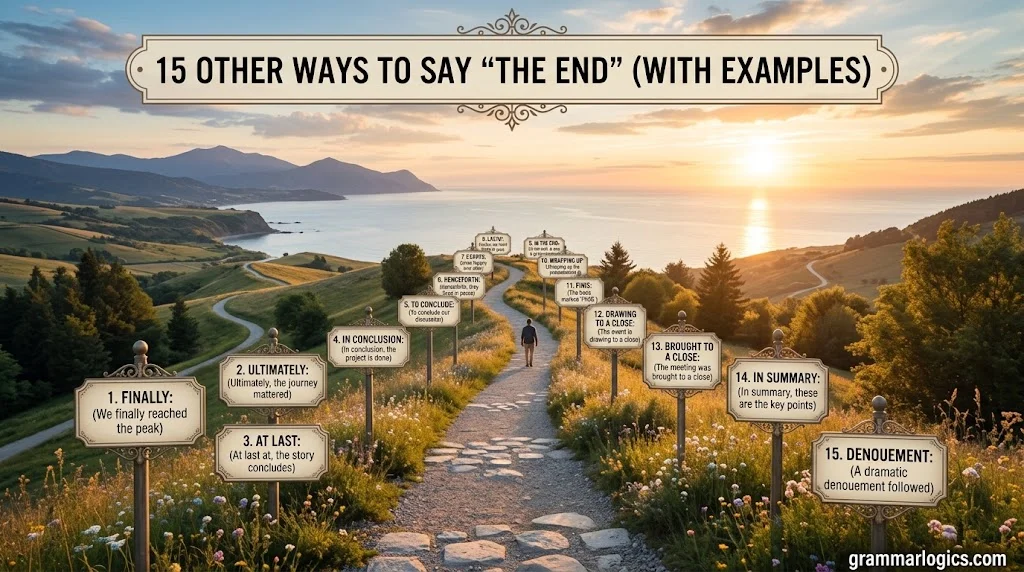
In this article, we will explore 15 other ways to say “the end”, along with their meanings and practical examples. These alternatives can improve your writing, strengthen your storytelling, and make your conclusions more effective. From simple expressions like “the conclusion” to creative phrases like “the final chapter,” each option offers a different way to signal that something has finished. By understanding their meanings, tones, and best uses, you can choose expressions that fit your message and leave your readers with a clear and memorable final impression.
What Does “The End” Mean?
“The end” refers to the final point of something, such as a story, activity, event, relationship, process, or period. It tells the reader or listener that something has finished or reached its conclusion. In everyday English, the expression can describe a simple stopping point, as in “That is the end of our meeting,” or the final part of a creative work, such as a book or film. Depending on the context, it can communicate completion, closure, finality, or a sense of accomplishment. In emotional situations, it may also suggest that an important chapter of someone’s life has come to a close.
Common Situations Where “The End” Is Used
People use “the end” in many everyday and creative situations. In books, short stories, and films, it signals that the narrative has finished. In presentations, speeches, and meetings, it can indicate that the speaker has reached the final section. Writers may use it in personal messages, social media captions, or reflective posts to describe the completion of an experience or chapter of life.
The expression also appears in informal conversations when someone wants to make it clear that an activity or discussion is finished. In professional writing, however, alternatives such as “In conclusion” or “To summarize” may sound more appropriate when introducing a final point. Choosing a suitable expression helps make the ending clear, natural, and appropriate for the audience.
Is It Professional or Polite to Say “The End”?
“The end” is a clear and neutral expression that works well in everyday conversation, creative writing, and many informal situations. It is not impolite, but its suitability depends on the purpose of the message. For example, placing “The End” at the bottom of a short story is perfectly natural, while using it as the final line of a formal business report may sound overly simple.
In professional communication, expressions such as “In conclusion,” “To summarize,” or “This concludes the presentation” can communicate completion more precisely. In personal writing, “A chapter closes” may express a more reflective or emotional feeling. The best choice depends on whether you want to sound formal, conversational, thoughtful, or dramatic.
Advantages and Disadvantages of Saying “The End”
Advantages
The phrase “the end” is short, familiar, and easy to understand. It communicates completion without requiring a lengthy explanation, making it especially useful in stories, films, and casual conversations. It can also create a satisfying sense of closure when a reader reaches the final page or a viewer finishes watching a film. Because it is widely understood, it works across many everyday contexts.
Disadvantages
Although the phrase is effective, it can sometimes feel plain or predictable, especially when a writer wants to create a strong emotional impression. It may not explain whether something ended successfully, unexpectedly, permanently, or temporarily. In formal documents, it can also sound less polished than a purpose-specific closing expression. Choosing a more descriptive alternative can help communicate the intended tone and meaning more accurately.
15 Alternatives to “The End”
- The Conclusion
- The Finish
- The Final Chapter
- The Closing
- The Wrap-Up
- In Conclusion
- To Sum Up
- That’s a Wrap
- All Done
- The Final Word
- A Chapter Closes
- The Last Word
- The Story Ends Here
- Until Next Time
- A New Beginning
1. The Conclusion
Meaning
“The conclusion” refers to the final part of a piece of writing, discussion, presentation, or argument. It signals that the main ideas have been brought together.
Definition
A conclusion is the final section that completes or summarizes something.
Detailed Explanation
“The conclusion” is a useful alternative when you want to describe the final section of a structured piece of work. Unlike the general phrase “the end,” it often suggests that the preceding information has been considered and brought to a logical close. It is particularly suitable for essays, reports, presentations, and formal discussions. The expression sounds more academic and organized than a simple closing phrase.
Scenario Examples
Scenario: A student finishes an assignment.
Example: “I have written the conclusion, so my essay is complete.”
Scenario: A presenter reaches the final slide.
Example: “Let’s move to the conclusion and review our main findings.”
Best Use
Use this expression in academic writing, reports, presentations, and formal discussions where a clear final section is needed.
Tone
Tone: Formal, organized, professional.
It sounds structured and purposeful, making it appropriate for educational and workplace communication.
2. The Finish
Meaning
“The finish” refers to the point where an activity, race, task, or process ends. It often emphasizes reaching the final stage.
Definition
The finish is the point at which an activity or process is completed.
Detailed Explanation
“The finish” works especially well when the focus is on completing something that required effort or progress. It is common in sports, competitions, projects, and everyday tasks. Compared with “the end,” it can emphasize the final stretch or the achievement of reaching a goal. It does not necessarily imply that a story or discussion has reached a meaningful conclusion.
Scenario Examples
Scenario: A runner completes a race.
Example: “She crossed the finish line with a huge smile.”
Scenario: A team completes a project.
Example: “We are almost at the finish, so let’s review the last few details.”
Best Use
Use it when discussing races, projects, tasks, goals, or processes that have a clear completion point.
Tone
Tone: Practical, direct, encouraging.
It often suggests progress and achievement rather than emotional closure.
3. The Final Chapter
Meaning
“The final chapter” refers to the last part of a book or the closing stage of a longer experience.
Definition
The final chapter is the last section of a story or the final stage of a larger journey.
Detailed Explanation
This expression can be literal or figurative. Literally, it describes the last chapter of a book. Figuratively, it can describe the final period of a career, relationship, project, or important life experience. Compared with “the end,” it creates a more reflective feeling because it suggests that several stages have led to this moment. It is especially effective when you want to communicate that something meaningful is approaching completion.
Scenario Examples
Scenario: A novelist discusses a book.
Example: “I am finally writing the final chapter of my novel.”
Scenario: Someone prepares to retire.
Example: “After thirty years in education, she is entering the final chapter of her teaching career.”
Best Use
Use it in creative writing, personal reflections, memoirs, and messages about major life transitions.
Tone
Tone: Reflective, emotional, thoughtful.
It adds a sense of history and significance to an ending.
4. The Closing
Meaning
“The closing” refers to the final part of an event, communication, performance, or process.
Definition
The closing is the last section or stage of something.
Detailed Explanation
“The closing” is useful when an ending has a defined structure or purpose. It commonly appears in speeches, ceremonies, meetings, and written communication. In business, it can also refer to the final stage of a transaction, although the precise meaning depends on the context. Unlike “the end,” it often sounds organized and professional, especially when referring to a planned final section.
Scenario Examples
Scenario: A host finishes an event.
Example: “We will now begin the closing remarks.”
Scenario: A company completes a transaction.
Example: “The closing is scheduled for Friday, provided all documents are approved.”
Best Use
Use it for formal events, speeches, meetings, business transactions, and organized programs.
Tone
Tone: Professional, formal, structured.
It works well when an ending is part of a planned process.
5. The Wrap-Up
Meaning
“The wrap-up” refers to the final part of a discussion, meeting, activity, or presentation, often involving a brief review of what has happened.
Definition
A wrap-up is a short final section that brings an activity to a close.
Detailed Explanation
“The wrap-up” is a natural, conversational expression that often includes a summary or a review of important points. It is common in workplaces, classrooms, podcasts, and informal discussions. Unlike “the end,” it suggests that participants may briefly revisit what they learned or accomplished before finishing. It is less formal than “the conclusion” but often more useful when the final stage involves practical next steps.
Scenario Examples
Scenario: A manager finishes a team meeting.
Example: “Before we leave, let’s have a quick wrap-up of today’s decisions.”
Scenario: A teacher finishes a lesson.
Example: “Our wrap-up will cover the three main ideas from this chapter.”
Best Use
Use it in team meetings, lessons, workshops, podcasts, and informal presentations.
Tone
Tone: Friendly, practical, conversational.
It makes the final stage feel organized without sounding overly formal.
6. In Conclusion
Meaning
“In conclusion” introduces the final thoughts of a speech, essay, report, or discussion.
Definition
It is a formal transition phrase used to signal a final statement or summary.
Detailed Explanation
“In conclusion” helps readers and listeners recognize that the main discussion is ending. It is particularly effective when the speaker wants to restate an argument, summarize evidence, or deliver a final recommendation. Unlike “the end,” it introduces the concluding message rather than simply naming the stopping point. It can sound repetitive if used too often, so it is best reserved for places where a clear transition is helpful.
Scenario Examples
Scenario: A student finishes an argumentative essay.
Example: “In conclusion, public parks provide important benefits to local communities.”
Scenario: A speaker finishes a formal presentation.
Example: “In conclusion, our results support the need for further planning.”
Best Use
Use it in essays, reports, formal speeches, and structured presentations.
Tone
Tone: Formal, logical, authoritative.
It signals that the final argument or summary is beginning.
7. To Sum Up
Meaning
“To sum up” means to present the most important points briefly before finishing.
Definition
It is an expression used to summarize the main information in a discussion or piece of writing.
Detailed Explanation
“To sum up” is a straightforward way to bring together the key points of a conversation, lesson, report, or presentation. It is usually more conversational than “in conclusion,” making it suitable for both spoken English and accessible writing. The expression emphasizes summary rather than the mere fact that something has stopped. It is especially useful when the audience needs a quick reminder of the main message.
Scenario Examples
Scenario: A teacher reviews a lesson.
Example: “To sum up, remember that verbs describe actions or states.”
Scenario: A colleague finishes explaining a proposal.
Example: “To sum up, we need a smaller budget and a clearer timeline.”
Best Use
Use it in classroom explanations, presentations, meetings, and everyday discussions.
Tone
Tone: Clear, helpful, conversational.
It makes complicated information easier to review before a discussion ends.
8. That’s a Wrap
Meaning
“That’s a wrap” is an informal expression used to announce that an activity, event, or production has finished.
Definition
It means something is finished, and no further work is expected for the moment.
Detailed Explanation
“That’s a wrap” is especially common in film, television, photography, and creative production. It is also used casually after completing a project, event, or busy day. Compared with “the end,” it sounds more energetic and celebratory. However, it is not ideal for every formal situation, and it may suggest completion of a work session rather than the permanent ending of a larger project.
Scenario Examples
Scenario: A film crew finishes shooting.
Example: “That’s a wrap on our final scene!”
Scenario: Friends finish organizing a party.
Example: “The decorations are up, the food is ready, and that’s a wrap!”
Best Use
Use it in creative projects, filming, photography, casual team messages, and celebratory updates.
Tone
Tone: Casual, upbeat, celebratory.
It makes an ending feel like a shared accomplishment.
9. All Done
Meaning
“All done” means that a task, activity, or piece of work has been completed.
Definition
It is an informal expression indicating that nothing remains to be finished for the current task.
Detailed Explanation
“All done” is common in everyday speech, especially when someone wants to confirm that a task is complete. It works well for chores, assignments, meals, small projects, and simple activities. Unlike “the end,” it focuses on completion rather than the final point of a story or event. The expression is friendly and uncomplicated, but it may sound too casual for formal reports or official correspondence.
Scenario Examples
Scenario: A child finishes homework.
Example: “I have checked every answer, and I’m all done!”
Scenario: A coworker finishes preparing documents.
Example: “The files are uploaded, and the task is all done.”
Best Use
Use it in casual conversations, family messages, everyday tasks, and informal workplace chats.
Tone
Tone: Casual, simple, reassuring.
It communicates completion without adding unnecessary detail.
10. The Final Word
Meaning
“The final word” refers to the last statement or decisive comment on a subject.
Definition
It is the last or most decisive statement made about a topic or situation.
Detailed Explanation
“The final word” is often used when someone wants to emphasize a concluding opinion, decision, or message. It can suggest authority or certainty, particularly when a person has the responsibility to make the last decision. In writing, it may also describe a memorable closing statement. Unlike “the end,” it focuses on the final message rather than simply indicating that an activity is finished.
Scenario Examples
Scenario: A manager announces a decision.
Example: “The director will have the final word on the proposed changes.”
Scenario: A writer ends an opinion article.
Example: “Her final word was a reminder to treat every customer with respect.”
Best Use
Use it in debates, opinion writing, decision-making discussions, and situations where a final statement matters.
Tone
Tone: Decisive, confident, authoritative.
It emphasizes the importance or influence of the last statement.
11. A Chapter Closes
Meaning
“A chapter closes” describes the ending of an important period, experience, or stage of life.
Definition
It is a figurative expression for completing one meaningful stage before moving forward.
Detailed Explanation
This expression is especially useful when an ending carries emotional significance. It can describe leaving a job, graduating from school, moving away, or finishing a long-term project. Compared with “the end,” it suggests that the experience was part of a larger personal journey. It does not necessarily mean that everything is finished; rather, one stage has ended while another may follow.
Scenario Examples
Scenario: A student graduates.
Example: “As graduation approaches, a chapter closes and a new adventure begins.”
Scenario: A colleague leaves a company after many years.
Example: “Today, a chapter closes after twelve wonderful years with this team.”
Best Use
Use it in personal reflections, graduation messages, retirement announcements, farewell posts, and milestone celebrations.
Tone
Tone: Emotional, reflective, hopeful.
It acknowledges the significance of the past while allowing room for future possibilities.
12. The Last Word
Meaning
“The last word” can refer to the final remark in a conversation or the concluding statement on a subject.
Definition
It means the last comment or statement made before a conversation or discussion ends.
Detailed Explanation
“The last word” is related to “the final word,” but its meaning depends strongly on context. It may simply identify the final remark, or it may suggest that someone wants to settle a disagreement or have the final say. In personal conversations, it can sometimes carry a competitive or argumentative feeling. It is therefore important to consider whether the expression describes a neutral ending or a struggle over who gets to speak last.
Scenario Examples
Scenario: Two colleagues finish discussing a proposal.
Example: “Before we close the meeting, let Maya have the last word.”
Scenario: Someone describes an unresolved disagreement.
Example: “Neither of them wanted to give the other the last word.”
Best Use
Use it in discussions, debates, dialogue, storytelling, and situations involving a final comment or decision.
Tone
Tone: Direct, conversational, sometimes assertive.
It can be neutral or slightly confrontational depending on the situation.
13. The Story Ends Here
Meaning
“The story ends here” directly communicates that a particular story or sequence of events has reached its final point.
Definition
It is a phrase indicating that no further part of the current story will follow.
Detailed Explanation
This expression works literally when discussing a story, but it can also be used figuratively to describe the end of a relationship, disagreement, or personal situation. It sounds more dramatic and definite than “the end.” Depending on context, it can communicate acceptance, determination, disappointment, or finality. Because it may imply that no continuation is expected, it is best used when that strong message is intentional.
Scenario Examples
Scenario: A writer ends a short story.
Example: “After years of searching, he finally found his home, and the story ends here.”
Scenario: Someone establishes a personal boundary.
Example: “I have explained my decision, and the story ends here.”
Best Use
Use it in creative writing, dramatic dialogue, personal statements, and situations requiring a firm ending.
Tone
Tone: Dramatic, direct, definitive.
It communicates a strong sense of closure and may sound firm in personal communication.
14. Until Next Time
Meaning
“Until next time” is a friendly farewell used when people expect to meet, communicate, or interact again.
Definition
It is a closing expression that says goodbye while suggesting a future meeting or interaction.
Detailed Explanation
Unlike “the end,” this phrase does not necessarily mean something is permanently finished. Instead, it closes the current interaction while leaving the door open for another one. It is common in video endings, podcasts, newsletters, friendly conversations, and recurring events. The phrase creates a warmer and more inviting impression than a simple announcement of completion, but it should not be used when a permanent ending needs to be made clear.
Scenario Examples
Scenario: A content creator finishes a video.
Example: “Thanks for watching, and until next time, keep learning something new!”
Scenario: Friends finish a conversation before a planned visit.
Example: “It was lovely catching up. Until next time!”
Best Use
Use it in podcasts, videos, newsletters, casual farewells, and recurring social events.
Tone
Tone: Warm, friendly, optimistic.
It suggests continuity and connection rather than permanent closure.
15. A New Beginning
Meaning
“A new beginning” emphasizes the start of a fresh stage after something has ended.
Definition
It is an expression describing the start of a new phase, opportunity, or direction.
Detailed Explanation
“A new beginning” is not an exact synonym for “the end.” Instead, it offers a positive way to frame an ending by focusing on what comes next. It works well when someone is graduating, starting a new job, recovering from a setback, or making a significant life change. The expression communicates hope and possibility rather than finality alone. Choose it when you want readers to understand that an ending is also creating room for future growth.
Scenario Examples
Scenario: Someone starts a new job after leaving an old one.
Example: “Leaving my previous role feels like a new beginning.”
Scenario: A student graduates and looks ahead.
Example: “Graduation is not just an ending; it is a new beginning filled with possibilities.”
Best Use
Use it in motivational writing, personal announcements, graduation messages, career transitions, and reflective social media posts.
Tone
Tone: Hopeful, positive, encouraging.
It turns attention toward future opportunities instead of focusing only on what has finished.
FAQs
What is another way to say “the end”?
Some alternatives include “the conclusion,” “the finish,” “the final chapter,” “the closing,” and “the wrap-up.” The best choice depends on whether you are finishing a story, presentation, task, or personal experience.
What does “the end” mean?
“The end” means the final point of something. It can refer to the completion of a story, event, activity, process, or stage of life.
Is “the end” professional?
Yes, it can be appropriate in certain professional contexts, but it may sound too simple in formal reports or presentations. “In conclusion,” “the closing,” or “to sum up” may be more suitable depending on the purpose.
What is a more emotional way to say “the end”?
“A chapter closes” and “the final chapter” can create a more emotional or reflective feeling. They are particularly useful for farewells, life changes, and meaningful personal experiences.
Which alternative works best in formal communication?
“In conclusion” is useful for essays, reports, and presentations, while “the closing” works well for organized events and formal processes. Choose the expression that matches the structure and purpose of your message.
Conclusion
Choosing the right alternative to “the end” can make your writing and conversations more expressive, clear, and appropriate for the situation. While “the conclusion” works well in formal writing, “that’s a wrap” brings a casual and celebratory feeling, and “a chapter closes” adds emotional depth to a personal message.
Expressions such as “until next time” and “a new beginning” also help communicate that some endings leave room for future experiences. Remember that these phrases are not always interchangeable. Consider your audience, purpose, and intended tone before choosing one. The most effective ending is the one that communicates your message naturally and leaves readers with the right impression.