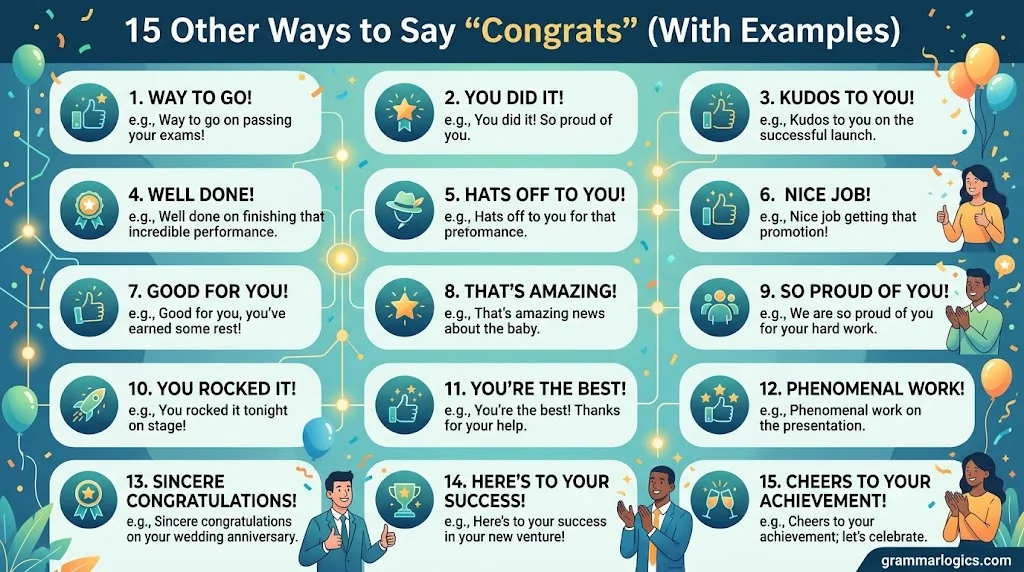
Celebrating someone’s success becomes more meaningful when you choose the right words. Learning other ways to say “congrats” helps you express happiness, appreciation, and encouragement in a more personal and memorable way.
Whether someone has achieved a goal, received a promotion, graduated, or celebrated a special milestone, the right words can make them feel truly appreciated. While “congrats” is a friendly and popular expression, using different phrases can make your message sound more genuine, thoughtful, and appropriate for the occasion. A simple change in wording can turn an ordinary message into something special. From casual conversations with friends to professional messages for colleagues, exploring different expressions helps you celebrate achievements with confidence and warmth.
In this guide, you will discover 15 other ways to say “congrats” that suit different situations, relationships, and communication styles. Each alternative offers a unique way to recognize someone’s hard work, celebrate an important achievement, or share in their happiness. You will learn which expressions work best in casual conversations, formal settings, greeting cards, emails, and social media posts. With clear meanings and practical examples, choosing the right phrase becomes easier. Whether you want to sound more professional, enthusiastic, supportive, or heartfelt, these alternatives will help you express your congratulations naturally and make every celebration feel more meaningful.
What Does “Congrats” Mean?
“Congrats” is a shortened, informal form of “congratulations.” People use it to express happiness, approval, or good wishes when someone achieves something positive or experiences an important milestone. For example, you might say “Congrats on your graduation!” to a friend who has completed college or “Congrats on the promotion!” to a colleague who has advanced in their career. The expression communicates that you recognize another person’s achievement and are pleased about their success. Although “congrats” is widely understood and friendly, its shortened form makes it more suitable for casual conversations than highly formal messages. Choosing a longer or more specific expression can help communicate deeper appreciation, excitement, or respect.
Common Situations Where “Congrats” Is Used
People commonly use “congrats” when celebrating achievements, milestones, and happy news. Friends might send it through text messages after hearing about a new job, engagement, graduation, or personal accomplishment. On social media, it often appears in comments celebrating birthdays, awards, promotions, and other important moments.
In professional settings, colleagues may use the phrase to acknowledge successful projects, promotions, awards, or career milestones. Students can use it to celebrate good grades, scholarships, and academic achievements. Family members might choose it when celebrating a wedding, a new baby, or another joyful event.
Although “congrats” works in many situations, alternatives can make your message more meaningful. A phrase such as “Well deserved!” emphasizes someone’s effort, while “I’m so happy for you!” communicates personal warmth. In formal emails, a complete expression of congratulations may sound more polished and respectful.
Is It Professional or Polite to Say “Congrats”?
“Congrats” is generally polite, friendly, and informal. It is appropriate for conversations with friends, familiar colleagues, classmates, and people with whom you have a relaxed relationship. In a workplace chat or an informal email, saying “Congrats on the promotion!” can sound natural and encouraging.
However, the phrase may feel too casual for a formal business letter, an official announcement, or a message to a senior executive you do not know well. In those situations, “Congratulations on your achievement” or “Please accept my sincere congratulations” may communicate greater professionalism. The best choice depends on your relationship with the recipient, the importance of the occasion, and the communication setting. A short message can still be respectful, but adding a specific detail about the achievement often makes it feel more thoughtful.
Advantages and Disadvantages of Saying “Congrats”
Advantages
The biggest advantage of “congrats” is its simplicity. It is short, familiar, and easy to use in conversations, text messages, and social media comments. The word communicates positive feelings without making a message unnecessarily complicated. It also works well when you want to acknowledge someone’s achievement quickly, especially in casual situations. Because it is widely understood, you can use it for many occasions, from passing an exam to receiving a promotion.
Disadvantages
The main limitation of “congrats” is that it can sometimes feel brief or impersonal, particularly when someone has worked hard to reach an important goal. A single word may not fully communicate how proud, excited, or happy you feel. Its informal tone may also be less suitable for official correspondence or important professional announcements. In addition, repeating the same expression in every message can make your communication feel predictable. Choosing a more specific phrase allows you to recognize someone’s effort, express stronger emotions, or match the tone of the occasion.
15 Other Ways to Say “Congrats”
- Congratulations!
- Well done!
- Great job!
- Way to go!
- Kudos to you!
- I’m so happy for you!
- You deserve it!
- That’s fantastic news!
- What an achievement!
- Hats off to you!
- Bravo!
- You nailed it!
- Proud of you!
- Wishing you continued success!
- Many congratulations on your achievement!
1. Congratulations!
Meaning
“Congratulations!” is the complete form of “congrats.” It expresses happiness and recognition when someone achieves something, reaches a milestone, or shares exciting news.
Definition
A polite expression used to acknowledge another person’s success or celebrate a positive event.
Detailed Explanation
“Congratulations!” is one of the most versatile expressions for celebrating achievements. Unlike the shortened “congrats,” it sounds slightly more polished and works in both casual and professional settings. You can use it for academic success, career advancement, weddings, awards, and other important milestones. Adding the specific achievement makes the message more personal and meaningful.
Scenario Examples
Scenario: A colleague receives a promotion.
Example: “Congratulations on your promotion! Your hard work has paid off.”
Scenario: A friend gets married.
Example: “Congratulations to you both! Wishing you a wonderful life together.”
Scenario: A student wins a scholarship.
Example: “Congratulations on earning your scholarship. That’s wonderful news!”
Best Use
Use this expression in professional emails, personal messages, formal announcements, and everyday conversations. It is especially useful when you want a safe, widely appropriate alternative.
Tone
Tone: Polite, positive, versatile.
It communicates genuine recognition without sounding overly casual or excessively emotional.
2. Well Done!
Meaning
“Well done!” recognizes that someone has performed a task successfully or achieved something through effort and skill.
Definition
An expression of praise used to acknowledge good work, performance, or accomplishment.
Detailed Explanation
“Well done!” places greater emphasis on effort and performance than a general congratulatory message. It is especially suitable when someone has completed a difficult task, performed well in an examination, or handled a challenge successfully. The expression can sound encouraging when spoken by a teacher, manager, parent, or friend. However, it is not always the best choice for occasions such as an engagement or wedding, where a more traditional congratulatory phrase feels more natural.
Scenario Examples
Scenario: A student earns excellent marks.
Example: “Well done on your final exams! You should feel proud of yourself.”
Scenario: An employee completes a challenging project.
Example: “Well done on getting the presentation ready ahead of schedule.”
Scenario: A friend finishes a long-distance race.
Example: “Well done! I know how much training that took.”
Best Use
Use “well done” when praising effort, skill, performance, or a completed task, especially in education, sports, and workplace communication.
Tone
Tone: Encouraging, appreciative, supportive.
It highlights the person’s effort and the quality of what they accomplished.
3. Great Job!
Meaning
“Great job!” expresses approval and happiness about something someone has done successfully.
Definition
A friendly phrase used to praise a person for doing something well.
Detailed Explanation
“Great job!” is a natural choice when you want to recognize someone’s performance in a simple, enthusiastic way. It is more focused on the quality of the work than on celebrating a major life event. You can use it with children, teammates, coworkers, and friends. In a formal letter, a more complete sentence may sound more professional, but in everyday communication, this phrase feels warm and direct.
Scenario Examples
Scenario: A teammate delivers an excellent presentation.
Example: “Great job with the presentation today! Your explanation was clear and engaging.”
Scenario: A child learns a new skill.
Example: “Great job tying your shoes all by yourself!”
Scenario: A coworker solves a difficult problem.
Example: “Great job figuring that out. Your solution saved us time.”
Best Use
Use this expression for successful tasks, good performances, teamwork, learning milestones, and everyday praise.
Tone
Tone: Friendly, enthusiastic, encouraging.
Its straightforward wording makes appreciation easy to communicate without sounding overly formal.
4. Way to Go!
Meaning
“Way to go!” celebrates a person’s success with excitement and encouragement.
Definition
An informal expression used to show approval or enthusiasm about someone’s achievement.
Detailed Explanation
This phrase sounds energetic and conversational, making it ideal for celebrating a positive result. It often communicates more excitement than a neutral “congratulations.” People commonly use it when someone reaches a goal, wins a competition, or makes noticeable progress. Because it is informal, it works better in friendly conversations and team settings than in formal business correspondence.
Scenario Examples
Scenario: A friend reaches a fitness goal.
Example: “Way to go! You’ve been working toward that goal for months.”
Scenario: A teammate wins a competition.
Example: “Way to go, everyone! That was a fantastic team effort.”
Scenario: A student completes a difficult assignment.
Example: “Way to go on finishing the project before the deadline!”
Best Use
Use “way to go” in casual messages, team celebrations, friendly conversations, and encouraging social media comments.
Tone
Tone: Energetic, casual, enthusiastic.
It conveys excitement and approval, especially when you want your message to feel lively.
5. Kudos to You!
Meaning
“Kudos to you!” recognizes someone’s achievement, effort, or contribution and expresses respect for what they have done.
Definition
An expression of praise or recognition for a person’s accomplishment.
Detailed Explanation
“Kudos to you!” can sound slightly more appreciative and recognition-focused than “congrats.” It is particularly useful when someone has demonstrated initiative, dedication, creativity, or excellent judgment. The phrase works in workplace discussions as well as casual conversations, although it can sound a little more deliberate than everyday expressions such as “great job.” It is especially effective when you want to acknowledge the value of someone’s contribution rather than simply celebrate the outcome.
Scenario Examples
Scenario: A colleague organizes a successful event.
Example: “Kudos to you for bringing the whole event together so smoothly.”
Scenario: A friend volunteers for a community project.
Example: “Kudos to you for giving your time to such a meaningful cause.”
Scenario: A teammate develops a useful idea.
Example: “Kudos to you for suggesting a solution that worked for everyone.”
Best Use
Use this expression when acknowledging initiative, thoughtful work, teamwork, and meaningful contributions.
Tone
Tone: Appreciative, respectful, encouraging.
It recognizes the person’s contribution and can be particularly effective in professional or collaborative settings.
6. I’m So Happy for You!
Meaning
“I’m so happy for you!” expresses personal happiness about something good that has happened to another person.
Definition
A warm expression used to share in someone’s joy or celebrate their good fortune.
Detailed Explanation
This phrase focuses on emotional connection rather than simply acknowledging an achievement. It is ideal when someone shares news that genuinely matters to them, such as getting a dream job, becoming engaged, or reaching a long-awaited goal. Unlike “well done,” it does not necessarily evaluate the person’s performance; instead, it shows that their happiness matters to you. It is especially natural between friends, relatives, partners, and people who share a close relationship.
Scenario Examples
Scenario: A friend gets accepted into their preferred university.
Example: “I’m so happy for you! I know how much you wanted to study there.”
Scenario: A sibling announces an engagement.
Example: “I’m so happy for you both. You look genuinely excited!”
Scenario: A colleague lands a dream job.
Example: “I’m so happy for you! This sounds like a wonderful next step in your career.”
Best Use
Use this phrase in personal messages, close relationships, emotional celebrations, and conversations about exciting life changes.
Tone
Tone: Warm, heartfelt, personal.
It communicates shared happiness and makes the message feel more intimate than a brief congratulation.
7. You Deserve It!
Meaning
“You deserve it!” expresses the belief that someone has earned a positive outcome or is worthy of the success they have received.
Definition
A supportive expression that recognizes someone’s effort, merit, or suitability for a good outcome.
Detailed Explanation
This phrase adds a sense of earned success to your message. It is especially meaningful when someone has worked hard for a promotion, award, opportunity, or personal milestone. Unlike a general congratulation, it communicates that the positive outcome feels fair or well deserved. However, context matters: saying “you deserve it” may sound dismissive if someone is disappointed about a setback, and it is less appropriate when you do not know enough about the situation to judge whether the outcome was earned.
Scenario Examples
Scenario: A hardworking colleague receives a promotion.
Example: “You deserve it! I’ve seen how much dedication you’ve brought to this team.”
Scenario: A friend wins an award.
Example: “You deserve it after all the time and effort you put into your work.”
Scenario: A sibling achieves a personal goal.
Example: “You deserve to celebrate this moment. You’ve worked so hard for it.”
Best Use
Use this expression when you want to recognize hard work, persistence, dedication, or a well-earned opportunity.
Tone
Tone: Supportive, affirming, personal.
It adds a judgment of merit, so it works best when you genuinely believe the person has earned the outcome.
8. That’s Fantastic News!
Meaning
“That’s fantastic news!” expresses strong happiness and excitement in response to a positive announcement.
Definition
An enthusiastic response used to show that someone’s news is especially pleasing or exciting.
Detailed Explanation
This phrase focuses on the news itself, rather than directly praising the person who shared it. It is useful when someone tells you about a new job, a successful application, a major purchase, or another positive development. The wording feels lively without being overly emotional, making it suitable for both personal conversations and many professional interactions. To make the message more personal, you can follow it with a question or a sentence explaining why you are pleased.
Scenario Examples
Scenario: A friend shares news about a new job.
Example: “That’s fantastic news! When do you start?”
Scenario: A colleague announces that a proposal has been approved.
Example: “That’s fantastic news! The team will be pleased to hear that.”
Scenario: A cousin receives good news about university admission.
Example: “That’s fantastic news! I hope you enjoy this exciting new chapter.”
Best Use
Use it when responding to good news, successful applications, positive announcements, and exciting developments.
Tone
Tone: Enthusiastic, positive, conversational.
It expresses excitement naturally and keeps the focus on the happy announcement.
9. What an Achievement!
Meaning
“What an achievement!” highlights the importance or impressive nature of something a person has accomplished.
Definition
An expression used to emphasize that an accomplishment is significant, admirable, or noteworthy.
Detailed Explanation
This expression is particularly effective when someone has reached a challenging or meaningful milestone. It gives the accomplishment itself more attention than a short “congrats” message would. You might use it for completing a demanding qualification, finishing a major project, or reaching an important personal goal. The phrase sounds more reflective and emphatic than casual praise, so it is often best when the achievement genuinely deserves special recognition.
Scenario Examples
Scenario: A friend completes a professional qualification while working full-time.
Example: “What an achievement! Balancing work and study must have taken real commitment.”
Scenario: A local athlete breaks a personal record.
Example: “What an achievement! You’ve made incredible progress this season.”
Scenario: A team completes a complex project.
Example: “What an achievement for the whole team. Your collaboration really paid off.”
Best Use
Use this expression for major milestones, demanding projects, impressive progress, and accomplishments that deserve special attention.
Tone
Tone: Admiring, appreciative, emphatic.
It emphasizes the significance of the accomplishment rather than simply offering a routine congratulation.
10. Hats Off to You!
Meaning
“Hats off to you!” expresses admiration and respect for someone’s success, effort, or ability.
Definition
An idiomatic expression used to show that someone deserves recognition or admiration.
Detailed Explanation
“Hats off to you!” suggests that the person has done something worthy of respect. It is often used after an impressive achievement, especially when the person has overcome a challenge or demonstrated exceptional dedication. The phrase is more expressive and idiomatic than “congratulations,” giving your message a slightly distinctive style. Although it can work in workplace conversations, it is generally better suited to friendly or semi-formal communication than highly formal letters.
Scenario Examples
Scenario: A friend completes a demanding hiking challenge.
Example: “Hats off to you for finishing that trail despite the difficult conditions.”
Scenario: A coworker manages a complicated event.
Example: “Hats off to you for coordinating everything so efficiently.”
Scenario: A student balances school and a part-time job.
Example: “Hats off to you for managing both responsibilities so well.”
Best Use
Use this expression when recognizing impressive effort, perseverance, skill, or a particularly admirable accomplishment.
Tone
Tone: Respectful, admiring, conversational.
It communicates appreciation with a little more personality than a standard congratulatory phrase.
11. Bravo!
Meaning
“Bravo!” expresses enthusiastic approval or admiration for an impressive performance or accomplishment.
Definition
A short exclamation used to praise someone’s performance or successful effort.
Detailed Explanation
“Bravo!” is especially associated with performances, presentations, and moments when someone has done something impressive. It can also be used more broadly to praise a clever solution or a successful effort. Compared with “congratulations,” it often feels more like a spontaneous expression of admiration. It may sound theatrical or playful in ordinary conversation, so consider the relationship and setting before using it in a formal message.
Scenario Examples
Scenario: A friend performs in a school play.
Example: “Bravo! You brought so much energy to the performance.”
Scenario: A colleague delivers an engaging presentation.
Example: “Bravo on that presentation. You handled the questions confidently.”
Scenario: A teammate finds an elegant solution to a problem.
Example: “Bravo! That’s a clever way to approach the issue.”
Best Use
Use “bravo” for performances, presentations, creative work, and moments of impressive execution.
Tone
Tone: Enthusiastic, admiring, expressive.
Its short, emphatic style works best when you want to celebrate something noticeably impressive.
12. You Nailed It!
Meaning
“You nailed it!” means that someone did something extremely well or achieved exactly the result they wanted.
Definition
An informal expression of praise used when someone performs a task successfully or gets something exactly right.
Detailed Explanation
This phrase is more specific than a general congratulation because it emphasizes excellent execution. It is natural when someone gives a strong presentation, answers a difficult question correctly, performs well, or completes a task with impressive accuracy. The expression sounds confident and energetic, making it especially suitable for casual conversations and friendly workplace exchanges. It is not the best choice for every milestone, such as a wedding or a new baby, because it usually relates to doing something well rather than celebrating a life event.
Scenario Examples
Scenario: A friend gives a speech at an event.
Example: “You nailed it! Your speech was funny, thoughtful, and easy to follow.”
Scenario: A coworker answers a challenging client question.
Example: “You nailed it in that meeting. Your explanation addressed every concern.”
Scenario: A student solves a difficult problem.
Example: “You nailed that question. You clearly understood the concept.”
Best Use
Use this phrase for successful performances, accurate answers, effective presentations, and tasks completed exceptionally well.
Tone
Tone: Casual, confident, enthusiastic.
It emphasizes the quality of someone’s performance rather than simply acknowledging a positive event.
13. Proud of You!
Meaning
“Proud of you!” expresses pride in someone’s efforts, growth, decisions, or accomplishments.
Definition
A personal expression used to communicate admiration and emotional support for another person’s progress or success.
Detailed Explanation
This phrase carries a stronger emotional connection than a simple congratulatory message. It can be especially meaningful when someone has overcome a personal challenge, developed a new skill, or worked consistently toward a difficult goal. Parents, partners, close friends, and mentors often use it to recognize both achievements and personal growth. Because it can sound intimate or paternal depending on the relationship, it is best used when that level of warmth feels appropriate.
Scenario Examples
Scenario: A friend completes a difficult personal challenge.
Example: “I’m proud of you for sticking with it, even when things became difficult.”
Scenario: A parent celebrates a child’s academic progress.
Example: “I’m so proud of you for the effort you’ve put into your studies.”
Scenario: A partner reaches a long-term goal.
Example: “Proud of you for taking that step. I know it wasn’t easy.”
Best Use
Use this expression in close relationships, mentoring, personal milestones, and situations where emotional encouragement matters.
Tone
Tone: Affectionate, supportive, heartfelt.
It communicates emotional investment in the person, not just approval of the result.
14. Wishing You Continued Success!
Meaning
“Wishing you continued success!” expresses good wishes for someone’s future achievements as well as recognition of their current progress.
Definition
A polite expression used to encourage someone and hope that their success continues.
Detailed Explanation
This phrase looks beyond the immediate achievement and focuses on what may come next. It is particularly suitable when someone starts a new role, completes a professional milestone, or moves into another stage of their career. Unlike “great job,” it does not primarily praise a specific performance; instead, it communicates goodwill for future progress. Its polished wording makes it useful in professional emails, farewell messages, formal notes, and public acknowledgments.
Scenario Examples
Scenario: A colleague accepts a new leadership position.
Example: “Congratulations on your new role. Wishing you continued success in this exciting chapter.”
Scenario: A business partner launches a new venture.
Example: “Thank you for sharing the update. Wishing you continued success with your business.”
Scenario: A former classmate earns a professional qualification.
Example: “Wishing you continued success as you put your new skills into practice.”
Best Use
Use this phrase in professional correspondence, career-related messages, formal notes, and situations involving future goals.
Tone
Tone: Professional, respectful, encouraging.
It combines positive recognition with good wishes for future achievements.
15. Many Congratulations on Your Achievement!
Meaning
“Many congratulations on your achievement!” is an emphatic way to recognize someone’s success and communicate sincere goodwill.
Definition
A formal or semi-formal expression used to celebrate a notable accomplishment.
Detailed Explanation
This phrase is more elaborate than “congrats” and gives the message a polished, respectful feel. It works well when acknowledging an important award, professional milestone, academic accomplishment, or significant personal success. The wording may feel too formal or wordy for a quick text to a close friend, but it is useful when you want to give an achievement special recognition. For a more natural message, consider naming the accomplishment directly rather than leaving it general.
Scenario Examples
Scenario: A professional receives an industry award.
Example: “Many congratulations on your achievement. Your dedication to your field is commendable.”
Scenario: A student completes a postgraduate degree.
Example: “Many congratulations on your achievement! Wishing you the very best in your future studies and career.”
Scenario: A colleague earns a significant certification.
Example: “Many congratulations on your achievement. I hope this opens up exciting opportunities for you.”
Best Use
Use this expression in formal emails, professional announcements, academic messages, and written notes recognizing significant accomplishments.
Tone
Tone: Formal, respectful, celebratory.
Its fuller wording gives the message a more ceremonial feel than a brief, informal expression.
FAQs
What is another way to say “congrats”?
Some natural alternatives are “Congratulations!”, “Well done!”, “Great job!”, “Way to go!”, and “I’m so happy for you!” The best choice depends on what you are celebrating. Use “well done” for effort or performance and “I’m so happy for you” when you want to express personal happiness.
What does “congrats” mean?
“Congrats” means “congratulations.” It is an informal expression used to acknowledge someone’s achievement or celebrate positive news. People commonly use it for promotions, graduations, awards, engagements, and other happy occasions.
Is “congrats” professional?
“Congrats” can be professional enough for informal workplace communication, such as a team chat or a friendly email to a colleague. For formal letters, official announcements, or communication with someone you do not know well, “Congratulations on your achievement” is generally a more polished choice.
What is a more heartfelt way to say “congrats”?
“I’m so happy for you!” and “Proud of you!” are heartfelt alternatives. The first expresses shared happiness, while the second communicates personal pride and support. Choose the phrase that best reflects your relationship with the recipient and the situation.
Which alternative works best in formal communication?
“Congratulations on your achievement” is a strong general choice for formal communication. When you want to acknowledge future opportunities, “Wishing you continued success” is also appropriate. For a particularly important accomplishment, add a specific detail to make the message more sincere and meaningful.
Conclusion
Choosing the right words can make a congratulatory message feel more genuine, thoughtful, and memorable. Although “congrats” works well in everyday conversation, other expressions allow you to recognize someone’s effort, celebrate their success, or express heartfelt happiness. Use “well done” when you want to praise performance, “you deserve it” when acknowledging hard work, and “I’m so happy for you” when sharing someone’s excitement.
For professional settings, a complete expression such as “Congratulations on your achievement” often sounds more polished. Remember that the best alternative depends on the occasion, your relationship with the recipient, and the emotion you want to communicate. A few carefully chosen words can show someone that their success truly matters to you.