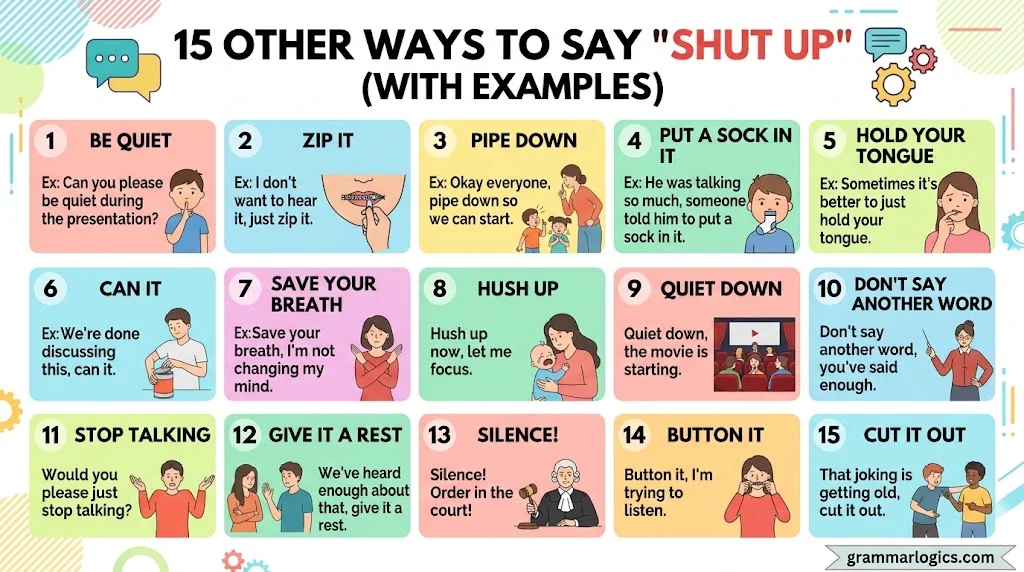
The phrase “shut up” is commonly used to tell someone to stop talking, but it can sound rude, harsh, or disrespectful. Choosing a more suitable expression helps you communicate your message clearly while maintaining politeness and respect.
There are times when you may want someone to stop talking, especially during an argument, an important conversation, or a moment when you need to concentrate. However, saying “shut up” can easily hurt someone’s feelings or create unnecessary tension. Learning other ways to say “shut up” allows you to express yourself more thoughtfully in different situations. Whether you are speaking with friends, colleagues, family members, or strangers, the right words can help you sound polite, confident, and respectful without losing your message.
English offers many alternatives to “shut up” that suit different situations and tones. For example, you can say “Please be quiet” in a polite setting, “Let me finish” when someone interrupts you, or “Could you lower your voice?” when someone is speaking too loudly. Some expressions sound friendly and gentle, while others are more direct or firm. Understanding these differences helps you choose the most appropriate phrase for each conversation, avoid misunderstandings, and communicate your boundaries effectively. In this guide, you will discover 15 useful alternatives with meanings and examples.
What Does “Shut Up” Mean?
“Shut up” is an informal expression that usually means stop talking or become quiet. People often use it when someone is speaking too much, interrupting, making noise, or saying something they do not want to hear. Depending on the speaker’s tone and the relationship between the people involved, the phrase can sound playful, impatient, angry, or offensive. Among close friends, it may sometimes be used jokingly. However, during an argument or a serious conversation, it can feel disrespectful because it directly tells another person to stop speaking.
The expression can also communicate surprise or disbelief in certain casual situations. For example, someone might say “Shut up!” after hearing exciting news, meaning something like “I can’t believe it!” rather than asking the other person to become silent. This meaning depends heavily on facial expressions, tone, and context. Understanding these differences helps you choose an appropriate alternative instead of using the same phrase in every situation.
Common Situations Where “Shut Up” Is Used
People commonly use this expression during casual conversations, disagreements, jokes, and moments of frustration. Friends may use it playfully when teasing one another, while someone in an argument might use it to express anger or end a conversation. It can also appear in text messages and on social media, where the absence of facial expressions can make the message seem harsher than intended.
In professional settings, classrooms, customer conversations, and unfamiliar relationships, the expression is generally less suitable. A colleague who keeps interrupting may respond better to a respectful request to let someone finish speaking. Similarly, a teacher or meeting leader may need a calm way to restore order. Choosing the right alternative to “shut up” allows you to set boundaries, reduce misunderstandings, and maintain a more respectful conversation.
Is It Professional or Polite to Say “Shut Up”?
“Shut up” is usually informal and direct, and it can sound rude or aggressive. Although close friends sometimes use it humorously, that familiarity does not make it appropriate in every relationship. The expression may communicate frustration clearly, but it can also embarrass someone or make them feel that their opinion does not matter.
In professional communication, it is generally better to use respectful language that explains what you need. For example, asking someone to lower their voice or requesting a moment to finish speaking communicates the problem without unnecessarily insulting them. In situations involving repeated interruptions or disruptive behavior, a firm and clear statement may be necessary. The goal is to remain assertive without being disrespectful. The best wording depends on the circumstances, the relationship, and how serious the situation is.
Advantages and Disadvantages of Saying “Shut Up”
Advantages
The main advantage of “shut up” is its brevity and directness. It communicates an immediate desire for silence without requiring a long explanation. In a playful exchange between close friends, it may express surprise or teasing when both people understand the intended meaning. In a noisy or frustrating situation, the phrase also makes the speaker’s feelings unmistakable.
Disadvantages
The biggest disadvantage is that the phrase can sound insulting, dismissive, or aggressive. It may make another person defensive and turn a minor disagreement into a larger conflict. It also offers little room for politeness or emotional nuance, especially in workplace conversations or unfamiliar relationships. In writing, the lack of vocal tone can make its meaning even harder to interpret. Choosing a more considerate expression can help you communicate the same need while protecting the relationship.
15 Alternatives to “Shut Up”
- Please Be Quiet
- Could You Lower Your Voice?
- Let’s Keep It Down
- Please Stop Talking
- Let Me Finish, Please
- Could We Have Some Silence?
- That’s Enough, Please
- Hold On a Second
- Let’s Focus, Please
- Give Me a Moment, Please
- One Person at a Time, Please
- Can We Pause the Conversation?
- Please Keep Your Voice Down
- Silence, Please
- Zip It
1. Please Be Quiet
Meaning
“Please be quiet” asks someone to stop making noise or speaking. Unlike “shut up,” it includes polite wording that makes the request sound more considerate.
Definition
A respectful request for someone to remain silent or reduce noise.
Detailed Explanation
This expression is useful when you need quiet without sounding unnecessarily angry. The word “please” softens the instruction, although the sentence remains direct. It works particularly well when people need to concentrate, listen, or respect a quiet environment. Your tone still matters because saying it sharply can make even polite wording sound impatient.
Scenario Examples
Scenario: Students are talking during a lesson.
Example: “Please be quiet so everyone can hear the teacher.”
Scenario: A family member is speaking while someone studies.
Example: “Please be quiet for a few minutes while I finish this assignment.”
Scenario: Visitors are talking in a library.
Example: “Please be quiet; people are trying to read.”
Best Use
Use this phrase in classrooms, libraries, shared spaces, and everyday conversations when you need someone to stop making noise. It is also suitable for polite requests in familiar or unfamiliar settings.
Tone
Tone: Polite, direct, respectful.
It communicates a clear expectation while avoiding the harshness often associated with “shut up.”
2. Could You Lower Your Voice?
Meaning
“Could you lower your voice?” asks someone to speak more quietly rather than stop talking completely. It is helpful when the volume of someone’s voice is the problem.
Definition
A polite request to reduce speaking volume.
Detailed Explanation
This expression focuses on how loudly someone is speaking, not whether they should speak at all. It sounds more considerate because it is phrased as a question. You can use it when someone is shouting, speaking loudly in public, or disturbing others nearby. It is not the best choice when the real issue is constant interruptions or unwanted comments.
Scenario Examples
Scenario: A coworker is speaking loudly in an open office.
Example: “Could you lower your voice a little? I’m trying to concentrate.”
Scenario: Friends are talking loudly at a restaurant.
Example: “Could you lower your voice? People at the next table can hear us.”
Best Use
Use this phrase in offices, restaurants, homes, public transport, and other shared environments where people can continue talking but should do so more quietly.
Tone
Tone: Courteous, calm, practical.
The question format makes the request less confrontational while clearly identifying the issue.
3. Let’s Keep It Down
Meaning
“Let’s keep it down” encourages everyone involved to reduce noise. It feels more collaborative than a command directed at one person.
Definition
A casual request for a group or individual to speak or make noise more quietly.
Detailed Explanation
The word “let’s” presents the request as something people can do together. This makes the phrase useful when several people are becoming noisy. It is casual and friendly in many everyday situations, but it may sound too informal for a serious workplace discussion. Unlike “shut up,” it does not demand complete silence; it simply asks for a lower noise level.
Scenario Examples
Scenario: Friends are chatting loudly in a shared apartment.
Example: “Let’s keep it down; the neighbors might be sleeping.”
Scenario: A group is waiting outside a classroom.
Example: “Let’s keep it down until the presentation is over.”
Best Use
Use it with friends, family members, classmates, or informal groups when you want to reduce noise without singling anyone out.
Tone
Tone: Casual, cooperative, friendly.
It encourages people to adjust their behavior together rather than making one person feel attacked.
4. Please Stop Talking
Meaning
“Please stop talking” directly asks someone to end their speech. It is firmer than a request to lower their voice because it concerns whether the person continues speaking.
Definition
A direct request for someone to stop speaking.
Detailed Explanation
This expression is appropriate when you need the conversation to stop, particularly when someone is interrupting, distracting others, or ignoring earlier requests. Adding “please” provides some politeness, but the message remains firm. It can sound serious or impatient depending on delivery. Use it thoughtfully because it may still feel dismissive if the other person is trying to explain something important.
Scenario Examples
Scenario: A student keeps talking during an examination.
Example: “Please stop talking while the exam is in progress.”
Scenario: Someone repeatedly interrupts an important phone call.
Example: “Please stop talking for a moment so I can hear the caller.”
Best Use
Use this phrase when a clear boundary is needed in classrooms, meetings, phone calls, or conversations where continued talking is causing a problem.
Tone
Tone: Firm, direct, controlled.
It communicates a clear limit while retaining a basic level of courtesy.
5. Let Me Finish, Please
Meaning
“Let me finish, please” asks someone to allow you to complete what you are saying. It addresses interruptions rather than demanding silence from everyone.
Definition
A polite but firm request to complete a statement without interruption.
Detailed Explanation
This expression is particularly useful when someone repeatedly speaks over you. It makes your immediate need clear while preserving your right to contribute to the conversation. Compared with “shut up,” it explains what you want the other person to do instead of simply telling them to stop speaking. It can work in personal discussions and professional meetings, especially when delivered calmly.
Scenario Examples
Scenario: A colleague interrupts your project update.
Example: “Let me finish, please, and then I’ll be happy to hear your thoughts.”
Scenario: A family discussion becomes heated.
Example: “Let me finish, please. I want you to understand my point.”
Scenario: A friend interrupts a story.
Example: “Just let me finish this part, and then you can tell me what happened to you.”
Best Use
Use this expression in meetings, disagreements, group discussions, and personal conversations when you need an uninterrupted opportunity to speak.
Tone
Tone: Assertive, respectful, composed.
It sets a boundary without dismissing the other person’s right to speak afterward.
6. Could We Have Some Silence?
Meaning
“Could we have some silence?” asks people to create a quiet environment. It emphasizes the need for silence rather than criticizing a particular person.
Definition
A request for a period of quiet or an absence of distracting noise.
Detailed Explanation
This expression works when a group needs quiet for concentration, reflection, or an important activity. Its question format makes it sound less commanding than a blunt instruction. However, it can sound somewhat formal or unusual in very casual conversations. It also does not necessarily mean that nobody can speak for the rest of the day; it usually refers to the immediate situation.
Scenario Examples
Scenario: A group is preparing for a quiet moment of reflection.
Example: “Could we have some silence for a minute before we begin?”
Scenario: People are making noise during a presentation.
Example: “Could we have some silence so the speaker can continue?”
Best Use
Use it during presentations, moments of reflection, group activities, and situations where everyone needs a short period of quiet.
Tone
Tone: Calm, considerate, slightly formal.
It requests a shared quiet environment without directly blaming an individual.
7. That’s Enough, Please
Meaning
“That’s enough, please” tells someone that their behavior or comments need to stop. Depending on context, it can address excessive talking, teasing, arguing, or other unwanted behavior.
Definition
A firm request to end an action that has gone too far.
Detailed Explanation
This expression communicates that a boundary has been reached. It can be useful when someone continues making hurtful remarks or when a disagreement is becoming unproductive. The phrase is broader than “shut up” because it can refer to behavior other than speaking. Although “please” softens the words, the message is still firm and may sound serious.
Scenario Examples
Scenario: Friends continue teasing someone after the joke stops being funny.
Example: “That’s enough, please. The joke is starting to hurt their feelings.”
Scenario: A disagreement becomes increasingly heated.
Example: “That’s enough, please. We can discuss this without shouting.”
Best Use
Use this expression when teasing, arguing, or disruptive behavior needs to stop. It is especially useful when you want to set a clear personal boundary.
Tone
Tone: Firm, serious, controlled.
It signals that a limit has been reached without using an insulting command.
8. Hold On a Second
Meaning
“Hold on a second” asks someone to pause briefly. It does not necessarily tell them to stop talking altogether.
Definition
A casual request for a short pause before a conversation continues.
Detailed Explanation
This phrase is useful when you need time to think, clarify something, or finish another task. It is less confrontational than a demand for silence because it suggests that the conversation will resume. The expression is especially natural in everyday speech and informal professional conversations. It is not appropriate if you need someone to remain silent for an extended period or stop disruptive behavior entirely.
Scenario Examples
Scenario: A friend starts explaining something before you understand the situation.
Example: “Hold on a second. Can you explain what happened first?”
Scenario: A colleague asks a question while you are checking information.
Example: “Hold on a second while I find the correct figures.”
Best Use
Use it during phone calls, casual discussions, meetings, and everyday situations when you need a brief interruption or a moment to gather your thoughts.
Tone
Tone: Casual, neutral, practical.
It pauses the conversation without suggesting that the other person has no right to speak.
9. Let’s Focus, Please
Meaning
“Let’s focus, please” encourages people to return their attention to the task or subject being discussed. It redirects the conversation rather than simply asking for silence.
Definition
A request for people to concentrate on the matter at hand.
Detailed Explanation
This expression is useful when side conversations or unrelated comments are distracting a group. It directs attention toward a shared goal and avoids blaming a particular individual. The wording is appropriate for many classroom and workplace situations, although it can sound impatient if repeated sharply. It is not an exact substitute for “shut up” because people may continue speaking as long as they remain on topic.
Scenario Examples
Scenario: A project meeting drifts into unrelated discussion.
Example: “Let’s focus, please, so we can finish reviewing the proposal.”
Scenario: Students start chatting during group work.
Example: “Let’s focus, please. We still need to complete the last two questions.”
Best Use
Use this phrase during meetings, lessons, workshops, study sessions, and collaborative tasks when the group needs to return to the main objective.
Tone
Tone: Professional, constructive, mildly firm.
It keeps attention on the shared task instead of turning the situation into a personal confrontation.
10. Give Me a Moment, Please
Meaning
“Give me a moment, please” asks someone to allow you a little time before continuing the conversation. It is useful when you need to think, finish a task, or collect your thoughts.
Definition
A courteous request for a brief period without interruption.
Detailed Explanation
This phrase emphasizes your need for time rather than the other person’s unwanted speech. It sounds more considerate than an abrupt command and can help prevent a rushed or emotional response. It is particularly effective when you are overwhelmed, distracted, or trying to handle several things at once. However, it does not directly address someone who is persistently noisy or deliberately disruptive.
Scenario Examples
Scenario: A customer asks a question while you are checking their order.
Example: “Give me a moment, please, and I’ll confirm those details.”
Scenario: A friend wants an immediate answer during a difficult discussion.
Example: “Give me a moment, please. I want to think carefully before I respond.”
Best Use
Use it in customer service, personal discussions, phone calls, and professional situations when you need a brief pause without sounding dismissive.
Tone
Tone: Polite, thoughtful, composed.
It creates room for a better response while showing consideration for the other person.
11. One Person at a Time, Please
Meaning
“One person at a time, please” asks people to take turns speaking. It is especially useful when several people are talking simultaneously.
Definition
A request for speakers to communicate individually rather than all at once.
Detailed Explanation
This expression addresses overlapping conversations rather than silencing a single person. It establishes a fair and practical rule that helps everyone be heard. The wording is suitable for meetings, classrooms, group discussions, and situations involving multiple questions. It may not work when only one person is being disruptive, because the problem in that case is not necessarily that several people are speaking together.
Scenario Examples
Scenario: Several students ask questions at the same time.
Example: “One person at a time, please, so I can answer each question properly.”
Scenario: A team meeting becomes difficult to follow.
Example: “One person at a time, please. Let’s hear the project updates in order.”
Best Use
Use it in meetings, group conversations, classrooms, workshops, and customer-service environments where several people need to speak.
Tone
Tone: Organized, fair, respectful.
It introduces a clear speaking rule without treating anyone as the problem.
12. Can We Pause the Conversation?
Meaning
“Can we pause the conversation?” asks everyone involved to take a temporary break from talking. It is especially useful when emotions are rising or the discussion is no longer productive.
Definition
A request to temporarily stop a discussion and resume it later or after a short break.
Detailed Explanation
This expression offers a constructive way to interrupt a difficult exchange. Rather than silencing someone, it suggests that the conversation itself needs a pause. It can help people calm down, reconsider their words, and return to the issue with a clearer perspective. However, it is not a permanent solution when someone repeatedly behaves disrespectfully; that may require a more explicit boundary.
Scenario Examples
Scenario: Two partners are becoming frustrated during a disagreement.
Example: “Can we pause the conversation for ten minutes and come back to it calmly?”
Scenario: A workplace discussion is going in circles.
Example: “Can we pause the conversation and review the facts before making a decision?”
Best Use
Use it in sensitive personal discussions, conflict resolution, negotiations, and meetings where a short break may improve communication.
Tone
Tone: Diplomatic, thoughtful, de-escalating.
It focuses on improving the conversation rather than blaming either participant.
13. Please Keep Your Voice Down
Meaning
“Please keep your voice down” asks someone to speak more quietly. It is particularly useful when the person’s volume is disturbing others or making a situation uncomfortable.
Definition
A polite but direct request to reduce speaking volume.
Detailed Explanation
This expression is similar to asking someone to lower their voice, but it can sound slightly more like an instruction. It is appropriate when a person is shouting, speaking loudly in a shared space, or becoming too noisy during a conversation. It does not ask the person to stop speaking completely. The word “please” makes the request more courteous, although a calm delivery remains important.
Scenario Examples
Scenario: Someone is shouting during a family disagreement.
Example: “Please keep your voice down so we can discuss this calmly.”
Scenario: A passenger is talking loudly on public transport.
Example: “Please keep your voice down; other passengers are resting.”
Best Use
Use it in homes, public spaces, workplaces, and situations where loud speech needs to be reduced without ending the conversation.
Tone
Tone: Respectful, firm, practical.
It identifies the specific behavior that needs to change while allowing the discussion to continue.
14. Silence, Please
Meaning
“Silence, please” is a brief instruction asking people to become quiet. It is more formal and commanding than many everyday alternatives.
Definition
A concise request or instruction for complete quiet.
Detailed Explanation
This expression is often associated with organized settings where quiet is necessary, such as examinations, formal events, or public announcements. Its short structure makes it easy to understand, but it may sound authoritative or impersonal in casual conversation. Compared with “shut up,” it focuses on the environment rather than insulting a particular person. In a friendly conversation, however, it can sound unnecessarily stiff.
Scenario Examples
Scenario: An examination supervisor prepares students to begin a test.
Example: “Silence, please. The examination is about to start.”
Scenario: An audience continues talking before a performance.
Example: “Silence, please. The show will begin shortly.”
Best Use
Use it in formal gatherings, examinations, performances, and other organized settings where everyone needs to remain quiet.
Tone
Tone: Formal, authoritative, concise.
It communicates a clear expectation and works best when the speaker has responsibility for maintaining order.
15. Zip It
Meaning
“Zip it” is an informal expression that tells someone to stop talking immediately. It can sound playful between close friends, but it may also come across as rude.
Definition
A slang expression meaning to stop speaking or remain silent.
Detailed Explanation
This phrase is short, forceful, and highly conversational. Friends may use it jokingly when someone is teasing them or about to reveal a surprise. However, in an argument, it can sound dismissive and disrespectful because it gives the other person little room to respond. It is not a suitable choice for most professional or formal settings. The relationship and delivery strongly influence how it is received.
Scenario Examples
Scenario: A friend is about to reveal a surprise party.
Example: “Zip it! You’re going to ruin the surprise.”
Scenario: Two close friends are teasing one another.
Example: “Oh, zip it! You know that’s not what happened.”
Best Use
Use it sparingly in playful conversations with people who understand your sense of humor. Avoid it in workplace emails, customer interactions, formal discussions, or serious disagreements.
Tone
Tone: Slang, playful or rude, depending on context.
Its informal character makes it expressive among familiar people but risky when respect and professionalism matter.
FAQs
What is another way to say “shut up”?
Some useful alternatives include “Please be quiet,” “Let me finish, please,” and “Could you lower your voice?” The best choice depends on whether you need silence, want to prevent interruptions, or simply need someone to speak more quietly.
What does “shut up” mean?
“Shut up” usually means stop talking or become quiet. In some informal situations, it can also express surprise or disbelief. Its meaning depends on context, tone, and the relationship between the speakers.
Is “shut up” professional?
Generally, no. It often sounds too blunt or disrespectful for professional communication. A more considerate expression can help you set boundaries while maintaining a respectful relationship with colleagues, customers, or managers.
What is a more polite way to say “shut up”?
“Please be quiet” is a straightforward, polite option when you need silence. If someone is interrupting you, “Let me finish, please” is more appropriate because it explains what you need without dismissing the other person.
Which alternative works best in formal communication?
The best expression depends on the situation. “Could you lower your voice?” works when someone is speaking too loudly, while “One person at a time, please” helps manage group discussions. For interruptions, a calm request to finish speaking is often more effective than a command to stop talking.
Conclusion
Choosing the right words can make a difficult conversation easier to manage. Although “shut up” is short and direct, it can sound harsh, especially when someone feels upset or disrespected. Alternatives such as “Please be quiet,” “Let me finish, please,” and “Can we pause the conversation?” offer different ways to express your needs without unnecessarily increasing tension.
Some expressions are best for reducing noise, while others help manage interruptions or create space during disagreements. Before choosing a phrase, consider your relationship with the listener, the situation, and the tone you want to communicate. Clear communication does not require harsh language. A thoughtful expression can help you set boundaries, protect relationships, and make your message easier to understand.