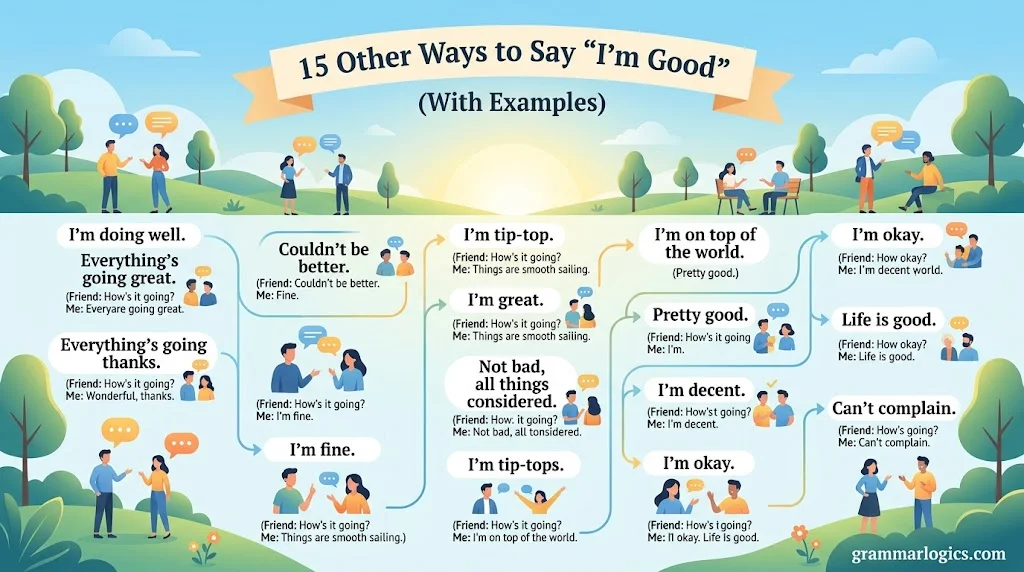
“I’m good” is a common expression used to describe how you feel, respond politely, or let someone know you are doing well.
In everyday conversations, “I’m good” is a simple and friendly way to answer questions like “How are you?” or “How have you been?” However, using the same phrase repeatedly can make your communication sound less expressive. Learning other ways to say “I’m good” can help you improve your English vocabulary and communicate more naturally in different situations. Whether you are talking with friends, responding to colleagues, or having a casual conversation with someone new, choosing the right words can make your responses more engaging. From simple expressions like “I’m doing well” to more cheerful replies like “I’m fantastic,” there are plenty of alternatives to explore.
The best alternative depends on the conversation, tone, and situation. For example, you might say “I’m doing great” when you feel happy, “I’m fine, thanks” in a polite conversation, or “I can’t complain” when you want to sound relaxed and casual. Understanding these expressions can help you speak more confidently and naturally in both personal and professional settings. In this guide, you will discover 15 useful alternatives to “I’m good,” along with clear explanations and practical examples. These phrases will help you expand your vocabulary, avoid repetition, and choose the most appropriate response when someone asks how you are feeling.
What Does “I’m Good” Mean?
“I’m good” is a common English expression that usually means you are feeling fine, doing well, or experiencing no particular problems. People often use it to answer questions such as “How are you?” or “How’s everything going?” Depending on the situation, it can communicate happiness, satisfaction, confidence, or simple reassurance. For example, saying “I’m good, thanks for asking” is a friendly way to respond to someone who checks on you.
The expression can also mean that you do not need or want something. If someone offers you another cup of coffee and you reply, “I’m good, thanks,” you are politely declining the offer. In other situations, the phrase may suggest that you are comfortable with a decision or do not need additional help. Its exact meaning depends on the conversation, your tone of voice, and the question being asked.
Common Situations Where “I’m Good” Is Used
People use “I’m good” in everyday conversations, text messages, social gatherings, and informal workplace discussions. It is especially common when someone asks how you are feeling or whether everything is going well. Friends might use it during casual chats, while colleagues may say it when greeting each other at work.
The phrase is also useful when declining an offer without sounding unfriendly. For instance, you might say “I’m good, thank you” when a waiter offers you another drink or a colleague asks whether you need assistance. However, repeating the same expression can sometimes make conversations feel predictable. Alternatives such as “I’m doing well,” “Can’t complain,” or “I’m feeling great” allow you to communicate a more specific mood, level of satisfaction, or degree of enthusiasm.
Is It Professional or Polite to Say “I’m Good”?
Yes, “I’m good” is generally polite and acceptable in everyday English, including many informal workplace conversations. It sounds friendly, relaxed, and natural when responding to a greeting or declining an offer. For example, telling a coworker, “I’m good, thanks. How about you?” is perfectly appropriate in most casual professional settings.
However, the expression may sound too casual in some formal emails, interviews, or professional introductions. In those situations, “I’m doing well, thank you” can sound more polished and respectful. If someone offers assistance, “No, thank you. I have everything I need” communicates your response more clearly. The best alternative depends on whether you are describing your well-being, expressing satisfaction, or politely declining something.
Advantages and Disadvantages of Saying “I’m Good”
Advantages
One major advantage of “I’m good” is its simplicity. It is short, easy to remember, and widely understood by English speakers. The expression works well in casual conversations because it communicates a positive or neutral response without requiring a long explanation. It can also help you decline an offer politely when combined with words such as “thanks” or “thank you.” Its flexible meaning makes it useful in many everyday situations, from greeting friends to responding to colleagues.
Disadvantages
The main limitation of “I’m good” is that it can be vague. Someone who is feeling excellent, merely okay, or uninterested in discussing their feelings might use the same words. Without additional context, listeners may not understand the speaker’s actual mood. The phrase can also sound casual in formal settings or seem dismissive if delivered without warmth. Choosing a more specific expression can help communicate enthusiasm, reassurance, gratitude, or professional courtesy more effectively.
15 Other Ways to Say “I’m Good”
- I’m doing well.
- I’m great.
- I’m feeling good.
- I’m doing just fine.
- I’m well, thank you.
- Can’t complain.
- Things are going well.
- I’m pretty good.
- I’m doing okay.
- All is well.
- I’m in a good place.
- Better than ever.
- I’m fantastic.
- I’m doing alright.
- No complaints here.
1. I’m Doing Well
Meaning
“I’m doing well” means that things are going positively in your life or that you feel fine. It is a natural alternative to “I’m good” when someone asks about your general well-being.
Definition
A polite expression used to communicate that you are feeling fine or managing your life satisfactorily.
Detailed Explanation
This expression sounds slightly more polished than “I’m good,” making it suitable for both personal and professional conversations. It can refer to your general circumstances rather than only your immediate mood. The phrase is positive without sounding overly excited or emotional. It is especially useful when you want to answer a greeting clearly and respectfully.
Scenario Examples
Scenario: A colleague greets you before a meeting.
Example: “I’m doing well, thank you. How has your morning been?”
Scenario: An old friend asks how life has been lately.
Example: “I’m doing well! Work has been busy, but everything is going smoothly.”
Best Use
Use this expression in workplace conversations, professional introductions, polite greetings, and everyday discussions.
Tone
Tone: Polite, calm, professional.
It communicates a positive response while maintaining a respectful and composed tone.
2. I’m Great
Meaning
“I’m great” expresses a strong positive feeling. It suggests that you are feeling very good or that things are going particularly well.
Definition
A cheerful expression used to describe an excellent mood or positive situation.
Detailed Explanation
Compared with “I’m good,” this phrase communicates greater enthusiasm. It is ideal when you genuinely feel happy, energetic, or excited about something. In casual conversation, it can make your response sound more lively and engaging. However, it may feel exaggerated if you are having an ordinary day and simply want to acknowledge a greeting.
Scenario Examples
Scenario: A friend asks how you feel after a relaxing weekend.
Example: “I’m great! I finally had time to rest and enjoy myself.”
Scenario: Your teammate asks how you are after completing an important project.
Example: “I’m great, thanks. I’m really happy with how the presentation turned out.”
Best Use
Choose this phrase when speaking with friends, family, teammates, or people with whom you have a comfortable relationship.
Tone
Tone: Enthusiastic, upbeat, friendly.
The word “great” adds extra positivity and makes your response feel energetic.
3. I’m Feeling Good
Meaning
“I’m feeling good” describes a positive physical or emotional state. It emphasizes how you feel at the moment rather than how your life is going overall.
Definition
An expression that communicates a pleasant mood or a sense of physical or emotional well-being.
Detailed Explanation
This phrase is especially useful when your feelings are the main topic of conversation. It may refer to having plenty of energy, feeling relaxed, or experiencing an improved mood. Unlike “I’m good,” which can be a general social response, “I’m feeling good” draws attention to your current state. It is informal and natural, although it may require clarification if the listener is asking about a specific health concern.
Scenario Examples
Scenario: Your friend asks how you feel after a morning walk.
Example: “I’m feeling good. Getting outside really helped clear my head.”
Scenario: A family member checks on you after a stressful week.
Example: “I’m feeling good today, thanks for checking on me.”
Best Use
Use this phrase in personal conversations about mood, energy, relaxation, or general well-being.
Tone
Tone: Warm, personal, relaxed.
It sounds more focused on your feelings than a standard greeting response.
4. I’m Doing Just Fine
Meaning
“I’m doing just fine” means that you are managing well and have no major problems to report. It often communicates reassurance.
Definition
A conversational expression indicating that things are satisfactory or that you are managing comfortably.
Detailed Explanation
The phrase can sound reassuring when someone is worried about you. Depending on your voice, it may also suggest that you are managing independently and do not need assistance. It is slightly more emphatic than “I’m good,” but it does not necessarily mean that everything is perfect. In some situations, the word “just” can make the response sound mildly defensive, so context matters.
Scenario Examples
Scenario: Your parent asks whether you are settling into your new apartment.
Example: “I’m doing just fine. The neighborhood is quiet, and I’m getting used to everything.”
Scenario: A friend worries because you have been busy lately.
Example: “Don’t worry about me. I’m doing just fine.”
Best Use
Use it when reassuring someone, answering personal questions, or explaining that you are managing a situation adequately.
Tone
Tone: Reassuring, casual, sometimes firm.
It can offer comfort, although a strong delivery may sound like you want to end the discussion.
5. I’m Well, Thank You
Meaning
“I’m well, thank you” is a polite way to say that you are fine. It acknowledges the other person’s question while maintaining a respectful tone.
Definition
A courteous response to a greeting that communicates satisfactory well-being.
Detailed Explanation
This expression sounds more formal than “I’m good” and is appropriate when speaking to people you do not know well. It works in professional introductions, meetings, and polite social interactions. Adding “thank you” shows appreciation for the other person’s interest. Although it may sound slightly traditional in very casual conversations, it remains a clear and grammatically natural response.
Scenario Examples
Scenario: You meet a new client before a scheduled appointment.
Example: “I’m well, thank you. I hope your journey here was comfortable.”
Scenario: A teacher asks how you are before class begins.
Example: “I’m well, thank you. I’m ready for today’s lesson.”
Best Use
Choose this expression for professional greetings, formal introductions, and conversations that call for extra courtesy.
Tone
Tone: Respectful, polite, formal.
Its measured wording makes it suitable for situations where professionalism matters.
6. Can’t Complain
Meaning
“Can’t complain” means that things are going reasonably well or that you have no serious problems to mention. It is often used as a relaxed response to “How are you?”
Definition
An informal expression suggesting that life is satisfactory, even if it is not perfect.
Detailed Explanation
This phrase is more understated than “I’m great.” It often communicates contentment without making a big statement about your feelings. The expression can sound humorous or modest because it suggests that things are good enough to be thankful for. It is less suitable for formal communication or serious conversations in which someone genuinely wants to understand how you are feeling.
Scenario Examples
Scenario: A neighbor asks how your week is going.
Example: “Can’t complain. The weather has been nice, and work is manageable.”
Scenario: A colleague checks in while you are getting coffee.
Example: “Can’t complain! Just trying to finish a few tasks before lunch.”
Best Use
Use it during casual chats with friends, neighbors, coworkers, or acquaintances.
Tone
Tone: Relaxed, modest, conversational.
It gives a positive but understated answer without sounding overly enthusiastic.
7. Things Are Going Well
Meaning
“Things are going well” means that your current circumstances or activities are progressing positively. It focuses more on how life is developing than on your immediate mood.
Definition
A statement indicating that your plans, responsibilities, or general circumstances are progressing satisfactorily.
Detailed Explanation
This phrase is useful when someone asks about your work, studies, family, or personal progress. It provides a broader answer than “I’m good” and can invite further conversation about what you have been doing. The expression sounds positive without being overly emotional. If you are discussing a specific project, you can make it clearer by naming the area that is going well.
Scenario Examples
Scenario: A former classmate asks how your new job is going.
Example: “Things are going well. I’m learning a lot and getting comfortable with the team.”
Scenario: A friend asks whether your exam preparation is on track.
Example: “Things are going well so far. I’ve finished most of my revision.”
Best Use
Use this expression when discussing progress, plans, work, education, or general life circumstances.
Tone
Tone: Positive, composed, informative.
It offers a useful overview without making your response too personal or overly detailed.
8. I’m Pretty Good
Meaning
“I’m pretty good” means that you are doing well or feeling fine. It usually communicates moderate positivity rather than extreme excitement.
Definition
An informal expression indicating that your condition or mood is reasonably good.
Detailed Explanation
The word “pretty” softens the statement and makes it sound relaxed. This expression is common in casual conversations, especially when you want to give a positive answer without overstating how you feel. It can also suggest that your day is going well enough, even if everything is not perfect. In formal situations, “I’m doing well” may sound more polished.
Scenario Examples
Scenario: A friend messages you after a few quiet days.
Example: “I’m pretty good! How have you been?”
Scenario: Someone asks how you feel after a busy day at college.
Example: “I’m pretty good, just a little tired from all the studying.”
Best Use
Choose this phrase for texting, informal greetings, friendly conversations, and relaxed social situations.
Tone
Tone: Casual, friendly, mildly positive.
It expresses satisfaction without suggesting that everything is exceptionally good.
9. I’m Doing Okay
Meaning
“I’m doing okay” means that you are managing or feeling reasonably well. Depending on the situation, it may also suggest that things are acceptable but not especially good.
Definition
A neutral expression indicating that someone is coping adequately with their current circumstances.
Detailed Explanation
Unlike “I’m great,” this phrase does not communicate strong enthusiasm. It is useful when you want to give an honest but brief answer without discussing every detail. Sometimes it reassures the listener that you are managing, even if you have a few challenges. Because the phrase can sound neutral or slightly uncertain, a close friend may ask a follow-up question if they sense that something is wrong.
Scenario Examples
Scenario: A friend checks on you during a difficult week.
Example: “I’m doing okay, thanks. I’m taking things one day at a time.”
Scenario: Your coworker asks how you are handling a new assignment.
Example: “I’m doing okay so far. I’m still getting familiar with the process.”
Best Use
Use this expression when you feel reasonably fine, are managing a challenge, or prefer a neutral answer.
Tone
Tone: Neutral, honest, understated.
It leaves room for a more detailed conversation without forcing you to share personal information.
10. All Is Well
Meaning
“All is well” means that everything is fine or that there are no significant problems. It focuses on the overall situation rather than only on personal feelings.
Definition
A concise expression used to reassure someone that circumstances are satisfactory.
Detailed Explanation
This phrase can sound calm, confident, and slightly formal. It is particularly useful when someone wants confirmation that everything is under control. Unlike “I’m good,” it often refers to a broader situation, such as a plan, household, or project. In casual conversation, it may sound a little dramatic or traditional, so “Everything is fine” can sometimes feel more natural.
Scenario Examples
Scenario: Your family asks whether you arrived safely at your destination.
Example: “I’ve checked into the hotel, and all is well.”
Scenario: A team member asks whether the event preparations are complete.
Example: “All is well. The equipment is ready, and the guests are arriving soon.”
Best Use
Use it for reassurance, brief status updates, personal messages, and situations where you want to communicate that everything is under control.
Tone
Tone: Calm, reassuring, composed.
It gives the listener a sense of stability and confidence.
11. I’m in a Good Place
Meaning
“I’m in a good place” means that you feel comfortable or satisfied with your current life circumstances, emotional state, or personal progress.
Definition
An expression describing a positive and relatively stable stage in someone’s life.
Detailed Explanation
This phrase communicates more than simply feeling fine at the moment. It often suggests emotional balance, personal growth, or satisfaction with the direction your life is taking. People may use it when discussing relationships, career decisions, recovery from difficult experiences, or personal goals. Because it can carry emotional depth, it may sound too serious for a quick greeting or a simple question about your day.
Scenario Examples
Scenario: A friend asks how you have been feeling after making a major life change.
Example: “I’m in a good place now. The move was challenging, but I feel settled.”
Scenario: Someone asks whether you are happy with your current career.
Example: “I’m in a good place professionally, and I’m enjoying the work I do.”
Best Use
Use this phrase during meaningful conversations about personal development, emotional well-being, life changes, or career satisfaction.
Tone
Tone: Reflective, confident, emotionally positive.
It suggests a sense of stability rather than temporary happiness.
12. Better Than Ever
Meaning
“Better than ever” means that you are feeling better or experiencing more positive circumstances than you have in the past.
Definition
An expression describing an improved condition that is better than at any previous point.
Detailed Explanation
This phrase is stronger than “I’m good” because it suggests noticeable improvement or exceptional well-being. It works particularly well when you have recovered from a difficult period, achieved a goal, or made a positive change in your life. However, it is not a neutral synonym because it compares your current situation with an earlier one. Use it when that comparison is accurate rather than as a routine answer to every greeting.
Scenario Examples
Scenario: An old friend asks how you have been since changing jobs.
Example: “Better than ever! I finally have a healthier work-life balance.”
Scenario: Someone asks how you feel after completing a rehabilitation or fitness program.
Example: “I’m feeling better than ever, and I have much more energy these days.”
Best Use
Use it when describing recovery, personal improvement, a new opportunity, or a genuinely positive change.
Tone
Tone: Enthusiastic, confident, optimistic.
It highlights progress and communicates that your current circumstances feel especially good.
13. I’m Fantastic
Meaning
“I’m fantastic” means that you feel exceptionally good or are having a very positive experience. It expresses more enthusiasm than the ordinary phrase “I’m good.”
Definition
A highly positive expression used to describe an excellent mood or overall condition.
Detailed Explanation
This phrase is best when your happiness or excitement is genuine. It can make a conversation more lively and encourage the other person to ask what is going well. In contrast with “I’m doing well,” which is measured and professional, “I’m fantastic” is more expressive and informal. It may feel exaggerated in a serious conversation or when you want to give a restrained response.
Scenario Examples
Scenario: Your friend asks how you feel after receiving exciting news.
Example: “I’m fantastic! I just found out that I got the scholarship.”
Scenario: A family member calls to check on you during a holiday.
Example: “I’m fantastic, thanks for asking. We’re having a wonderful time together.”
Best Use
Choose this expression when speaking with friends, family, or colleagues in cheerful and informal settings.
Tone
Tone: Excited, enthusiastic, expressive.
It communicates strong positive feelings rather than simple satisfaction.
14. I’m Doing Alright
Meaning
“I’m doing alright” means that you are managing reasonably well. It can express a neutral or mildly positive response, depending on your tone.
Definition
An informal expression indicating that your current situation is acceptable or manageable.
Detailed Explanation
This phrase is similar to “I’m doing okay,” although some speakers use it to sound a little more reassuring. It does not necessarily mean that everything is excellent; it simply suggests that you are coping. It is natural in everyday conversation and can be useful when you want to answer without providing much detail. In formal writing, “I’m doing well” is generally a more polished choice.
Scenario Examples
Scenario: A neighbor asks how you are managing during a busy month.
Example: “I’m doing alright, thanks. Just trying to keep everything organized.”
Scenario: A friend asks how you are after a minor disappointment.
Example: “I’m doing alright. I was disappointed at first, but I’m moving forward.”
Best Use
Use it in casual conversations, friendly messages, and situations where you want to communicate that you are coping.
Tone
Tone: Relaxed, understated, conversational.
It provides a realistic response without suggesting either extreme happiness or serious distress.
15. No Complaints Here
Meaning
“No complaints here” means that you are generally satisfied with how things are going and have no major problems to report.
Definition
A casual expression indicating contentment with your current circumstances.
Detailed Explanation
This phrase is similar to “Can’t complain,” but it can sound slightly more personal and conversational. It communicates satisfaction without claiming that life is perfect. The wording may also carry a lighthearted or humorous feeling, especially among friends and coworkers. It is best suited to informal situations because its conversational style may feel out of place in formal correspondence.
Scenario Examples
Scenario: A coworker asks how your new schedule is working out.
Example: “No complaints here. I’m getting more done in the mornings.”
Scenario: A friend asks how your weekend has been.
Example: “No complaints here! Good food, nice weather, and plenty of time to relax.”
Best Use
Use this phrase during informal workplace chats, friendly conversations, casual text messages, and everyday social interactions.
Tone
Tone: Casual, content, lightly humorous.
It conveys satisfaction in an easygoing way without sounding overly enthusiastic.
FAQs
What is another way to say “I’m good”?
Some natural alternatives are “I’m doing well,” “I’m great,” “I’m feeling good,” and “I’m doing just fine.” The best choice depends on whether you want to sound professional, cheerful, relaxed, or reassuring.
What does “I’m good” mean?
“I’m good” usually means that you feel fine or that things are going well. It can also mean that you do not need something, such as when you politely decline an offer of food, a drink, or assistance.
Is “I’m good” professional?
Yes, it is acceptable in many informal workplace conversations. For a more polished response during a formal meeting, interview, or professional introduction, “I’m doing well, thank you” is often a better choice.
What is a more polite way to say “I’m good”?
“I’m well, thank you” is a courteous alternative when someone asks how you are. If you are declining an offer, “No, thank you. I’m all set” may communicate your meaning more clearly.
Which alternative works best in formal communication?
“I’m doing well, thank you” is a reliable option for formal greetings and professional conversations. It sounds respectful and natural without being overly stiff. For a formal written update, you may want to describe the specific situation rather than use a general greeting response.
Conclusion
Choosing the right expression can make everyday conversations feel more natural and meaningful. Although “I’m good” is a useful phrase, alternatives such as “I’m doing well,” “I’m feeling good,” and “I’m in a good place” allow you to communicate different moods and circumstances more clearly.
Some expressions are ideal for professional greetings, while others work better with friends, family, or people you know well. Remember that similar phrases do not always carry exactly the same meaning. Consider the situation, your relationship with the listener, and the feeling you want to express before choosing your words. With a little practice, you can build a more flexible vocabulary and respond with greater confidence in both casual and professional conversations.