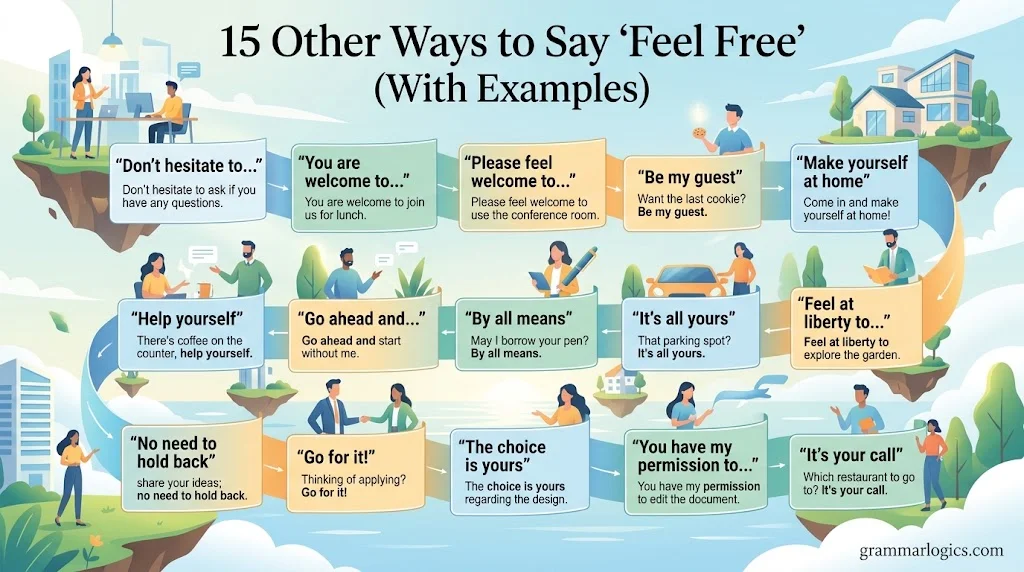
“Feel free” is a friendly expression that makes people feel comfortable asking questions, sharing ideas, or taking action without hesitation. Learning other ways to say “feel free” can help you communicate more naturally, politely, and confidently in everyday conversations, emails, and professional settings.
The phrase “feel free” is commonly used to give someone permission, offer help, or encourage them to do something without feeling uncomfortable. Whether you are writing a professional email, talking with friends, or welcoming someone into a new environment, choosing the right words can make your message sound more natural and inviting. Exploring different ways to say “feel free” allows you to express openness, kindness, and encouragement while matching the tone of each situation. Some alternatives sound formal and professional, while others feel casual, warm, or conversational.
Although “feel free” is a simple and useful expression, repeating it too often can make your communication sound predictable. Using suitable synonyms and alternative phrases helps you add variety to your writing and speaking while keeping your meaning clear. For example, expressions such as “don’t hesitate,” “you’re welcome to,” “go ahead,” and “by all means” can communicate permission or encouragement in slightly different ways. Understanding these differences is especially helpful when writing business emails, communicating with colleagues, or speaking politely with others. In this guide, you’ll discover 15 other ways to say “feel free,” complete with meanings and practical examples to help you choose the best expression for every situation.
What Does “Feel Free” Mean?
“Feel free” means that someone is welcome or encouraged to do something without feeling uncomfortable, hesitant, or obligated to ask for additional permission. It is a friendly expression that communicates openness and gives another person the freedom to act. For example, saying “Feel free to contact me” lets someone know that reaching out is welcome. The phrase is commonly used before a verb, such as ask, call, share, or visit.
The meaning can change slightly depending on the situation. In a workplace, “Feel free to ask questions” creates an open environment for discussion. Among friends, “Feel free to stop by” sounds casual and welcoming. Although the expression generally communicates permission, it can also suggest encouragement or reassurance. It does not mean that someone must take the suggested action; it simply makes the option available.
Common Situations Where “Feel Free” Is Used
People use “feel free” in everyday conversations, text messages, emails, and professional communication. A teacher might say, “Feel free to ask for help,” while a colleague might write, “Feel free to send me your feedback.” In customer service, it can reassure customers that they are welcome to request assistance. Friends may use it when inviting someone to visit, borrow something, or join an activity.
An alternative can be useful when you want to make your message more formal, personal, direct, or encouraging. For instance, “Please don’t hesitate to contact me” may sound more polished in a business email, while “You’re welcome to join us” may feel more natural when extending an invitation. The best wording depends on your relationship with the reader and the action you want to encourage.
Is It Professional or Polite to Say “Feel Free”?
Yes, “feel free” is generally polite and professional when used appropriately. It creates a relaxed atmosphere and lets people know that they have permission to ask questions, provide suggestions, or contact you. In workplace emails, meetings, and customer communication, the expression is often suitable because it sounds approachable rather than demanding.
However, it is somewhat conversational, so a more formal expression may be preferable in official letters, policies, or sensitive situations. “Please do not hesitate to contact me” sounds more formal, while “You are welcome to submit your feedback” offers a polished alternative. Context also matters: saying “Feel free to finish the report” might sound like permission, but it could create confusion if completing the report is actually a required responsibility. Choose wording that makes both permission and expectations clear.
Advantages and Disadvantages of Saying “Feel Free”
Advantages
The main advantage of “feel free” is its friendly and welcoming tone. It encourages people to communicate openly without making them feel pressured. The expression is short, easy to understand, and suitable for many situations, including workplace emails, casual conversations, invitations, and customer service messages. It can also make a request or offer sound less demanding by emphasizing that the other person has a choice.
Disadvantages
Although the phrase is useful, it can sound repetitive if used in every email or conversation. In highly formal writing, it may seem too casual compared with more polished expressions. It can also be unclear when a task is mandatory rather than optional. For example, telling an employee to “feel free to submit the report” might suggest that submitting it is not required. Choosing a more precise alternative can communicate the intended level of permission, encouragement, or obligation.
15 Synonyms for “Feel Free”
- You’re welcome to
- Don’t hesitate to
- Go ahead
- Please feel welcome to
- Be my guest
- You’re more than welcome to
- Don’t be afraid to
- You can certainly
- Please feel free to
- Help yourself
- By all means
- Don’t think twice about
- You’re invited to
- I encourage you to
- There’s no need to ask
1. You’re Welcome to
Meaning
“You’re welcome to” tells someone that they have permission to do something or are invited to take part. Like “feel free,” it communicates openness, but it can sound especially natural when offering an invitation or access to something.
Definition
A polite expression that gives someone permission or invites them to do something.
Detailed Explanation
This phrase works well when you want to make an option available without putting pressure on the other person. It often sounds a little more specific than “feel free” because it directly presents an opportunity. You can use it for social invitations, shared resources, and workplace arrangements. However, it does not always encourage action as strongly as “I encourage you to.”
Scenario Examples
Scenario: A colleague wants to review a presentation.
Example: “You’re welcome to use my slides as a reference.”
Scenario: A friend asks whether they can attend a gathering.
Example: “You’re welcome to join us for dinner.”
Scenario: A teacher invites students to seek extra help.
Example: “You’re welcome to visit during office hours.”
Best Use
Use this expression for polite invitations, permission, and shared resources. It fits emails, conversations, and friendly professional messages.
Tone
Tone: Welcoming, polite, friendly. It makes the other person feel included without demanding a response.
2. Don’t Hesitate to
Meaning
“Don’t hesitate to” encourages someone to take action without feeling uncertain or uncomfortable. It is especially useful when inviting questions or offering assistance.
Definition
An expression asking someone not to delay or feel reluctant about doing something.
Detailed Explanation
This phrase is more formal than “feel free” in many professional situations. It reassures the recipient that asking for help or making contact is appropriate. It is common in business emails, customer service, and professional correspondence. Unlike a general permission statement, it places greater emphasis on overcoming hesitation.
Scenario Examples
Scenario: A manager offers support to a new employee.
Example: “Don’t hesitate to ask me if you need help with the software.”
Scenario: A business closes an email to a customer.
Example: “Don’t hesitate to contact our support team if you have further questions.”
Scenario: A student needs clarification about an assignment.
Example: “Don’t hesitate to email me if any instructions are unclear.”
Best Use
Use it in professional emails, customer service, academic communication, and formal offers of help.
Tone
Tone: Professional, reassuring, respectful. It makes asking for assistance seem acceptable and welcome.
3. Go Ahead
Meaning
“Go ahead” gives someone permission to proceed with an action. It is a direct alternative when the person is waiting for approval or confirmation.
Definition
A phrase that allows someone to begin or continue an action.
Detailed Explanation
Unlike “feel free,” which often presents an open invitation, “go ahead” commonly responds to a specific request or situation. It can be brief and practical, making it useful in conversations and workplace discussions. The phrase can sound encouraging, but its tone depends on delivery. In formal writing, a fuller sentence may be more appropriate than this short expression.
Scenario Examples
Scenario: A colleague asks whether they can share an idea during a meeting.
Example: “Go ahead. I’d like to hear your suggestion.”
Scenario: A friend asks whether they can borrow a book.
Example: “Go ahead and take it. I’m finished reading it.”
Scenario: A customer asks whether they can complete a purchase.
Example: “Go ahead and place your order when you’re ready.”
Best Use
Use it for immediate permission, quick decisions, and everyday conversation. It works particularly well when someone is waiting for your approval.
Tone
Tone: Direct, casual, encouraging. It gives a clear signal that the other person can proceed.
4. Please Feel Welcome to
Meaning
“Please feel welcome to” invites someone to participate or take action in a warm, courteous way. It emphasizes inclusion and comfort.
Definition
A polite invitation that encourages someone to take part or use an available opportunity.
Detailed Explanation
This expression is useful when you want to make a person feel included rather than simply give permission. It can suit community announcements, event invitations, and messages to people who may not know you well. It is somewhat longer and less conversational than “feel free.” In everyday speech, “You’re welcome to” may sound smoother, so choose this wording when an explicitly welcoming tone is important.
Scenario Examples
Scenario: A community organizer welcomes questions.
Example: “Please feel welcome to share your ideas during the discussion.”
Scenario: A school invites parents to an event.
Example: “Please feel welcome to bring your family to the open house.”
Scenario: A host introduces a shared space.
Example: “Please feel welcome to use the reading room whenever it is available.”
Best Use
Use it for community messages, event invitations, welcoming announcements, and inclusive communication.
Tone
Tone: Warm, courteous, inclusive. It focuses on making people feel comfortable and accepted.
5. Be My Guest
Meaning
“Be my guest” gives someone permission to do something, often in response to a request. It can also communicate generous hospitality.
Definition
An informal expression meaning that someone may do what they have asked to do.
Detailed Explanation
This phrase is more conversational than “feel free” and is often used when granting permission directly. It works naturally when someone wants to borrow an item, sit somewhere, or take a small liberty. Depending on context and delivery, it can also sound sarcastic, especially when the speaker is annoyed. Because of this possible nuance, it is best used with people who understand your tone.
Scenario Examples
Scenario: A friend asks to borrow your headphones.
Example: “Be my guest. Just put them back in the case afterward.”
Scenario: A visitor asks whether they can sit by the window.
Example: “Be my guest; that seat is available.”
Scenario: A colleague asks to use your whiteboard.
Example: “Be my guest. I’ll be finished with it in a minute.”
Best Use
Use it in casual conversations, friendly interactions, and informal situations involving permission.
Tone
Tone: Casual, generous, sometimes playful. The exact feeling depends on the relationship and how it is said.
6. You’re More Than Welcome to
Meaning
“You’re more than welcome to” expresses generous permission or a particularly warm invitation. It reassures someone that their participation is genuinely appreciated.
Definition
A friendly expression emphasizing that someone is very welcome to do something.
Detailed Explanation
This wording adds warmth to a basic invitation. It is helpful when someone might worry about being a burden or imposing on others. The phrase can be used in both personal and professional settings, although it may feel overly enthusiastic for routine instructions. Unlike “go ahead,” it emphasizes hospitality rather than simply authorizing an action.
Scenario Examples
Scenario: A friend wonders whether they can stay longer.
Example: “You’re more than welcome to stay for another cup of tea.”
Scenario: A team leader invites feedback.
Example: “You’re more than welcome to share additional suggestions after the meeting.”
Scenario: A neighbor asks to use your garden table.
Example: “You’re more than welcome to use it this afternoon.”
Best Use
Use it for warm invitations, reassuring messages, hospitality, and encouraging participation.
Tone
Tone: Warm, generous, reassuring. It communicates that the person’s presence or contribution is genuinely welcome.
7. Don’t Be Afraid to
Meaning
“Don’t be afraid to” encourages someone to act despite worry, shyness, or uncertainty. It is more emotionally supportive than a simple permission statement.
Definition
An expression encouraging someone not to let fear or nervousness prevent an action.
Detailed Explanation
This phrase is useful when someone lacks confidence or worries about making a mistake. It goes beyond granting permission because it addresses the person’s feelings. For example, “Don’t be afraid to ask questions” suggests that questions are welcome even if the person feels nervous. However, it can sound patronizing if the recipient is not actually afraid, so consider the person’s circumstances before using it.
Scenario Examples
Scenario: A teacher encourages a quiet student.
Example: “Don’t be afraid to speak up when you have an idea.”
Scenario: A friend is nervous about trying a new hobby.
Example: “Don’t be afraid to give it a try. You might really enjoy it.”
Scenario: A new employee is learning a complicated process.
Example: “Don’t be afraid to ask for clarification if something doesn’t make sense.”
Best Use
Use it for encouragement, supportive conversations, learning environments, and confidence-building messages.
Tone
Tone: Supportive, reassuring, encouraging. It acknowledges possible anxiety and encourages action.
8. You Can Certainly
Meaning
“You can certainly” confirms that someone is permitted or able to do something. It sounds positive and assured.
Definition
A polite expression confirming that an action is allowed or possible.
Detailed Explanation
This phrase is useful when answering a request with confidence. It often sounds more deliberate than “feel free” because it directly confirms that the action is acceptable. It can work in customer service, workplace communication, and everyday exchanges. However, it is usually followed by a specific action, so it is less suitable as a broad invitation without additional context.
Scenario Examples
Scenario: A customer asks whether they can change a booking.
Example: “You can certainly request a different appointment time.”
Scenario: A colleague asks whether they can contribute to a report.
Example: “You can certainly add your findings to the final section.”
Scenario: A student asks whether they can submit a question after class.
Example: “You can certainly email me your question this evening.”
Best Use
Use it for polite responses, customer communication, workplace discussions, and confirming permission.
Tone
Tone: Assured, courteous, professional. It communicates confidence while remaining respectful.
9. Please Feel Free to
Meaning
“Please feel free to” is a courteous version of “feel free” that explicitly signals politeness. It encourages an action while making the invitation sound considerate.
Definition
A polite phrase inviting someone to do something without feeling uncomfortable or pressured.
Detailed Explanation
Adding “please” can make the expression feel more courteous, particularly in written communication. It is useful when addressing customers, colleagues, students, or people you do not know well. The phrase remains conversational rather than highly formal. Since it has almost the same meaning as the original, it is most useful when you want a slightly more polite presentation rather than a different message.
Scenario Examples
Scenario: A colleague shares a draft document.
Example: “Please feel free to leave comments directly in the file.”
Scenario: A customer receives an order confirmation.
Example: “Please feel free to contact us if you need help tracking your delivery.”
Scenario: A tutor sends notes to a student.
Example: “Please feel free to review these examples before our next lesson.”
Best Use
Use it in emails, customer service messages, workplace communication, and polite written invitations.
Tone
Tone: Polite, helpful, professional. It makes an open invitation sound considerate without becoming stiff.
10. Help Yourself
Meaning
“Help yourself” gives someone permission to take or use something without asking for individual assistance. It is especially common with food, drinks, and shared items.
Definition
An expression inviting someone to take what they need from an available supply.
Detailed Explanation
This phrase is more specific than “feel free” because it usually relates to taking or using something. It sounds welcoming in homes, offices, and informal gatherings. In a workplace, it can encourage colleagues to use shared stationery or refreshments. It is not generally suitable for inviting someone to ask questions or contact you, because its usual meaning concerns access to things.
Scenario Examples
Scenario: A host shows guests where the refreshments are.
Example: “Help yourself to some fruit and biscuits.”
Scenario: An office manager leaves supplies on a table.
Example: “Help yourself to any of the spare notebooks.”
Scenario: A friend offers snacks before a movie.
Example: “The popcorn is on the counter, so help yourself.”
Best Use
Use it for food, drinks, shared supplies, and informal hospitality.
Tone
Tone: Friendly, generous, relaxed. It makes guests or colleagues feel comfortable taking what is available.
11. By All Means
Meaning
“By all means” expresses strong agreement or enthusiastic permission. It tells someone that their proposed action is acceptable.
Definition
A phrase meaning that someone is welcome or encouraged to proceed with a suggested action.
Detailed Explanation
This expression is useful when responding positively to a request or suggestion. Compared with “feel free,” it often sounds more emphatic and slightly more formal. It works well in conversation and some professional situations, especially when you want to give clear approval. In certain contexts, however, it may sound stiff or sarcastic, so the surrounding words and tone matter.
Scenario Examples
Scenario: A colleague asks whether they can present an alternative idea.
Example: “By all means, explain your approach to the team.”
Scenario: A guest asks whether they can open a window.
Example: “By all means, the room is a little warm.”
Scenario: A student asks whether they can suggest a different book.
Example: “By all means, I’d be interested in hearing your recommendation.”
Best Use
Use it for clear permission, enthusiastic agreement, and polite discussions where a slightly formal tone is appropriate.
Tone
Tone: Assured, courteous, sometimes emphatic. It conveys approval more strongly than a neutral invitation.
12. Don’t Think Twice About
Meaning
“Don’t think twice about” encourages someone to take action without unnecessary worry or hesitation. It can also suggest that an action is completely acceptable.
Definition
An informal expression telling someone not to worry about doing something.
Detailed Explanation
This phrase adds reassurance and can help someone feel that they are not imposing on you. For example, telling a friend not to think twice about calling suggests that their contact is welcome. It is more personal and reassuring than “feel free,” but it may sound too casual for formal documents. Depending on the context, it can encourage action or reassure someone that they have made the right choice.
Scenario Examples
Scenario: A friend apologizes for calling late with a problem.
Example: “Don’t think twice about calling me when you need someone to talk to.”
Scenario: A colleague is unsure whether to request help.
Example: “Don’t think twice about asking me to review the figures.”
Scenario: A family member worries about borrowing a book.
Example: “Don’t think twice about taking it with you.”
Best Use
Use it for personal reassurance, supportive messages, and informal conversations where warmth matters.
Tone
Tone: Reassuring, familiar, supportive. It reduces the sense that someone is inconveniencing you.
13. You’re Invited to
Meaning
“You’re invited to” tells someone that they are welcome to attend or participate in an event or activity. It is more specific than the general expression “feel free.”
Definition
A phrase formally or informally offering someone an invitation to an event or activity.
Detailed Explanation
This expression is best when the action involves joining an organized event, gathering, or activity. It can sound professional in announcements and invitations, while a more casual version can suit social messages. Unlike “feel free,” it does not naturally apply to every action, such as asking a question or borrowing an object. Use it when you want the invitation itself to be clear.
Scenario Examples
Scenario: A company announces a staff workshop.
Example: “You’re invited to attend our product demonstration on Friday.”
Scenario: A friend shares plans for a birthday celebration.
Example: “You’re invited to celebrate my birthday with us this weekend.”
Scenario: A community center announces a public discussion.
Example: “You’re invited to join the conversation and share your views.”
Best Use
Use it for events, meetings, celebrations, workshops, and organized activities.
Tone
Tone: Welcoming, clear, formal or friendly depending on context. It explicitly communicates an invitation rather than general permission.
14. I Encourage You to
Meaning
“I encourage you to” expresses active support for someone taking a particular action. It is stronger than “feel free” because it recommends or promotes the action rather than simply allowing it.
Definition
A phrase showing that you support or recommend someone doing something.
Detailed Explanation
This expression works when you want someone to participate, offer feedback, explore an opportunity, or take a constructive step. It is common in education, leadership, workplace communication, and formal guidance. Unlike a neutral permission phrase, it communicates your positive opinion about the action. Because it is more directive, it may not be suitable when you simply want to leave the decision entirely open.
Scenario Examples
Scenario: A supervisor wants the team to share ideas.
Example: “I encourage you to suggest improvements to our current process.”
Scenario: A teacher motivates students to participate in class.
Example: “I encourage you to explain how you reached your answer.”
Scenario: A mentor advises someone considering professional development.
Example: “I encourage you to explore the training opportunities available to you.”
Best Use
Use it for professional guidance, educational settings, leadership, and situations where you actively recommend an action.
Tone
Tone: Supportive, purposeful, professional. It communicates encouragement rather than simply granting permission.
15. There’s No Need to Ask
Meaning
“There’s no need to ask” reassures someone that they do not have to request permission for a particular action. It suggests that the action is already acceptable.
Definition
A phrase telling someone that asking for permission is unnecessary in the situation.
Detailed Explanation
This expression can make close friends, family members, or trusted colleagues feel comfortable. It differs from “feel free” because it specifically removes the expectation of asking first. That can communicate trust and familiarity, especially when discussing shared belongings or routine requests. However, it should only be used when the person genuinely has permission; otherwise, it may create confusion about boundaries or responsibilities.
Scenario Examples
Scenario: A family member wants to take a snack from the kitchen.
Example: “There’s no need to ask before taking fruit from the bowl.”
Scenario: A close colleague regularly uses shared office supplies.
Example: “There’s no need to ask before using the spare paper.”
Scenario: A friend worries about contacting you during a difficult week.
Example: “There’s no need to ask whether you can call me when you’re having a rough day.”
Best Use
Use it for close relationships, shared resources, and situations where permission has already been established.
Tone
Tone: Reassuring, familiar, trusting. It communicates that the person does not need to seek repeated approval.
FAQs
What is another way to say “feel free”?
Some natural alternatives are “you’re welcome to,” “don’t hesitate to,” “go ahead,” and “you’re more than welcome to.” The best choice depends on whether you want to give permission, offer an invitation, or encourage someone to act.
What does “feel free” mean?
“Feel free” means that someone is welcome or encouraged to do something without feeling uncomfortable or needing additional permission. For example, “Feel free to ask questions” tells someone that asking questions is acceptable.
Is “feel free” professional?
Yes. It is generally suitable for workplace emails, customer communication, and team discussions. For more formal correspondence, “please do not hesitate to contact me” may sound more polished.
What is a more polite way to say “feel free”?
“Please feel free to” and “you’re welcome to” are polite alternatives. For professional messages, “please don’t hesitate to contact me” is also a good option when inviting someone to get in touch.
Which alternative works best in formal communication?
“Don’t hesitate to” is a strong choice when inviting questions or contact. If you are formally inviting someone to an event, “you’re invited to” may be more appropriate. Choose the phrase that accurately reflects the action and the level of formality required.
Conclusion
Choosing the right alternative to “feel free” can make your communication more natural, considerate, and effective. Although the original phrase is friendly and widely useful, different situations call for different expressions. “Don’t hesitate to” works well in professional emails, “be my guest” suits casual permission, and “I encourage you to” communicates active support. Meanwhile, “you’re welcome to” is a versatile option for invitations and polite offers.
The key is to consider your audience, your relationship with them, and the message you want to convey. A phrase that sounds warm in a personal conversation may feel too casual in an official email. By understanding the meaning and tone of these alternatives, you can choose wording that feels clear, respectful, and appropriate. Good communication is not just about giving permission; it is about helping others feel comfortable and understood.