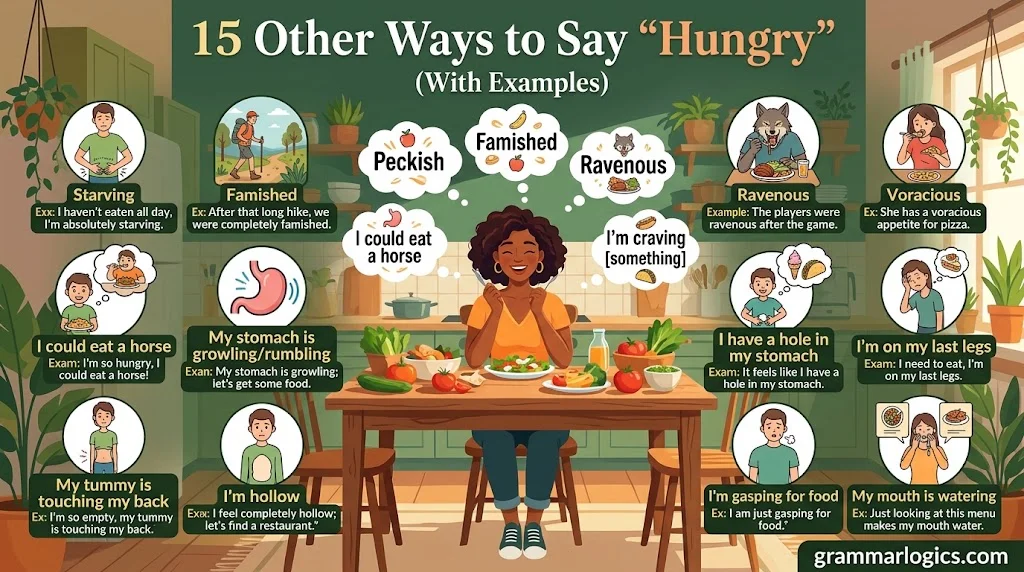
Being hungry is a common feeling, but expressing it in different ways can make your English sound more natural, engaging, and expressive in everyday conversations and writing.
There are many other ways to say “hungry” depending on how you feel and the situation you want to describe. For example, you might say “starving” when you are extremely hungry, “peckish” when you want a small snack, or “ravenous” when you have a strong desire to eat. These alternatives help you communicate your feelings more clearly and add variety to your vocabulary. Whether you are chatting with friends, writing a blog post, or improving your English skills, learning different expressions for hunger can make your communication more interesting and effective.
Choosing the right synonym for hungry can also help you express different levels of hunger in a more accurate way. Some phrases are casual and friendly, while others are more descriptive or suitable for creative writing. For instance, “I could eat a horse” is a humorous expression that describes extreme hunger, whereas “I could use a snack” sounds polite and relaxed. Understanding these differences allows you to choose words that fit your tone, audience, and purpose. In this article, we will explore 15 other ways to say “hungry”, complete with clear meanings and practical examples to help you expand your vocabulary and communicate with confidence.
What Does “Hungry” Mean?
Hungry means feeling the physical need or desire to eat food. It is commonly used when your stomach feels empty, your energy is low, or you are ready for a meal. For example, someone might say, “I’m hungry; let’s get lunch.” The word can describe anything from a slight appetite to a strong need for food, depending on the situation. It is a common adjective in everyday English and works naturally in conversations, text messages, and informal writing.
The word also has a figurative meaning. People may describe themselves as hungry for success, knowledge, adventure, or opportunity when they strongly desire to achieve or experience something. In this context, hungry does not refer to food; it expresses ambition, motivation, or a powerful desire. Understanding the difference between physical hunger and figurative hunger helps you choose the most suitable expression for your intended meaning.
Common Situations Where “Hungry” Is Used
People use the word hungry in many everyday situations. At home, you might tell your family that you are ready for dinner. While texting a friend, you could suggest getting something to eat. At school or work, the word can help explain why you need a lunch break or a quick snack. It is also common in restaurants when discussing appetite or deciding what to order.
In writing, the word can describe a character who needs food or someone who is eager to achieve a goal. For example, a writer might describe a character as hungry for adventure. In professional communication, the figurative expression can suggest ambition, although more specific wording may be clearer. Choosing an alternative helps you express how strongly you feel, whether you mean physical hunger, a desire for food, or a deeper sense of ambition.
Is It Professional or Polite to Say “Hungry”?
Yes, hungry is a normal, polite, and widely accepted English word. It is appropriate in professional settings when discussing lunch breaks, meal arrangements, or food preferences. For example, “I’m getting hungry. Would you like to take a lunch break?” sounds natural and courteous. The word itself is neither rude nor overly informal, although the way you express your needs can affect the tone.
In a formal email, you may want to use more specific language if the situation calls for it. For example, “I’m ready for lunch” can sound more practical when coordinating a meeting schedule. In motivational or business contexts, hungry for success communicates strong ambition, but it may sound more energetic than formal alternatives such as “highly motivated.” The best choice depends on whether you are discussing food, expressing a personal feeling, or describing a professional goal.
Advantages and Disadvantages of Saying “Hungry”
Advantages
- Clear meaning: Most English speakers immediately understand that you want or need food.
- Everyday usefulness: The word works naturally in conversations, messages, and informal writing.
- Flexible usage: It can describe physical appetite as well as a strong desire for success, learning, or new experiences.
- Easy communication: It helps you express a basic need without requiring a lengthy explanation.
Disadvantages
- Limited emotional detail: The word may not show whether you want a small snack or feel extremely hungry.
- Possible repetition: Using it repeatedly in a story or article can make the writing less expressive.
- Figurative ambiguity: “Hungry for success” means ambitious, while “hungry for lunch” refers to food. Context determines the meaning.
- Different levels of intensity: A simple statement may not communicate severe hunger or a particular craving as precisely as another expression.
15 Synonyms and Alternatives for “Hungry”
- Famished
- Starving
- Peckish
- Ravenous
- Feeling peckish
- Ready for a meal
- In need of food
- Having an appetite
- Could eat a horse
- Feeling empty
- Craving something to eat
- Ready to eat
- Needing a bite to eat
- Eager for food
- Hungry for more
1. Famished
Meaning
Famished means feeling extremely hungry and strongly needing food. It describes a more intense level of hunger than the ordinary word hungry.
Definition
Famished is an adjective used to describe someone who needs food very badly.
Detailed Explanation
Use this expression when you have gone a long time without eating or feel ready for a substantial meal. It communicates strong physical hunger and can make a sentence more expressive. Although it is common in everyday English, it can sound slightly dramatic when the situation involves only mild hunger. It works particularly well in storytelling and casual conversation.
Scenario Examples
- Scenario: You have finished a long day at work without lunch. Example: “I’m absolutely famished. Let’s find somewhere to eat.”
- Scenario: Your friend returns home after traveling all day. Example: “We must be famished after that long journey.”
Best Use
Use famished in casual conversations, personal messages, and descriptive writing when ordinary hunger feels too mild to express your appetite.
Tone
Tone: Strong, expressive, conversational.
The word emphasizes how much you need food without sounding impolite.
2. Starving
Meaning
Starving commonly means feeling extremely hungry. In casual conversation, people often use it to exaggerate how much they want to eat.
Definition
Starving means experiencing severe hunger, although in everyday speech it frequently describes an intense appetite rather than literal starvation.
Detailed Explanation
This expression is one of the most familiar ways to communicate strong hunger. Friends might say they are starving when they have missed lunch or are waiting for dinner. However, literal starvation is a serious condition caused by prolonged lack of food, so the expression should be understood in context. In ordinary conversation, it usually communicates urgency rather than a medical condition.
Scenario Examples
- Scenario: You have not eaten since breakfast. Example: “I’m starving. Can we stop for lunch?”
- Scenario: Your friend asks whether you want to order dinner. Example: “Yes, please! I’m starving.”
Best Use
Use starving in casual speech, friendly text messages, and informal conversations when you want to emphasize strong hunger.
Tone
Tone: Casual, emphatic, familiar.
It sounds natural among friends and family but may be too dramatic for a formal description of an ordinary appetite.
3. Peckish
Meaning
Peckish means slightly hungry, especially when you feel like having a small snack rather than a full meal.
Definition
Peckish is an informal adjective describing a mild desire to eat.
Detailed Explanation
Unlike famished or starving, peckish communicates mild hunger. It is useful when you do not need a complete meal but would enjoy a biscuit, some fruit, or another small snack. The expression is particularly common in British English, although other English speakers may understand it too. Its lighthearted quality makes it suitable for relaxed conversations.
Scenario Examples
- Scenario: You are working in the afternoon and want a snack. Example: “I’m feeling a little peckish. Do we have any fruit?”
- Scenario: A friend asks whether you want something to eat before dinner. Example: “I’m a bit peckish, so a few crackers would be nice.”
Best Use
Use peckish in friendly conversations, casual messages, and relaxed social situations when you want to describe a small appetite.
Tone
Tone: Light, informal, mildly playful.
It makes hunger sound gentle rather than urgent.
4. Ravenous
Meaning
Ravenous means extremely hungry and eager to eat a large amount of food.
Definition
Ravenous is an adjective that describes an intense appetite or powerful feeling of hunger.
Detailed Explanation
This word expresses very strong hunger and can sound more vivid than hungry. It is especially effective after strenuous exercise, a long hike, or a day filled with activity. Although it is appropriate in conversation, it also appears frequently in descriptive and creative writing. Compared with peckish, it suggests that a small snack probably will not be enough.
Scenario Examples
- Scenario: You finish a challenging mountain hike. Example: “I’m ravenous after that hike. Let’s get a proper meal.”
- Scenario: Your family returns from a long road trip. Example: “Everyone is ravenous, so let’s eat before unpacking.”
Best Use
Use ravenous in storytelling, casual conversation, and descriptive writing when you want to emphasize an intense appetite.
Tone
Tone: Vivid, emphatic, expressive.
It paints a stronger picture of hunger than a neutral word would.
5. Feeling peckish
Meaning
Feeling peckish means experiencing a slight desire to eat something. It usually suggests that a small snack would be enough.
Definition
This phrase describes the experience of being mildly hungry.
Detailed Explanation
The phrase uses the adjective peckish to describe how someone feels at a particular moment. It is a natural option when you want to mention your appetite without making it sound urgent. The wording can also soften a suggestion to get food, especially in a social setting. Unlike starving, it does not imply that you have missed several meals or need a large amount of food.
Scenario Examples
- Scenario: You are visiting a friend in the afternoon. Example: “I’m feeling peckish. Would you like to share some snacks?”
- Scenario: Your colleague takes a short break from work. Example: “I’m feeling a little peckish, so I’m going to grab an apple.”
Best Use
Use feeling peckish in casual conversations, friendly invitations, and everyday messages when describing mild hunger.
Tone
Tone: Gentle, conversational, friendly.
The phrase expresses a small appetite without putting pressure on anyone else to eat.
6. Ready for a meal
Meaning
Ready for a meal means that you feel prepared or willing to eat a proper meal, often because you have developed an appetite.
Definition
This phrase describes someone who is prepared to eat food, usually breakfast, lunch, or dinner.
Detailed Explanation
This wording focuses on the next step—eating—rather than directly describing the physical feeling of hunger. It can sound practical and natural when coordinating meals with family, friends, or coworkers. It does not necessarily mean you are extremely hungry; you may simply feel that it is the right time to eat. That makes it useful when you want to suggest a meal without emphasizing your discomfort.
Scenario Examples
- Scenario: You and a friend have finished shopping. Example: “I’m ready for a meal. Shall we find a restaurant?”
- Scenario: Your family is deciding when to serve dinner. Example: “We’re all ready for a meal, so let’s set the table.”
Best Use
Use ready for a meal when planning lunch or dinner, arranging a restaurant visit, or politely suggesting that it is time to eat.
Tone
Tone: Practical, neutral, polite.
It emphasizes readiness to eat instead of the intensity of your appetite.
7. In need of food
Meaning
In need of food means that someone needs something to eat. It focuses on the need for nourishment rather than simply describing an appetite.
Definition
This phrase describes a person who requires food, whether because of hunger or a lack of access to a meal.
Detailed Explanation
This wording is more serious and descriptive than the everyday adjective hungry. It may be appropriate when discussing people who lack reliable access to food or explaining a practical need. In ordinary conversation, however, it can sound unnecessarily formal if you simply want to say that you would like lunch. Context matters, because needing food can describe a basic necessity rather than a temporary craving.
Scenario Examples
- Scenario: You are organizing a community food collection. Example: “The project supports families in need of food and other essentials.”
- Scenario: A traveler has run out of supplies. Example: “After hours on the trail, we were in need of food and water.”
Best Use
Use in need of food in informational writing, community support discussions, and situations involving practical needs or limited food supplies.
Tone
Tone: Serious, descriptive, compassionate.
It highlights the need for nourishment rather than the casual enjoyment of eating.
8. Having an appetite
Meaning
Having an appetite means feeling a desire to eat. It can describe normal hunger or a person’s general willingness to eat food.
Definition
An appetite is a desire for food, so having an appetite means feeling ready or interested in eating.
Detailed Explanation
This expression is useful when discussing how much someone wants to eat without using an especially emotional word. It can describe an ordinary desire for a meal, but it also appears in health-related conversations about eating habits. Unlike ravenous, it does not necessarily suggest intense hunger. The phrase may also be used negatively, as in “I don’t have much of an appetite,” when someone does not feel like eating.
Scenario Examples
- Scenario: A friend asks whether you want dinner. Example: “Yes, I’m having quite an appetite tonight after all that exercise.”
- Scenario: Someone is recovering from a tiring day and does not want much food. Example: “I haven’t had much of an appetite today, so I’ll have some soup.”
Best Use
Use having an appetite when discussing eating preferences, meal plans, or whether someone feels like eating. In polished English, “I’ve got an appetite” or “I have a good appetite” may sound more natural in some contexts.
Tone
Tone: Neutral, descriptive, slightly more measured.
It focuses on the desire to eat rather than how urgent that desire feels.
9. Could eat a horse
Meaning
Could eat a horse is an informal idiom meaning that someone is extremely hungry.
Definition
This humorous expression exaggerates hunger to show that a person feels ready to eat a very large meal.
Detailed Explanation
The phrase is not meant literally. It is a colorful way to tell someone that you have a very strong appetite, often after physical activity or a long wait for food. Because it is an idiom, its meaning depends on familiarity with everyday English expressions. It works well with friends and family but is generally unsuitable for formal reports or serious discussions about food insecurity.
Scenario Examples
- Scenario: You return home after playing football. Example: “I could eat a horse! Is dinner ready yet?”
- Scenario: Your friends ask how hungry you are after a long drive. Example: “Honestly, I could eat a horse. Let’s stop somewhere for food.”
Best Use
Use could eat a horse in humorous conversations, informal storytelling, and friendly messages when you want to exaggerate your appetite.
Tone
Tone: Humorous, casual, exaggerated.
Its playful wording makes the statement more colorful than simply saying you are hungry.
10. Feeling empty
Meaning
Feeling empty can describe a sensation of emptiness in the stomach, sometimes associated with hunger. However, it can also refer to emotional emptiness.
Definition
This phrase describes a feeling of emptiness, which may be physical or emotional depending on the context.
Detailed Explanation
When discussing food, feeling empty may suggest that your stomach feels empty after several hours without eating. However, the expression is not an exact synonym for hungry because it can communicate sadness, loneliness, or a lack of emotional fulfillment. A sentence such as “My stomach feels empty” makes the physical meaning clearer. Adding that detail helps prevent misunderstandings, especially in writing.
Scenario Examples
- Scenario: You have not eaten since early morning. Example: “My stomach feels empty, so I’m going to make some breakfast.”
- Scenario: You are describing a character after an emotional loss. Example: “She felt empty inside and struggled to explain why.”
Best Use
Use feeling empty in descriptive writing or personal conversations when the context clearly communicates whether the feeling is physical or emotional.
Tone
Tone: Reflective, descriptive, potentially emotional.
The phrase is less direct than hungry and often benefits from additional context.
11. Craving something to eat
Meaning
Craving something to eat means strongly wanting food, often because a particular taste or type of food sounds appealing.
Definition
A craving is a strong desire for something, so this phrase describes a strong desire to eat.
Detailed Explanation
This expression can communicate hunger, but it often emphasizes what you want to eat rather than a physical need for food. For example, you might crave chocolate even after having dinner. You can also use it when you simply want a snack but do not have a particular dish in mind. If you mean that your stomach needs food, hungry may be more precise; if you want a particular flavor, craving is often the better choice.
Scenario Examples
- Scenario: You are relaxing at home after dinner. Example: “I’m craving something to eat, maybe popcorn or a few cookies.”
- Scenario: A friend asks what you would like to order. Example: “I’m craving something spicy. Do you know a good place nearby?”
Best Use
Use craving something to eat in conversations about snacks, food preferences, restaurant choices, and specific food desires.
Tone
Tone: Casual, expressive, appetite-focused.
It communicates a strong desire for food, although that desire may not come from physical hunger alone.
12. Ready to eat
Meaning
Ready to eat means prepared or willing to start eating. It may imply hunger, but it can also simply mean that someone is available for a meal.
Definition
This phrase describes a person who is prepared to eat or food that can be eaten without further preparation, depending on context.
Detailed Explanation
When talking about people, the phrase works well when everyone is deciding whether to begin a meal. It is less focused on the sensation of hunger than expressions such as famished or ravenous. For example, asking “Are you ready to eat?” is a friendly way to check whether someone wants to start dinner. Be aware that ready-to-eat can also describe prepared foods, such as ready-to-eat meals, so context determines its meaning.
Scenario Examples
- Scenario: You have finished cooking dinner for your family. Example: “Everything is on the table. Are you ready to eat?”
- Scenario: You and a friend have arrived at a café. Example: “I’m ready to eat whenever you are.”
Best Use
Use ready to eat when inviting someone to start a meal, coordinating food plans, or asking whether others want to eat now.
Tone
Tone: Friendly, practical, conversational.
It makes eating the focus rather than emphasizing the intensity of hunger.
13. Needing a bite to eat
Meaning
Needing a bite to eat means feeling that you need some food, usually a small meal or snack.
Definition
This phrase describes a need for something to eat, often without suggesting extreme hunger.
Detailed Explanation
This expression is a natural choice when you want to mention hunger in a relaxed, understated way. Although a bite can literally mean a small amount of food, the phrase often refers more broadly to getting something to eat. It is especially useful when you are busy and want a quick snack or a short break. Compared with starving, it sounds less urgent and more practical.
Scenario Examples
- Scenario: You are running errands and need a quick break. Example: “I need a bite to eat before we head to the next store.”
- Scenario: A colleague has been working through the afternoon. Example: “Let’s take a break. I think we could both use a bite to eat.”
Best Use
Use needing a bite to eat in everyday conversations, casual workplace discussions, and friendly messages about taking a food break.
Tone
Tone: Relaxed, understated, practical.
It expresses a simple need for food without suggesting an overwhelming appetite.
14. Eager for food
Meaning
Eager for food means strongly wanting food or looking forward to eating. It emphasizes desire and anticipation more than the physical sensation of hunger.
Definition
Eager for food describes someone who is keen to receive or eat food.
Detailed Explanation
This phrase can be useful in descriptive writing, particularly when explaining the behavior of animals, children, or people waiting for a meal. In ordinary conversation, however, it can sound less natural than “hungry” or “ready to eat.” It emphasizes eagerness and anticipation, so it is not always interchangeable with hungry. Choose it when the person’s enthusiasm for food matters more than simply stating that they need to eat.
Scenario Examples
- Scenario: A group of children gathers around the table before dinner. Example: “The children were eager for food after spending the afternoon playing outside.”
- Scenario: You are describing pets waiting for their meal. Example: “The puppies were eager for food as soon as they heard the bowl being filled.”
Best Use
Use eager for food in descriptive writing and situations where excitement or anticipation about eating is important. For ordinary conversation, a simpler expression is usually more natural.
Tone
Tone: Descriptive, anticipatory, slightly formal.
It draws attention to someone’s eagerness rather than directly describing an empty stomach.
15. Hungry for more
Meaning
Hungry for more usually means wanting more of something, such as knowledge, success, experience, or opportunity. It can also refer to wanting additional food, depending on context.
Definition
This phrase describes a strong desire for more of something, often in a figurative rather than literal sense.
Detailed Explanation
Unlike the other food-focused expressions, this phrase frequently communicates ambition or a desire for continued progress. Someone who is hungry for more may want to learn new skills, achieve a greater goal, or explore additional opportunities. In a meal setting, the phrase can also suggest that someone wants another serving. Because its meaning changes with context, make the intended subject clear when using it in writing.
Scenario Examples
- Scenario: A student enjoys learning a new subject. Example: “After finishing the course, she was hungry for more knowledge.”
- Scenario: An athlete wants to keep improving after a victory. Example: “The team celebrated its win but remained hungry for more success.”
- Scenario: A guest enjoys dinner and wants another serving. Example: “That pasta was delicious. I’m hungry for more!”
Best Use
Use hungry for more in motivational writing, discussions about ambition, learning, personal growth, or meals when the context makes the intended meaning clear.
Tone
Tone: Ambitious, enthusiastic, expressive.
It communicates a continuing desire, often with a sense of motivation or excitement.
FAQs
1. What is another way to say “hungry”?
Some common alternatives are famished, starving, peckish, ravenous, and ready to eat. Choose the expression according to how hungry you feel. For mild hunger, peckish works well, while famished and ravenous communicate a much stronger appetite.
2. What does “hungry” mean?
Hungry means feeling the need or desire to eat food. It can also describe a strong desire for something beyond food, such as success, knowledge, or new experiences. The intended meaning depends on the context.
3. Is “hungry” professional?
Yes, hungry is appropriate in professional communication when discussing meals, lunch breaks, or food arrangements. It can also describe ambition, as in “hungry for success.” However, expressions such as highly motivated may sound more precise in formal business writing.
4. What is a more polite way to say “hungry”?
You can say “I’m ready for a meal” or “I’d like something to eat” when you want a polite, natural alternative. These expressions communicate your desire for food without sounding dramatic. For a friendly invitation, you might say, “Would you like to get something to eat?”
5. Which alternative to “hungry” works best in formal communication?
The best choice depends on the situation. “Ready for lunch” works well when discussing meal schedules, while “in need of food” may be suitable when describing a practical need for nourishment. In professional writing about ambition, “highly motivated” is often clearer than “hungry for success.”
Conclusion
Choosing the right alternative to hungry helps you express your appetite more clearly and make everyday conversations more interesting. Words such as peckish describe mild hunger, while famished and ravenous communicate a much stronger need for food. Expressions like “ready to eat” and “needing a bite to eat” are useful when discussing meal plans or taking a break.
Meanwhile, “hungry for more” can express ambition, curiosity, or a desire for continued success. Although these phrases share some similarities, they are not always interchangeable. Consider your audience, the situation, and the intensity of the feeling before choosing your words. With a little practice, you can use these expressions naturally in conversations, text messages, and writing.