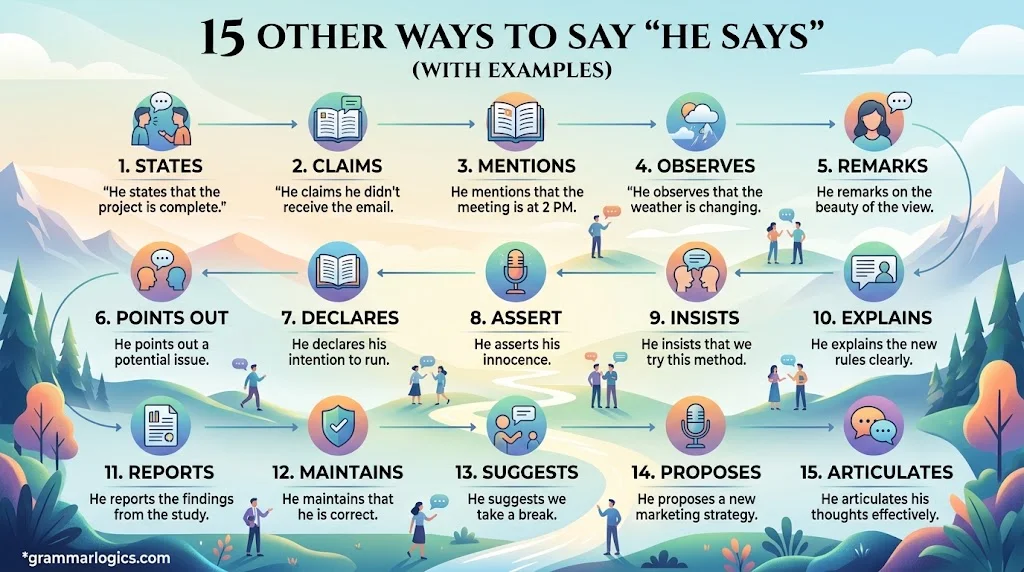
Finding the right alternatives to “He Says” can make your writing more natural, engaging, and clear.
The phrase “He says” is commonly used to report someone’s words, opinions, thoughts, or statements. However, repeating the same expression throughout an article, story, or conversation can make your writing feel dull. Using suitable synonyms and alternative phrases helps improve sentence variety and keeps readers interested. Whether you are writing an essay, preparing a professional report, or sharing a personal story, choosing the right expression can make your message more effective. The best alternative depends on the context, the speaker’s intention, and the tone you want to communicate.
Learning different ways to say “He says” also helps you express ideas more precisely. For example, “he explains” works well when someone makes an idea clear, while “he mentions” is useful for introducing a brief detail. Similarly, “he claims” may suggest that a statement needs verification, whereas “he states” sounds more formal and direct. Understanding these differences allows you to choose words that match your meaning. In this guide, you will discover 15 useful alternatives to “He says,” complete with meanings and practical examples to help you improve your everyday communication and writing skills.
What Does “He Says” Mean?
“He says” is a present-tense expression used to report what a male person communicates through speech or, in some contexts, writing. The word “he” identifies the person, while “says” describes the act of communicating something. For example, “He says he is busy” reports information that someone has shared. The expression can introduce an opinion, explanation, statement, instruction, promise, or claim. Its meaning depends on the surrounding sentence and the speaker’s intention. In everyday English, “he says” is a neutral and widely understood reporting expression. It does not automatically show whether the speaker is confident, uncertain, angry, polite, or truthful. Those details usually come from the words being reported and the context in which they are spoken.
Common Situations Where “He Says” Is Used
People use “he says” in everyday conversations, text messages, storytelling, school assignments, news reports, and workplace communication. For example, you might say, “He says the meeting starts at nine,” when sharing information from a colleague. In a personal conversation, the phrase can help explain another person’s feelings or opinions. In stories, it introduces dialogue and keeps the reader informed about who is speaking.
The expression also appears in essays, reports, and informal writing. However, repeating it too often can make a paragraph sound monotonous. Choosing alternatives such as “he explains,” “he notes,” or “he argues” can make the writing more precise. The important point is to select a reporting verb that accurately represents what the person actually communicates.
Is It Professional or Polite to Say “He Says”?
Yes, “he says” is generally professional, polite, and grammatically correct. It is a neutral expression suitable for everyday conversations, emails, academic writing, and workplace discussions. For example, “He says the report is ready” communicates information without adding unnecessary emotion or judgment. Its simplicity makes it useful when the writer wants to report a statement accurately.
In formal writing, however, a more specific verb may provide better context. “He explains” suggests clarification, while “he states” emphasizes a direct statement. “He argues” indicates a reasoned position, and “he claims” can suggest that a statement is being reported without confirming its truth. These expressions are not always interchangeable. Choose the wording that reflects the speaker’s actual intention rather than using a more formal word simply to sound professional.
Advantages and Disadvantages of Saying “He Says”
Advantages
The main advantage of “he says” is its simplicity. Most English speakers understand it immediately, and it does not introduce an unnecessary judgment about the speaker’s message. It works in casual conversation, professional communication, storytelling, and many forms of writing. Because it is neutral, it is also useful when you want to report someone’s words without suggesting that you agree or disagree. English learners can use it confidently in a wide range of situations.
Disadvantages
The main limitation of “he says” is that it can become repetitive when used in every sentence. It may also be less precise than a reporting verb that identifies the purpose of a statement. For example, “he explains” highlights clarification, while “he admits” indicates acknowledgment of something that may be difficult or uncomfortable. Using the wrong alternative can change the meaning, so variety should never come at the expense of accuracy.
15 Synonyms and Alternatives for “He Says”
- He states
- He explains
- He mentions
- He notes
- He points out
- He remarks
- He adds
- He claims
- He argues
- He suggests
- He observes
- He comments
- He declares
- He tells us
- He emphasizes
1. He States
Meaning
“He states” means that a person expresses information or an opinion clearly and directly. It is a useful alternative when reporting a straightforward statement without adding emotional meaning.
Definition
To state something means to express it clearly in words, either verbally or in writing.
Detailed Explanation
“He states” sounds slightly more formal and precise than “he says.” It is particularly useful when reporting information in a document, announcement, report, or academic discussion. The expression does not necessarily mean the statement is true; it simply reports what the person expressed. It works best when the speaker presents information directly rather than explaining a complicated idea or sharing a casual observation.
Scenario Examples
Scenario 1: Workplace report
Example: The manager states that all employees must submit their forms by Friday.
Scenario 2: Academic writing
Example: The author states that regular practice can improve writing skills.
Scenario 3: Everyday conversation
Example: He states that he will arrive at six, so we should be ready.
Best Use
Use “he states” in formal writing, reports, announcements, academic assignments, and professional communication. It is especially helpful when the wording needs to sound clear and objective.
Tone
Tone: Formal, direct, neutral.
The expression focuses on the content of the statement rather than the speaker’s emotions.
2. He Explains
Meaning
“He explains” means that a person makes something easier to understand by providing details, reasons, or clarification.
Definition
To explain something means to describe how or why it happens or what it means.
Detailed Explanation
Unlike “he says,” this expression suggests that the speaker is helping someone understand an idea or situation. It is suitable when a person provides reasons, instructions, or additional information. Using “he explains” signals that the message contains clarification rather than simply reporting a fact. It should not be used when someone merely makes a brief statement without explaining anything.
Scenario Examples
Scenario 1: Classroom discussion
Example: He explains how the water cycle works using a simple diagram.
Scenario 2: Workplace communication
Example: He explains why the project deadline needs to be extended.
Scenario 3: Helping a friend
Example: He explains how to reset the phone without losing important files.
Best Use
Choose this expression for teaching, instructions, workplace discussions, educational writing, and conversations that clarify a problem.
Tone
Tone: Helpful, informative, clear.
It suggests that the speaker is making an effort to improve another person’s understanding.
3. He Mentions
Meaning
“He mentions” means that a person refers to something briefly, usually without discussing it in great detail.
Definition
To mention something means to bring it up in conversation or writing.
Detailed Explanation
“He mentions” is useful when someone introduces a detail as part of a larger conversation. Compared with “he says,” it often suggests that the information is brief or secondary to the main topic. It does not necessarily mean the speaker wants to explain or emphasize the information. This expression works naturally when reporting a small detail, a passing comment, or something that someone brings up casually.
Scenario Examples
Scenario 1: Conversation with a colleague
Example: He mentions that the office will close early on Thursday.
Scenario 2: Talking about a friend
Example: He mentions that his brother is visiting next weekend.
Scenario 3: Project discussion
Example: He mentions a possible change to the presentation during the meeting.
Best Use
Use “he mentions” in casual conversations, meeting summaries, emails, personal messages, and written accounts of discussions.
Tone
Tone: Casual, neutral, conversational.
It presents information without making it sound especially important or dramatic.
4. He Notes
Meaning
“He notes” means that a person draws attention to a fact, detail, or observation.
Definition
To note something means to recognize, record, or point out information.
Detailed Explanation
This expression often sounds more formal than “he says.” It is useful when reporting a relevant detail that deserves attention but does not necessarily require a lengthy explanation. “He notes” can introduce an observation in an essay, report, presentation, or professional discussion. Depending on the context, it may mean that the person simply records a fact or deliberately draws the audience’s attention to it.
Scenario Examples
Scenario 1: Business meeting
Example: He notes that the team completed the first phase ahead of schedule.
Scenario 2: Research discussion
Example: He notes that the results differ slightly from the original predictions.
Scenario 3: Email update
Example: He notes that the updated document is available in the shared folder.
Best Use
This phrase works well in professional emails, reports, academic writing, presentations, and meeting summaries.
Tone
Tone: Professional, measured, informative.
It helps present a detail thoughtfully without making the statement sound overly forceful.
5. He Points Out
Meaning
“He points out” means that a person draws attention to a particular fact, problem, difference, or important detail.
Definition
To point something out means to make someone aware of information they may have overlooked.
Detailed Explanation
“He points out” is more focused than the general expression “he says.” It suggests that the information deserves attention or may have been missed by others. The phrase can introduce a useful observation, a correction, or a reminder. Although it is common in everyday English, it can also fit professional discussions. It may sound slightly corrective when the speaker identifies an error or challenges an assumption.
Scenario Examples
Scenario 1: Team discussion
Example: He points out that two figures in the report do not match.
Scenario 2: Planning a trip
Example: He points out that the museum is closed on Mondays.
Scenario 3: Classroom conversation
Example: He points out a mistake in the calculation before submitting the assignment.
Best Use
Use “he points out” when highlighting important facts, overlooked details, mistakes, differences, or practical concerns.
Tone
Tone: Direct, informative, sometimes corrective.
The expression directs attention to a specific detail and can help make a discussion more accurate.
6. He Remarks
Meaning
“He remarks” means that a person makes a comment or observation about something.
Definition
To remark means to say something about a subject, situation, or experience.
Detailed Explanation
“He remarks” can sound slightly more literary or formal than “he says,” particularly in storytelling and written descriptions. It is often used when someone comments on what they notice, experience, or think. The word does not necessarily suggest that the comment is important or lengthy. Its effect depends on the surrounding sentence, and it can describe a casual observation or a more pointed comment.
Scenario Examples
Scenario 1: Describing the weather
Example: He remarks that the evening air feels cooler than usual.
Scenario 2: Storytelling
Example: He remarks that the old house looks different after the renovation.
Scenario 3: Friendly conversation
Example: He remarks that everyone seems unusually cheerful today.
Best Use
Choose this expression for narrative writing, descriptive passages, conversations, and situations where someone makes an observation.
Tone
Tone: Observational, conversational, sometimes literary.
It gives a sentence a slightly more descriptive quality than the neutral “he says.”
7. He Adds
Meaning
“He adds” means that a person provides extra information after making an earlier statement.
Definition
To add something in conversation means to contribute another point, detail, or thought.
Detailed Explanation
This expression is particularly useful when someone continues speaking or supplements information that has already been shared. Unlike “he says,” it connects the new statement to something previously discussed. It can introduce another fact, a clarification, or an additional opinion. However, the expression generally requires a conversational or written context in which the person has already communicated something relevant.
Scenario Examples
Scenario 1: Project update
Example: He adds that the final presentation will include the latest figures.
Scenario 2: Personal conversation
Example: He adds that he can pick us up after work if needed.
Scenario 3: News summary
Example: He adds that further details will be shared later in the week.
Best Use
Use “he adds” in dialogue, interviews, reports, meeting notes, emails, and conversations involving additional information.
Tone
Tone: Natural, informative, conversational.
It helps connect ideas smoothly and prevents repeated use of the same reporting expression.
8. He Claims
Meaning
“He claims” means that a person says something is true, especially when the information has not been independently confirmed or is being questioned.
Definition
To claim something means to assert that it is true or that something belongs to or applies to someone.
Detailed Explanation
“He claims” is not always a neutral replacement for “he says.” It can suggest doubt, disagreement, or a need for verification, particularly in news reports and discussions about disputed facts. However, it can also be used without hostility when describing what someone asserts. The surrounding context determines whether the expression sounds skeptical. Choose it carefully because it may imply that the statement has not been established as fact.
Scenario Examples
Scenario 1: Reporting a disputed statement
Example: He claims that he sent the application before the deadline.
Scenario 2: Everyday conversation
Example: He claims he can finish the entire project in one afternoon.
Scenario 3: News-style writing
Example: He claims that the agreement was signed without his permission.
Best Use
Use “he claims” when reporting assertions, disputed information, allegations, or statements that may require verification.
Tone
Tone: Assertive, potentially skeptical, context-dependent.
It reports a person’s assertion without necessarily confirming that the assertion is correct.
9. He Argues
Meaning
“He argues” means that a person presents reasons to support an opinion, position, or conclusion.
Definition
To argue a point means to give reasons or evidence in support of a particular position.
Detailed Explanation
“He argues” is especially useful when someone is developing an opinion or trying to persuade others. Unlike “he says,” it indicates that the statement is supported by reasoning or forms part of a debate. The word does not always mean that people are fighting or speaking angrily. In academic and professional contexts, it often refers to a reasoned position supported by evidence. Use it when the speaker is making a case rather than simply reporting information.
Scenario Examples
Scenario 1: Academic essay
Example: He argues that public libraries should receive more funding.
Scenario 2: Workplace discussion
Example: He argues that the team should test the new design before launching it.
Scenario 3: Friendly debate
Example: He argues that walking is the easiest way to explore the city.
Best Use
This phrase is appropriate for essays, debates, opinion pieces, presentations, research discussions, and persuasive communication.
Tone
Tone: Analytical, persuasive, assertive.
It emphasizes reasoning and the position the speaker is trying to support.
10. He Suggests
Meaning
“He suggests” means that a person proposes an idea, offers a possible explanation, or recommends a course of action.
Definition
To suggest something means to put forward an idea or possibility for consideration.
Detailed Explanation
“He suggests” can be a useful alternative when the speaker is offering an idea rather than making a definite statement. It often sounds less forceful than “he insists” or “he declares.” The phrase may introduce a recommendation, a possible interpretation, or a tentative explanation. Because it can serve different purposes, readers should use the context to determine whether the speaker is making a proposal or indicating a possibility.
Scenario Examples
Scenario 1: Planning a meeting
Example: He suggests moving the meeting to Friday afternoon.
Scenario 2: Helping a friend
Example: He suggests taking a short break before continuing the assignment.
Scenario 3: Discussing possible causes
Example: He suggests that the delay may have been caused by bad weather.
Best Use
Choose “he suggests” for recommendations, brainstorming, polite advice, proposals, and tentative explanations.
Tone
Tone: Cooperative, thoughtful, relatively gentle.
It allows an idea to be considered without presenting it as a command or unquestionable fact.
11. He Observes
Meaning
“He observes” means that a person notices something and expresses an observation about it.
Definition
To observe means to notice, examine, or comment on something that can be seen or recognized.
Detailed Explanation
“He observes” often introduces a thoughtful comment based on what someone notices. It is particularly useful in descriptive, analytical, and academic writing. Compared with “he says,” it highlights the act of noticing or interpreting a detail. It may also introduce an insight about behavior, events, or patterns. Use it when the speaker is making an observation rather than simply passing along a message or giving an instruction.
Scenario Examples
Scenario 1: Describing a group
Example: He observes that the students become more confident after practicing together.
Scenario 2: Workplace review
Example: He observes that customer questions have increased since the new service launched.
Scenario 3: Everyday conversation
Example: He observes that the neighborhood is much quieter in the early morning.
Best Use
This expression works well in analytical writing, research, reflective essays, reports, and descriptions of behavior or events.
Tone
Tone: Thoughtful, analytical, observant.
It suggests that the speaker has noticed a detail and is drawing attention to it.
12. He Comments
Meaning
“He comments” means that a person expresses an opinion or makes a statement about a particular subject.
Definition
To comment means to give a remark, observation, or opinion about something.
Detailed Explanation
“He comments” is useful when someone responds to a topic or offers an opinion about it. It often suggests a reaction to something that has already been mentioned or presented. The expression can be neutral, positive, or negative depending on the words that follow. It is more specific than “he says” when the purpose is to show that a statement is a response or evaluation rather than a simple piece of information.
Scenario Examples
Scenario 1: Reviewing a presentation
Example: He comments that the opening slide could be more engaging.
Scenario 2: Discussing a film
Example: He comments on the film’s unusual ending during the conversation.
Scenario 3: Workplace feedback
Example: He comments that the revised schedule looks more practical.
Best Use
Use “he comments” in discussions, reviews, interviews, feedback sessions, and situations where someone responds to a topic.
Tone
Tone: Neutral, evaluative, conversational.
It frames the statement as a comment or reaction rather than a simple announcement.
13. He Declares
Meaning
“He declares” means that a person announces something clearly and firmly, often with confidence or emphasis.
Definition
To declare means to announce or state something openly and decisively.
Detailed Explanation
“He declares” is stronger than the neutral “he says.” It can convey certainty, determination, or the importance of an announcement. In formal settings, it may refer to an official statement or announcement. In storytelling, it can make dialogue sound dramatic or emphatic. Because it carries more weight, it is not the best choice for ordinary information unless the speaker is genuinely making a firm or significant statement.
Scenario Examples
Scenario 1: Public announcement
Example: He declares that the event will continue despite the unexpected delay.
Scenario 2: Storytelling
Example: He declares that he will never abandon his friends.
Scenario 3: Celebrating an achievement
Example: He declares the competition officially open.
Best Use
Choose “he declares” for announcements, decisive statements, formal declarations, dramatic dialogue, and moments of strong conviction.
Tone
Tone: Firm, emphatic, sometimes dramatic.
It gives a statement greater force and importance than an ordinary reporting verb.
14. He Tells Us
Meaning
“He tells us” means that a person communicates information directly to a group that includes the speaker and the listener.
Definition
To tell someone something means to communicate information, news, instructions, or a story to that person.
Detailed Explanation
“He tells us” is a natural expression when the audience or recipient of the information matters. Unlike “he says,” it identifies who receives the message. It can introduce facts, personal news, instructions, or explanations, depending on the sentence. The phrase is common in everyday speech and storytelling, but it may sound too conversational for some formal reports. Use it when you want to make the relationship between the speaker and the audience clear.
Scenario Examples
Scenario 1: Family conversation
Example: He tells us that he will visit during the holidays.
Scenario 2: Classroom instructions
Example: He tells us to read the next chapter before Monday.
Scenario 3: A personal update
Example: He tells us how he learned to play the guitar.
Best Use
Use “he tells us” in conversations, personal stories, classroom situations, instructions, and writing that addresses a specific audience.
Tone
Tone: Personal, conversational, direct.
It makes the communication feel more immediate by identifying the people receiving the message.
15. He Emphasizes
Meaning
“He emphasizes” means that a person gives special importance to a particular point, idea, or detail.
Definition
To emphasize something means to highlight it or make clear that it deserves particular attention.
Detailed Explanation
“He emphasizes” is useful when a speaker wants the audience to understand that a particular point matters. It is more focused and stronger than “he says” because it signals importance or repeated attention. The expression commonly appears in presentations, professional discussions, persuasive writing, and explanations of important requirements. It should only be used when the speaker genuinely stresses a point, rather than when they simply mention it in passing.
Scenario Examples
Scenario 1: Workplace meeting
Example: He emphasizes the importance of checking every figure before submitting the report.
Scenario 2: Teacher’s instructions
Example: He emphasizes that students must include references in their assignments.
Scenario 3: Public speaking
Example: He emphasizes the need for patience when learning a new skill.
Best Use
Choose this expression for presentations, instructions, persuasive writing, professional communication, and discussions about important priorities.
Tone
Tone: Serious, purposeful, assertive.
It signals that the speaker considers the information especially important and wants the audience to remember it.
FAQs
1. What is another way to say “he says”?
Some natural alternatives include “he states,” “he explains,” “he mentions,” “he notes,” and “he remarks.” The best choice depends on the purpose of the statement. For example, use “he explains” to clarify an idea and “he mentions” to introduce a brief detail.
2. What does “he says” mean?
“He says” means that a male person communicates something through speech or, in some contexts, writing. It is a neutral reporting expression used to introduce information, opinions, instructions, and other statements.
3. Is “he says” professional?
Yes. “He says” is appropriate for many professional situations, including conversations, emails, and reports. When a more precise tone is needed, expressions such as “he states,” “he notes,” or “he explains” may better communicate the purpose of the statement.
4. What is a more polite way to say “he says”?
“He says” is already neutral and generally polite. Depending on the situation, “he explains” may sound helpful, while “he suggests” can present a recommendation more gently. The appropriate expression depends on what the person actually communicates.
5. Which alternative works best in formal communication?
“He states” is a strong general choice for formal communication when reporting a direct statement. Use “he explains” for clarification, “he notes” for an important detail, and “he argues” when describing a position supported by reasoning.
Conclusion
Choosing the right alternative to “he says” can make your writing more precise, expressive, and natural. Although the original phrase works well in most everyday situations, reporting verbs such as “he explains,” “he notes,” and “he emphasizes” help communicate the purpose and importance of a statement. Some alternatives are suitable for formal reports, while others work better in casual conversations, storytelling, or persuasive writing.
Remember that similar expressions do not always have identical meanings. “He claims” may suggest uncertainty, whereas “he declares” often conveys confidence or determination. Before choosing a phrase, consider the speaker’s intention, the audience, and the context. With thoughtful word choices, you can improve your vocabulary, reduce repetition, and communicate ideas more clearly in both spoken and written English.