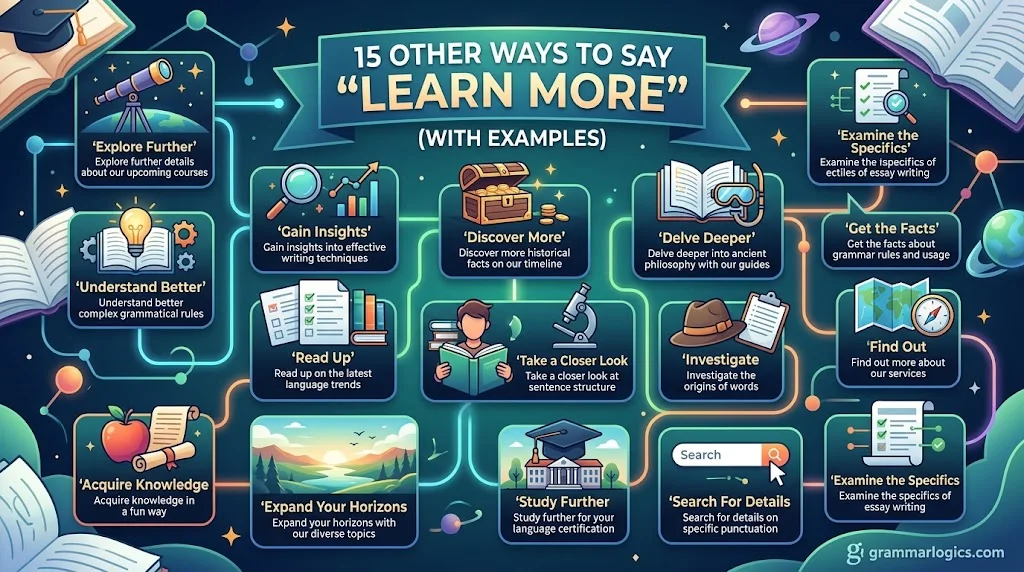
Learning new expressions helps you communicate clearly, expand your vocabulary, and make your writing more engaging in everyday conversations and professional settings.
When you want to encourage someone to discover additional information, the phrase “learn more” is a simple and effective choice. However, using the same expression repeatedly can make your writing sound predictable. Exploring different ways to say “learn more” allows you to share information naturally, invite curiosity, and create stronger connections with your audience. Whether you are writing a blog post, sending an email, preparing a presentation, or speaking with friends, choosing the right alternative can make your message more interesting and meaningful.
There are many useful alternatives to “learn more” that suit different situations, from casual conversations to formal business communication. Expressions such as “find out more,” “discover more,” “explore further,” and “gain deeper insight” can help you communicate your message with greater variety and precision. ach phrase carries a slightly different tone and purpose, so understanding when to use it is important. In this guide, you will discover practical alternatives to “learn more,” along with clear explanations and real-life examples to help you improve your English and make your writing more engaging.
What Does “Learn More” Mean?
“Learn more” means to gain additional knowledge, discover new information, or develop a deeper understanding of a particular subject. People use this expression when they want to know more about something they have heard, read, or experienced. For example, someone might say, “I would like to learn more about digital marketing,” to express an interest in understanding the topic beyond what they already know. The phrase can refer to formal education, personal interests, workplace training, or simple curiosity.
The expression is also widely used to invite others to explore information. Businesses often include “Learn More” on websites, advertisements, product pages, and promotional materials to encourage visitors to discover additional details. In educational settings, teachers may use it to recommend further reading or research. Although the phrase is simple and versatile, its exact meaning depends on the context. Sometimes it emphasizes gaining knowledge, while in other situations, it simply encourages someone to read additional information or explore a subject.
Common Situations Where “Learn More” Is Used
The phrase “learn more” appears in many everyday and professional situations. In casual conversations, people use it when discussing hobbies, interests, travel, technology, or unfamiliar subjects. For example, a friend might say, “I want to learn more about photography,” when expressing a new interest.
In professional communication, the phrase often appears in emails, presentations, training materials, and business discussions. A manager might encourage an employee to learn more about a new software tool, while a colleague may suggest exploring an unfamiliar process. It communicates curiosity and a willingness to develop new skills.
The expression is particularly common in digital content and marketing. Websites frequently use “Learn More” as a button or link that directs readers to additional information. Bloggers may use it to introduce related articles, while businesses use it to explain products, services, or company policies. In education, it encourages students to research subjects beyond their lessons. Depending on the audience, alternatives such as “Explore Further,” “Find Out More,” or “Get More Information” can make the message more specific and engaging.
Is It Professional or Polite to Say “Learn More”?
Yes, “learn more” is both professional and polite in most situations. It is a neutral, approachable expression that works well in emails, presentations, educational content, and business communication. For example, “You can learn more about our services on our website” sounds helpful without being overly formal. It is also suitable for conversations in which someone expresses interest in developing their knowledge or skills.
However, the best wording depends on what you want the reader to do. If you are directing someone toward specific facts, “get more information” may sound clearer. If you want to encourage exploration, “explore further” may feel more inviting. In a formal report, “gain a deeper understanding” can communicate a more thoughtful or academic purpose. For a website button, “Discover More” may create a more engaging invitation. The original phrase is not inappropriate; choosing an alternative simply allows you to match your wording to your audience, purpose, and communication style.
Advantages and Disadvantages of Saying “Learn More”
Advantages
One major advantage of “learn more” is its simplicity. Almost everyone can understand it, including English learners and people unfamiliar with specialized vocabulary. It is short enough for website buttons, headings, advertisements, and social media captions. The phrase also encourages curiosity without sounding demanding or overly promotional.
Another benefit is its flexibility. You can use it when discussing education, personal interests, business services, or general information. It communicates a positive intention to gain knowledge and works in both casual and professional settings. Because the expression is familiar, readers usually understand the intended action immediately.
Disadvantages
Although “learn more” is versatile, it can sometimes be too general. It does not always explain whether someone should read an article, examine specific details, conduct research, or develop a deeper understanding. In a situation requiring clear instructions, a more specific phrase may be more effective.
The expression can also become repetitive when used across multiple website pages, emails, or marketing materials. For instance, several buttons labeled “Learn More” may provide little information about what each link contains. Alternatives such as “View Our Services,” “Explore the Guide,” or “Get the Details” can communicate a clearer purpose. The best choice depends on the action you want your audience to take.
15 Synonyms and Alternatives for “Learn More”
- Find Out More
- Get More Information
- Explore Further
- Discover More
- Read More
- Look Into It
- Dig Deeper
- Gain a Deeper Understanding
- Get the Details
- Expand Your Knowledge
- Learn About
- Investigate Further
- Explore the Topic
- Get Up to Speed
- Uncover More Information
1. Find Out More
Meaning
“Find out more” means to discover additional information about something. It emphasizes finding answers or learning facts that you do not currently know. This expression is particularly useful when encouraging someone to explore a subject, service, event, or opportunity.
Definition
To find out more means to obtain further knowledge or discover additional facts about a particular matter.
Detailed Explanation
“Find out more” is one of the closest and most natural alternatives to “learn more.” It often focuses on discovering information rather than studying a subject in depth. The expression sounds friendly, direct, and approachable, making it suitable for conversations and written communication. It is also widely used in website links and promotional messages because it encourages readers to take the next step. Although the phrases are similar, “find out more” can sound slightly more action-oriented when the goal is to discover specific facts.
Scenario Examples
Scenario 1: Website communication
A company wants visitors to discover its available services.
Example: Visit our website to find out more about our consulting packages.
Scenario 2: Everyday conversation
A friend is curious about a new course.
Example: I heard the course is excellent, so I am going to find out more before enrolling.
Best Use
Use this expression in website buttons, friendly emails, advertisements, conversations, and informational content. It is especially effective when you want readers to discover additional facts without suggesting that they need to study a subject extensively.
Tone
Tone: Friendly, informative, approachable.
It invites curiosity while remaining natural and easy to understand.
2. Get More Information
Meaning
“Get more information” means to obtain additional facts, explanations, or details about a subject. Unlike “learn more,” which can suggest developing knowledge, this phrase focuses more directly on receiving information.
Definition
To get more information means to obtain additional details about a person, service, subject, event, or situation.
Detailed Explanation
This expression is especially useful when accuracy and clarity matter. It works well when someone needs specific information before making a decision or taking action. Compared with “find out more,” it sounds slightly more formal and practical. It is suitable for professional emails, customer service messages, business websites, and official announcements. However, it may sound less personal when used in a casual conversation about an interesting subject.
Scenario Examples
Scenario 1: Customer service
A customer needs details about a subscription.
Example: Please contact our support team to get more information about the available plans.
Scenario 2: Workplace communication
An employee wants clarification about a new policy.
Example: I will speak with the HR department to get more information about the updated guidelines.
Best Use
Choose this phrase for business communication, customer support, formal emails, service descriptions, and situations requiring specific facts.
Tone
Tone: Professional, clear, practical.
Its straightforward wording helps people understand that additional details are available.
3. Explore Further
Meaning
“Explore further” means to investigate a subject in greater detail or continue examining something that interests you. It suggests curiosity and a willingness to go beyond the basic information.
Definition
To explore further means to continue examining or investigating a subject to discover additional information or possibilities.
Detailed Explanation
This expression is useful when you want to encourage someone to examine a subject more deeply rather than simply read a few extra facts. It often appears in educational materials, research discussions, travel content, and professional development resources. Compared with “learn more,” it has a slightly more exploratory tone and can suggest that several possibilities are worth considering. It is particularly effective when the subject is broad or offers different perspectives. However, it may be less suitable when someone needs a quick, specific answer.
Scenario Examples
Scenario 1: Education
A teacher encourages students to investigate a historical subject.
Example: You can explore further by reading about the events that influenced the movement.
Scenario 2: Travel planning
A traveler wants to discover additional attractions.
Example: Explore further to discover the smaller towns and cultural attractions near your destination.
Best Use
Use “explore further” in educational resources, travel blogs, research materials, professional development, and content that encourages discovery.
Tone
Tone: Thoughtful, curious, encouraging.
The expression invites readers to investigate a subject at their own pace.
4. Discover More
Meaning
“Discover more” means to uncover additional information, ideas, opportunities, or experiences. It often emphasizes the excitement of finding something new.
Definition
To discover more means to uncover additional facts, possibilities, or experiences that were not previously known.
Detailed Explanation
“Discover more” is an engaging alternative when you want your message to create curiosity. It is particularly effective in marketing, creative writing, travel content, and website headings. Unlike “get more information,” which sounds practical, this expression highlights the possibility of finding something interesting or valuable. It can make a message feel more inviting without becoming overly formal. However, it may be less appropriate for technical instructions or official communications where precise details matter more than an appealing presentation.
Scenario Examples
Scenario 1: Online shopping
A customer wants to explore a product collection.
Example: Discover more about our new collection and the inspiration behind each design.
Scenario 2: Community event
An organizer invites people to learn about local activities.
Example: Discover more about the workshops and activities planned for this year’s festival.
Best Use
Choose this phrase for marketing materials, website buttons, product pages, tourism content, newsletters, and engaging social media posts.
Tone
Tone: Inviting, enthusiastic, engaging.
It creates a sense of curiosity and encourages readers to explore something new.
5. Read More
Meaning
“Read more” means to continue reading or access additional written content. It is more specific than “learn more” because it points directly toward reading material.
Definition
To read more means to continue reading a text or open additional written information about a subject.
Detailed Explanation
This expression works best when the next step involves reading an article, report, story, or extended explanation. It is common in blogs, online newspapers, newsletters, and social media posts. Unlike “learn more,” it does not necessarily suggest gaining knowledge through videos, conversations, or practical experiences. Instead, it tells readers that more written material is available. This directness makes it useful for digital publishing, although it is not the right choice when the additional information is primarily presented through a video or interactive demonstration.
Scenario Examples
Scenario 1: Blogging
A blog post introduces a related topic.
Example: Read more about simple ways to improve your everyday writing.
Scenario 2: Newsletters
A newsletter contains a short summary of a longer report.
Example: We have summarized the main findings below; read more in the full report.
Best Use
Use “read more” for blog posts, articles, news stories, newsletters, online publications, and links to written resources.
Tone
Tone: Direct, neutral, informative.
It clearly tells readers that additional written content is available.
6. Look Into It
Meaning
“Look into it” means to investigate something, check the available information, or try to understand a situation. It is often used when someone wants to find an answer or resolve a question.
Definition
To look into something means to examine or investigate it to obtain more information or understand what is happening.
Detailed Explanation
This expression is more investigative than the general phrase “learn more.” It is particularly useful when someone needs to check facts, understand a problem, or research a possibility before deciding what to do. In everyday speech, it sounds natural and conversational. In professional settings, it can communicate that someone intends to examine a matter carefully. However, “look into it” does not always mean that the person wants to study the subject broadly; it often refers to a specific question or issue that needs attention.
Scenario Examples
Scenario 1: Workplace problem
A colleague reports an error in a shared document.
Example: Thanks for pointing that out. I will look into it and correct any mistakes.
Scenario 2: Personal decision
Someone is considering joining a fitness center.
Example: I am interested in that gym, so I will look into it before signing up.
Best Use
Choose this expression for problem-solving, casual conversations, workplace discussions, preliminary research, and situations where a specific matter needs investigation.
Tone
Tone: Conversational, practical, purposeful.
It suggests that someone will actively investigate rather than simply read additional material.
7. Dig Deeper
Meaning
“Dig deeper” means to investigate a subject more thoroughly, examine underlying causes, or move beyond surface-level information. It often suggests a more detailed and critical approach.
Definition
To dig deeper means to examine something more closely to uncover underlying facts, reasons, or explanations.
Detailed Explanation
This phrase is especially useful when basic information is not enough to answer a question. It encourages a person to examine evidence, identify patterns, or understand why something happens. Compared with “learn more,” it sounds more investigative and can imply greater effort. It works well in research, journalism, problem-solving, and analytical discussions. However, it may sound unnecessarily intense when someone simply wants a few extra details about a product or event.
Scenario Examples
Scenario 1: Research project
A student finds an unexpected result during research.
Example: The initial findings are interesting, but we need to dig deeper to understand their possible causes.
Scenario 2: Personal development
Someone wants to understand a recurring habit.
Example: I started journaling to dig deeper into the reasons behind my daily routines.
Best Use
Use “dig deeper” in research, analytical writing, investigations, personal reflection, journalism, and discussions involving complex questions.
Tone
Tone: Analytical, determined, investigative.
It suggests a willingness to move beyond obvious explanations.
8. Gain a Deeper Understanding
Meaning
“Gain a deeper understanding” means to develop a more complete and thoughtful grasp of a subject. It emphasizes comprehension rather than simply collecting additional facts.
Definition
To gain a deeper understanding means to improve your ability to comprehend a subject, including its important details, relationships, or underlying ideas.
Detailed Explanation
This expression is more precise than “learn more” when the goal is meaningful understanding. It suggests that someone already has some knowledge but wants to connect ideas, understand complex concepts, or recognize important implications. It is common in academic writing, professional training, educational discussions, and reflective communication. The phrase sounds more formal and thoughtful than everyday alternatives. Because it is relatively long, it may be less effective for short website buttons or casual text messages.
Scenario Examples
Scenario 1: Academic writing
A student is studying a complicated subject.
Example: Comparing these two theories can help us gain a deeper understanding of human behavior.
Scenario 2: Workplace training
A new employee wants to understand a business process.
Example: The practical exercises helped me gain a deeper understanding of our customer service procedures.
Best Use
Choose this phrase for academic assignments, professional development, training materials, detailed explanations, and thoughtful discussions.
Tone
Tone: Formal, reflective, educational.
It emphasizes comprehension, depth, and meaningful learning.
9. Get the Details
Meaning
“Get the details” means to obtain specific facts or practical information about something. It is useful when a person needs to understand the important particulars before proceeding.
Definition
To get the details means to obtain the specific information needed to understand a plan, event, product, or situation.
Detailed Explanation
This expression focuses on concrete information rather than general knowledge. It is useful when someone wants to know dates, prices, requirements, instructions, or other important particulars. Compared with “learn more,” it sounds more direct and action-oriented. It works well in business communication, event announcements, customer service, and everyday planning. However, it is not an exact substitute when the purpose is to develop a broad understanding of a subject or study a topic in depth.
Scenario Examples
Scenario 1: Event planning
A person wants to attend a professional workshop.
Example: Contact the organizer to get the details about registration, timing, and location.
Scenario 2: Purchasing a service
A customer is considering a maintenance package.
Example: Before choosing a plan, I would like to get the details about the fees and included services.
Best Use
Use this expression for event information, product descriptions, service inquiries, scheduling, customer communication, and practical decisions.
Tone
Tone: Direct, practical, informative.
It signals that specific, useful facts are available or needed.
10. Expand Your Knowledge
Meaning
“Expand your knowledge” means to increase what you know about a subject or develop familiarity with new areas of learning. It emphasizes ongoing learning and intellectual growth.
Definition
To expand your knowledge means to acquire additional information and develop a broader understanding of a subject or several subjects.
Detailed Explanation
This phrase is especially appropriate when learning is a continuing goal rather than a one-time search for information. It suggests building knowledge through reading, study, training, experience, or discussion. Compared with “learn more,” it sounds more educational and purposeful. It is useful in personal development, professional training, educational content, and discussions about lifelong learning. However, it may sound too formal or ambitious for a simple request to check a few facts.
Scenario Examples
Scenario 1: Professional development
An employee wants to improve their understanding of industry changes.
Example: Attend the monthly seminars to expand your knowledge of current business practices.
Scenario 2: Personal interests
A reader wants to explore a new subject.
Example: I enjoy reading history books because they help me expand my knowledge of different cultures.
Best Use
Choose this expression for education, career development, training programs, self-improvement, and lifelong learning resources.
Tone
Tone: Motivational, educational, purposeful.
It emphasizes personal growth and the value of continued learning.
11. Learn About
Meaning
“Learn about” means to gain information or understanding about a particular person, subject, event, or activity. It is especially useful when introducing a topic for the first time.
Definition
To learn about something means to acquire knowledge or information concerning that subject.
Detailed Explanation
Unlike “learn more,” which generally suggests gaining additional knowledge, “learn about” can introduce a subject without implying that the reader already knows something about it. It is a natural expression for explaining what someone will study, discover, or become familiar with. The phrase works in everyday conversations, classroom instructions, websites, and educational materials. To make it more specific, you can identify the subject directly after “about.” For example, “learn about renewable energy” tells the reader exactly what the content covers.
Scenario Examples
Scenario 1: Education
A teacher introduces the next lesson.
Example: Next week, we will learn about the causes and effects of climate change.
Scenario 2: Company website
A visitor wants to understand a business.
Example: Visit our company page to learn about our mission, values, and services.
Best Use
Use “learn about” in educational content, introductory explanations, classroom discussions, informational websites, and general conversation.
Tone
Tone: Neutral, clear, educational.
It introduces a subject naturally without suggesting a particular level of depth.
12. Investigate Further
Meaning
“Investigate further” means to examine a matter more carefully to discover facts, identify causes, or verify information. It generally suggests a systematic approach.
Definition
To investigate further means to continue examining a subject or situation to establish additional facts or explanations.
Detailed Explanation
This expression is more formal and methodical than “learn more.” It is appropriate when a question requires careful examination, evidence, or verification. People may use it in research, workplace reviews, technical discussions, and formal reports. Unlike “explore further,” which can suggest open-ended discovery, “investigate further” often implies that a specific question or uncertainty needs to be resolved. It may sound too serious for casual interests, so consider the purpose and audience before using it.
Scenario Examples
Scenario 1: Workplace review
A manager notices a discrepancy in a monthly report.
Example: We should investigate further before deciding why the figures do not match.
Scenario 2: Academic research
A researcher identifies a question that needs additional examination.
Example: The preliminary results are promising, but the relationship between these factors needs to be investigated further.
Best Use
Choose this phrase for formal research, technical reports, workplace reviews, fact-checking, and situations requiring systematic examination.
Tone
Tone: Formal, analytical, serious.
It communicates careful investigation rather than general curiosity.
13. Explore the Topic
Meaning
“Explore the topic” means to examine a particular subject from different angles or investigate its important aspects. It encourages a more organized examination of a defined area.
Definition
To explore the topic means to study or examine a specific subject to understand its main ideas, details, and possible perspectives.
Detailed Explanation
This expression is useful when the subject has several aspects worth discussing. It works particularly well in lessons, presentations, group discussions, research projects, and blog content. Compared with “learn more,” it gives the reader a clearer sense that the subject itself will be examined. The wording can suggest an open-minded approach rather than a search for one specific answer. However, it is most natural when the topic has already been introduced or can be clearly identified.
Scenario Examples
Scenario 1: Classroom discussion
A teacher introduces a new issue for students to discuss.
Example: In our next lesson, we will explore the topic of responsible technology use.
Scenario 2: Blog writing
A writer introduces a detailed guide.
Example: This article explores the topic of effective communication in remote teams.
Best Use
Use this phrase for educational materials, presentations, blog posts, workshops, research discussions, and structured learning activities.
Tone
Tone: Educational, organized, thoughtful.
It encourages readers to consider a subject from more than one perspective.
14. Get Up to Speed
Meaning
“Get up to speed” means to become sufficiently informed about a subject, situation, or recent development to understand what is happening. It often involves catching up on information you have missed.
Definition
To get up to speed means to acquire the knowledge needed to understand a current situation or participate effectively.
Detailed Explanation
This informal expression is especially useful in workplaces and situations where information changes regularly. Someone who joins a project late may need to get up to speed on its progress, decisions, and responsibilities. Unlike “learn more,” the phrase often implies catching up rather than simply increasing existing knowledge. It is common in spoken English and friendly professional communication, but it may be less suitable for highly formal documents. In those settings, “become familiar with the latest developments” can communicate a similar idea more formally.
Scenario Examples
Scenario 1: New team member
An employee joins a project that has already started.
Example: I will review the meeting notes this afternoon to get up to speed on the project.
Scenario 2: Returning to work
A colleague returns after taking leave.
Example: Could you brief me on the latest changes so I can get up to speed?
Best Use
Choose this phrase for team meetings, workplace conversations, project updates, onboarding, and situations where someone needs to catch up.
Tone
Tone: Casual, practical, collaborative.
It suggests getting informed enough to follow a conversation or take part in an activity.
15. Uncover More Information
Meaning
“Uncover more information” means to discover additional facts that may not be immediately obvious. It can suggest revealing details through research, examination, or careful questioning.
Definition
To uncover more information means to discover additional facts or details that were previously unknown, hidden, or not fully understood.
Detailed Explanation
This expression is useful when finding information requires more than simply opening a webpage or reading a short description. It can imply that additional facts will emerge through investigation or closer examination. Compared with “learn more,” it has a stronger discovery-oriented tone and can sound more investigative. It works well in research, journalism, analytical writing, and discussions about understanding complicated situations. However, it may sound too dramatic for ordinary informational content when the details are already readily available.
Scenario Examples
Scenario 1: Research project
A student is examining an unfamiliar historical event.
Example: Reviewing original documents may help us uncover more information about what happened.
Scenario 2: Business analysis
A team wants to understand why customers are leaving a service.
Example: We need to examine the feedback carefully to uncover more information about the reasons behind customer cancellations.
Best Use
Use this expression for research, journalism, detailed analysis, investigations, and situations where additional facts need to be discovered.
Tone
Tone: Investigative, analytical, discovery-focused.
It emphasizes revealing additional information rather than simply receiving a general explanation.
FAQs
What is another way to say “learn more”?
Some natural alternatives include “find out more,” “get more information,” “explore further,” “discover more,” and “read more.” The best choice depends on your purpose. Use “read more” for written content, “get more information” for specific facts, and “explore further” when you want to encourage deeper investigation.
What does “learn more” mean?
“Learn more” means to gain additional knowledge or develop a better understanding of a subject. It can refer to studying, reading, asking questions, researching, or exploring new information. Businesses also use the phrase to invite visitors to view additional information about products or services.
Is “learn more” professional?
Yes, “learn more” is professional and polite in most situations. It works well in workplace emails, presentations, training materials, and business websites. For more formal writing, expressions such as “gain a deeper understanding” or “obtain further information” may be more appropriate depending on the context.
What is a more polite way to say “learn more”?
“You can find out more here” is a friendly and polite option. In professional communication, you could say, “Please visit our website for additional information.” If you are inviting someone to explore a subject, “You may wish to explore this topic further” offers a courteous alternative.
Which alternative works best in formal communication?
“Get more information,” “gain a deeper understanding,” and “investigate further” can all work well in formal settings. Choose “get more information” when you need specific facts, “gain a deeper understanding” when the goal is deeper comprehension, and “investigate further” when a matter requires careful examination.
Conclusion
Choosing the right alternative to “learn more” can make your writing clearer, more engaging, and better suited to your audience. Expressions such as “find out more” and “discover more” work well when inviting readers to explore information, while “get the details” is more useful when specific facts are needed. For academic and professional communication, “gain a deeper understanding” can express a more thoughtful learning goal.
Meanwhile, “get up to speed” is a natural choice when someone needs to catch up on recent developments. Although these phrases share a connection with gaining knowledge, they are not interchangeable in every situation. Consider your audience, purpose, and desired tone before choosing your wording. By using these 15 alternatives thoughtfully, you can communicate more naturally and make your messages more precise, helpful, and meaningful.