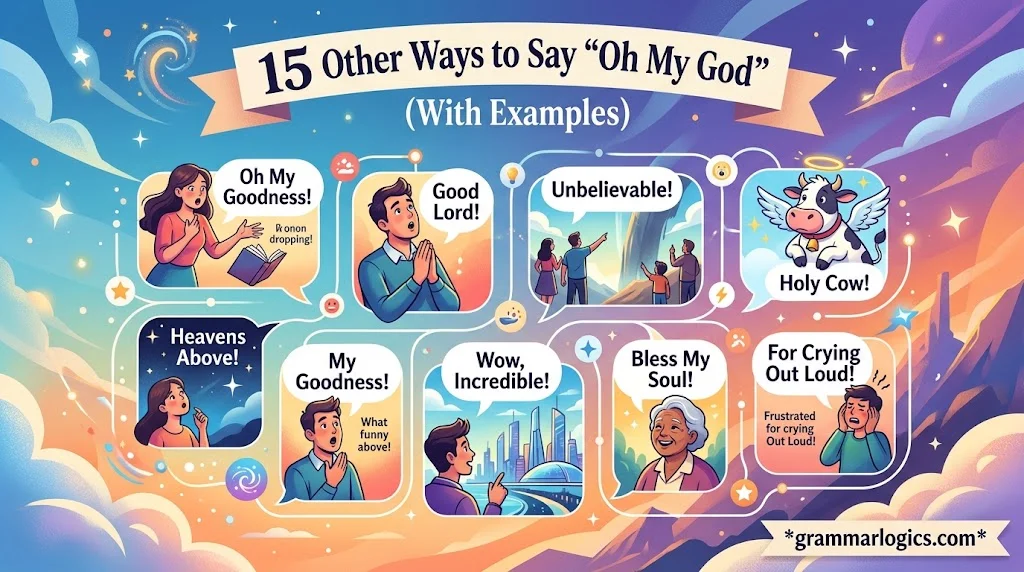
“Oh My God” is a common expression used to show surprise, excitement, shock, or disbelief in everyday conversations.
However, using the same phrase repeatedly can make your communication sound less expressive. Learning other ways to say “Oh My God” can help you express emotions more naturally and confidently. Whether you are chatting with friends, reacting to unexpected news, or writing informal messages, choosing the right expression makes your words more engaging. From casual reactions to polite alternatives, there are plenty of expressions to explore. Each option can help you communicate your feelings clearly while matching the situation, audience, and tone of your conversation.
In this guide, you will discover 15 other ways to say “Oh My God,” complete with meanings and practical examples. These alternatives will help you expand your vocabulary, avoid repetition, and sound more natural in English. You will also learn which expressions work best in casual conversations, professional settings, and friendly messages. Some alternatives communicate excitement, while others express amazement, concern, or disbelief. By understanding their meanings and appropriate usage, you can choose the best expression for every situation and make your everyday communication more effective, expressive, and engaging.
What Does “Oh My God” Mean?
“Oh My God” is an informal exclamation used to express a strong emotional reaction. People commonly say it when they feel surprised, excited, shocked, worried, amazed, or unable to believe something they have heard or seen. Its exact meaning depends on the situation, the speaker’s tone, and the surrounding conversation.
For example, someone might say it after receiving wonderful news, discovering an unexpected problem, or witnessing something unbelievable. The expression can communicate both positive and negative emotions, making it useful in many everyday situations. However, because it refers to God, some people consider it religiously sensitive or prefer not to use it for personal or cultural reasons. Alternatives can help speakers express the same feelings while adjusting their wording to fit their audience.
Common Situations Where “Oh My God” Is Used
People use “Oh My God” in casual conversations, text messages, social media comments, and conversations with friends or family. It often appears when someone hears surprising news, sees something impressive, or reacts to an unexpected event. For instance, a friend might use it after learning that someone has won a competition or planned a surprise party.
The phrase can also express disbelief, frustration, fear, or excitement. In personal relationships, it may make a reaction sound spontaneous and emotional. However, in professional emails, formal presentations, or conversations with unfamiliar people, a calmer expression may sound more appropriate. Choosing alternatives such as “I’m amazed,” “That’s incredible,” or “Seriously?” allows you to communicate your reaction without relying on the same exclamation every time.
Is It Professional or Polite to Say “Oh My God”?
“Oh My God” is generally casual and emotional, rather than formal or professional. It is usually acceptable among friends and people who are comfortable with informal language. In a relaxed workplace conversation, colleagues might also use it naturally when reacting to unexpected news. However, it may seem too informal in business emails, official meetings, academic writing, or customer communications.
Politeness also depends on the audience. Some people use the phrase without religious meaning, while others may find it disrespectful or uncomfortable. If you are unsure how someone feels about it, choosing a neutral expression such as “That’s surprising,” “I’m amazed,” or “That’s incredible” can be a safer choice. These alternatives express emotion while maintaining a respectful tone.
Advantages and Disadvantages of Saying “Oh My God”
Advantages
One advantage of “Oh My God” is its ability to communicate a strong reaction quickly. The phrase is familiar in many English-speaking environments and can express surprise, excitement, disbelief, or shock without requiring a long explanation. Its informal nature can also make conversations feel spontaneous and expressive. In friendly settings, it often helps people show that they are emotionally engaged with what someone has said.
Disadvantages
The phrase may not suit every audience or situation. Some people avoid it because of their religious beliefs, while others may consider it too casual for professional communication. It can also become repetitive when used in response to every surprising event. Additionally, the phrase does not explain whether the speaker feels happy, frightened, impressed, or upset. A more specific alternative can communicate the intended emotion more clearly and help avoid misunderstandings.
15 Alternatives to “Oh My God”
- Oh My Goodness
- Goodness Gracious
- Wow
- No Way
- Are You Serious?
- Unbelievable!
- That’s Incredible!
- I Can’t Believe It!
- Holy Cow!
- What on Earth?
- Oh My Gosh
- That’s Amazing!
- Seriously?
- I’m Speechless
- For Heaven’s Sake!
1. Oh My Goodness
Meaning
“Oh My Goodness” expresses surprise, excitement, concern, or disbelief in a gentler way than “Oh My God.” It is useful when you want to show a strong reaction without using explicitly religious wording.
Definition
An exclamation used to express surprise or another strong emotion politely.
Detailed Explanation
“Oh My Goodness” is a friendly, widely understood alternative for everyday conversation. It often communicates the same emotional reaction as the original phrase but sounds softer and more polite. It can fit conversations with family members, coworkers, acquaintances, and friends. Because it is less intense than some dramatic exclamations, it works especially well when you want to sound expressive without appearing overly emotional.
Scenario Examples
Scenario: Your friend shares exciting personal news.
Example: “Oh my goodness! You finally got the job!”
Scenario: You notice an unexpectedly beautiful view.
Example: “Oh my goodness, look at those mountains!”
Scenario: A colleague tells you about a difficult day.
Example: “Oh my goodness, that sounds exhausting.”
Best Use
Use this expression in friendly conversations, polite reactions, family messages, and informal workplace discussions. It is particularly useful when you want to remain warm and respectful.
Tone
Tone: Warm, polite, expressive.
It communicates genuine emotion without sounding as intense or potentially religiously sensitive as the original phrase.
2. Goodness Gracious
Meaning
“Goodness Gracious” expresses surprise, astonishment, or mild alarm. It is often used when something unexpected happens or when a person is impressed by an unusual situation.
Definition
A traditional English exclamation used to show surprise or concern.
Detailed Explanation
This expression sounds more traditional than “Oh My God.” It can convey surprise in a playful, dramatic, or slightly old-fashioned way. Depending on the speaker’s delivery, it may express genuine concern or lighthearted amazement. It is less common in some modern casual conversations, so it can sometimes sound humorous when used deliberately.
Scenario Examples
Scenario: You discover that a friend has completed a huge project overnight.
Example: “Goodness gracious, how did you finish all of that?”
Scenario: A child runs into the room covered in paint.
Example: “Goodness gracious! What happened in here?”
Best Use
Use it in playful conversations, family settings, storytelling, and lighthearted reactions. It is less suitable for formal business writing.
Tone
Tone: Traditional, surprised, slightly dramatic.
Its old-fashioned flavor can add personality to a reaction.
3. Wow
Meaning
“Wow” expresses surprise, admiration, amazement, or disbelief. It is one of the simplest alternatives when something catches your attention or exceeds your expectations.
Definition
A short exclamation used to show that something is surprising or impressive.
Detailed Explanation
“Wow” is brief, natural, and easy to use in both spoken and written English. Unlike “Oh My God,” it often emphasizes amazement or admiration rather than shock or distress. Its meaning depends heavily on tone: a cheerful “Wow!” sounds enthusiastic, while a slow “Wow…” may suggest disbelief. It is versatile enough for casual conversations and many relaxed professional situations.
Scenario Examples
Scenario: Your friend shows you a handmade painting.
Example: “Wow, you made this yourself?”
Scenario: A teammate presents impressive results.
Example: “Wow, we finished the project ahead of schedule.”
Scenario: You visit a beautiful historical building.
Example: “Wow, this place is incredible.”
Best Use
Use “Wow” in everyday conversations, text messages, social media comments, and informal workplace discussions. It also works when you want a brief reaction without explaining every emotion.
Tone
Tone: Neutral, impressed, enthusiastic.
Its simplicity makes it suitable for a wide range of situations.
4. No Way
Meaning
“No Way” expresses disbelief, astonishment, or strong surprise. It is especially useful when someone shares news that seems impossible or unexpectedly exciting.
Definition
An informal exclamation showing that something is difficult to believe.
Detailed Explanation
“No Way” is more direct and conversational than “Oh My God.” It often suggests that the speaker is struggling to believe what they have heard. With an enthusiastic tone, it can express excitement; with a serious tone, it may indicate disbelief or refusal. Because it is informal, it works best when speaking with people you know rather than in formal communication.
Scenario Examples
Scenario: Your friend tells you that a favorite singer is visiting your city.
Example: “No way! We have to get tickets!”
Scenario: A classmate reveals an unexpected test result.
Example: “No way! You scored full marks?”
Scenario: Someone tells you an unbelievable travel story.
Example: “No way, you met them at the airport?”
Best Use
Use this expression in casual conversations, friendly messages, and reactions to surprising news. Avoid it when a formal or carefully neutral response is needed.
Tone
Tone: Informal, energetic, disbelieving.
It works particularly well when you want to invite the other person to explain more.
5. Are You Serious?
Meaning
“Are You Serious?” expresses disbelief, surprise, or a need to confirm unexpected information. It can also communicate concern when someone describes a serious situation.
Definition
A question used to check whether surprising information is genuine.
Detailed Explanation
Unlike a simple exclamation, “Are You Serious?” directly asks the other person to confirm what they have said. It can show excitement, shock, suspicion, or frustration depending on delivery. The phrase may sound friendly among close friends, but a sharp tone can make it seem confrontational. It is most useful when you genuinely want clarification rather than merely expressing amazement.
Scenario Examples
Scenario: Your friend announces an unexpected engagement.
Example: “Are you serious? Congratulations!”
Scenario: A coworker explains that a deadline has moved forward.
Example: “Are you serious? We need to submit it today?”
Best Use
Use it in informal conversations and situations where confirmation matters. In professional settings, a calmer question such as “Is that confirmed?” may be more appropriate.
Tone
Tone: Direct, surprised, sometimes skeptical.
Your tone of voice determines whether the question sounds curious or challenging.
6. Unbelievable!
Meaning
“Unbelievable!” communicates that something is so surprising, impressive, or shocking that it is difficult to accept immediately.
Definition
An exclamation describing something that seems almost impossible to believe.
Detailed Explanation
“Unbelievable!” can express positive amazement or negative disbelief. It is often stronger than “Wow” and more focused on how extraordinary an event seems. The expression works when you want to emphasize the scale of a surprise rather than simply react to it. However, it can sound sarcastic if the speaker uses a dry or disapproving tone.
Scenario Examples
Scenario: Your team wins a competition against the strongest opponent.
Example: “Unbelievable! We actually won the final!”
Scenario: You hear about a long travel delay.
Example: “That’s unbelievable. You waited six hours for a train?”
Scenario: A friend completes a difficult challenge.
Example: “Unbelievable! You ran the entire marathon.”
Best Use
Use it for extraordinary achievements, shocking news, surprising events, and expressive storytelling.
Tone
Tone: Intense, amazed, emphatic.
It highlights how exceptional the situation feels to the speaker.
7. That’s Incredible!
Meaning
“That’s Incredible!” expresses strong admiration or amazement about something remarkable. It is particularly appropriate when the news is impressive or positive.
Definition
An enthusiastic statement showing that something is exceptionally impressive or surprising.
Detailed Explanation
This expression is more specific than “Oh My God” because it often communicates admiration rather than a general emotional reaction. It can help you sound encouraging when someone shares an achievement or exciting opportunity. The phrase is suitable for friendly conversations and many professional situations because it focuses on the event rather than using an intense exclamation. However, it may not fit negative news unless you intend to emphasize how extraordinary the situation is.
Scenario Examples
Scenario: A colleague explains how they solved a complicated problem.
Example: “That’s incredible! Your solution saved us hours of work.”
Scenario: Your friend shares news about a scholarship.
Example: “That’s incredible! You must be so proud.”
Scenario: You learn that a local student built a successful community project.
Example: “That’s incredible. Their work will help so many people.”
Best Use
Use it for achievements, positive announcements, impressive discoveries, and encouraging professional conversations.
Tone
Tone: Positive, appreciative, enthusiastic.
It communicates admiration more clearly than a general expression of surprise.
8. I Can’t Believe It!
Meaning
“I Can’t Believe It!” expresses disbelief, amazement, or a strong emotional reaction to unexpected news.
Definition
A statement showing that something feels too surprising to accept immediately.
Detailed Explanation
This phrase places emphasis on the speaker’s difficulty believing what has happened. It can express happiness, shock, disappointment, or sadness depending on the context. Compared with “Wow,” it is more personal because it directly describes the speaker’s reaction. It is a natural choice when an event challenges your expectations or leaves you emotionally overwhelmed.
Scenario Examples
Scenario: Your friend tells you that you have been accepted into your first-choice university.
Example: “I can’t believe it! I got accepted!”
Scenario: A family member shares unexpected news about a reunion.
Example: “I can’t believe it. Everyone is coming home this weekend?”
Scenario: Your favorite team wins after a dramatic final moment.
Example: “I can’t believe it! That last goal was amazing.”
Best Use
Use it in personal conversations, emotional messages, surprising announcements, and reactions to unexpected outcomes.
Tone
Tone: Emotional, sincere, astonished.
It makes your personal reaction clear without relying on a general exclamation.
9. Holy Cow!
Meaning
“Holy Cow!” is a playful expression of surprise, amazement, or shock. It is commonly used when something unexpected catches someone off guard.
Definition
An informal exclamation used to react to something surprising or remarkable.
Detailed Explanation
“Holy Cow!” is a lighthearted alternative that can make a reaction sound fun and expressive. It is generally less serious than a strong exclamation of shock and may be used to avoid wording that some people consider religiously sensitive. The phrase is informal and can sound humorous, especially when spoken with exaggerated enthusiasm. It may feel out of place in formal writing or serious professional conversations.
Scenario Examples
Scenario: You see a giant birthday cake at a party.
Example: “Holy cow! How many people is that cake supposed to feed?”
Scenario: Your friend shows you a surprisingly high electricity bill.
Example: “Holy cow, I didn’t realize it could cost that much.”
Best Use
Use it in casual conversations, family gatherings, playful reactions, and informal storytelling.
Tone
Tone: Playful, informal, surprised.
Its lighthearted quality makes it useful when you want to express astonishment without sounding too serious.
10. What on Earth?
Meaning
“What on Earth?” expresses confusion, disbelief, or surprise about something difficult to understand. It is especially useful when you want to know why something strange has happened.
Definition
A question or exclamation used to emphasize confusion or astonishment.
Detailed Explanation
“What on Earth?” often communicates more confusion than excitement. It suggests that the speaker cannot easily understand a situation, decision, or unexpected event. The phrase can be humorous when used gently, but it may sound critical or impatient when directed at another person. Unlike a general expression of amazement, it often invites an explanation.
Scenario Examples
Scenario: You find your keys inside the refrigerator.
Example: “What on earth are my keys doing in here?”
Scenario: A friend sends you a confusing set of instructions.
Example: “What on earth does this message mean?”
Scenario: You arrive at a meeting and discover that the location has changed without notice.
Example: “What on earth happened to the original meeting room?”
Best Use
Use it in informal conversations, humorous situations, and moments of genuine confusion. In professional settings, consider a more neutral question if you do not want to sound frustrated.
Tone
Tone: Curious, confused, sometimes exasperated.
The expression emphasizes that something seems strange or difficult to explain.
11. Oh My Gosh
Meaning
“Oh My Gosh” expresses surprise, excitement, concern, or disbelief in a casual and often gentler way than “Oh My God.”
Definition
An informal exclamation used to communicate a strong emotional reaction without directly using the word “God.”
Detailed Explanation
“Oh My Gosh” is a common alternative in everyday speech and online conversations. It can carry nearly the same emotional meaning as the original phrase while feeling more comfortable to people who prefer not to use religious language casually. The expression can be playful, enthusiastic, or concerned depending on the situation. Although it is widely understandable, it remains informal and is not usually the best choice for formal reports or official correspondence.
Scenario Examples
Scenario: Your friend reveals a surprise birthday plan.
Example: “Oh my gosh! You planned all of this for me?”
Scenario: You notice that your puppy has learned a new trick.
Example: “Oh my gosh, look how quickly she learned!”
Scenario: A friend shares a stressful travel experience.
Example: “Oh my gosh, that must have been frightening.”
Best Use
Use it in text messages, social media, friendly conversations, and informal personal communication.
Tone
Tone: Friendly, expressive, casual.
It preserves emotional energy while offering a familiar alternative to the original phrase.
12. That’s Amazing!
Meaning
“That’s Amazing!” expresses admiration, excitement, or appreciation for something especially good or impressive.
Definition
A positive exclamation used to show that something is exceptionally good or surprising.
Detailed Explanation
This phrase is especially useful when your reaction is positive rather than shocked or confused. It communicates appreciation and can make the other person feel that their achievement or news matters to you. Unlike “Oh My God,” it identifies the situation as impressive rather than leaving the exact emotion open to interpretation. It is also suitable for many workplace conversations, although a more restrained phrase may be preferable in highly formal settings.
Scenario Examples
Scenario: A coworker receives a promotion.
Example: “That’s amazing! Your hard work really paid off.”
Scenario: Your friend shares photos from a wildlife trip.
Example: “That’s amazing! Seeing those animals in person must have been unforgettable.”
Scenario: A student explains a creative science project.
Example: “That’s amazing. I love how you approached the problem.”
Best Use
Use it for good news, achievements, creative work, exciting experiences, and encouraging messages.
Tone
Tone: Positive, supportive, enthusiastic.
It shows appreciation without sounding overly dramatic.
13. Seriously?
Meaning
“Seriously?” expresses surprise, disbelief, or a desire to confirm information. Depending on the situation, it can also communicate annoyance or skepticism.
Definition
A short question used to show that something is surprising or difficult to believe.
Detailed Explanation
“Seriously?” is concise and highly dependent on context. A cheerful tone can express excitement, while a flat or sharp tone may suggest doubt or irritation. Unlike “Wow,” it often implies that the speaker wants to check whether the information is true. Because it can sound challenging, it is important to consider your relationship with the listener and the way the question is delivered.
Scenario Examples
Scenario: Your friend tells you they have booked a spontaneous trip.
Example: “Seriously? When are you leaving?”
Scenario: A teammate announces that the deadline has been extended.
Example: “Seriously? We actually have another week?”
Scenario: Someone repeatedly interrupts your explanation.
Example: “Seriously? Can I finish what I was saying?”
Best Use
Use it in informal conversations, reactions to unexpected information, and situations requiring confirmation. Avoid a sharp delivery when you want to remain diplomatic.
Tone
Tone: Direct, informal, curious or skeptical.
Its meaning changes considerably with facial expression and voice.
14. I’m Speechless
Meaning
“I’m Speechless” communicates that an event or experience has left you unable to find the right words. It can express amazement, gratitude, shock, or disappointment.
Definition
A statement indicating that someone is too emotionally affected to respond easily.
Detailed Explanation
“I’m Speechless” focuses on the effect an event has on you rather than simply announcing that you are surprised. It can sound deeply sincere when someone receives an unexpected gift or hears meaningful news. It can also communicate shock after a troubling event. Unlike a quick exclamation, this phrase suggests a stronger emotional impact and works best when the speaker genuinely feels overwhelmed.
Scenario Examples
Scenario: Your friends organize a surprise celebration for you.
Example: “I’m speechless. I had no idea you were planning this.”
Scenario: A family member gives you a heartfelt letter.
Example: “I’m honestly speechless. Thank you for writing this.”
Scenario: You witness an extraordinary musical performance.
Example: “I’m speechless. That performance was unforgettable.”
Best Use
Use it for meaningful surprises, heartfelt moments, extraordinary performances, and emotionally powerful experiences.
Tone
Tone: Sincere, emotional, deeply impressed.
It suggests that ordinary words do not seem sufficient for the moment.
15. For Heaven’s Sake!
Meaning
“For Heaven’s Sake!” is an exclamation used to express frustration, impatience, urgency, or strong concern. It does not always communicate amazement, so it is best used when the emotional context fits.
Definition
An expression used to emphasize frustration, urgency, or an emotionally charged reaction.
Detailed Explanation
This phrase can replace “Oh My God” in situations where the original expression communicates frustration or exasperation rather than happiness. It has a somewhat traditional flavor and may sound dramatic in everyday conversation. Depending on delivery, it can express concern or impatience, but it may also sound irritated. Because it invokes heaven, it is not necessarily suitable for everyone who prefers to avoid religious expressions.
Scenario Examples
Scenario: Your children keep arguing while you are trying to concentrate.
Example: “For heaven’s sake, can we all take a breath and calm down?”
Scenario: A friend ignores an important reminder several times.
Example: “For heaven’s sake, please check the appointment time before leaving.”
Best Use
Use it in informal conversations, dramatic dialogue, and moments of frustration or urgency. Avoid it when you want to sound calm, neutral, or professionally diplomatic.
Tone
Tone: Exasperated, emphatic, sometimes dramatic.
It is more appropriate for expressing impatience than for celebrating exciting news.
FAQs
What is another way to say “Oh My God”?
Some common alternatives are “Oh My Goodness,” “Wow,” “No Way,” “Unbelievable!” and “I Can’t Believe It!” The best choice depends on whether you feel excitement, admiration, confusion, or disbelief.
What does “Oh My God” mean?
“Oh My God” is an exclamation used to express surprise, excitement, shock, concern, or disbelief. Its meaning depends on the context and the speaker’s tone.
Is “Oh My God” professional?
It is generally considered informal. It may be acceptable in relaxed conversations with colleagues, but neutral expressions such as “That’s surprising” or “That’s remarkable” are often better for formal emails and meetings.
What is a more polite way to say “Oh My God”?
“Oh My Goodness” is a widely understood, gentler alternative. “Wow” is another useful option when you want to express surprise without using explicitly religious wording.
Which alternative works best in formal communication?
For professional communication, choose an expression that clearly describes your reaction without sounding overly emotional. “That’s remarkable,” “That’s surprising,” or “I’m impressed” can work well, depending on the context. In a formal email, a complete sentence is often more appropriate than a dramatic exclamation.
Conclusion
Choosing the right expression helps you communicate your feelings more clearly and naturally. Although “Oh My God” is a familiar way to express surprise, excitement, or disbelief, it may not suit every audience or situation. Alternatives such as “Oh My Goodness,” “Wow,” and “That’s Incredible!” can make your reaction sound warmer, more positive, or more polite.
Other expressions, including “Seriously?” and “What on Earth?”, are better suited to disbelief or confusion. Remember that similar phrases do not always have identical meanings, and your tone can change how a listener understands them. Consider your audience, your relationship with the person, and the emotion you want to express before choosing your words. The best expression is the one that communicates your genuine reaction while respecting the situation.