Expressing excitement makes conversations more lively, positive, and engaging, especially when sharing good news or looking forward to something special.
There are many natural ways to express excitement in English, whether you are talking to friends, writing professional emails, or sharing your happiness online. Instead of repeating “I am excited” in every conversation, you can use different expressions that communicate your feelings more clearly. Phrases such as “I can’t wait,” “I’m thrilled,” and “I’m looking forward to it” help you sound more natural and confident. Choosing the right words also allows you to express your enthusiasm according to the situation, audience, and level of formality.
Learning other ways to say “I am excited” can improve your vocabulary and make your English communication more expressive. Whether you are preparing for an important event, celebrating an achievement, anticipating a trip, or discussing a new opportunity, the right phrase can make your message more meaningful. Some expressions sound casual and friendly, while others are suitable for workplace conversations, formal emails, and professional announcements. By exploring these useful alternatives and practical examples, you can discover how to communicate excitement naturally, avoid repetitive wording, and express positive emotions with greater clarity in everyday conversations and writing.
What Does “I Am Excited” Mean?
“I Am Excited” means feeling very happy, enthusiastic, or eager about something that is happening or expected to happen. People commonly use this expression when looking forward to an event, starting a new opportunity, receiving good news, or anticipating an enjoyable experience. For example, someone might say, “I am excited about my new job,” to express happiness and positive expectations about starting a new position. The phrase can communicate both present enthusiasm and anticipation for the future. Depending on the context, it may also suggest nervous energy, especially when someone is preparing for an important event or unfamiliar experience.
Common Situations Where “I Am Excited” Is Used
People use “I Am Excited” in everyday conversations, text messages, social media posts, and personal communication to share positive feelings. A student might express excitement about graduating, while a traveler may use it when talking about an upcoming vacation. Friends often use the phrase when planning a celebration or meeting after a long time apart.
The expression also fits workplace communication when discussing a new project, promotion, or professional opportunity. In emails, it can show enthusiasm about joining a team or collaborating with colleagues. Sometimes, an alternative works better because it communicates a more specific feeling, such as eagerness to begin, confidence about an opportunity, or joyful anticipation.
Is It Professional or Polite to Say “I Am Excited”?
Yes, “I Am Excited” is generally polite, positive, and appropriate for professional communication. You can use it in work emails, interviews, presentations, and conversations with colleagues when expressing enthusiasm about a project or opportunity. For example, “I am excited to work with your team” sounds friendly and professional without being overly formal.
The phrase is also natural in casual conversations, where it communicates happiness openly. However, the best wording depends on the situation and your relationship with the reader. In a formal proposal, “I look forward to collaborating with you” may sound more measured, while “I can’t wait to get started” feels more energetic and conversational. Choosing an alternative allows you to adjust the tone, formality, and emotional intensity of your message.
Advantages and Disadvantages of Saying “I Am Excited”
Advantages
The phrase is clear, positive, and easy to understand. It tells people directly that you feel enthusiastic about an experience, plan, or opportunity. It works across many situations, from personal conversations to professional emails, without requiring complicated vocabulary. Because the expression is familiar, readers can quickly understand your feelings. It can also help build a friendly connection by showing genuine interest in something you will share with others.
Disadvantages
Although the phrase is useful, it can become repetitive if you use it in every message about good news or future plans. It may also feel too general when you want to communicate a more specific emotion. For instance, “I am eager to begin” emphasizes readiness, while “I am thrilled” expresses stronger enthusiasm. In a highly formal message, a calmer expression such as “I look forward to the opportunity” may better suit the occasion. The original phrase is not inherently unprofessional; its suitability depends on the context and intended tone.
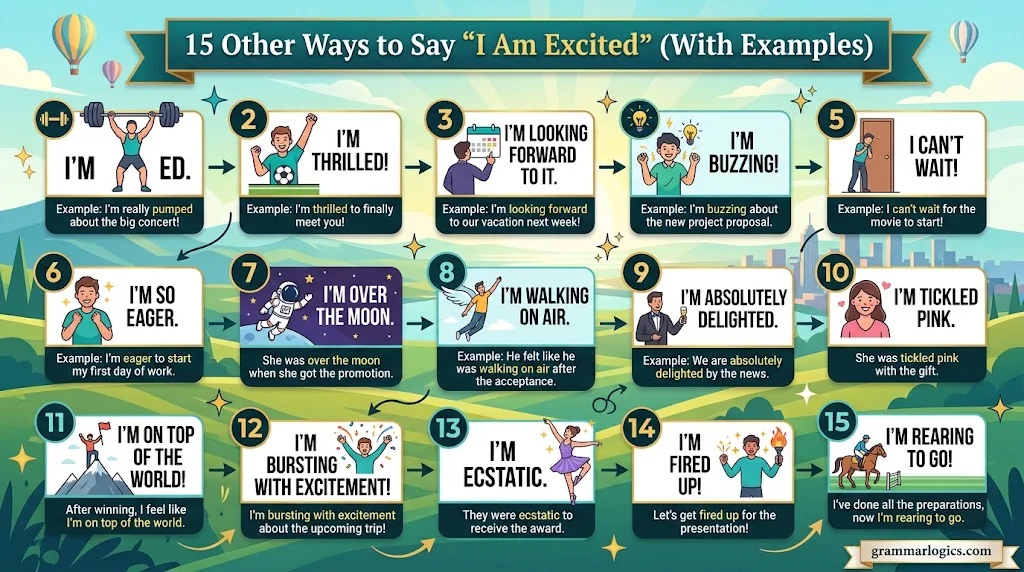
15 Synonyms and Alternatives for “I Am Excited”
- I’m thrilled
- I’m looking forward to it
- I can’t wait
- I’m eager to get started
- I’m delighted
- I’m so happy about this
- I’m really enthusiastic
- I’m excited about the opportunity
- I’m pumped
- I’m over the moon
- I’m counting down the days
- I’m keen to begin
- This is exciting
- I’m buzzing
- I’m full of anticipation
1. I’m Thrilled
Meaning
“I’m thrilled” means feeling extremely happy and excited about something positive. It expresses stronger emotion than the everyday phrase “I Am Excited.”
Definition
A phrase used to communicate intense happiness, enthusiasm, or delight about an event, achievement, or opportunity.
Detailed Explanation
“I’m thrilled” is ideal when something makes you exceptionally happy. It communicates genuine enthusiasm and often suggests that the news or experience is especially meaningful to you. This expression works in both personal and professional communication, although it sounds more emotionally expressive than a neutral statement. Use it when you want your excitement to feel noticeable and sincere.
Scenario Examples
Scenario: You receive a promotion at work.
Example: “I’m thrilled to accept this promotion and take on new responsibilities.”
Scenario: Your friend announces an upcoming wedding.
Example: “I’m thrilled for you both! I can’t wait to celebrate.”
Best Use
Use this phrase for wonderful news, achievements, celebrations, and exciting professional opportunities.
Tone
Tone: Enthusiastic, warm, expressive.
It communicates a high level of happiness without sounding unnatural in most everyday situations.
2. I’m Looking Forward to It
Meaning
“I’m looking forward to it” means you feel positive anticipation about something that will happen in the future.
Definition
An expression that communicates pleasure or interest in an upcoming event, activity, or experience.
Detailed Explanation
This phrase focuses more on anticipation than on intense excitement. It is particularly useful when you want to sound friendly, composed, and professional. Unlike “I’m thrilled,” it does not necessarily suggest overwhelming happiness. It also works well when responding to invitations, confirming meetings, or discussing future plans.
Scenario Examples
Scenario: A colleague schedules a project meeting.
Example: “Thank you for arranging the meeting. I’m looking forward to it.”
Scenario: A friend invites you to dinner.
Example: “Friday sounds great! I’m really looking forward to it.”
Best Use
Use it in professional emails, polite replies, social invitations, and conversations about future plans.
Tone
Tone: Polite, positive, composed.
It expresses interest without sounding overly emotional or informal.
3. I Can’t Wait
Meaning
“I can’t wait” means you are so excited or eager about something that you do not want to wait for it to happen.
Definition
An informal expression of strong anticipation for a future event or experience.
Detailed Explanation
This phrase communicates immediate, energetic enthusiasm. It is more conversational than “I’m looking forward to it” and often sounds especially natural between friends and family members. Although its literal wording refers to not wanting to wait, it is generally understood as an expression of excitement rather than impatience. In formal business writing, a more measured alternative may be preferable.
Scenario Examples
Scenario: You are about to travel abroad.
Example: “I can’t wait to explore Japan next month!”
Scenario: You are texting a friend about a reunion.
Example: “It’s been ages since we last met. I can’t wait to see you!”
Best Use
Use it in casual conversations, friendly texts, travel plans, celebrations, and personal messages.
Tone
Tone: Casual, energetic, enthusiastic.
It makes your anticipation feel spontaneous and personal.
4. I’m Eager to Get Started
Meaning
“I’m eager to get started” means you are enthusiastic and ready to begin a task, project, or activity.
Definition
A phrase expressing a strong desire to begin something without unnecessary delay.
Detailed Explanation
This expression combines excitement with readiness to take action. Unlike general enthusiasm, it suggests that you are prepared to move forward and contribute. It is particularly useful when beginning a job, joining a team, or starting a new project. The phrase sounds professional while still communicating genuine interest.
Scenario Examples
Scenario: You are joining a new company.
Example: “Thank you for the warm welcome. I’m eager to get started and contribute to the team.”
Scenario: Your class is beginning a group assignment.
Example: “I’ve reviewed the instructions, and I’m eager to get started on our presentation.”
Best Use
Use it for new jobs, professional projects, academic assignments, and collaborative activities.
Tone
Tone: Motivated, confident, professional.
It shows that your enthusiasm is supported by a willingness to act.
5. I’m Delighted
Meaning
“I’m delighted” means you feel great pleasure or happiness about something positive.
Definition
A polite expression used to communicate genuine happiness or satisfaction.
Detailed Explanation
“I’m delighted” sounds slightly more refined than the everyday phrase “I’m excited.” It is useful when responding to good news, accepting an invitation, or expressing happiness about a professional development. The word emphasizes pleasure rather than eagerness to begin something. It can therefore sound especially appropriate when you want to communicate warmth with a polished tone.
Scenario Examples
Scenario: A client agrees to work with your company.
Example: “I’m delighted that we’ve reached an agreement and look forward to working together.”
Scenario: Someone invites you to an important celebration.
Example: “I’m delighted to be invited. Thank you for thinking of me.”
Best Use
Use it in polite emails, formal invitations, professional conversations, and personal celebrations.
Tone
Tone: Courteous, warm, polished.
It communicates happiness in a graceful and respectful way.
6. I’m So Happy About This
Meaning
“I’m so happy about this” expresses strong personal happiness about a particular event, decision, or piece of news.
Definition
A straightforward phrase used to communicate that something has made you very happy.
Detailed Explanation
This expression is personal and emotionally direct. It works especially well when you want to emphasize how much a situation means to you rather than simply saying you are enthusiastic. The word “so” adds emotional emphasis, making the phrase feel natural in relaxed conversations. In a formal setting, you may prefer a more specific statement explaining what you appreciate.
Scenario Examples
Scenario: Your friend tells you they have recovered from a difficult period.
Example: “I’m so happy about this. You’ve worked hard to get here.”
Scenario: Your family celebrates your graduation.
Example: “I’m so happy about this achievement, and I’m grateful for everyone’s support.”
Best Use
Use it in personal messages, family conversations, celebrations, and responses to meaningful news.
Tone
Tone: Heartfelt, sincere, friendly.
It puts your happiness at the center of the message.
7. I’m Really Enthusiastic
Meaning
“I’m really enthusiastic” means you have strong interest, energy, and positive feelings about an activity, idea, or opportunity.
Definition
An expression communicating active interest and a willingness to engage with something.
Detailed Explanation
This phrase is useful when your excitement involves more than simply feeling happy. It suggests that you are interested in participating, learning, contributing, or exploring an idea. It can fit professional discussions, interviews, and academic settings, especially when you want to explain your motivation. However, enthusiasm usually describes your attitude toward something rather than the anticipation of a specific event.
Scenario Examples
Scenario: An interviewer asks about a potential role.
Example: “I’m really enthusiastic about the chance to contribute to your research team.”
Scenario: A student joins a science club.
Example: “I’m really enthusiastic about learning how these experiments work.”
Best Use
Use it when discussing projects, learning opportunities, career goals, hobbies, and areas of interest.
Tone
Tone: Positive, engaged, purposeful.
It communicates sustained interest and willingness to participate.
8. I’m Excited About the Opportunity
Meaning
“I’m excited about the opportunity” means you feel enthusiastic about a possibility that may lead to something valuable or enjoyable.
Definition
A phrase used to express positive expectations about a chance to do, learn, or achieve something.
Detailed Explanation
This expression is especially useful when the source of your excitement is a particular opportunity. It communicates optimism while keeping the focus on what lies ahead. In professional settings, it can show that you value a potential role, partnership, or responsibility. It is more specific than simply saying “I’m excited,” because it identifies what is creating your enthusiasm.
Scenario Examples
Scenario: You receive an interview invitation.
Example: “I’m excited about the opportunity to discuss how my skills could support your team.”
Scenario: A school offers you a place in an exchange program.
Example: “I’m excited about the opportunity to study in another country and meet new people.”
Best Use
Use it for job applications, interviews, partnerships, educational programs, and new responsibilities.
Tone
Tone: Professional, optimistic, respectful.
It conveys enthusiasm while acknowledging the value of the opportunity.
9. I’m Pumped
Meaning
“I’m pumped” means you feel highly energized and excited about something.
Definition
An informal expression used to show strong enthusiasm, motivation, or readiness.
Detailed Explanation
This phrase is common in casual American English and often conveys a sense of energy or anticipation. It is particularly natural when discussing sports, concerts, competitions, trips, or challenging activities. Compared with “I’m delighted,” it sounds more relaxed and energetic. Because it is slang, it may not be the best choice for formal correspondence or situations requiring a restrained tone.
Scenario Examples
Scenario: Your team has an important match.
Example: “I’m pumped for tomorrow’s game. We’ve practiced hard for this.”
Scenario: You and your friends are planning a road trip.
Example: “The bags are packed, and I’m pumped for our weekend adventure!”
Best Use
Use it in casual conversations, sports discussions, social media captions, and informal group chats.
Tone
Tone: Energetic, informal, upbeat.
It makes your excitement sound lively and action-oriented.
10. I’m Over the Moon
Meaning
“I’m over the moon” means you are extremely happy and delighted about something.
Definition
An idiom expressing exceptional happiness, often in response to wonderful news or a major achievement.
Detailed Explanation
This expression communicates a very high level of happiness. It is often used when something meaningful or especially positive has happened, such as receiving an award, getting a dream job, or celebrating an important personal milestone. Unlike “I’m eager to get started,” it focuses on emotional joy rather than readiness. The idiom is natural in friendly British English and is widely understood elsewhere, too.
Scenario Examples
Scenario: You learn that your work has won an award.
Example: “I’m over the moon that our project received first prize!”
Scenario: A friend announces the birth of a baby.
Example: “We’re over the moon about the new arrival. Congratulations!”
Best Use
Use it for major achievements, happy announcements, family milestones, and exciting personal news.
Tone
Tone: Joyful, expressive, celebratory.
It conveys happiness that feels especially intense and memorable.
11. I’m Counting Down the Days
Meaning
“I’m counting down the days” means you are eagerly waiting for a specific future event.
Definition
An expression describing strong anticipation as the date of an expected event approaches.
Detailed Explanation
This phrase highlights the passage of time before something you are excited about. It works best when an event has a known or expected date, such as a vacation, wedding, concert, or reunion. It differs from “I’m thrilled” because it emphasizes waiting rather than the intensity of happiness itself. The expression can also suggest that you think about the upcoming event often.
Scenario Examples
Scenario: Your holiday begins in two weeks.
Example: “I’m counting down the days until we leave for the beach!”
Scenario: You are preparing for a family reunion.
Example: “Only ten days left! I’m counting down the days until everyone gets here.”
Best Use
Use it for upcoming holidays, concerts, weddings, reunions, birthdays, and other dated events.
Tone
Tone: Playful, eager, anticipatory.
It shows that the event is on your mind and you are excited for it to arrive.
12. I’m Keen to Begin
Meaning
“I’m keen to begin” means you are interested in starting something and feel positively motivated to do so.
Definition
An expression communicating willingness and enthusiasm to start an activity or task.
Detailed Explanation
This phrase is especially natural in British, Australian, and other varieties of English where “keen” commonly means enthusiastic or eager. It is somewhat more measured than “I can’t wait,” so it can fit professional conversations as well as everyday speech. The expression emphasizes readiness and interest rather than overwhelming emotion. Use it when you want to sound engaged without appearing too informal.
Scenario Examples
Scenario: A manager explains an upcoming assignment.
Example: “I’ve read through the project brief, and I’m keen to begin.”
Scenario: You enroll in a language course.
Example: “I’m keen to begin learning Spanish and practicing with other students.”
Best Use
Use it in workplace discussions, educational settings, team projects, and everyday conversations, particularly in British or Australian English.
Tone
Tone: Positive, composed, motivated.
It expresses eagerness in a relatively restrained way.
13. This Is Exciting
Meaning
“This is exciting” means that a situation, event, or development creates enthusiasm or anticipation.
Definition
A statement describing something as interesting, promising, or emotionally stimulating.
Detailed Explanation
Unlike “I Am Excited,” which directly describes your feelings, “This is exciting” describes the situation itself. It is useful when sharing a reaction with other people or inviting them to appreciate a positive development. The expression can sound enthusiastic without making the conversation entirely about you. Its strength depends on your delivery and context, so it may communicate anything from mild interest to strong excitement.
Scenario Examples
Scenario: Your team discovers a promising idea.
Example: “This is exciting! We could turn the concept into a useful new product.”
Scenario: A friend reveals the destination for a surprise trip.
Example: “This is exciting! I’ve always wanted to visit that city.”
Best Use
Use it in group conversations, brainstorming sessions, reactions to announcements, and discussions about promising developments.
Tone
Tone: Enthusiastic, conversational, inclusive.
It focuses on the positive situation and can help create shared excitement.
14. I’m Buzzing
Meaning
“I’m buzzing” means you feel very excited, energized, or emotionally uplifted.
Definition
An informal expression describing a strong sense of excitement or positive energy.
Detailed Explanation
This expression is particularly common in British and some other varieties of informal English. It often describes the feeling that follows great news, a successful event, or an enjoyable experience. Unlike “I’m looking forward to it,” it can describe excitement you are already experiencing rather than anticipation alone. Because the phrase is colloquial, it is best reserved for relaxed conversations rather than formal emails.
Scenario Examples
Scenario: Your team wins a competition.
Example: “I’m buzzing after that win! All our hard work paid off.”
Scenario: You have just returned from a fantastic concert.
Example: “I’m still buzzing from last night’s show. The atmosphere was incredible.”
Best Use
Use it in casual conversations, friendly messages, sports discussions, and reactions to memorable experiences.
Tone
Tone: Energetic, informal, expressive.
It communicates excitement that feels lively and difficult to contain.
15. I’m Full of Anticipation
Meaning
“I’m full of anticipation” means you feel strongly expectant about something that is going to happen.
Definition
An expression describing a state of eager expectation about a future event or experience.
Detailed Explanation
This phrase places more emphasis on expectation than on happiness itself. It can suggest a thoughtful or heightened sense of waiting, particularly when an upcoming event feels important or uncertain. Compared with “I can’t wait,” it sounds more formal and less conversational. Although it is grammatically correct, it can feel slightly literary or deliberate in everyday speech, so a simpler expression may sometimes sound more natural.
Scenario Examples
Scenario: You are preparing for the opening night of a play.
Example: “I’m full of anticipation as we prepare to perform in front of a live audience.”
Scenario: You are waiting for the announcement of an important decision.
Example: “I’m full of anticipation as we wait to hear the final results.”
Best Use
Use it in reflective writing, descriptive passages, formal speeches, and situations involving meaningful future events.
Tone
Tone: Thoughtful, expectant, slightly formal.
It highlights the feeling of waiting for something significant to unfold.
FAQs
What is another way to say “I Am Excited”?
Some natural alternatives include “I’m thrilled,” “I can’t wait,” “I’m looking forward to it,” and “I’m eager to get started.” The best expression depends on your situation. Use “I’m thrilled” for strong happiness, “I can’t wait” for casual enthusiasm, and “I’m looking forward to it” for polite or professional communication.
What does “I Am Excited” mean?
“I Am Excited” means feeling enthusiastic, happy, or eager about something. It is commonly used when anticipating a future event, celebrating good news, starting a new project, or experiencing something enjoyable. The phrase can express anything from cheerful anticipation to intense enthusiasm, depending on the context.
Is “I Am Excited” professional?
Yes, “I Am Excited” is appropriate in many professional situations. You can use it in emails, interviews, meetings, and workplace conversations to communicate enthusiasm about an opportunity or project. For a more formal tone, consider “I look forward to the opportunity” or “I’m pleased to be involved.”
What is a more polite way to say “I Am Excited”?
“I’m delighted” and “I’m looking forward to it” are polite alternatives. For professional communication, you might say, “I’m delighted to have the opportunity to work with your team.” These expressions communicate positive feelings while maintaining a respectful and considerate tone.
Which alternative works best in formal communication?
“I’m looking forward to it” is an excellent choice for most formal and professional situations. It communicates positive anticipation without sounding overly emotional. If you are discussing a specific opportunity, “I’m excited about the opportunity” is also appropriate. Choose the expression that best matches your message and the level of formality required.
Conclusion
Choosing the right words helps you express excitement in a way that feels natural, sincere, and appropriate for the situation. Although “I Am Excited” works well in everyday conversations and professional settings, alternatives such as “I’m thrilled,” “I’m looking forward to it,” and “I’m eager to get started” communicate different shades of enthusiasm. Some phrases emphasize happiness, while others highlight anticipation, motivation, or readiness to act.
When selecting an alternative, consider your audience, relationship, and purpose. A casual message to a friend may call for energetic wording, while a workplace email may benefit from a more polished expression. The best phrase is the one that accurately reflects your feelings and fits the moment. With these alternatives, you can communicate excitement more confidently and add variety to your everyday English.