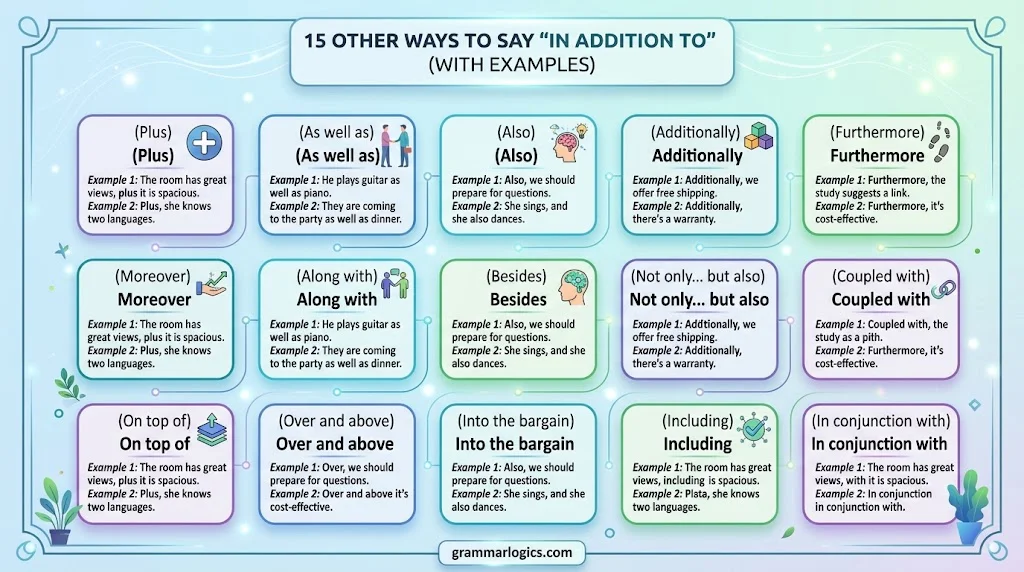
The phrase “in addition to” helps us connect ideas and share information clearly. However, using different expressions can make your writing more natural, engaging, and effective.
When writing an article, email, or academic assignment, choosing the right words can improve the flow of your message. Other ways to say “in addition to” allow you to express extra information without repeating the same phrase. Alternatives such as “besides,” “along with,” and “as well as” can help you connect ideas smoothly while keeping your sentences easy to understand.
Whether you are writing professionally, studying English, or having everyday conversations, learning these alternatives can strengthen your communication skills. Some expressions sound more formal, while others feel relaxed and conversational. Understanding these small differences helps you choose the most suitable phrase for each situation. In this guide, you will discover 15 useful alternatives to “in addition to,” complete with clear meanings and practical examples to help you use them confidently in your writing and speech.
What Does “In Addition To” Mean?
“In addition to” means including something extra alongside something that has already been mentioned. It connects two or more people, things, activities, or ideas to show that they are part of the same situation. For example, “In addition to English, she speaks French” means that she speaks English and French. The phrase is commonly used in everyday conversations, academic writing, business communication, and formal documents. It usually introduces a noun, pronoun, or verb ending in -ing, as in “In addition to his job, he studies at university.” Depending on the context, it can communicate extra information, an additional responsibility, or another benefit.
Common Situations Where “In Addition To” Is Used
People use “in addition to” whenever they want to mention something extra without replacing the original idea. In everyday conversation, it can introduce another activity, interest, or responsibility. In school assignments, it helps students connect supporting points and develop explanations. In professional emails and reports, it introduces extra tasks, services, qualifications, or information.
The phrase is also useful in customer communication when explaining the features of a product or service. For example, a business might mention free delivery in addition to a product warranty. However, repeating the same expression throughout a long document can make the writing sound monotonous. Choosing a suitable alternative can improve readability, flow, and clarity while keeping the intended meaning intact.
Is It Professional or Polite to Say “In Addition To”?
Yes, “in addition to” is professional, neutral, and polite in most situations. It works well in academic writing, business emails, reports, presentations, and formal conversations because it introduces extra information without sounding demanding or emotional. For example, “In addition to your regular duties, you will help train new employees” is clear and professional.
The phrase is also appropriate in casual conversations, although expressions such as “besides” or “along with” may sound more relaxed. In formal writing, “as well as” and “further to” can sometimes provide a useful variation, depending on the sentence. The important point is to choose an expression that fits the grammar and meaning of the sentence rather than replacing every occurrence automatically.
Advantages and Disadvantages of Saying “In Addition To”
Advantages
- Clear meaning: It immediately signals that something extra is being included.
- Professional tone: It fits business, academic, and formal writing.
- Versatility: It can introduce additional responsibilities, qualities, activities, and information.
- Logical connections: It helps readers understand how different details relate to one another.
Disadvantages
- Repetition: Using it too often can make writing feel predictable.
- Formality: It may sound slightly formal in relaxed conversations.
- Sentence length: Repeated use can make sentences unnecessarily complicated.
- Limited nuance: It does not always express the same relationship as phrases such as “together with,” “apart from,” or “on top of.”
15 Synonyms for “In Addition To”
- Besides
- As Well As
- Along With
- Together With
- Additionally
- Moreover
- Furthermore
- Plus
- On Top Of
- Coupled With
- Not to Mention
- In Conjunction With
- Over and Above
- Alongside
- As an Added Bonus
1. Besides
Meaning
Besides means in addition to something or someone already mentioned. It can introduce another item, fact, reason, or consideration.
Definition
A word used to indicate an extra point or something included alongside an existing one.
Detailed Explanation
“Besides” is a flexible alternative that works in both everyday conversations and many written contexts. It is generally less formal than “in addition to,” making it suitable for friendly discussions and informal messages. Depending on the sentence, it can also introduce an extra reason rather than simply another item. Be aware that “besides” can sometimes mean “apart from,” so the intended relationship should be clear.
Scenario Examples
Scenario: Talking about language skills.
Example: Besides English, Amir speaks Arabic and Urdu.
Scenario: Discussing reasons to exercise.
Example: Besides improving your fitness, walking can help you relax.
Scenario: Planning a weekend.
Example: Besides visiting the museum, we could explore the old town.
Best Use
Use “besides” in casual conversations, friendly emails, explanations, and informal writing. It is especially useful when adding another reason or option.
Tone
Tone: Conversational, natural, and friendly. It makes additional information feel easy to introduce without unnecessary formality.
2. As Well As
Meaning
As well as means together with or in addition to something else. It adds another person, activity, or quality to the sentence.
Definition
A phrase used to include another item or action alongside the first.
Detailed Explanation
“As well as” is a natural choice for both professional and everyday English. It often sounds smooth when adding skills, responsibilities, or activities. For example, “She manages the accounts as well as the customer service team” includes two responsibilities. Its grammar can differ from “and,” particularly when the phrase introduces a verb ending in -ing. Choose it when you want a clear connection without making the sentence sound overly formal.
Scenario Examples
Scenario: Describing a colleague’s skills.
Example: Daniel handles scheduling as well as staff training.
Scenario: Explaining a course.
Example: The course covers grammar as well as practical writing.
Scenario: Discussing hobbies.
Example: She enjoys gardening as well as painting.
Best Use
Use “as well as” in workplace communication, educational writing, descriptions, and everyday conversation when you want to connect related details.
Tone
Tone: Neutral, polished, and professional. It is appropriate in many settings without sounding stiff.
3. Along With
Meaning
Along with means together with or accompanied by something or someone. It introduces an additional person, item, or activity.
Definition
A phrase that indicates something is included or present with another thing.
Detailed Explanation
“Along with” emphasizes that two things occur or are included together. It works particularly well when mentioning people, documents, equipment, or responsibilities. Unlike “moreover,” which introduces another point in an argument, “along with” usually connects items directly within a sentence. It is useful when you want natural wording that remains suitable for professional communication.
Scenario Examples
Scenario: Sending work documents.
Example: Please send the completed form along with your identification.
Scenario: Describing an employee.
Example: Maria, along with her colleagues, attended the training session.
Scenario: Packing for a trip.
Example: Bring a jacket along with your walking shoes.
Best Use
Use “along with” in emails, instructions, everyday speech, and descriptions when two or more things belong together.
Tone
Tone: Neutral, practical, and conversational. It makes additional details easy to understand.
4. Together With
Meaning
Together with means accompanied by or combined with another person or thing. It highlights the presence of both elements.
Definition
A phrase indicating that something is included or occurs alongside something else.
Detailed Explanation
“Together with” is useful when you want to emphasize cooperation, combination, or shared involvement. It can introduce people participating in an activity or items included in a package. Compared with “along with,” it may place slightly more emphasis on the idea of being together. In formal documents, it can sound clear and organized, although it should not replace “in addition to” mechanically in every sentence.
Scenario Examples
Scenario: Announcing a team project.
Example: Together with the design team, we developed a new website.
Scenario: Listing application materials.
Example: Submit your application together with the required certificates.
Scenario: Describing a gift package.
Example: The order includes a notebook together with a matching pen.
Best Use
Use “together with” in professional reports, project descriptions, instructions, and situations involving cooperation or combined items.
Tone
Tone: Clear, collaborative, and moderately formal. It emphasizes the connection between the things being mentioned.
5. Additionally
Meaning
Additionally means also or in addition. It introduces another piece of information, point, or requirement.
Definition
An adverb used to present extra information alongside what has already been stated.
Detailed Explanation
“Additionally” works well when you are adding a separate point to a discussion. Unlike “in addition to,” which normally introduces a noun or an -ing form, “additionally” often connects complete statements. For example, “The hotel offers free breakfast. Additionally, guests can use the fitness center.” It is especially useful in structured writing, but frequent use can make prose sound mechanical.
Scenario Examples
Scenario: Writing a business update.
Example: The team completed the first phase. Additionally, we prepared the next project schedule.
Scenario: Explaining school requirements.
Example: Students must submit the essay. Additionally, they need to complete the online quiz.
Scenario: Describing a service.
Example: The plan includes regular maintenance. Additionally, customers receive technical support.
Best Use
Use “additionally” in reports, formal emails, academic writing, presentations, and organized explanations.
Tone
Tone: Professional, neutral, and informative. It introduces another point in a clear, structured way.
6. Moreover
Meaning
Moreover means in addition to what has already been said, especially when introducing a supporting or important point.
Definition
A formal linking adverb used to add information that strengthens an explanation or argument.
Detailed Explanation
“Moreover” does more than simply list another item; it often signals that the next point adds weight to the previous one. It is common in essays, reports, and persuasive writing. For example, you might explain that a policy saves money and then use “moreover” to introduce another benefit. It usually sounds more formal than “besides” or “plus,” so it may feel unnatural in a casual text message.
Scenario Examples
Scenario: Writing an essay about public transport.
Example: Public transport reduces traffic congestion. Moreover, it can lower household travel costs.
Scenario: Presenting a proposal.
Example: The new system saves time. Moreover, it makes routine tasks easier to track.
Scenario: Explaining a school program.
Example: The program supports academic growth. Moreover, it encourages teamwork.
Best Use
Use “moreover” in academic essays, formal reports, proposals, and persuasive arguments when the additional point strengthens your case.
Tone
Tone: Formal, persuasive, and confident. It signals that the next point is relevant to the larger argument.
7. Furthermore
Meaning
Furthermore means in addition to the information already provided. It introduces another supporting detail or argument.
Definition
A formal transition word used to add a related point to an explanation or discussion.
Detailed Explanation
“Furthermore” is particularly useful in organized writing where ideas need to build logically. It is similar to “moreover,” but the choice between them often depends on style and sentence flow rather than a major difference in meaning. It can help introduce evidence, benefits, concerns, or recommendations. In casual conversation, however, it may sound overly formal when simpler wording would work just as well.
Scenario Examples
Scenario: Writing a research summary.
Example: The results show improved attendance. Furthermore, student participation increased.
Scenario: Preparing a business report.
Example: The updated process reduces errors. Furthermore, it makes staff training easier.
Scenario: Supporting an environmental proposal.
Example: Planting trees improves local shade. Furthermore, it can support urban wildlife.
Best Use
Use “furthermore” in formal reports, academic writing, presentations, and structured arguments.
Tone
Tone: Formal, logical, and authoritative. It helps connect supporting ideas in a well-organized discussion.
8. Plus
Meaning
Plus means with something extra or in addition to something else. It is a simple, direct way to include another benefit, feature, or item.
Definition
An informal word used to add another item, advantage, or point.
Detailed Explanation
“Plus” is shorter and more conversational than “in addition to.” It works well when listing benefits, sharing plans, or explaining why something is useful. For example, “The apartment is close to work, plus it has a balcony” sounds natural in everyday speech. In formal writing, “additionally” or “as well as” may be a better fit. Also, “plus” can have mathematical meanings, so its function depends on context.
Scenario Examples
Scenario: Recommending a café.
Example: The coffee is excellent, plus the outdoor seating is lovely.
Scenario: Discussing a fitness class.
Example: The sessions are affordable, plus you can book them online.
Scenario: Planning a day out.
Example: We can visit the beach, plus stop at the seafood market.
Best Use
Use “plus” in casual conversations, texts, informal recommendations, and friendly messages.
Tone
Tone: Casual, upbeat, and straightforward. It introduces an extra point without making the sentence sound formal.
9. On Top Of
Meaning
On top of can mean in addition to something that already exists. In informal conversation, it often introduces an extra task, burden, expense, or benefit.
Definition
An expression meaning in addition to, often with emphasis on an extra amount or responsibility.
Detailed Explanation
“On top of” is especially natural when the additional item feels significant or comes after an existing responsibility. For example, “On top of working full-time, she is studying for an exam” highlights how much she has to manage. It can also introduce a positive extra, such as an added benefit. Because it is conversational and sometimes emphasizes pressure, it is not always the best substitute in formal documents.
Scenario Examples
Scenario: Talking about a busy schedule.
Example: On top of my regular duties, I have to prepare the monthly report.
Scenario: Describing a travel deal.
Example: On top of the discounted room rate, breakfast is included.
Scenario: Discussing household expenses.
Example: On top of rent, we need to budget for utilities.
Best Use
Use “on top of” in informal conversations, personal messages, and discussions about extra costs, duties, or benefits.
Tone
Tone: Conversational and emphatic. It often draws attention to the added weight or value of something.
10. Coupled With
Meaning
Coupled with means combined with or considered alongside another factor. It often shows how two things work together or influence a result.
Definition
A phrase used to connect two related factors, qualities, or circumstances.
Detailed Explanation
“Coupled with” is more analytical than many everyday alternatives. It is useful when discussing a combination of circumstances, evidence, advantages, or challenges. For example, “Strong demand, coupled with limited supply, increased prices” explains how two factors contributed to one outcome. It does not always mean simply adding another item to a list; it often emphasizes the relationship between two elements. Use it when that connection matters.
Scenario Examples
Scenario: Explaining a business result.
Example: Rising demand, coupled with higher shipping costs, affected the final price.
Scenario: Discussing a student’s progress.
Example: Regular practice, coupled with helpful feedback, improved her writing.
Scenario: Describing a difficult situation.
Example: Limited time, coupled with a small team, made the project challenging.
Best Use
Use “coupled with” in reports, analysis, professional writing, and explanations of cause or combined effects.
Tone
Tone: Analytical, professional, and precise. It emphasizes how two factors work together.
11. Not to Mention
Meaning
Not to mention introduces an additional point that the speaker considers especially relevant, noteworthy, or worth emphasizing.
Definition
An expression used to add another detail, often one that strengthens the previous statement.
Detailed Explanation
“Not to mention” is a natural way to emphasize an extra reason, quality, or problem. For example, “The trip is expensive, not to mention exhausting” adds a second concern with emphasis. Unlike the neutral phrase “in addition to,” it often conveys the speaker’s attitude toward the extra detail. It is common in spoken English and informal writing, but it may be less suitable for highly formal reports.
Scenario Examples
Scenario: Talking about a long commute.
Example: The journey takes two hours, not to mention the traffic.
Scenario: Recommending a restaurant.
Example: The food is delicious, not to mention the generous portions.
Scenario: Discussing a challenging assignment.
Example: We have three deadlines this week, not to mention the presentation on Friday.
Best Use
Use “not to mention” in conversations, informal writing, reviews, and persuasive messages when the extra detail deserves emphasis.
Tone
Tone: Expressive, conversational, and emphatic. It often adds surprise, frustration, admiration, or extra persuasion.
12. In Conjunction With
Meaning
In conjunction with means in combination or working together with something else. It often describes coordinated activities, systems, people, or processes.
Definition
A formal expression indicating that two or more things are used, performed, or considered together.
Detailed Explanation
“In conjunction with” is more formal than “along with” and is particularly useful when two things are coordinated. It commonly appears in professional, technical, academic, and administrative writing. For instance, a company might introduce a training program in conjunction with a new software system. It is not always the most natural phrase for a simple list of unrelated items. Choose it when the idea of cooperation or coordinated use is important.
Scenario Examples
Scenario: Announcing a training initiative.
Example: The workshop will run in conjunction with the annual staff meeting.
Scenario: Describing a health campaign.
Example: The school organized the campaign in conjunction with a local community center.
Scenario: Explaining a research method.
Example: The researchers analyzed interviews in conjunction with survey responses.
Best Use
Use “in conjunction with” in official announcements, technical documents, academic writing, and professional communication where coordination matters.
Tone
Tone: Formal, technical, and precise. It emphasizes that activities or elements are being handled together.
13. Over and Above
Meaning
Over and above means in addition to something already expected, required, or included. It can emphasize an extra amount or contribution.
Definition
An expression referring to something beyond an existing amount, requirement, or expectation.
Detailed Explanation
“Over and above” often highlights that something goes beyond the basic level. It is useful for describing extra costs, effort, benefits, or responsibilities. For example, “Employees received a bonus over and above their regular salary” indicates an additional payment. Although it can overlap with “in addition to,” it often carries a stronger sense of exceeding a baseline. In everyday writing, simpler alternatives may be easier to read.
Scenario Examples
Scenario: Discussing employee compensation.
Example: The company provided travel reimbursement over and above the standard allowance.
Scenario: Describing volunteer work.
Example: She spent several hours over and above her usual commitment helping the community.
Scenario: Explaining a service package.
Example: Premium members receive extra support over and above the basic service.
Best Use
Use “over and above” in professional discussions, financial explanations, agreements, and descriptions of extra effort or benefits.
Tone
Tone: Emphatic, professional, and slightly formal. It draws attention to something that exceeds what is normally expected.
14. Alongside
Meaning
Alongside means beside, together with, or in addition to something else. It can refer to physical position or to things that exist or happen together.
Definition
A word used to indicate that something is present, developed, or carried out with another thing.
Detailed Explanation
“Alongside” is concise and versatile, making it useful for discussing people, activities, projects, or developments. It often suggests that two things exist or progress side by side. For example, “The company offers mentoring alongside technical training” shows that both forms of support are provided. Unlike “moreover,” it connects related elements rather than introducing a separate argument. In some contexts, it can mean literally next to something, so the sentence should make the intended meaning clear.
Scenario Examples
Scenario: Describing professional development.
Example: Employees receive coaching alongside their regular training.
Scenario: Discussing education.
Example: Students study science alongside mathematics and technology.
Scenario: Reporting on a community project.
Example: The city is improving public transport alongside its cycling routes.
Best Use
Use “alongside” in professional communication, educational writing, project descriptions, and discussions of parallel activities.
Tone
Tone: Neutral, polished, and concise. It presents related elements as complementary parts of the same picture.
15. As an Added Bonus
Meaning
As an added bonus introduces an extra benefit or pleasant advantage beyond what someone already expects.
Definition
A phrase used to highlight an additional positive feature, reward, or benefit.
Detailed Explanation
“As an added bonus” is not a universal synonym for “in addition to” because it specifically emphasizes something favorable. It is ideal when describing a product, experience, offer, or opportunity that provides extra value. For example, a hotel might offer a complimentary breakfast as an added bonus. The expression sounds warmer and more promotional than the original phrase. Avoid using it for neutral facts, extra burdens, or negative circumstances.
Scenario Examples
Scenario: Recommending a holiday destination.
Example: The hotel is close to the beach, and as an added bonus, it offers free bicycle rentals.
Scenario: Describing an online course.
Example: You receive downloadable worksheets and, as an added bonus, access to a monthly Q&A session.
Scenario: Sharing good news with a friend.
Example: We got seats near the stage, and as an added bonus, parking was free.
Best Use
Use “as an added bonus” in friendly recommendations, product descriptions, customer communication, travel writing, and discussions of extra benefits.
Tone
Tone: Positive, warm, and enthusiastic. It highlights an unexpected or particularly welcome advantage.
FAQs
What is another way to say “in addition to”?
Common alternatives include “as well as,” “along with,” “besides,” and “together with.” The best choice depends on your sentence, audience, and intended meaning.
What does “in addition to” mean?
“In addition to” means including something extra alongside something already mentioned. For example, “In addition to her job, she volunteers at a shelter” means she has a job and also volunteers.
Is “in addition to” professional?
Yes. It is a neutral and professional expression suitable for emails, reports, academic assignments, presentations, and formal documents.
What is a more polite way to say “in addition to”?
“In addition to” is already polite. However, “along with” or “as well as” may sound more natural in a friendly message, depending on the sentence.
Which alternative works best in formal communication?
“Additionally,” “furthermore,” and “in conjunction with” can work well in formal communication. Use “additionally” to introduce another point, “furthermore” to strengthen an argument, and “in conjunction with” when describing coordinated activities.
Conclusion
Choosing the right alternative to “in addition to” can make your communication clearer, more natural, and less repetitive. Expressions such as “as well as,” “along with,” and “together with” work well when connecting people, activities, or items. Meanwhile, “moreover” and “furthermore” are useful for building formal arguments, while “as an added bonus” highlights an extra benefit.
Remember that similar expressions do not always have exactly the same meaning or tone. Consider your audience, the purpose of your sentence, and the relationship between the ideas you want to connect. With practice, you can use these 15 alternatives confidently in emails, essays, conversations, and professional documents. The best expression is the one that communicates your meaning accurately and fits the situation naturally.