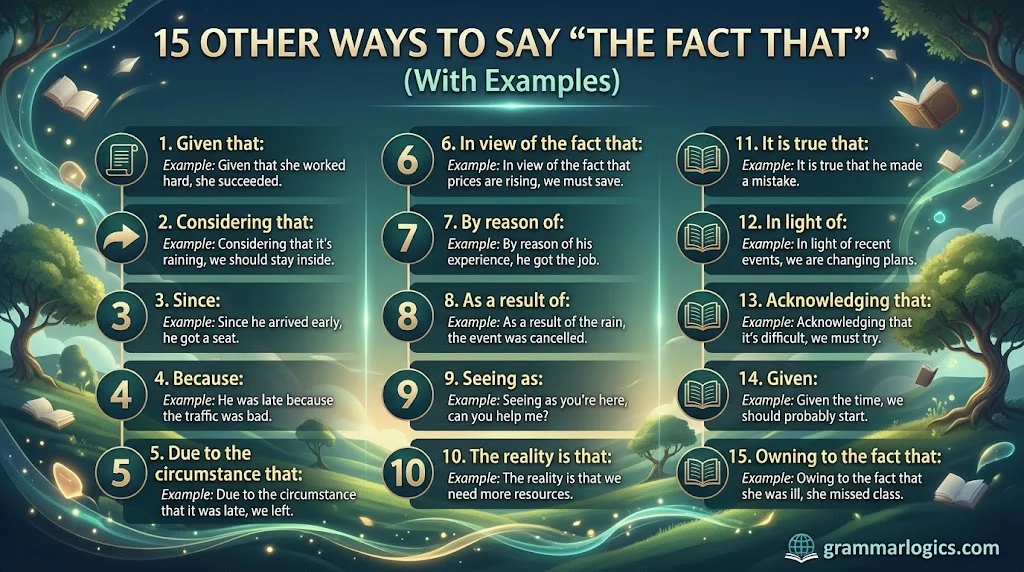
Words play an important role in making communication clear, natural, and meaningful. The phrase “the fact that” is common, but using different expressions can make your writing smoother and more engaging.
When expressing ideas, explaining reasons, or sharing opinions, choosing the right words helps readers understand your message more easily. Although “the fact that” is useful in everyday conversations and formal writing, repeating it too often can make sentences feel wordy. Learning other ways to say “the fact that” allows you to express your thoughts with greater clarity and confidence. These alternatives can help you create more natural sentences, improve your vocabulary, and make your communication more effective in both personal and professional situations.
Whether you are writing an essay, preparing a professional email, or having a casual conversation, finding suitable alternatives to “the fact that” can improve your language skills. Expressions such as “because,” “given that,” “considering that,” and “the reality that” can communicate similar ideas, depending on the context. However, each phrase has its own meaning and tone, so choosing the right one is important. Understanding these differences will help you avoid unnecessary repetition and make your writing sound more polished. In this guide, you will discover 15 useful alternatives to “the fact that,” along with clear explanations and practical examples to help you use them naturally.
What Does “The Fact That” Mean?
“The fact that” is a phrase used to introduce a statement, situation, or piece of information that someone considers true or important. It connects a main idea with a supporting detail, explanation, or observation. For example, in the sentence “The fact that she arrived early impressed everyone,” the phrase introduces the information that she arrived early. This information explains why people were impressed.
The expression is common in everyday conversation, academic writing, professional communication, and formal discussions. It can emphasize a situation, acknowledge evidence, or introduce a reason for a particular opinion. However, it sometimes makes sentences longer than necessary. Depending on the context, writers can replace it with expressions such as “the reality that,” “given that,” “the point that,” or simply remove it to create a more direct sentence.
Common Situations Where “The Fact That” Is Used
People use “the fact that” in several situations where they want to explain, emphasize, or acknowledge information.
- Everyday conversation: Someone might say, “The fact that you remembered my birthday means a lot to me.”
- Professional communication: Employees may use the phrase to explain a decision, discuss a problem, or support a recommendation.
- Academic writing: Students and researchers may introduce observations, arguments, and evidence with this expression.
- Personal communication: It can help someone explain why a particular action or situation matters emotionally.
- Formal writing: Reports and presentations may use the phrase to establish relevant circumstances or clarify an argument.
- Emails and messages: Writers sometimes use it to explain a concern, provide context, or justify a request.
Although the phrase is useful, repeating it too often can make writing unnecessarily complicated. Choosing an alternative that matches the sentence’s meaning can improve clarity, flow, and readability.
Is It Professional or Polite to Say “The Fact That”?
Yes, “the fact that” is generally professional, neutral, and grammatically acceptable. It is appropriate in business emails, academic essays, reports, presentations, and formal discussions. It can also sound natural in everyday conversation when someone wants to emphasize an important detail.
However, the phrase may become wordy when used repeatedly or when the information could be expressed more directly. For example, “The fact that the deadline was extended gave us more time” can become “The extended deadline gave us more time.” In formal writing, alternatives such as “given that” and “the reality that” may be more suitable when they accurately convey the intended meaning. The best choice depends on whether you want to emphasize a truth, explain a reason, or simply communicate information.
Advantages and Disadvantages of Saying “The Fact That”
Advantages
- Emphasizes information: It draws attention to a particular situation or detail.
- Provides context: It helps connect information with an explanation or conclusion.
- Works in formal writing: The phrase is suitable for academic, professional, and analytical discussions.
- Clarifies an argument: It can introduce information that supports a point or explains a decision.
Disadvantages
- Can create wordiness: Sometimes, the words can be removed without changing the sentence’s meaning.
- May reduce readability: Repeated use can make writing feel heavy or unnecessarily complicated.
- Can weaken directness: Shorter expressions may communicate an idea more clearly.
- Does not fit every context: Some alternatives express a reason or condition rather than simply identifying a fact, so they cannot always be substituted directly.
15 Synonyms and Alternatives for “The Fact That”
- The reality that
- The truth that
- The point that
- The idea that
- The circumstance that
- The knowledge that
- The observation that
- The understanding that
- The consideration that
- Given that
- Considering that
- Since
- Because
- The reason that
- The fact is that
Note: These expressions are not all exact synonyms. Some introduce a truth or observation, while others express a reason or condition. Choose the option that fits your sentence grammatically and conveys your intended meaning.
1. The Reality That
Meaning
“The reality that” introduces a situation that exists in the real world, especially when the situation is important, difficult, or different from what someone expected.
Definition
A phrase used to emphasize an actual situation or condition.
Detailed Explanation
This expression is useful when you want to draw attention to real circumstances rather than assumptions or expectations. It often carries more emphasis than the original phrase because it highlights what is actually happening. It works well in discussions about challenges, decisions, and practical limitations. However, it can sound unnecessarily dramatic when the information is ordinary or unimportant.
Scenario Examples
Scenario: A manager explains a project delay.
Example: The reality that several team members are unavailable means we need to adjust the schedule.
Scenario: A friend discusses financial challenges.
Example: The reality that rent keeps increasing makes saving money more difficult.
Best Use
Use it in professional discussions, analytical writing, and serious conversations where actual circumstances deserve emphasis.
Tone
Tone: Realistic, serious, emphatic. It highlights the difference between expectations and actual conditions.
2. The Truth That
Meaning
“The truth that” introduces information presented as true, often when honesty, acknowledgment, or an important realization is involved.
Definition
A phrase that emphasizes the truth of a statement or situation.
Detailed Explanation
This expression is particularly useful when discussing honesty, personal realizations, or information that someone needs to acknowledge. It can carry a stronger emotional or persuasive tone than “the fact that.” Unlike a neutral reference to information, it may suggest that a truth has been overlooked, denied, or misunderstood. Use it when the idea of truth itself matters, rather than as a replacement in every sentence.
Scenario Examples
Scenario: A person acknowledges a relationship problem.
Example: The truth that we want different things has become difficult to ignore.
Scenario: A student reflects on a disappointing result.
Example: The truth that I need more practice has motivated me to study harder.
Best Use
Use it in personal reflections, persuasive writing, discussions about honesty, and emotionally meaningful conversations.
Tone
Tone: Honest, reflective, sometimes emotional. It gives the statement a sense of acknowledgment.
3. The Point That
Meaning
“The point that” introduces a particular detail that matters to an argument, explanation, or discussion.
Definition
A phrase used to emphasize a specific idea or relevant detail.
Detailed Explanation
This alternative works when you want readers or listeners to focus on an important aspect of a situation. It can make an explanation more conversational and direct than the original phrase. However, it does not always emphasize factual truth; sometimes, it emphasizes the importance or relevance of an idea. For example, “The point that we need more time remains important” focuses on the central issue rather than merely stating a fact.
Scenario Examples
Scenario: A colleague explains a project concern.
Example: The point that we have limited resources should guide our decision.
Scenario: A student participates in a classroom discussion.
Example: The point that the evidence is incomplete needs further attention.
Best Use
Use it in meetings, debates, presentations, classroom discussions, and explanatory writing.
Tone
Tone: Direct, analytical, conversational. It draws attention to the main issue.
4. The Idea That
Meaning
“The idea that” introduces a belief, possibility, suggestion, or concept that someone is considering.
Definition
A phrase used to present a thought, belief, or proposition.
Detailed Explanation
This expression is appropriate when the information involves a thought or interpretation rather than an established fact. It can make a sentence sound more exploratory and less absolute. For instance, “The idea that everyone learns differently is worth considering” presents a general concept for discussion. Unlike the original phrase, it may suggest that the statement is a belief or possibility rather than something conclusively established.
Scenario Examples
Scenario: A teacher discusses learning methods.
Example: The idea that students learn at different speeds should influence lesson planning.
Scenario: Two friends discuss a future trip.
Example: The idea that we could travel by train sounds exciting.
Best Use
Use it in brainstorming, educational discussions, opinion writing, and conversations about possibilities.
Tone
Tone: Thoughtful, exploratory, open-minded. It introduces an idea without necessarily presenting it as proven.
5. The Circumstance That
Meaning
“The circumstance that” introduces a particular condition or situation that affects an event, decision, or outcome.
Definition
A phrase that identifies a relevant condition or situation.
Detailed Explanation
This expression is useful when you need to describe the conditions surrounding a decision or event. It tends to sound more formal and analytical than the original phrase. It is especially suitable when the surrounding situation matters more than the simple truth of a statement. However, the wording can feel stiff in casual conversation, and “the fact that” or a shorter sentence may be more natural in everyday English.
Scenario Examples
Scenario: A company reviews an employee’s request.
Example: The circumstance that the employee works remotely does not change the reporting requirements.
Scenario: A school considers a student’s situation.
Example: The circumstance that several exams fall on the same day should be taken into account.
Best Use
Use it in formal reports, administrative communication, policy discussions, and explanations involving specific conditions.
Tone
Tone: Formal, objective, analytical. It emphasizes the conditions surrounding a situation.
6. The Knowledge That
Meaning
“The knowledge that” emphasizes information someone knows and how that knowledge affects their feelings, choices, or actions.
Definition
A phrase that highlights awareness or possession of particular information.
Detailed Explanation
This expression is especially useful when knowing something creates reassurance, motivation, responsibility, or concern. It differs from the original phrase because it focuses on someone’s awareness of information, not simply on whether that information is true. For example, “The knowledge that help was available reassured her” explains how awareness affected a person’s feelings. It is less suitable when no person’s knowledge or awareness is relevant.
Scenario Examples
Scenario: A new employee receives support.
Example: The knowledge that my manager is available if I need help makes me feel more confident.
Scenario: A family discusses an upcoming medical appointment without making a medical claim.
Example: The knowledge that someone will accompany me helps me feel less nervous.
Best Use
Use it in personal writing, reflective essays, reassuring messages, and discussions about awareness or understanding.
Tone
Tone: Reflective, reassuring, thoughtful. It highlights the effect of knowing something.
7. The Observation That
Meaning
“The observation that” introduces something noticed, identified, or remarked upon through attention or experience.
Definition
A phrase used to present a noticed detail or recorded observation.
Detailed Explanation
This alternative is useful when the statement comes from something someone has noticed rather than from a general assertion. It is common in analytical, academic, and professional writing. The phrase may imply that the information resulted from careful attention, although it does not automatically prove that the observation is correct. Choose it when the act of noticing or identifying a pattern is relevant to your message.
Scenario Examples
Scenario: A teacher reviews classroom participation.
Example: The observation that students participate more in small groups may help us plan future lessons.
Scenario: A team reviews customer feedback.
Example: The observation that customers often ask the same question suggests that our instructions need clarification.
Best Use
Use it in research, reports, feedback, classroom discussions, and evidence-based analysis.
Tone
Tone: Objective, analytical, professional. It presents information as something noticed or recorded.
8. The Understanding That
Meaning
“The understanding that” introduces an accepted belief, shared expectation, or interpretation that people use to guide their actions.
Definition
A phrase referring to a belief or assumption that someone accepts or shares.
Detailed Explanation
This expression is particularly useful when people have agreed on expectations or share a particular view of a situation. It can indicate mutual agreement, but the surrounding context determines whether that agreement is explicit or simply assumed. Unlike the original phrase, it emphasizes what someone understands or accepts, rather than the bare truth of a statement. In professional settings, it can help clarify expectations, responsibilities, and arrangements.
Scenario Examples
Scenario: A project team discusses responsibilities.
Example: We started the project with the understanding that everyone would submit their work by Friday.
Scenario: Two friends discuss a shared plan.
Example: I was working on the understanding that we would meet at six.
Best Use
Use it in workplace communication, agreements, planning, and conversations about shared expectations.
Tone
Tone: Cooperative, professional, explanatory. It emphasizes what people believe or have agreed upon.
9. The Consideration That
Meaning
“The consideration that” introduces a particular factor that should be taken into account when making a decision or evaluating a situation.
Definition
A phrase that identifies a relevant factor or point for consideration.
Detailed Explanation
This expression can be useful when discussing the factors influencing a choice. It focuses on the importance of accounting for a detail, rather than simply announcing that the detail is true. The wording is relatively formal and may sound unnatural in ordinary conversation. In many sentences, “the fact that” or a direct phrase such as “because” will be clearer, so use this option only when the meaning genuinely involves weighing a consideration.
Scenario Examples
Scenario: A manager evaluates a proposal.
Example: The consideration that our budget is limited should influence the final decision.
Scenario: A family plans an event.
Example: The consideration that some guests have young children affects our choice of venue.
Best Use
Use it in decision-making, formal evaluations, planning documents, and professional discussions.
Tone
Tone: Formal, careful, analytical. It emphasizes a factor that deserves attention.
10. Given That
Meaning
“Given that” introduces a known circumstance or piece of information that supports a decision, conclusion, or recommendation.
Definition
A conjunction meaning “taking into account that” or “because this is the case.”
Detailed Explanation
This is one of the most useful alternatives when the original phrase introduces a reason for a decision. It connects relevant information directly to a conclusion, making sentences more concise. Unlike “the fact that,” it usually expresses a relationship between the information and what follows. It is suitable for both professional and everyday English, although it may sound more formal than “since” in casual conversation.
Scenario Examples
Scenario: A team adjusts a meeting schedule.
Example: Given that several colleagues are traveling, we will hold the meeting online.
Scenario: A student explains a study decision.
Example: Given that the exam is tomorrow, I am reviewing the most important topics tonight.
Best Use
Use it in professional emails, reports, explanations, recommendations, and everyday discussions involving reasons.
Tone
Tone: Professional, logical, measured. It presents a circumstance as the basis for a conclusion.
11. Considering That
Meaning
“Considering that” introduces a circumstance that should be taken into account when judging a situation or explaining an outcome.
Definition
A phrase meaning “taking this circumstance into account.”
Detailed Explanation
This expression often helps explain why a result is reasonable, surprising, or understandable in a particular situation. It can communicate a balanced judgment by acknowledging relevant circumstances before presenting a conclusion. Compared with “given that,” it sometimes places more emphasis on evaluating the situation. It is useful in conversation and writing, but the sentence should clearly show how the circumstance relates to the conclusion.
Scenario Examples
Scenario: A friend comments on a difficult achievement.
Example: Considering that she had only one week to prepare, her presentation was excellent.
Scenario: A supervisor evaluates a new employee’s progress.
Example: Considering that he joined the team last month, he has learned the process quickly.
Best Use
Use it in evaluations, everyday explanations, feedback, and discussions that require a balanced judgment.
Tone
Tone: Reasonable, thoughtful, conversational. It shows that the circumstances have been taken into account.
12. Since
Meaning
“Since” can introduce a reason for an action or conclusion. It can also refer to time, so its meaning depends on the sentence.
Definition
A conjunction used to mean “because” or to indicate that something has been true from a particular time.
Detailed Explanation
When it expresses a reason, “since” is a concise alternative to a longer phrase that introduces supporting information. For example, “Since the office is closed, we will work from home” explains the decision directly. However, “since” can also refer to time, as in “I have worked here since June,” so the context must make the intended meaning clear. It should not replace “the fact that” when the sentence merely identifies information without expressing a reason.
Scenario Examples
Scenario: A colleague explains a change in plans.
Example: Since the client requested more time, we have moved the deadline to Monday.
Scenario: A student explains a choice.
Example: Since the library is quiet in the morning, I prefer studying there before class.
Best Use
Use it in emails, conversations, explanations, and concise professional writing when the sentence expresses a clear reason.
Tone
Tone: Neutral, natural, concise. It communicates a reason without unnecessary wording.
13. Because
Meaning
“Because” introduces the reason something happens, exists, or is done.
Definition
A conjunction that connects an action or result to its cause or explanation.
Detailed Explanation
“Because” is often the clearest alternative when “the fact that” introduces a reason. It removes unnecessary wording and shows the relationship between cause and result directly. For example, “The fact that she was prepared helped her succeed” can become “She succeeded because she was prepared.” The second version is shorter and more direct, but the sentence structure changes, so the replacement must be made carefully.
Scenario Examples
Scenario: A student explains an achievement.
Example: I finished the assignment early because I planned my time carefully.
Scenario: A customer explains a request.
Example: I would like to reschedule because I have a conflicting appointment.
Best Use
Use it in everyday conversation, emails, essays, instructions, and explanations of causes or reasons.
Tone
Tone: Clear, direct, neutral. It identifies the reason without adding unnecessary emphasis.
14. The Reason That
Meaning
“The reason that” introduces or identifies the explanation for an action, decision, or situation.
Definition
A phrase used to connect an event or outcome with its explanation.
Detailed Explanation
This expression works when the purpose of the sentence is to explain why something happened or why someone made a particular choice. It differs from the original phrase because it explicitly emphasizes a reason or cause. For example, “The reason that I left early was that I felt unwell” explains a decision, rather than merely stating information. In many cases, “the reason why” or “because” may sound more natural, depending on the sentence.
Scenario Examples
Scenario: A team member explains an absence.
Example: The reason that I missed the meeting was a scheduling conflict.
Scenario: A friend explains a change in behavior.
Example: The reason that she changed her plans was that her family needed her help.
Best Use
Use it in explanations, formal responses, written statements, and situations where the cause needs to be identified clearly.
Tone
Tone: Explanatory, neutral, slightly formal. It directs attention to the cause of a situation.
15. The Fact Is That
Meaning
“The fact is that” introduces a statement that the speaker wants to emphasize, especially when correcting a misunderstanding or making an important point.
Definition
An expression used to present information as an important or undeniable point.
Detailed Explanation
Although this expression resembles the original phrase, it serves a different grammatical purpose. “The fact that” usually connects information to another part of a sentence, whereas “the fact is that” commonly introduces a complete statement. It can sound firm or persuasive, particularly when someone wants to clarify a disagreement. Because it adds emphasis, it may seem confrontational if used in an overly forceful way.
Scenario Examples
Scenario: A colleague corrects a misunderstanding about a deadline.
Example: The fact is that we cannot submit the report until the figures have been checked.
Scenario: A friend discusses a difficult decision.
Example: The fact is that I need more time before I can make a final choice.
Best Use
Use it in discussions, persuasive writing, clarifications, and conversations where an important point needs emphasis.
Tone
Tone: Firm, direct, emphatic. It signals that the speaker wants the listener to recognize an important point.
FAQs
What is another way to say “the fact that”?
Common alternatives include “the reality that,” “the truth that,” “the point that,” and “the fact is that.” If the phrase introduces a reason, “given that,” “since,” or “because” may be more natural.
What does “the fact that” mean?
“The fact that” introduces a statement or situation presented as true or important. For example, “The fact that you helped me matters” emphasizes the importance of the help someone provided.
Is “the fact that” professional?
Yes. It is acceptable in professional emails, academic writing, reports, and presentations. However, removing unnecessary wording or choosing a more precise expression can make professional communication clearer.
What is a more polite way to say “the fact that”?
The phrase is already neutral and generally polite. If you want a softer or more natural sentence, you can restructure it. For example, “The fact that you were busy is understandable” could become “I understand that you were busy.”
Which alternative works best in formal communication?
“Given that” works well when introducing a relevant circumstance or reason. “The reality that” may suit a discussion of actual conditions, while “the observation that” can work well in analytical writing. The best option depends on the meaning and grammatical structure of the sentence.
Conclusion
Choosing the right alternative to “the fact that” can make your writing clearer, more natural, and easier to follow. Expressions such as “the reality that,” “the truth that,” and “the observation that” help emphasize different kinds of information, while “given that,” “since,” and “because” are often better when explaining a reason.
The important thing is to consider the meaning, grammar, tone, and context before replacing one phrase with another. In professional communication, a concise expression may improve readability, while personal writing may benefit from wording that conveys a specific feeling or perspective. Rather than memorizing every alternative, learn how each expression works in a sentence. This will help you choose language that communicates your ideas accurately and confidently.