Feeling tired is a normal part of life, but choosing the right words can help you express your feelings more clearly. Exploring other ways to say “tired” makes your writing and conversations more natural, engaging, and meaningful.
Whether you have had a long day at work, spent hours studying, or simply need some rest, the word “tired” may not fully describe how you feel. Sometimes, you might feel exhausted, sleepy, drained, or worn out. Each expression carries a slightly different meaning and helps communicate your level of fatigue. Learning these alternatives can improve your everyday English vocabulary and make your conversations sound more natural. They are also useful when writing emails, messages, blog posts, or personal stories. By choosing the right phrase, you can express your feelings more accurately and help others understand your situation.
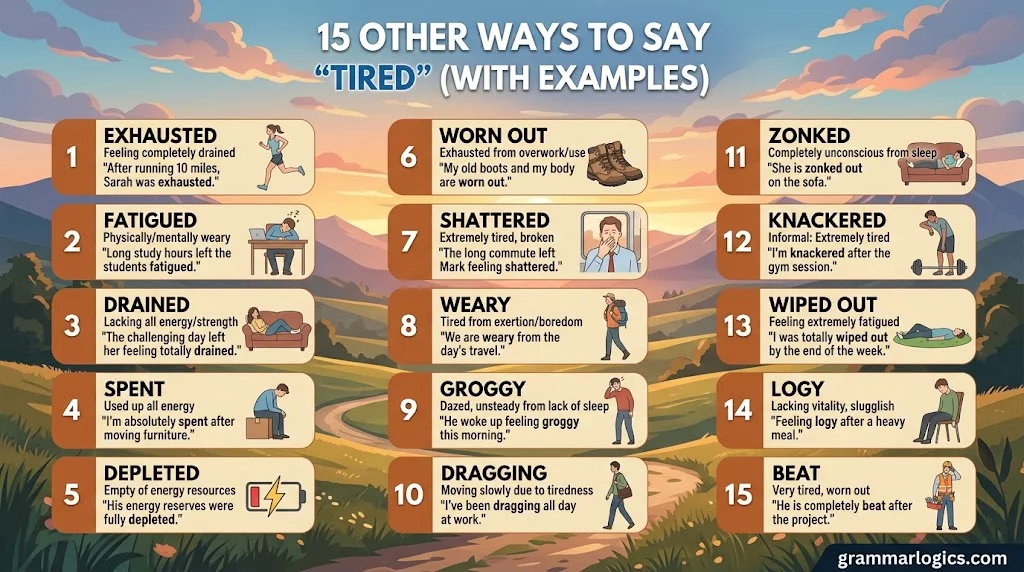
In this article, we will explore 15 other ways to say “tired” with clear meanings and practical examples. These alternatives will help you describe physical exhaustion, mental fatigue, and the need for relaxation in different situations. You will discover expressions suitable for casual conversations with friends, professional communication, and everyday writing. Some phrases sound friendly and informal, while others are more descriptive and expressive. Understanding these differences will help you choose the most appropriate words for your message. Whether you are improving your English skills or looking for fresh vocabulary for your blog, these useful alternatives will help you communicate with greater clarity, confidence, and variety.
What Does “Tired” Mean?
The word tired means feeling a need for rest or sleep because your body or mind has used energy. People commonly feel tired after working for long hours, exercising, studying, traveling, or staying awake late at night. For example, someone might say, “I’m tired after a busy day at work,” to explain why they want to relax. The word can describe both physical fatigue and mental exhaustion, depending on the situation.
Tired can also express a lack of patience, interest, or enthusiasm. For instance, “I’m tired of arguing about the same thing” means the speaker is frustrated with a repeated situation rather than physically sleepy. Similarly, “I’m tired of this routine” communicates boredom or dissatisfaction. Understanding these differences helps you choose an appropriate alternative, whether you want to describe low energy, a need for sleep, emotional exhaustion, or frustration.
Common Situations Where “Tired” Is Used
People use tired in many everyday situations. After a long workday, someone might tell a friend, “I’m tired and need to go home.” Students may use it after studying for exams, while parents might say they are tired after looking after their children all day. In text messages, the word is a simple way to explain why someone wants to rest, cancel plans, or spend a quiet evening at home.
The word also appears in professional and personal communication. A colleague might explain that they feel exhausted after meeting a deadline, while a friend might describe feeling mentally drained after a difficult conversation. On social media, people sometimes share that they are worn out after a busy week. When the basic word feels too general, alternatives such as exhausted, sleepy, or burned out can communicate the specific feeling more accurately. The best choice depends on whether the person needs sleep, physical recovery, mental rest, or a break from stress.
Is It Professional or Polite to Say “Tired”?
Yes, tired is a polite, natural, and widely accepted word in professional and personal communication. It is not rude or inappropriate by itself. In a workplace, you might say, “I’m feeling tired after a long day,” or “I’m a little tired, so I’ll review this again tomorrow.” These statements communicate your condition without sounding disrespectful. However, the way you explain your tiredness matters, particularly when discussing responsibilities or deadlines.
In more formal communication, expressions such as fatigued or mentally exhausted may be more precise when describing a specific condition. In casual conversation, phrases like “I’m beat” and “I’m wiped out” sound friendly and informal. If you mean that a repeated problem has frustrated you, “I’m tired of this” can sound direct or emotional. A softer expression, such as “I’m finding this situation difficult,” may be more appropriate when speaking with a manager, customer, or colleague.
Advantages and Disadvantages of Saying “Tired”
Advantages
The word tired is simple, familiar, and easy to understand. It works in everyday conversations, text messages, emails, and many workplace situations. Because it does not exaggerate how someone feels, it can be a useful choice when describing an ordinary need for rest. It also covers physical and mental fatigue, making it flexible enough for different circumstances.
Disadvantages
Although the word is useful, tired does not always explain the exact feeling. It may refer to sleepiness, physical exhaustion, mental strain, or frustration, leaving the listener to interpret the intended meaning. Repeating it too often can also make communication less expressive. Alternatives such as “sleepy,” “drained,” and “burned out” communicate different experiences more clearly, although they are not interchangeable in every situation.
15 Alternatives to “Tired”
- Exhausted
- Sleepy
- Worn out
- Drained
- Fatigued
- Weary
- Beat
- Wiped out
- Run-down
- Spent
- Burned out
- Low on energy
- In need of rest
- Mentally exhausted
- Bone-tired
1. Exhausted
Meaning
Exhausted means feeling extremely tired, with very little energy left. It describes a stronger level of fatigue than ordinary tiredness.
Definition
Exhausted: Completely or extremely tired after using a great deal of physical or mental energy.
Detailed Explanation
Use “exhausted” when “tired” does not fully describe how much energy you have lost. It can refer to physical effort, such as strenuous exercise, or mental effort, such as managing a demanding project. The word is stronger than tired and often suggests that rest is necessary. It is suitable for both everyday and professional communication, depending on how the sentence is framed.
Scenario Examples
Scenario: A demanding day at work.
Example: “I’m exhausted after dealing with deadlines all afternoon.”
Scenario: A friend has completed a difficult hike.
Example: “We were exhausted by the time we reached the top.”
Scenario: A student has been preparing for exams.
Example: “I’ve been studying all week, and I’m completely exhausted.”
Best Use
Use exhausted when you want to emphasize serious fatigue after physical activity, long hours, or intense concentration.
Tone
Tone: Direct, descriptive, and moderately strong. It communicates a clear need for rest without sounding overly dramatic.
2. Sleepy
Meaning
Sleepy means feeling ready to sleep or having difficulty staying awake. Unlike general tiredness, it specifically suggests a need for sleep.
Definition
Sleepy: Feeling that you want or need to go to sleep.
Detailed Explanation
Choose “sleepy” when the main problem is drowsiness rather than physical exhaustion. It is common after staying up late, waking up early, or eating a large meal. The expression is softer and more specific than “exhausted.” It does not necessarily mean that someone has used all their energy; they may simply need a nap or a full night’s sleep.
Scenario Examples
Scenario: A child is getting ready for bed.
Example: “I’m getting sleepy, so can we read one more story?”
Scenario: A friend sends a late-night message.
Example: “I’m too sleepy to finish this movie tonight.”
Scenario: Someone is struggling to stay awake while reading.
Example: “I feel sleepy after reading for an hour.”
Best Use
Use sleepy in casual conversation when you feel drowsy, especially when discussing bedtime, naps, or a lack of sleep.
Tone
Tone: Gentle, casual, and friendly. It often sounds softer than saying you are completely exhausted.
3. Worn Out
Meaning
Worn out means extremely tired after prolonged activity, pressure, or effort. It can describe both physical and mental fatigue.
Definition
Worn out: Feeling depleted after doing something demanding for a long time.
Detailed Explanation
“Worn out” is a natural, conversational expression that suggests your energy has gradually run low. It works well after a busy week, caring for family members, or handling several responsibilities at once. Compared with “sleepy,” it focuses more on the effects of sustained effort than on the desire to sleep. It can also describe objects that have become damaged through extensive use, so the context determines its meaning.
Scenario Examples
Scenario: A parent has spent the day caring for young children.
Example: “I’m worn out after chasing the kids around all day.”
Scenario: A colleague has completed a demanding week.
Example: “Everyone looks worn out after this week’s deadlines.”
Scenario: A friend has been moving furniture.
Example: “I’m completely worn out from carrying those boxes upstairs.”
Best Use
Use worn out in casual conversations about prolonged effort, busy schedules, and responsibilities that leave you with little energy.
Tone
Tone: Conversational, relatable, and slightly emphatic. It communicates that fatigue has built up over time.
4. Drained
Meaning
Drained means feeling as though your energy has been used up. It often describes emotional or mental fatigue, although it can also refer to physical tiredness.
Definition
Drained: Having very little energy or emotional capacity remaining.
Detailed Explanation
“Drained” is especially useful when a situation has taken a lot out of you emotionally. A difficult discussion, stressful meeting, or demanding day can leave you feeling drained even when you have not done much physical work. Unlike “sleepy,” the word does not necessarily mean you want to sleep immediately. It suggests that you need time, quiet, or a break to recover your energy.
Scenario Examples
Scenario: A friend has had a difficult conversation.
Example: “That conversation left me feeling emotionally drained.”
Scenario: An employee has attended meetings all day.
Example: “I’m mentally drained after back-to-back meetings.”
Scenario: Someone has dealt with several stressful problems.
Example: “I’ve been handling one problem after another, and I feel drained.”
Best Use
Use drained when describing emotional pressure, mental effort, stressful experiences, or a general loss of energy.
Tone
Tone: Reflective, personal, and emotionally expressive. It communicates fatigue that may go beyond the physical need for sleep.
5. Fatigued
Meaning
Fatigued means experiencing physical or mental tiredness. It is a slightly more formal alternative to the everyday word “tired.”
Definition
Fatigued: Affected by fatigue, with reduced energy or capacity for activity.
Detailed Explanation
“Fatigued” is useful when you want to describe tiredness in a measured, professional way. It appears in workplace discussions, health-related explanations, and formal writing. Unlike casual expressions such as “beat,” it sounds more neutral and precise. However, it can feel unnecessarily formal in a relaxed conversation with friends, where “tired” or “worn out” would usually sound more natural.
Scenario Examples
Scenario: An employee explains their condition after working a long shift.
Example: “I’m feeling fatigued after several hours of continuous work.”
Scenario: A person describes a long journey.
Example: “The extended drive left us physically fatigued.”
Scenario: A report describes the effects of demanding work.
Example: “Employees may feel fatigued when they have insufficient time to recover between shifts.”
Best Use
Use fatigued in professional reports, formal communication, or situations where a neutral description of tiredness is appropriate.
Tone
Tone: Formal, neutral, and descriptive. It sounds more technical than ordinary conversational language.
6. Weary
Meaning
Weary means very tired, often because of prolonged effort, worry, difficulty, or repeated experiences. It can suggest emotional as well as physical fatigue.
Definition
Weary: Feeling tired or worn down after a long period of effort or difficulty.
Detailed Explanation
“Weary” often carries a deeper sense of weariness than simple physical tiredness. It can describe someone who has been dealing with the same challenge for a long time or who feels discouraged by repeated difficulties. The word is common in reflective writing and can sound more literary than everyday speech. Choose it when you want to communicate not just low energy but also the burden of an ongoing experience.
Scenario Examples
Scenario: Someone has been waiting for an important decision for weeks.
Example: “I’m weary of waiting for an answer that never seems to come.”
Scenario: A traveler has spent several days on the road.
Example: “The weary travelers finally reached their hotel.”
Scenario: A friend has dealt with repeated disagreements.
Example: “She’s weary of having the same argument every weekend.”
Best Use
Use weary in thoughtful conversation, descriptive writing, or situations involving prolonged effort, worry, or frustration.
Tone
Tone: Reflective, serious, and sometimes literary. It can communicate emotional weight as well as fatigue.
7. Beat
Meaning
Beat is an informal expression meaning very tired or exhausted. It is commonly used in relaxed conversation.
Definition
Beat: Extremely tired, especially after a busy or demanding day.
Detailed Explanation
When someone says, “I’m beat,” they usually mean that they have little energy left and want to relax. The expression is short, natural, and familiar in informal English. It sounds more casual than “fatigued” and can make a conversation feel relaxed. However, it is generally unsuitable for highly formal reports or situations where a more professional description is expected.
Scenario Examples
Scenario: A friend asks whether you want to go out after work.
Example: “I’d love to, but I’m beat. Can we meet tomorrow?”
Scenario: A sports team has finished a tough practice.
Example: “We’re all beat after that training session.”
Scenario: Someone messages a family member after traveling.
Example: “Just got home. I’m beat and heading straight to bed.”
Best Use
Use beat in casual speech, friendly texts, and conversations with people you know well.
Tone
Tone: Informal, friendly, and straightforward. It expresses strong tiredness without sounding formal or technical.
8. Wiped Out
Meaning
Wiped out means extremely tired, often after intense activity or a particularly demanding day.
Definition
Wiped out: So tired that you have very little energy left.
Detailed Explanation
“Wiped out” is a strong, informal phrase that emphasizes how completely an activity has used your energy. It works well after exercise, traveling, working long hours, or managing a hectic schedule. Like “beat,” it is conversational, but it can sound a little more emphatic. The phrase also has other meanings in different contexts, so the surrounding sentence should make it clear that you mean exhaustion.
Scenario Examples
Scenario: Someone finishes a long workout.
Example: “That workout wiped me out.”
Scenario: A family returns from a full day of sightseeing.
Example: “We’re all wiped out after walking around the city.”
Scenario: A colleague has finished a major project.
Example: “I’m wiped out after preparing the final presentation.”
Best Use
Use wiped out in informal conversations when you want to emphasize that an activity has left you completely exhausted.
Tone
Tone: Casual, emphatic, and expressive. It communicates a high level of tiredness.
9. Run-Down
Meaning
Run-down describes feeling tired, low in energy, or generally unwell. It can suggest that you have not been getting enough rest or have been under prolonged strain.
Definition
Run-down: Feeling physically weak, tired, or lacking your usual energy.
Detailed Explanation
“Run-down” is useful when your tiredness seems connected to a busy schedule, poor sleep, or ongoing stress. It can describe a general state of feeling below your normal level rather than exhaustion from one specific activity. Unlike “sleepy,” it may suggest that you feel physically depleted or slightly unwell. If the feeling persists or comes with concerning symptoms, it is sensible to seek appropriate medical advice rather than assuming that rest alone will solve it.
Scenario Examples
Scenario: A friend has been working late for several nights.
Example: “I’ve been feeling run-down since the project started.”
Scenario: Someone explains why they are taking a quiet weekend.
Example: “I feel a little run-down, so I’m going to rest at home.”
Scenario: A coworker notices that a colleague has less energy than usual.
Example: “You seem run-down lately. Have you had enough time to rest?”
Best Use
Use run-down when describing a general lack of energy that may have developed over several days or weeks.
Tone
Tone: Concerned, conversational, and descriptive. It often suggests that someone needs recovery or better rest.
10. Spent
Meaning
Spent means having used up nearly all your energy. It can describe physical exhaustion, mental fatigue, or the feeling of being unable to do much more.
Definition
Spent: Completely depleted of energy or strength after effort.
Detailed Explanation
“Spent” is a concise way to communicate that you have reached your limit after a demanding experience. It often suggests that you cannot comfortably continue working or participating in an activity. The word can sound slightly more serious or reflective than “beat,” although it is also natural in everyday speech. It is particularly effective when you want to describe the result of sustained effort rather than simply feeling ready for bed.
Scenario Examples
Scenario: A volunteer has spent the day organizing a community event.
Example: “I’m spent after setting up the entire hall.”
Scenario: A student has completed several challenging assignments.
Example: “I’ve finished my coursework, and I’m mentally spent.”
Scenario: A friend asks whether you have energy for another activity.
Example: “Honestly, I’m spent. I’d rather have a quiet evening.”
Best Use
Use spent after demanding work, intensive study, lengthy activities, or situations that have used nearly all your energy.
Tone
Tone: Direct, restrained, and emphatic. It suggests that you have little capacity left for additional effort.
11. Burned Out
Meaning
Burned out describes a state of ongoing exhaustion and reduced motivation associated with prolonged stress or excessive demands. It often relates to work or caregiving responsibilities.
Definition
Burned out: Feeling persistently exhausted or mentally depleted after prolonged stress or pressure.
Detailed Explanation
“Burned out” is not simply another word for being tired after one busy afternoon. It usually suggests a more sustained problem in which stress, workload, or responsibilities have made it difficult to recover and stay motivated. The expression is especially common when discussing work-related pressure, although it can apply to other demanding parts of life. If you only need sleep after a long day, “sleepy” or “exhausted” may be more accurate.
Scenario Examples
Scenario: An employee has been working excessive hours for months.
Example: “I’m starting to feel burned out from working late every night.”
Scenario: A student has been juggling exams and extracurricular activities.
Example: “I need to slow down before I get burned out.”
Scenario: A caregiver explains why they need support.
Example: “I’ve been doing everything on my own, and I’m feeling burned out.”
Best Use
Use burned out when describing prolonged stress, emotional depletion, reduced motivation, or difficulty recovering from ongoing demands.
Tone
Tone: Serious, candid, and reflective. It suggests an ongoing strain rather than ordinary temporary tiredness.
12. Low on Energy
Meaning
Low on energy means having less energy than usual and feeling less ready to be active. It does not necessarily mean you are extremely tired.
Definition
Low on energy: Having limited physical or mental energy for activities.
Detailed Explanation
This expression is useful when you want to describe tiredness without making it sound severe. It may refer to a quiet afternoon, a demanding morning, or a day when you simply do not feel as energetic as usual. Compared with “exhausted,” it is softer and leaves room for the possibility that you can still complete your tasks. It is also a flexible phrase for discussing how you feel without giving too much personal detail.
Scenario Examples
Scenario: A friend suggests going for a run.
Example: “I’m a little low on energy today. Could we go tomorrow instead?”
Scenario: A colleague asks how your afternoon is going.
Example: “I’m low on energy after lunch, so I’m taking a short break.”
Scenario: Someone explains why they want a relaxed weekend.
Example: “I’ve had a busy week, and I’m feeling low on energy.”
Best Use
Use low on energy in everyday conversation, friendly messages, and workplace situations where you want to describe mild or moderate tiredness.
Tone
Tone: Gentle, neutral, and understated. It communicates your condition without exaggerating it.
13. In Need of Rest
Meaning
In need of rest means that you need a break or time to recover from effort. It focuses on what your body or mind requires rather than simply describing how you feel.
Definition
In need of rest: Requiring time away from activity to recover energy.
Detailed Explanation
This phrase is a clear and slightly more formal way to communicate that you need to pause and recover. It can be useful when explaining why you are taking time off, postponing an activity, or stepping away from work. Unlike “beat,” it does not sound slangy, and unlike “exhausted,” it does not necessarily suggest extreme fatigue. It emphasizes the practical need for recovery and can sound measured in professional settings.
Scenario Examples
Scenario: An employee explains why they are taking a break.
Example: “After several hours of focused work, I’m in need of rest.”
Scenario: A traveler arrives after a long journey.
Example: “We’re in need of rest before continuing our trip tomorrow.”
Scenario: A friend declines an invitation politely.
Example: “Thank you for inviting me, but I’m in need of some rest tonight.”
Best Use
Use in need of rest in polite messages, formal explanations, and situations where you want to emphasize recovery rather than the intensity of your tiredness.
Tone
Tone: Polite, composed, and slightly formal. It expresses a need without sounding abrupt.
14. Mentally Exhausted
Meaning
Mentally exhausted means feeling worn out because of thinking, concentrating, making decisions, or handling emotional pressure.
Definition
Mentally exhausted: Experiencing significant mental fatigue after demanding cognitive or emotional activity.
Detailed Explanation
This phrase is more specific than “tired” because it identifies the mind as the main source of exhaustion. It may describe the feeling after studying for hours, solving difficult problems, or dealing with a complicated situation. It does not automatically mean that someone is physically exhausted or sleepy. Using this expression helps others understand why a break from decisions, conversation, or concentration might be more helpful than simply sitting down.
Scenario Examples
Scenario: A student finishes a difficult study session.
Example: “I’m mentally exhausted after working through those practice questions.”
Scenario: A manager has spent the day resolving workplace problems.
Example: “I’ve made decisions all day, and I’m mentally exhausted.”
Scenario: A friend has had a stressful conversation.
Example: “That discussion was difficult, and I feel mentally exhausted now.”
Best Use
Use mentally exhausted when describing fatigue caused mainly by concentration, decision-making, complex tasks, or emotional strain.
Tone
Tone: Clear, thoughtful, and specific. It explains the type of fatigue rather than just its intensity.
15. Bone-Tired
Meaning
Bone-tired means extremely tired, with an emphasis on deep physical or overall exhaustion. It is a vivid expression that suggests a strong need for rest.
Definition
Bone-tired: So deeply exhausted that the tiredness feels intense and complete.
Detailed Explanation
“Bone-tired” is an expressive, informal phrase that describes profound fatigue. It can be used after physically demanding work, a long journey, or several nights of poor sleep. Compared with the general word “tired,” it creates a stronger picture of someone who has very little energy left. Because it is vivid and conversational, it usually fits personal communication and descriptive writing better than formal workplace reports.
Scenario Examples
Scenario: A worker finishes a long day of physical labor.
Example: “I’m bone-tired after spending the entire day repairing the fence.”
Scenario: A traveler arrives home after an overnight journey.
Example: “We got home at dawn, and I was bone-tired.”
Scenario: A friend describes a week full of responsibilities.
Example: “Between work and family commitments, I’ve been bone-tired all week.”
Best Use
Use bone-tired when you want to emphasize deep, intense exhaustion in casual conversation or descriptive writing.
Tone
Tone: Vivid, informal, and emphatic. It communicates a particularly strong level of fatigue.
FAQs
What is another way to say “tired”?
Some common alternatives are exhausted, sleepy, worn out, drained, and fatigued. Choose the expression that best describes your experience. For example, “sleepy” suggests that you need sleep, while “drained” often refers to emotional or mental fatigue.
What does “tired” mean?
Tired means needing rest or sleep because of physical or mental effort. It can also describe frustration or a loss of interest, as in “I’m tired of repeating myself.” The exact meaning depends on the sentence and situation.
Is “tired” professional?
Yes. Tired is a normal, polite word that can be used in professional communication. In a formal report, “fatigued” may be more appropriate, while “tired” usually sounds natural in workplace conversations and everyday emails.
What is a more polite way to say “tired”?
“I’m in need of some rest” is a polite alternative when explaining why you need a break. You could also say, “I’m feeling a little low on energy today.” Both expressions communicate your needs without sounding overly dramatic.
Which alternative works best in formal communication?
Fatigued is often a suitable choice for formal or professional writing when you want to describe physical or mental tiredness. However, the best expression depends on the context. “Mentally exhausted” may be clearer when discussing demanding cognitive work, while “in need of rest” emphasizes the need for recovery.
Conclusion
Choosing the right alternative to tired helps you explain your feelings more accurately and naturally. While “exhausted” communicates intense fatigue, “sleepy” focuses on the need for sleep, and “drained” often describes emotional or mental strain. Expressions such as “beat” and “wiped out” suit casual conversations, whereas “fatigued” works well in more formal settings.
The important thing is to consider the meaning, tone, and context before choosing your words. You do not need an elaborate expression every time you feel tired; sometimes, the simplest word is the best one. However, learning different phrases gives you more flexibility when speaking, writing messages, or communicating professionally. Choose the expression that most honestly describes how you feel.