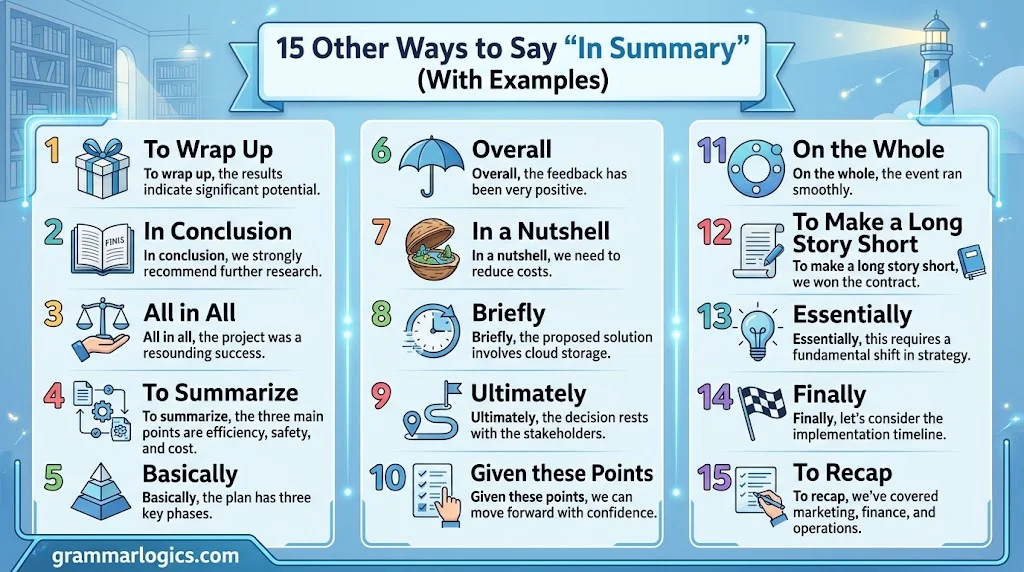
When writing or speaking, choosing the right words helps make your message clearer and more effective. “In summary” is a useful phrase for reviewing key points, concluding discussions, and presenting important information.
Whether you are writing an essay, preparing a presentation, or ending a professional email, using different expressions can make your communication more natural and engaging. Exploring other ways to say “in summary” helps you avoid repetition while keeping your ideas organized. These alternatives allow you to summarize information clearly, connect your thoughts smoothly, and leave your readers with a strong understanding of your main message.
The phrase “in summary” is commonly used to bring together the most important ideas after a detailed explanation. However, repeating it throughout your writing can make your content sound predictable or less engaging. Using alternatives such as “to sum up,” “in conclusion,” “overall,” and “to put it briefly” can improve the flow of your sentences and make your message more interesting. Each expression has its own tone and purpose, making some better suited to academic writing, business communication, or casual conversations. Learning these alternatives will help you write more confidently, express your ideas effectively, and create clear, polished content for different audiences.
What Does “In Summary” Mean?
“In summary” is a phrase used to present the main points of a discussion, explanation, report, or piece of writing in a shorter form. It signals that the speaker or writer is bringing together important information without repeating every detail. For example, a student might use it to review the key ideas of an essay, while a manager might use it to highlight the main findings of a meeting. The expression is generally neutral, clear, and professional, making it suitable for both spoken and written communication. It can also introduce a final conclusion, although its main purpose is to summarize information rather than introduce an entirely new idea.
Common Situations Where “In Summary” Is Used
People commonly use “in summary” when they want to make information easier to understand or remember. In academic writing, it can introduce a brief review of an argument or research topic. During workplace meetings, presentations, and business reports, it helps speakers highlight important decisions, findings, or next steps. Teachers may use it to review a lesson, while students can use it to bring an essay to a clear ending.
The phrase also works in emails, articles, and formal discussions when a concise recap is helpful. However, repeating it throughout a document can make the writing feel predictable. Alternatives such as “to sum up” or “overall” can create variety, while “in conclusion” may be more suitable when the writer is presenting a final judgment rather than simply reviewing information.
Is It Professional or Polite to Say “In Summary”?
Yes, “in summary” is professional, polite, and widely accepted in formal and semi-formal communication. It works particularly well in business reports, academic assignments, presentations, and emails that require a clear overview of previous information. The phrase is not rude or overly direct, and it helps signal a transition toward the main takeaway. In casual conversations, however, it may sound slightly formal depending on the situation. A phrase like “to sum it up” can feel more relaxed, while “the bottom line is” sounds more direct and emphasizes the most important point. The best expression depends on your audience, purpose, and desired tone.
Advantages and Disadvantages of Saying “In Summary”
Advantages
- Clear meaning: Readers immediately understand that a brief recap is coming.
- Professional tone: It fits academic, business, and formal writing.
- Better organization: It helps separate the main ideas from supporting details.
- Conciseness: It encourages writers to focus on the most important information.
- Versatility: It works in reports, presentations, essays, and discussions.
Disadvantages
- Repetition: Using the phrase too often can make writing sound predictable.
- Formality: It may feel stiff in relaxed conversations or friendly messages.
- Limited emphasis: It introduces a summary but does not necessarily highlight a final decision or recommendation.
- Less variety: Other expressions may better match the purpose, tone, or audience of a particular message.
15 Synonyms for “In Summary”
- To Sum Up
- In Conclusion
- To Summarize
- Overall
- In Short
- In Brief
- All in All
- To Put It Simply
- In a Nutshell
- To Recap
- Briefly
- On the Whole
- The Bottom Line Is
- In Essence
- Taking Everything into Account
1. To Sum Up
Meaning
“To sum up” means to bring together the most important points of a discussion or explanation. It is a natural alternative to “in summary” when you want to review information clearly.
Definition
A phrase used to present the main ideas of something in a concise form.
Detailed Explanation
“To sum up” is slightly more conversational than “in summary,” but it remains suitable for many professional situations. It tells the audience that you are about to highlight the essential information. The phrase works well at the end of a presentation, discussion, or explanation. It is especially useful when you want your final remarks to sound clear without being overly formal.
Scenario Examples
Scenario: A student finishes an essay about healthy habits.
Example: “To sum up, regular exercise and a balanced diet can improve overall well-being.”
Scenario: A team leader closes a project meeting.
Example: “To sum up, we have completed the first stage and will begin testing next week.”
Best Use
Use this phrase in presentations, essays, meetings, and everyday explanations when you want a clear and natural recap.
Tone
Tone: Clear, conversational, professional.
It sounds approachable while still being organized and purposeful.
2. In Conclusion
Meaning
“In conclusion” introduces the final thoughts or judgment of a discussion. It is closely related to “in summary,” but it often signals that the writer is bringing an argument or piece of writing to an end.
Definition
An expression used to introduce the final statement or concluding section of a discussion.
Detailed Explanation
“In conclusion” is more formal than many other alternatives on this list. It is especially common in academic essays, speeches, reports, and structured presentations. Unlike a simple recap, a conclusion may include the writer’s final interpretation or recommendation. Use it when you are genuinely ending an argument or discussion, rather than merely shortening a long explanation.
Scenario Examples
Scenario: A student completes an argumentative essay about public transportation.
Example: “In conclusion, investing in reliable public transportation can benefit both communities and the environment.”
Scenario: A speaker ends a formal presentation.
Example: “In conclusion, our findings support expanding the program next year.”
Best Use
Choose this expression for academic essays, formal reports, speeches, and persuasive writing.
Tone
Tone: Formal, authoritative, structured.
Its formal quality makes the ending feel deliberate and complete.
3. To Summarize
Meaning
“To summarize” means to explain the most important information in fewer words. It is a direct alternative when your main goal is to condense information rather than provide a final judgment.
Definition
A phrase used to introduce a shortened account of the essential points.
Detailed Explanation
“To summarize” is direct and practical, making it useful in both spoken and written English. It focuses attention on the main information rather than every supporting detail. The phrase can introduce a short recap in a meeting, lesson, report, or email. Compared with “in conclusion,” it does not necessarily suggest that the broader discussion is finished.
Scenario Examples
Scenario: A teacher reviews a lesson before students leave.
Example: “To summarize, photosynthesis allows plants to convert light energy into chemical energy.”
Scenario: A colleague explains a lengthy email thread.
Example: “To summarize, the client approved the design but requested changes to the delivery schedule.”
Best Use
Use it in educational explanations, business communication, reports, and detailed discussions that need a concise recap.
Tone
Tone: Neutral, direct, informative.
It communicates the purpose immediately without adding unnecessary formality.
4. Overall
Meaning
“Overall” expresses the general picture or main impression after considering several details. It can replace “in summary” when you want to give a broad assessment rather than list every point again.
Definition
A word used to describe the general result, impression, or situation when considered as a whole.
Detailed Explanation
“Overall” is concise and flexible, particularly when summarizing results or evaluating an experience. It often introduces a general judgment based on several factors. Unlike “in summary,” it does not always introduce a complete recap; it may simply communicate the speaker’s overall assessment. This makes it particularly useful in reviews, reports, and performance evaluations.
Scenario Examples
Scenario: An employee discusses a completed project.
Example: “Overall, the project went well, although we needed extra time to complete testing.”
Scenario: A customer shares feedback about a restaurant.
Example: “Overall, the service was excellent, and the food arrived quickly.”
Best Use
Use “overall” in reviews, evaluations, reports, presentations, and everyday conversations when expressing a general impression.
Tone
Tone: Balanced, neutral, reflective.
It leaves room for both positive and negative details without overstating either side.
5. In Short
Meaning
“In short” means that you are expressing the main idea in a brief and simple way. It is useful when a detailed explanation can be reduced to one important point.
Definition
An expression that introduces a concise statement of the essential meaning or result.
Detailed Explanation
“In short” is a compact expression that helps readers focus on the central message. It often works well after a longer explanation, especially when you want to make a complicated subject easier to understand. The phrase is less formal than “in conclusion” and can sound natural in both writing and conversation. It may simplify the message more aggressively than “in summary,” so make sure the shorter statement preserves the intended meaning.
Scenario Examples
Scenario: A friend explains why they changed jobs.
Example: “In short, I wanted more flexibility and better opportunities to learn.”
Scenario: A presenter explains a complicated business problem.
Example: “In short, our costs increased faster than our revenue.”
Best Use
Choose “in short” for concise explanations, emails, presentations, and casual discussions.
Tone
Tone: Concise, accessible, straightforward.
It helps make the central point easy to grasp.
6. In Brief
Meaning
“In brief” means presenting the essential information in a limited amount of space or time. It is useful when you need a short overview of a larger subject.
Definition
A phrase indicating that information will be presented briefly, with only the main details included.
Detailed Explanation
“In brief” sounds polished and slightly formal, making it appropriate for professional documents and structured explanations. It emphasizes brevity and encourages the reader to focus on the key facts. Although it is similar to “in short,” it often feels more suitable for written communication. It does not automatically signal a final conclusion, so it can appear near the beginning of an overview as well as toward the end of a discussion.
Scenario Examples
Scenario: A project manager introduces a report’s key findings.
Example: “In brief, customer satisfaction improved, but response times still need attention.”
Scenario: A student explains a historical event during class.
Example: “In brief, the agreement ended the conflict and established new trade rules.”
Best Use
Use it in executive summaries, reports, academic explanations, and professional emails.
Tone
Tone: Polished, concise, professional.
Its restrained wording suits situations where clarity and efficiency matter.
7. All in All
Meaning
“All in all” expresses a general judgment after considering the different parts of a situation. It is particularly useful when you want to reflect on an experience as a whole.
Definition
An expression used to give an overall opinion or assessment after considering several factors.
Detailed Explanation
“All in all” is warmer and more conversational than “in summary.” It often introduces a balanced final impression of an event, experience, or decision. The expression is especially useful when the situation had both advantages and disadvantages. Unlike a strictly factual summary, it frequently communicates the speaker’s personal evaluation.
Scenario Examples
Scenario: A friend describes a weekend trip with a few minor problems.
Example: “All in all, we had a wonderful weekend despite the rainy weather.”
Scenario: A team member reflects on a demanding project.
Example: “All in all, the project was challenging, but we learned a lot from it.”
Best Use
Use “all in all” in personal reflections, reviews, informal reports, and everyday conversation.
Tone
Tone: Friendly, reflective, balanced.
It sounds natural when expressing an overall impression rather than presenting strictly formal findings.
8. To Put It Simply
Meaning
“To put it simply” means explaining an idea in easier language so that it is more accessible. It can replace “in summary” when the goal is to simplify the main message rather than merely shorten it.
Definition
A phrase used to introduce a straightforward explanation of an idea.
Detailed Explanation
This expression focuses on simplicity and understanding, not just brevity. It is especially helpful when discussing technical subjects, complicated instructions, or unfamiliar concepts. Compared with “in summary,” it suggests that the next statement will make the information easier to understand. Be careful not to use it in a way that sounds dismissive, especially when explaining a subject to an expert or someone who already understands it.
Scenario Examples
Scenario: A teacher explains a difficult scientific concept.
Example: “To put it simply, gravity is the force that attracts objects toward one another.”
Scenario: A consultant explains a business decision to a new client.
Example: “To put it simply, we need to reduce unnecessary expenses before expanding.”
Best Use
Choose this phrase for teaching, customer communication, presentations, and explanations of complex ideas.
Tone
Tone: Helpful, accessible, explanatory.
It signals an effort to make information easier to follow.
9. In a Nutshell
Meaning
“In a nutshell” means expressing the main idea in a very short and memorable way. It is a casual alternative that often introduces a simplified version of a longer explanation.
Definition
An informal expression used to communicate the essential point in very few words.
Detailed Explanation
“In a nutshell” is more conversational than “in summary” and is common in everyday speech, informal writing, and friendly messages. It helps the listener focus on the central takeaway without going through every detail. The expression can make a message sound approachable, but it may be too casual for some formal reports or academic assignments. It is best when the main idea can be condensed without losing important qualifications.
Scenario Examples
Scenario: A friend asks what happened during a long meeting.
Example: “In a nutshell, we agreed to postpone the launch until the new features are ready.”
Scenario: A colleague explains a complicated proposal informally.
Example: “In a nutshell, we’re investing more now to save time later.”
Best Use
Use it in casual conversations, informal presentations, blog posts, and friendly emails.
Tone
Tone: Casual, approachable, conversational.
It makes a brief explanation feel less formal and more engaging.
10. To Recap
Meaning
“To recap” means to review the important points that have already been discussed. It is especially useful when you want to remind an audience of information before moving to the next step.
Definition
A phrase used to repeat or review the key details of a previous discussion.
Detailed Explanation
“To recap” is a practical alternative to “in summary,” particularly in meetings, lessons, and presentations. It emphasizes revisiting previously shared information rather than offering a new interpretation. The expression is common in professional speech and is also suitable for informal conversations. It works particularly well before action items, reminders, or a final review of decisions.
Scenario Examples
Scenario: A manager finishes discussing tasks with the team.
Example: “To recap, Maria will handle the design, and James will prepare the client report.”
Scenario: A tutor reviews the main points before an exam.
Example: “To recap, remember the three stages of the process and how they connect.”
Best Use
Choose “to recap” for meetings, training sessions, classroom discussions, presentations, and follow-up emails.
Tone
Tone: Practical, organized, professional.
It helps everyone remember the key information and understand what happens next.
11. Briefly
Meaning
“Briefly” means using only a few words or a limited amount of time to communicate information. It can introduce a short overview or signal that an explanation will be concise.
Definition
An adverb meaning in a short or concise manner.
Detailed Explanation
“Briefly” is a flexible word that can fit naturally into formal and informal sentences. Unlike “in summary,” it does not always introduce a concluding statement; it can describe how information is presented at any point. For example, a speaker may briefly explain the background before discussing the details. This makes it useful when the emphasis is on the length of the explanation rather than the ending of a discussion.
Scenario Examples
Scenario: A speaker introduces the background of a project.
Example: “Briefly, the project began last year to improve access to local services.”
Scenario: A colleague asks for a quick update.
Example: “I’ll briefly explain the changes before we review the new schedule.”
Best Use
Use “briefly” in reports, presentations, emails, introductions, and concise explanations.
Tone
Tone: Neutral, efficient, professional.
It communicates that the explanation will be short without necessarily implying that the discussion is ending.
12. On the Whole
Meaning
“On the whole” means considering all the relevant parts of a situation before making a general judgment. It is useful when the overall result matters more than individual details.
Definition
An expression used to describe a general assessment after considering the situation as a whole.
Detailed Explanation
“On the whole” is similar to “overall,” but it often sounds a little more reflective and measured. It is useful when an evaluation includes both strengths and weaknesses. Rather than simply repeating the main points, the phrase helps express a balanced conclusion based on those details. It is suitable for thoughtful reviews, formal discussions, and written evaluations.
Scenario Examples
Scenario: A teacher evaluates a student’s progress during the semester.
Example: “On the whole, your writing has improved, although your paragraph structure needs more attention.”
Scenario: A team reviews a new working arrangement.
Example: “On the whole, the new schedule has helped us collaborate more effectively.”
Best Use
Choose this expression for evaluations, reviews, reports, and balanced discussions.
Tone
Tone: Measured, thoughtful, balanced.
It suggests that the judgment takes several factors into account.
13. The Bottom Line Is
Meaning
“The bottom line is” introduces the most important point, result, or practical conclusion. It is a useful alternative when the audience needs to understand what matters most.
Definition
An expression used to emphasize the essential fact or main conclusion of a situation.
Detailed Explanation
This phrase is more direct than “in summary” because it highlights the key takeaway rather than simply reviewing information. It is common in business discussions, negotiations, and everyday conversations about decisions or results. It can also sound firm or blunt if the surrounding language is too forceful. Use it when you want to make the practical implication clear, especially after explaining several details.
Scenario Examples
Scenario: A manager explains why a project deadline must change.
Example: “The bottom line is that we need two more days to test the software properly.”
Scenario: A friend asks whether an expensive purchase is worthwhile.
Example: “The bottom line is that you should buy it only if it fits your budget.”
Best Use
Use it in business communication, decision-making discussions, negotiations, and direct explanations.
Tone
Tone: Direct, decisive, practical.
It draws attention to the central point and often emphasizes action or consequences.
14. In Essence
Meaning
“In essence” means expressing the fundamental nature or central idea of something without including every detail. It is a useful choice when you want to focus on the underlying meaning.
Definition
A phrase used to introduce the essential nature or core meaning of an idea.
Detailed Explanation
“In essence” is more analytical than “in summary.” It suggests that the speaker is identifying what matters at the deepest or most basic level, rather than listing all the main points. The phrase is appropriate in academic writing, professional discussions, and explanations of abstract ideas. Because it emphasizes the core meaning, it should not be used when important details or exceptions are necessary to understand the subject accurately.
Scenario Examples
Scenario: A lecturer explains the purpose of a new policy.
Example: “In essence, the policy aims to make public services more accessible.”
Scenario: A consultant explains a company’s new strategy.
Example: “In essence, the strategy focuses on serving existing customers more effectively.”
Best Use
Choose “in essence” for analytical writing, formal explanations, strategy discussions, and conceptual summaries.
Tone
Tone: Thoughtful, analytical, polished.
It gives the impression that the speaker has identified the central idea beneath the details.
15. Taking Everything into Account
Meaning
“Taking everything into account” means considering all the important facts, circumstances, and possible outcomes before reaching an overall judgment. It is useful when a conclusion depends on several factors.
Definition
A phrase used to introduce a judgment made after considering all relevant information.
Detailed Explanation
This expression is longer and more reflective than “in summary.” It emphasizes the process of weighing different factors before reaching a conclusion. It works particularly well when the information includes competing advantages, disadvantages, risks, or priorities. Unlike a simple recap, it suggests that the final statement is based on an assessment of the evidence rather than merely a repetition of previous points.
Scenario Examples
Scenario: A family decides whether to move to a new city.
Example: “Taking everything into account, moving closer to work would make daily life easier for us.”
Scenario: A project team evaluates whether to continue a trial program.
Example: “Taking everything into account, the benefits justify extending the trial for another month.”
Best Use
Use it in evaluations, decision-making, recommendations, formal discussions, and thoughtful written conclusions.
Tone
Tone: Considered, balanced, deliberate.
It communicates that the conclusion follows from weighing the relevant circumstances.
FAQs
What is another way to say “in summary”?
Some common alternatives are “to sum up,” “in short,” “overall,” “to summarize,” and “in brief.” The best choice depends on whether you want to recap information, express a general assessment, or bring an argument to an end.
What does “in summary” mean?
“In summary” means presenting the main points of information in a shorter form. It helps readers or listeners understand the essential message without reviewing every detail.
Is “in summary” professional?
Yes. “In summary” is professional and appropriate for reports, presentations, academic writing, and workplace communication. It is generally clear and neutral, although a more conversational phrase may suit an informal discussion better.
What is a more casual way to say “in summary”?
“In a nutshell,” “all in all,” and “to sum it up” can sound more conversational. For example, you could say, “In a nutshell, we need more time to finish the project.”
Which alternative works best in formal communication?
“In conclusion,” “in brief,” and “to summarize” are strong options for formal communication. Use “in conclusion” when ending an argument, “in brief” when presenting a concise overview, and “to summarize” when reviewing important information.
Conclusion
Choosing the right alternative to “in summary” can make your writing clearer, more engaging, and better suited to your audience. Expressions such as “to sum up” and “to recap” work well when reviewing information, while “in conclusion” is often better for ending an argument or formal presentation.
If you want to express a general judgment, “overall” or “on the whole” may be more natural. For a direct takeaway, “the bottom line is” can communicate the main point clearly. Remember that similar phrases do not always serve exactly the same purpose. Consider your audience, the context, and the message you want to communicate before choosing your wording. The best expression is the one that conveys your main idea accurately and naturally.