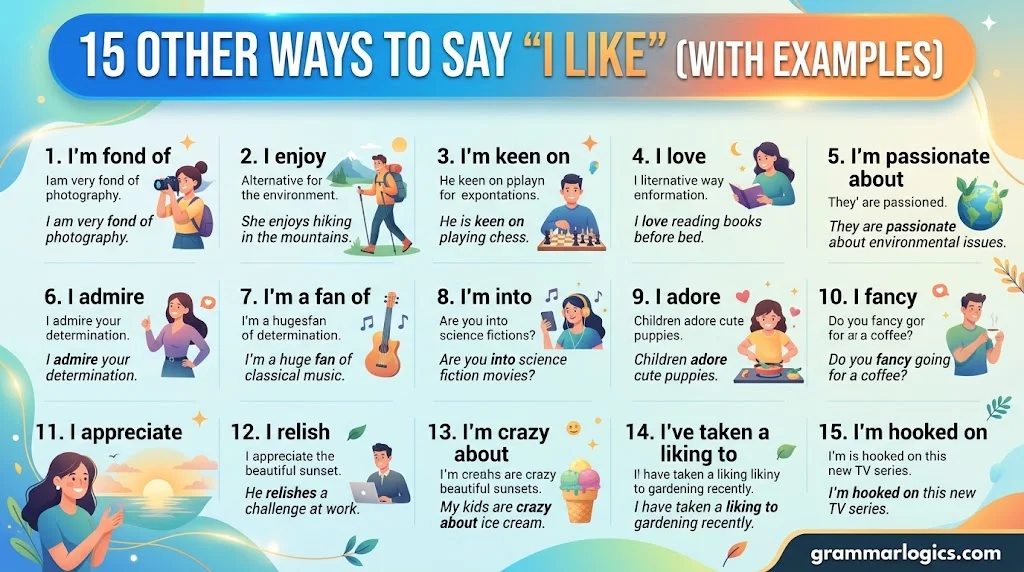
Finding the right words to express your feelings can make everyday conversations more natural, clear, and meaningful. Learning other ways to say “I like” helps you share your interests and opinions with greater confidence.
Whether you are talking about your favorite food, appreciating someone’s work, or expressing your feelings, the phrase “I like” is simple and useful. However, using the same expression repeatedly can make your communication sound less engaging. Exploring different phrases allows you to express appreciation, enjoyment, and admiration more naturally in conversations, emails, and writing.
In this article, you will discover 15 other ways to say “I like”, along with clear meanings and practical examples to help you use each expression correctly. From casual conversations with friends to professional discussions, these alternatives will help you communicate your preferences more effectively. You will also learn which phrases sound friendly, enthusiastic, or formal, making it easier to choose the right words for different situations. By expanding your vocabulary, you can express your thoughts with greater variety and make your English sound more confident, fluent, and engaging.
What Does “I Like” Mean?
“I like” means that you enjoy, appreciate, prefer, or feel positively about someone or something. It is one of the most common expressions in English and can describe many feelings, from enjoying a particular food to appreciating someone’s personality or showing romantic interest. For example, saying “I like this song” means the song gives you pleasure, while “I like your ideas” expresses appreciation for someone’s thoughts. The exact meaning depends on the context and the words that follow it. In personal relationships, “I like you” can express affection or interest, although it does not always mean romantic attraction. The phrase is flexible, simple, and suitable for both spoken and written English.
Common Situations Where “I Like” Is Used
People use “I like” in everyday conversations, text messages, social media posts, school discussions, workplace communication, and personal relationships. You might say, “I like your presentation” to compliment a colleague, “I like reading before bed” to describe a hobby, or “I like the way you think” to appreciate someone’s perspective. The expression is also useful when discussing preferences, recommending something, or explaining what makes an experience enjoyable.
However, repeating the same phrase can sometimes make your communication sound less expressive. Choosing alternatives such as “I enjoy,” “I appreciate,” or “I’m fond of” lets you communicate more precisely. For example, “I appreciate” emphasizes value or gratitude, while “I’m fond of” often suggests a warmer, more personal attachment. The best choice depends on what you like and how you want your message to sound.
Is It Professional or Polite to Say “I Like”?
Yes, “I like” is generally polite, natural, and appropriate in professional and casual settings. At work, you can say, “I like your approach to this project,” or “I like this proposal because it addresses the main problem.” These sentences communicate a positive opinion without sounding overly formal. In emails and meetings, however, alternatives such as “I appreciate your suggestion” or “I find this approach effective” may communicate appreciation or professional judgment more precisely.
In personal conversations, “I like” sounds friendly and straightforward. It can express enjoyment, approval, or affection, depending on the context. In romantic situations, “I like you” may feel sincere but relatively understated. Expressions such as “I’m attracted to you” communicate a more specific kind of interest. Rather than assuming one phrase is always better, consider your relationship with the listener and the feeling you want to express.
Advantages and Disadvantages of Saying “I Like”
Advantages
- Simple and clear: Most English speakers understand the expression immediately.
- Versatile: It works for hobbies, food, entertainment, opinions, people, and experiences.
- Friendly and natural: It fits everyday conversation without sounding stiff.
- Easy for learners: Its basic structure is straightforward and widely useful.
- Suitable for many settings: It can be used in casual messages, classroom discussions, and professional conversations.
Disadvantages
- Limited emotional detail: “I like it” may not communicate strong enthusiasm or deep appreciation.
- Can become repetitive: Using the same phrase repeatedly may make writing less engaging.
- Sometimes vague: “I like you” can mean friendship, affection, or romantic interest.
- May understate your feelings: If you love an activity or strongly admire someone’s work, a stronger expression may be more accurate.
- Not always the most precise choice: In formal communication, “I appreciate” or “I recommend” may better express your intended meaning.
15 Synonyms and Alternatives for “I Like”
- I Enjoy
- I Love
- I’m Fond Of
- I Appreciate
- I’m Into
- I Have a Soft Spot for
- I Admire
- I’m a Fan of
- I Prefer
- I’m Interested in
- I Have a Taste for
- I Think Highly of
- I Get a Lot of Enjoyment From
- I Find It Appealing
- It Appeals to Me
1. I Enjoy
Meaning
“I enjoy” means that something gives you pleasure, satisfaction, or a positive experience. It is particularly useful when talking about activities, hobbies, experiences, and things you regularly do for pleasure.
Definition
To enjoy something means to take pleasure or satisfaction in doing it or experiencing it.
Detailed Explanation
“I enjoy” is a natural alternative when you want to emphasize the experience of doing something rather than simply expressing a general preference. It often sounds slightly more descriptive than “I like.” You can use it for activities such as reading, traveling, cooking, or learning new skills. However, it is less natural than “I like” in certain expressions of personal attraction, such as “I enjoy you.”
Scenario Examples
- Scenario: Talking about a weekend hobby.
Example: “I enjoy gardening because it helps me relax after a busy week.” - Scenario: Discussing professional development.
Example: “I enjoy working with people who bring fresh ideas to the team.” - Scenario: Sharing a reading preference.
Example: “I enjoy mystery novels with unexpected endings.”
Best Use
Use “I enjoy” when discussing activities, experiences, hobbies, and work you find satisfying. It works well in conversation, personal writing, and professional discussions.
Tone
Tone: Friendly, natural, and slightly descriptive. It expresses pleasure without necessarily suggesting intense enthusiasm.
2. I Love
Meaning
“I love” expresses a strong positive feeling toward someone or something. Depending on the context, it can communicate enthusiasm, deep affection, or intense enjoyment.
Definition
To love something or someone means to feel very strong affection for them or to enjoy something greatly.
Detailed Explanation
“I love” is stronger than “I like” and should be used when you genuinely want to communicate greater enthusiasm or affection. It works naturally with favorite activities, foods, places, and creative work. In personal relationships, it can express deep emotional attachment, so its meaning depends heavily on the subject and situation. Using it for something ordinary can also be a casual way to show excitement rather than a serious declaration of deep feeling.
Scenario Examples
- Scenario: Recommending a favorite restaurant.
Example: “I love the homemade pasta at that little Italian restaurant.” - Scenario: Praising a friend’s creative project.
Example: “I love the colors you chose for this painting.” - Scenario: Expressing affection to a partner.
Example: “I love how you always make time for the people you care about.”
Best Use
Choose “I love” when you want to communicate strong enthusiasm, affection, or enjoyment. Avoid it when a simple, neutral preference would better reflect your feelings.
Tone
Tone: Enthusiastic, affectionate, and expressive. It communicates a stronger feeling than the original phrase.
3. I’m Fond Of
Meaning
“I’m fond of” means that you have a warm feeling toward someone or something. It can suggest affection, familiarity, or a lasting personal preference.
Definition
To be fond of someone or something means to feel affection for them or to enjoy them in a warm, familiar way.
Detailed Explanation
This expression often sounds gentler and more understated than “I love.” It is useful when describing people, animals, places, or activities that hold a special place in your life. For example, “I’m fond of old movies” suggests an established preference, while “I’m fond of her” communicates affection without necessarily implying romance. Because it can sound slightly more traditional than everyday alternatives, it may feel especially natural in thoughtful conversation or personal writing.
Scenario Examples
- Scenario: Talking about childhood memories.
Example: “I’m fond of the little town where I spent my summers.” - Scenario: Describing a family pet.
Example: “My grandfather is particularly fond of his old dog.” - Scenario: Sharing a reading preference.
Example: “I’m fond of historical novels that bring the past to life.”
Best Use
Use “I’m fond of” for warm preferences, personal attachments, and gentle expressions of affection.
Tone
Tone: Warm, gentle, and slightly traditional. It conveys affection without sounding overly intense.
4. I Appreciate
Meaning
“I appreciate” means that you recognize the value, quality, effort, or importance of something. It can express positive judgment, gratitude, or respect.
Definition
To appreciate something means to recognize its worth or feel grateful for it.
Detailed Explanation
“I appreciate” is especially useful when “I like” feels too general or casual. At work, it can acknowledge someone’s effort, a helpful suggestion, or a thoughtful decision. In personal communication, it can show gratitude for someone’s kindness or support. Unlike “I enjoy,” it does not necessarily mean that something gives you pleasure; instead, it emphasizes its value or the importance you attach to it.
Scenario Examples
- Scenario: Thanking a colleague for assistance.
Example: “I appreciate the time you took to explain the new process.” - Scenario: Responding to a thoughtful gesture.
Example: “I really appreciate you checking in on me.” - Scenario: Giving feedback on a proposal.
Example: “I appreciate the practical approach you’ve taken to solve this issue.”
Best Use
Choose “I appreciate” for professional communication, gratitude, thoughtful feedback, and recognizing someone’s effort.
Tone
Tone: Respectful, considerate, and professional. It can also feel warm and personal when used sincerely.
5. I’m Into
Meaning
“I’m into” means that you are interested in, enthusiastic about, or actively enjoy something. It is common in informal conversations, especially when discussing hobbies, music, entertainment, or personal interests.
Definition
To be into something means to have a strong interest in it or enjoy it regularly.
Detailed Explanation
This expression is more casual than “I enjoy” and often suggests an active interest rather than a simple positive opinion. For instance, “I’m into photography” implies that photography is an interest or hobby. It can also refer to romantic attraction, as in “I’m into him,” although this use is informal. Because of its conversational style, it is generally better suited to messages and everyday speech than formal business writing.
Scenario Examples
- Scenario: Meeting someone with similar hobbies.
Example: “I’m really into hiking and exploring new trails.” - Scenario: Discussing music with a friend.
Example: “I’m into jazz lately. Do you know any good artists?” - Scenario: Talking about romantic interest with a close friend.
Example: “I think I’m into him, but I’m not sure if he feels the same way.”
Best Use
Use “I’m into” for casual conversations about interests, hobbies, entertainment, and informal romantic attraction.
Tone
Tone: Casual, relaxed, and enthusiastic. It sounds conversational rather than formal.
6. I Have a Soft Spot for
Meaning
“I have a soft spot for” means that you feel a particular affection or fondness for someone or something. It often suggests a personal weakness for a favorite thing or a special emotional connection.
Definition
To have a soft spot for someone or something means to feel unusually warm or affectionate toward them.
Detailed Explanation
This expression communicates more emotional warmth than a simple statement of preference. It is often used for people, animals, nostalgic places, favorite treats, or things that make you feel sentimental. Saying “I have a soft spot for old cartoons” suggests that they bring you particular pleasure or happy memories. It is not a formal synonym for every use of “I like,” because its meaning includes a sense of special affection.
Scenario Examples
- Scenario: Explaining why you help stray animals.
Example: “I have a soft spot for stray cats, so I always leave food outside.” - Scenario: Talking about a favorite childhood treat.
Example: “I have a soft spot for homemade chocolate cookies.” - Scenario: Describing a memorable place.
Example: “I have a soft spot for the village where my grandparents lived.”
Best Use
Use this phrase when you want to express special affection, nostalgia, or a sentimental preference.
Tone
Tone: Affectionate, personal, and slightly sentimental. It suggests an emotional connection beyond ordinary enjoyment.
7. I Admire
Meaning
“I admire” means that you respect someone or something because of its qualities, achievements, character, or abilities.
Definition
To admire means to regard someone or something with respect, approval, or appreciation.
Detailed Explanation
“I admire” is more specific than “I like” because it highlights respect rather than simple enjoyment. You might admire a person’s honesty, a colleague’s dedication, or an artist’s skill. It can communicate genuine appreciation without suggesting that you personally enjoy spending time with someone. This distinction makes it particularly useful when complimenting character, effort, courage, or professional ability.
Scenario Examples
- Scenario: Complimenting a hardworking colleague.
Example: “I admire how calmly you handle difficult situations.” - Scenario: Talking about a public figure.
Example: “I admire her commitment to helping young students.” - Scenario: Encouraging a friend.
Example: “I admire your courage in starting something new.”
Best Use
Choose “I admire” for respectful compliments, professional feedback, and expressing appreciation for someone’s qualities or achievements.
Tone
Tone: Respectful, sincere, and appreciative. It emphasizes the qualities you value rather than simply stating a preference.
8. I’m a Fan of
Meaning
“I’m a fan of” means that you enjoy, support, or have a strong interest in someone or something. It is particularly common when discussing entertainment, sports, artists, brands, or particular styles.
Definition
To be a fan of something means to enjoy or support it, often with enthusiasm.
Detailed Explanation
This expression often suggests more than a passing preference, especially when discussing a musician, sports team, author, or television series. For example, “I’m a fan of her music” means you enjoy her work, while “I’m a fan of this proposal” communicates approval in a more figurative sense. It is conversational and flexible, but it may sound less precise in formal reports or detailed professional evaluations. The expression focuses on enthusiasm or support rather than emotional intimacy.
Scenario Examples
- Scenario: Discussing a favorite singer.
Example: “I’m a big fan of her acoustic performances.” - Scenario: Talking about a sports team.
Example: “I’m a fan of the local team, even when they have a difficult season.” - Scenario: Sharing an opinion at work.
Example: “I’m a fan of this design because it makes the information easier to follow.”
Best Use
Use “I’m a fan of” for entertainment, sports, personal interests, and informal expressions of approval.
Tone
Tone: Friendly, enthusiastic, and conversational. It suggests active enjoyment or support.
9. I Prefer
Meaning
“I prefer” means that you like one option more than another. It is useful when expressing a choice, comparing alternatives, or explaining personal preferences.
Definition
To prefer something means to consider it better or more desirable than another available option.
Detailed Explanation
Unlike “I like,” which can simply express a positive feeling, “I prefer” usually implies a comparison or choice. For example, “I prefer tea” often suggests that tea is your choice over coffee or another drink. It can sound more decisive and precise when discussing work arrangements, travel plans, or everyday decisions. However, if you only want to compliment something without comparing it to anything else, “I like” may be more natural.
Scenario Examples
- Scenario: Choosing a drink at a café.
Example: “I prefer green tea because it has a lighter flavor.” - Scenario: Discussing a work schedule.
Example: “I prefer morning meetings so I can focus on other tasks later.” - Scenario: Planning a weekend trip.
Example: “I prefer quiet destinations where we can spend time outdoors.”
Best Use
Choose “I prefer” when comparing choices, stating preferences clearly, or making decisions in casual or professional settings.
Tone
Tone: Clear, practical, and moderately direct. It communicates a choice rather than just general enjoyment.
10. I’m Interested in
Meaning
“I’m interested in” means that something attracts your attention or that you want to learn more about it, explore it, or become involved with it.
Definition
To be interested in something means to feel curious about it or want to know more about it.
Detailed Explanation
This phrase is useful when you want to express curiosity, willingness, or potential involvement rather than simple enjoyment. Saying “I’m interested in photography” may mean that you want to learn photography, even if you are still a beginner. In professional communication, “I’m interested in the position” expresses a serious intention to consider or pursue an opportunity. The phrase can also refer to romantic interest, but it does not automatically mean affection or attraction in every context.
Scenario Examples
- Scenario: Exploring a new hobby.
Example: “I’m interested in learning how to make short films.” - Scenario: Applying for a job.
Example: “I’m interested in the position and would welcome the opportunity to discuss it.” - Scenario: Considering a course.
Example: “I’m interested in taking a course that will improve my writing skills.”
Best Use
Use “I’m interested in” for curiosity, learning, professional opportunities, and situations where you want to explore something further.
Tone
Tone: Thoughtful, neutral, and purposeful. It communicates attention or intention without claiming strong enjoyment.
11. I Have a Taste for
Meaning
“I have a taste for” means that you enjoy or have a particular preference for a certain type of thing. It is especially natural when discussing food, drinks, art, music, or distinctive styles.
Definition
To have a taste for something means to enjoy or prefer a particular kind of experience, flavor, or style.
Detailed Explanation
This expression is more specific than the general phrase “I like” and often describes a recognizable preference. For example, “I have a taste for spicy food” identifies a particular flavor preference. When used for music, art, or literature, it can suggest a personal style or refined interest. It is not equally natural with every noun, so expressions such as “I have a taste for my colleague” would generally sound inappropriate when expressing personal affection.
Scenario Examples
- Scenario: Discussing food preferences.
Example: “I have a taste for spicy dishes, especially when the weather is cold.” - Scenario: Talking about interior design.
Example: “She has a taste for simple furniture and natural materials.” - Scenario: Describing a reading preference.
Example: “I have a taste for historical fiction with realistic characters.”
Best Use
Use this phrase for food preferences, artistic interests, and particular styles or types of entertainment.
Tone
Tone: Descriptive, personal, and sometimes slightly sophisticated. It highlights a distinctive preference.
12. I Think Highly of
Meaning
“I think highly of” means that you have a strong positive opinion of someone, often because you respect their character, abilities, or judgment.
Definition
To think highly of someone means to hold them in high regard or have a favorable opinion of them.
Detailed Explanation
This phrase is more focused on respect and reputation than ordinary enjoyment. You might think highly of a colleague because they are reliable, or of a teacher because they explain difficult subjects clearly. It is particularly useful when describing your opinion of a person in a thoughtful or professional way. Although it can communicate admiration, it is not generally used to express a simple preference for food, music, or activities.
Scenario Examples
- Scenario: Recommending a former colleague.
Example: “I think highly of Daniel because he always follows through on his commitments.” - Scenario: Discussing a teacher.
Example: “Many students think highly of their instructor’s patience and fairness.” - Scenario: Giving a professional reference.
Example: “I think highly of her judgment and would trust her to lead the project.”
Best Use
Choose “I think highly of” when expressing respect, confidence in someone’s abilities, or a favorable opinion of a person.
Tone
Tone: Respectful, considered, and professional. It conveys esteem rather than casual enjoyment.
13. I Get a Lot of Enjoyment From
Meaning
“I get a lot of enjoyment from” means that an activity or experience gives you considerable pleasure or satisfaction.
Definition
To get enjoyment from something means to find it pleasurable or rewarding.
Detailed Explanation
This longer expression emphasizes the positive experience you receive from an activity. It can be useful when describing hobbies, volunteering, creative work, or tasks that feel rewarding. Compared with “I like,” it provides more detail about the satisfaction something brings into your life. It is less concise in everyday conversation, so a shorter alternative may work better in a quick text message.
Scenario Examples
- Scenario: Describing a creative hobby.
Example: “I get a lot of enjoyment from writing short stories in my free time.” - Scenario: Explaining a volunteering commitment.
Example: “I get a lot of enjoyment from helping children develop their reading skills.” - Scenario: Discussing a family activity.
Example: “We get a lot of enjoyment from cooking dinner together on Sundays.”
Best Use
Use this expression when you want to explain how an activity adds pleasure or satisfaction to your life, particularly in reflective conversations or personal writing.
Tone
Tone: Reflective, positive, and descriptive. It emphasizes the experience and its benefits.
14. I Find It Appealing
Meaning
“I find it appealing” means that something attracts your attention or seems attractive, interesting, or desirable.
Definition
To find something appealing means to consider it attractive or worth considering.
Detailed Explanation
This phrase is useful when explaining why an idea, design, proposal, or option attracts you. It can sound more analytical than “I like,” making it suitable for discussions where you want to evaluate something rather than simply express enthusiasm. For example, a flexible work schedule may appeal to you because it offers convenience. The phrase can refer to appearance, practical benefits, or general attractiveness, so the surrounding context helps clarify the reason.
Scenario Examples
- Scenario: Reviewing a website design.
Example: “I find the clean layout appealing because it makes the page easy to navigate.” - Scenario: Considering a job opportunity.
Example: “I find the flexible working hours appealing.” - Scenario: Discussing a travel destination.
Example: “I find the idea of staying in a quiet mountain cabin appealing.”
Best Use
Choose “I find it appealing” for evaluating ideas, designs, opportunities, and options in thoughtful or professional conversations.
Tone
Tone: Measured, thoughtful, and moderately formal. It expresses attraction or approval without sounding overly emotional.
15. It Appeals to Me
Meaning
“It appeals to me” means that something attracts your interest, matches your preferences, or seems desirable to you.
Definition
Something appeals to you when you find it attractive, interesting, or suitable for your tastes.
Detailed Explanation
This expression is similar to “I find it appealing,” but it places more emphasis on your personal response to something. It works well when discussing ideas, choices, activities, and lifestyles that suit your interests. For example, a quiet holiday may appeal to you because you prefer peaceful surroundings. It can sound more measured than “I love it,” and it does not necessarily imply that you have already tried or experienced the thing being discussed.
Scenario Examples
- Scenario: Choosing a holiday destination.
Example: “The idea of exploring small coastal towns appeals to me.” - Scenario: Discussing a new business idea.
Example: “Working on a smaller team appeals to me because I value close collaboration.” - Scenario: Considering a new hobby.
Example: “Learning pottery appeals to me because I’d enjoy making something by hand.”
Best Use
Use “It appeals to me” when expressing personal interest in an idea, opportunity, lifestyle, or option, especially before making a decision.
Tone
Tone: Thoughtful, calm, and slightly formal. It communicates a considered preference rather than strong excitement.
FAQs
What is another way to say “I Like”?
Another way to say “I like” is “I enjoy.” Other useful alternatives include “I appreciate,” “I’m fond of,” and “I’m a fan of.” The best choice depends on whether you want to express enjoyment, gratitude, affection, or enthusiasm.
What does “I Like” mean?
“I like” means that you enjoy, appreciate, prefer, or feel positively about someone or something. Its precise meaning depends on the context. For example, liking a hobby usually expresses enjoyment, while liking someone may communicate affection or personal interest.
Is “I Like” professional?
Yes, “I like” is generally acceptable in professional communication. It works well when giving straightforward feedback, such as “I like this approach.” In more formal situations, “I appreciate this suggestion” or “I find this approach effective” may communicate your point more precisely.
What is a more polite way to say “I Like”?
“I appreciate” is a useful alternative when you want to acknowledge someone’s effort, suggestion, or contribution politely. For example, “I appreciate your thoughtful recommendation” sounds respectful and specific. If you are talking about an activity, “I enjoy” may be more appropriate.
Which alternative works best in formal communication?
The best alternative depends on your purpose. “I appreciate” works well for acknowledging effort, “I find it appealing” suits thoughtful evaluations, and “I think highly of” expresses respect for a person. Choose the phrase that communicates your intended meaning rather than relying on formality alone.
Conclusion
Choosing the right expression can help you communicate your feelings more clearly and naturally. Although “I like” is useful in almost any everyday conversation, alternatives such as “I enjoy,” “I appreciate,” “I admire,” and “I’m fond of” offer different shades of meaning. Some phrases express enthusiasm, while others communicate respect, gratitude, curiosity, or a personal preference.
Understanding these differences helps you avoid repetition and choose words that fit your message. In professional settings, a precise expression can make feedback more constructive, while in personal conversations, a warmer phrase can make your feelings clearer. The next time you want to say “I like,” consider what you appreciate most and how you want the listener to feel. A thoughtful choice of words can make even a simple message more meaningful.