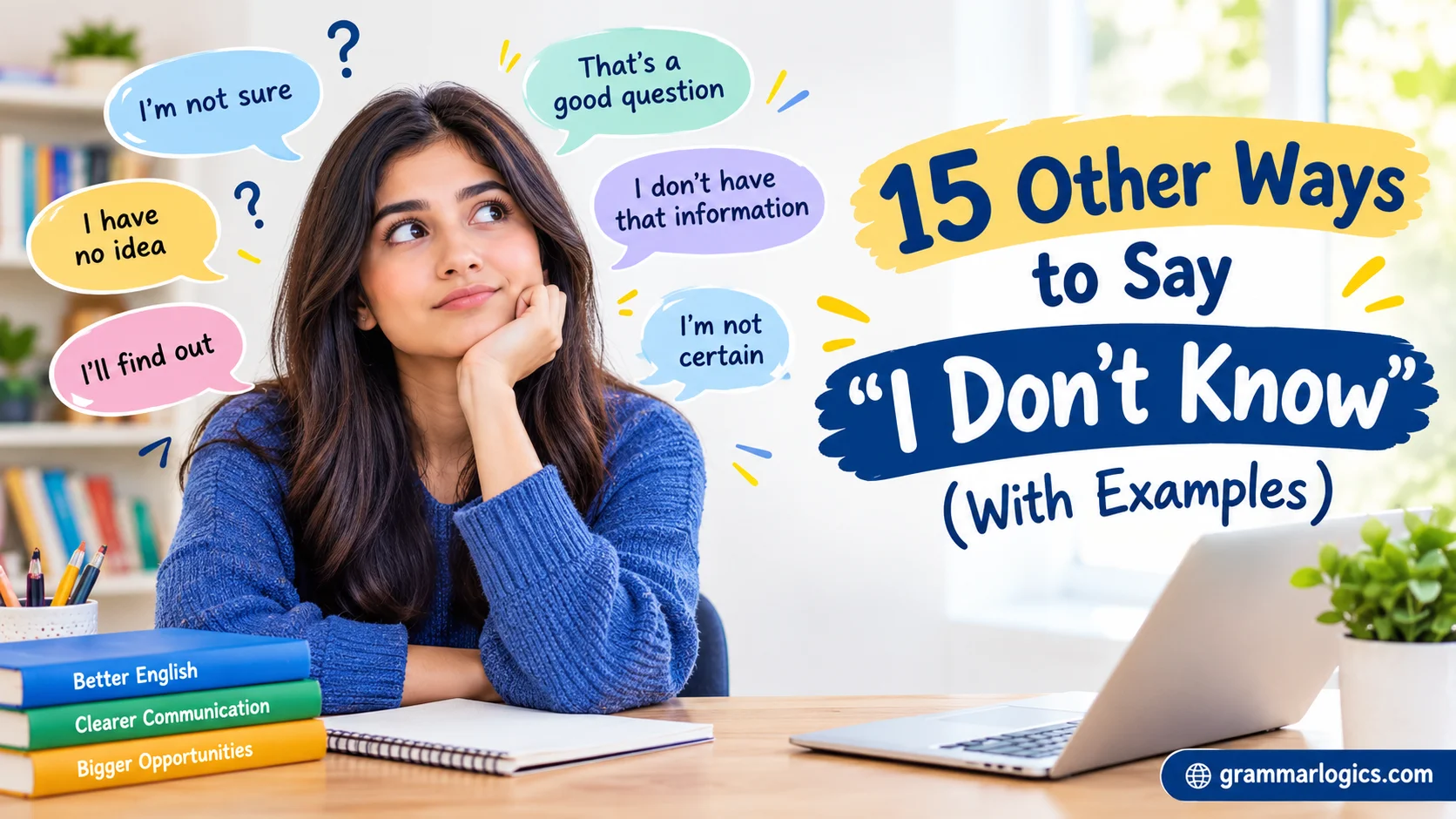
Sometimes, we do not have all the answers, and that is perfectly normal. Knowing other ways to say “I don’t know” can help you express uncertainty naturally, politely, and confidently in different situations.
Whether you are speaking with friends, writing emails, or communicating at work, choosing the right words can make your message sound more thoughtful and professional. Instead of repeating the same phrase, you can use expressions that better match your feelings and the situation. Some alternatives sound casual and friendly, while others show honesty, respect, or a willingness to find the answer
Learning different ways to express uncertainty can improve your English vocabulary, strengthen everyday conversations, and help you communicate more effectively. For example, saying “I’m not sure,” “I’ll find out,” or “I don’t have that information” can make your response sound more natural, depending on the context. These expressions allow you to be honest without sounding uninterested or unhelpful. They are especially useful in professional emails, classroom discussions, and everyday interactions where clear communication matters. With the right phrase, you can acknowledge what you do not know while showing confidence, politeness, and a willingness to learn.
What Does “I Don’t Know” Mean?
“I don’t know” means that someone does not have the information, answer, or understanding needed to respond to a question. It is a common English expression used when a person is uncertain about something, has not learned a particular fact, or cannot confidently explain a situation. For example, if someone asks what time a store closes and you have not checked its hours, you might say, “I don’t know what time it closes.” The phrase communicates a lack of knowledge or certainty, but it does not necessarily mean the speaker is unwilling to help. Depending on the speaker’s tone and the context, it can sound neutral, casual, honest, or slightly dismissive.
Common Situations Where “I Don’t Know” Is Used
People use “I don’t know” in many everyday situations. Friends may say it during casual conversations when discussing plans, movies, or personal decisions. Students use it when they cannot answer a question in class, while employees may use it when they are unsure about a project detail. It also appears in text messages, social media discussions, and personal conversations about difficult choices. In professional settings, the phrase can be appropriate when delivered honestly, especially if the speaker follows it with a plan to find the answer. However, alternatives such as “I’m not certain” or “Let me find out” can communicate uncertainty while showing professionalism, willingness, and initiative.
Is It Professional or Polite to Say “I Don’t Know”?
Yes, “I don’t know” can be both professional and polite because it is a straightforward way to acknowledge the limits of your knowledge. In the workplace, honesty is generally more useful than guessing or giving incorrect information. However, the expression may sound abrupt if it is delivered without explanation, particularly when a colleague or customer expects assistance. In these situations, adding a helpful response can make your message more constructive. For example, “I don’t know the answer right now, but I’ll check” sounds more supportive than simply saying, “I don’t know.” In formal emails, customer service, and important discussions, expressions such as “I’m not certain” or “I’ll need to verify that” may sound more polished. The best choice depends on your relationship with the listener and your willingness to help.
Advantages and Disadvantages of Saying “I Don’t Know”
Advantages
The biggest advantage of saying “I don’t know” is honesty. It prevents you from making assumptions, spreading incorrect information, or pretending to understand something you do not. The phrase is short, easy to understand, and appropriate for many everyday conversations. It can also encourage others to explain a topic or help you find the correct answer. In professional and academic environments, acknowledging uncertainty can demonstrate good judgment when accuracy matters.
Disadvantages
Although the expression is useful, it may sometimes sound abrupt, especially when someone expects guidance or assistance. Repeating it without offering an explanation or next step can make a speaker seem uninterested, even when that is not the intention. In customer communication or workplace discussions, it may also leave the listener uncertain about what will happen next. Choosing a more specific alternative can help you communicate whether you are unsure, need time to think, lack the necessary information, or intend to investigate the question.
Alternatives to “I Don’t Know”
- I’m not sure.
- I’m not certain.
- I have no idea.
- I’m unsure about that.
- I can’t say for sure.
- I’m not familiar with that.
- I don’t have that information.
- I’ll have to find out.
- Let me check.
- I’ll need to look into it.
- That’s a good question.
- I haven’t given it much thought.
- I’m still figuring that out.
- I couldn’t tell you.
- I wish I knew.
1. I’m Not Sure
Meaning
“I’m not sure” expresses uncertainty when you do not have a definite answer or cannot confidently make a decision. It is a softer alternative to “I don’t know.”
Definition
A polite expression used to communicate that you are uncertain about a fact, answer, or possibility.
Detailed Explanation
This phrase is useful when you have some information but cannot confirm whether it is correct. Compared with “I don’t know,” it often sounds less abrupt and more conversational. It can also communicate hesitation when discussing plans or making decisions. The expression does not automatically mean you lack all knowledge; it simply indicates that you are not confident enough to give a definite answer.
Scenario Examples
Scenario: A friend asks whether you will attend a birthday party.
Example: “I’m not sure yet. I’ll let you know tomorrow.”
Scenario: A classmate asks whether an assignment is due on Friday.
Example: “I’m not sure. We should check the class announcement.”
Scenario: A colleague asks whether a client has approved a proposal.
Example: “I’m not sure about the approval status, so I’ll confirm it.”
Best Use
Use this expression in casual conversations, workplace discussions, text messages, and situations where you want to acknowledge uncertainty politely.
Tone
Tone: Soft, neutral, conversational. It sounds less definite than “I don’t know” and leaves room for further discussion.
2. I’m Not Certain
Meaning
“I’m not certain” means you cannot confidently confirm a fact or conclusion. It is similar to “I’m not sure,” but it can sound slightly more formal.
Definition
A statement indicating that you do not have enough confidence to confirm something as true.
Detailed Explanation
This expression works well when accuracy matters and you want to avoid presenting an uncertain answer as a fact. It is suitable for professional conversations, careful explanations, and formal discussions. Unlike “I have no idea,” it does not suggest a complete lack of knowledge. Instead, it communicates that the available information may be incomplete or that further verification is needed.
Scenario Examples
Scenario: A manager asks whether a report includes the latest figures.
Example: “I’m not certain that it includes the latest figures. I’ll review the document.”
Scenario: Someone asks whether a historical event happened in a particular year.
Example: “I’m not certain of the exact year, so I’d prefer to verify it.”
Best Use
Choose this phrase for professional conversations, formal discussions, presentations, and situations where you want to be careful about accuracy.
Tone
Tone: Formal, measured, respectful. It emphasizes careful judgment rather than casual uncertainty.
3. I Have No Idea
Meaning
“I have no idea” communicates that you do not know the answer at all or have no useful information about a particular subject.
Definition
An informal expression indicating a complete or substantial lack of knowledge about something.
Detailed Explanation
This phrase is more emphatic than “I’m not sure.” It is common among friends and family, particularly when discussing unexpected events, mysteries, or everyday questions. Depending on your voice, it can sound humorous, surprised, or frustrated. Because it is more forceful, it may seem dismissive in a formal conversation if you do not add anything helpful.
Scenario Examples
Scenario: A friend asks where their missing keys might be.
Example: “I have no idea. Have you checked the kitchen counter?”
Scenario: Someone asks who will win an unpredictable competition.
Example: “I have no idea! Both teams are playing really well.”
Best Use
Use it in informal conversations, friendly text messages, and situations where you genuinely have no clue about the answer. Avoid it when a customer or colleague expects a careful professional response.
Tone
Tone: Casual, emphatic, sometimes playful. Its strength makes it more expressive than a neutral statement of uncertainty.
4. I’m Unsure About That
Meaning
“I’m unsure about that” indicates that you have doubts about a particular fact, suggestion, decision, or claim.
Definition
A statement expressing uncertainty or hesitation about a specific subject.
Detailed Explanation
This phrase directs attention to the particular issue you are discussing. It can be useful when you understand the general topic but question one detail or recommendation. In contrast with “I don’t know,” it may suggest that you have some knowledge but are not fully convinced. It can also express polite hesitation when responding to a suggestion without immediately agreeing or disagreeing.
Scenario Examples
Scenario: A coworker suggests changing a project deadline.
Example: “I’m unsure about that timeline because we still need approval from the design team.”
Scenario: A friend recommends an expensive purchase.
Example: “I’m unsure about that. Maybe we should compare a few options first.”
Best Use
Use this expression when discussing decisions, proposals, plans, or information that you want to examine more carefully.
Tone
Tone: Thoughtful, cautious, polite. It communicates hesitation without sounding unnecessarily confrontational.
5. I Can’t Say for Sure
Meaning
“I can’t say for sure” means you cannot give a definite answer because you lack confirmation or sufficient evidence.
Definition
An expression used when a person cannot confidently confirm whether something is true or will happen.
Detailed Explanation
This phrase is especially useful when a question involves predictions, possibilities, or incomplete information. It acknowledges that an answer may be possible without claiming certainty. Unlike “I have no idea,” it can imply that you have considered the situation but cannot make a reliable conclusion. It is also a natural way to avoid promising an outcome you cannot control.
Scenario Examples
Scenario: A friend asks whether the weather will improve before a picnic.
Example: “I can’t say for sure, but the forecast looks better for the afternoon.”
Scenario: A client asks whether a delivery will arrive before noon.
Example: “I can’t say for sure until the courier confirms the delivery window.”
Best Use
Choose this phrase for predictions, estimates, uncertain outcomes, and conversations where you want to avoid making a promise.
Tone
Tone: Careful, neutral, responsible. It sets a clear boundary around what you can confidently confirm.
6. I’m Not Familiar With That
Meaning
“I’m not familiar with that” means you have limited or no knowledge of a particular subject, product, process, or idea.
Definition
A polite expression used to explain that something is outside your current knowledge or experience.
Detailed Explanation
This expression is useful when someone mentions a topic you have not studied or encountered before. It sounds more professional than “I have no idea” because it focuses on your level of familiarity rather than dismissing the question. It does not necessarily mean the subject is impossible for you to understand; it simply indicates that you may need an explanation or some research. You can make the response more welcoming by expressing interest in learning about it.
Scenario Examples
Scenario: A colleague mentions a software tool you have never used.
Example: “I’m not familiar with that software. Could you show me how it works?”
Scenario: A friend recommends an unfamiliar author.
Example: “I’m not familiar with that author, but I’d be interested in reading one of their books.”
Best Use
Use it in workplace discussions, academic settings, professional introductions, and conversations about unfamiliar subjects.
Tone
Tone: Polite, professional, open-minded. It acknowledges a knowledge gap without suggesting unwillingness to learn.
7. I Don’t Have That Information
Meaning
“I don’t have that information” means you currently lack the specific facts or details needed to answer a question.
Definition
A direct statement explaining that the requested information is not available to you at the moment.
Detailed Explanation
This phrase is particularly useful when someone asks for a detail you cannot access immediately. It differs from “I don’t know” because it focuses on the availability of information, not necessarily your overall understanding. In a workplace or customer service setting, it can sound professional when paired with an offer to obtain the missing details. By itself, however, it may sound impersonal if the listener expects practical assistance.
Scenario Examples
Scenario: A customer asks for the exact date of a future product release.
Example: “I don’t have that information available right now, but I can check with our team.”
Scenario: A colleague asks for figures from a report you have not received.
Example: “I don’t have that information yet. Could you send me the latest report?”
Best Use
Use it for customer support, business communication, administrative questions, and situations involving specific facts or records.
Tone
Tone: Professional, factual, direct. It is most helpful when followed by a clear next step.
8. I’ll Have to Find Out
Meaning
“I’ll have to find out” means you do not know the answer yet, but you intend to investigate or ask someone who does.
Definition
A statement expressing that you need to obtain more information before answering a question.
Detailed Explanation
This expression shifts the conversation from uncertainty toward action. Rather than simply admitting that you lack an answer, you communicate that you plan to discover it. It can sound friendly in everyday conversations and responsible in the workplace. However, it implies an intention to follow up, so it is best used when you are genuinely willing and able to make the effort.
Scenario Examples
Scenario: A colleague asks whether a meeting room is available next week.
Example: “I’ll have to find out. I’ll check the booking calendar this afternoon.”
Scenario: A family member asks about the opening hours of a new restaurant.
Example: “I’ll have to find out before we decide what time to leave.”
Best Use
Choose it when you want to show initiative, investigate a question, or make clear that you will seek an answer.
Tone
Tone: Helpful, practical, proactive. It communicates a willingness to take responsibility for finding the information.
9. Let Me Check
Meaning
“Let me check” means you want to look at a source, record, message, or other resource before giving an answer.
Definition
A short expression indicating that you will verify information before responding.
Detailed Explanation
This is a practical alternative when the answer might be available through a quick check. It is common in offices, customer service, online conversations, and everyday planning. Unlike “I’m not sure,” it emphasizes an immediate action rather than simply describing your uncertainty. It works best when you have somewhere reliable to look, such as a calendar, email, document, or official website.
Scenario Examples
Scenario: A friend asks what time you agreed to meet.
Example: “Let me check our messages. I think we said six.”
Scenario: A customer asks whether an item is in stock.
Example: “Let me check our inventory before I confirm that for you.”
Best Use
Use it when you can verify an answer quickly, especially during customer conversations, scheduling, workplace discussions, and text exchanges.
Tone
Tone: Helpful, confident, service-oriented. It reassures the listener that you are making an effort to provide an accurate answer.
10. I’ll Need to Look Into It
Meaning
“I’ll need to look into it” means you must investigate a matter more thoroughly before you can provide a reliable answer.
Definition
A professional expression indicating that further research, review, or investigation is necessary.
Detailed Explanation
This phrase is more suitable for complex questions than for simple facts that can be checked immediately. It suggests that the answer may require reviewing records, gathering evidence, or speaking with other people. Compared with “Let me check,” it usually implies a more involved process and may take longer. It is particularly useful when you want to show that you take a concern seriously without making an unsupported promise.
Scenario Examples
Scenario: A customer reports an unexpected charge on their account.
Example: “I’ll need to look into it and review the transaction details before I can explain the charge.”
Scenario: A manager asks why a project has fallen behind schedule.
Example: “I’ll need to look into it before I can identify what caused the delay.”
Best Use
Choose this expression for workplace investigations, customer complaints, technical issues, project reviews, and questions requiring detailed research.
Tone
Tone: Professional, serious, methodical. It communicates that you intend to examine the matter carefully.
11. That’s a Good Question
Meaning
“That’s a good question” acknowledges that someone has raised a worthwhile question, even when you do not immediately know the answer.
Definition
A response recognizing the value of a question before considering or explaining the answer.
Detailed Explanation
This expression is useful when you want to respond positively instead of immediately admitting uncertainty. It gives you a natural moment to think and can encourage a thoughtful discussion. However, it is not a direct synonym for “I don’t know,” because it praises the question rather than explicitly stating that you lack an answer. If you cannot answer, follow it with an honest explanation or a plan to investigate.
Scenario Examples
Scenario: A student asks why a scientific process works in an unexpected way.
Example: “That’s a good question. Let’s review the experiment and see what explains the result.”
Scenario: A colleague asks whether a new policy will affect an existing project.
Example: “That’s a good question. I’ll confirm the details with the policy team.”
Best Use
Use it during meetings, classroom discussions, presentations, interviews, and conversations where thoughtful engagement matters.
Tone
Tone: Encouraging, respectful, reflective. It validates the other person’s curiosity without pretending to know the answer.
12. I Haven’t Given It Much Thought
Meaning
“I haven’t given it much thought” means you have not spent enough time considering a question, idea, or decision to form a clear opinion.
Definition
An expression explaining that you have not yet seriously considered a particular subject.
Detailed Explanation
This phrase works best when someone asks for your opinion or personal preference rather than a factual answer. It suggests that the issue has not received much consideration, not necessarily that you lack the knowledge needed to understand it. For example, you might use it when asked about future plans or an unfamiliar proposal. It can sound relaxed and honest, but in an important professional discussion, you may want to add when you can give a more considered response.
Scenario Examples
Scenario: A friend asks where you would like to travel next year.
Example: “I haven’t given it much thought yet. Maybe somewhere near the mountains.”
Scenario: A coworker asks your opinion about a proposed team activity.
Example: “I haven’t given it much thought, but I’ll consider the options before our next meeting.”
Best Use
Use it for personal opinions, future plans, preferences, and decisions that you have not seriously considered yet.
Tone
Tone: Reflective, casual, honest. It explains a lack of consideration rather than a lack of factual knowledge.
13. I’m Still Figuring That Out
Meaning
“I’m still figuring that out” means you are working toward an answer, understanding, or decision but have not reached a conclusion yet.
Definition
An expression indicating that you are actively trying to understand or resolve something.
Detailed Explanation
This phrase communicates an ongoing process rather than a complete lack of knowledge. It is especially natural when discussing personal goals, complicated choices, new experiences, or problems that require time to solve. Unlike “I don’t know,” it suggests that you are making progress or exploring your options. It may not be appropriate when someone needs a definite factual answer immediately, but it works well when uncertainty is part of a longer process.
Scenario Examples
Scenario: A friend asks what career you want to pursue.
Example: “I’m still figuring that out. I’m exploring a few different fields.”
Scenario: A new employee is learning an unfamiliar workflow.
Example: “I’m still figuring that out, but I’m getting more comfortable with the process.”
Best Use
Choose this expression for personal development, learning experiences, career decisions, and situations where you are actively working toward clarity.
Tone
Tone: Thoughtful, hopeful, informal. It emphasizes progress and exploration instead of simply admitting uncertainty.
14. I Couldn’t Tell You
Meaning
“I couldn’t tell you” is an informal expression meaning you do not know the answer or cannot provide a reliable response.
Definition
A conversational way to say that you are unable to answer a particular question.
Detailed Explanation
This phrase is often used in spoken English when someone asks about something unpredictable or outside your knowledge. It can sound relaxed and natural among friends, especially when the question is not serious. Depending on your delivery, however, it may sound dismissive if the listener expects a useful answer. In professional situations, “I’m not certain” or “I’ll need to verify that” will usually communicate uncertainty more clearly and respectfully.
Scenario Examples
Scenario: A friend asks whether a popular event will sell out.
Example: “I couldn’t tell you. It depends on how many tickets are left.”
Scenario: Someone asks why their favorite team performed poorly.
Example: “I couldn’t tell you. They seemed to struggle from the beginning.”
Best Use
Use it in informal conversation, relaxed discussions, and questions where a definite answer is unavailable. Avoid it when a more helpful or professional response is expected.
Tone
Tone: Casual, conversational, sometimes dismissive. Your delivery and the situation determine how friendly it sounds.
15. I Wish I Knew
Meaning
“I wish I knew” expresses that you do not know something and would like to have the answer.
Definition
A phrase showing a lack of knowledge combined with a desire for information or understanding.
Detailed Explanation
This expression adds an emotional element that “I don’t know” does not necessarily communicate. It can suggest curiosity, frustration, concern, or disappointment, depending on the subject. For example, it may be appropriate when you are wondering about an uncertain outcome or trying to understand someone’s behavior. However, it does not automatically promise that you will investigate the matter, so use a different expression if you intend to find the answer.
Scenario Examples
Scenario: A friend wonders when a distant relative will visit.
Example: “I wish I knew. It would be lovely to see them soon.”
Scenario: Someone is trying to understand why a plan suddenly changed.
Example: “I wish I knew why they changed their minds at the last minute.”
Best Use
Use it in personal conversations, emotional discussions, expressions of curiosity, and situations where you genuinely want an answer.
Tone
Tone: Curious, emotional, sometimes wistful. It communicates a desire for knowledge rather than just uncertainty.
FAQs
What is another way to say “I don’t know”?
You can say “I’m not sure,” “I’m not certain,” or “I don’t have that information.” Choose the expression that best fits your situation, relationship, and level of certainty.
What does “I don’t know” mean?
“I don’t know” means you do not have the information or certainty needed to answer a question. It is a common expression used in everyday conversations, academic settings, and professional communication.
Is “I don’t know” professional?
Yes. It can be professional when used honestly and respectfully. In a workplace, adding a helpful next step, such as checking a record or confirming a detail, makes the response more constructive.
What is a more polite way to say “I don’t know”?
“I’m not sure” is a softer option for everyday conversations. In professional settings, “I’ll need to verify that” or “Let me check and get back to you” may be more helpful.
Which alternative works best in formal communication?
“I’m not certain” is useful when you need to express uncertainty carefully. “I’ll need to look into it” works better when further investigation is required before you can provide an accurate answer.
Conclusion
Knowing how to express uncertainty is an important communication skill. Although “I don’t know” is honest and widely understood, other expressions can help you communicate more precisely, politely, and naturally. Use “I’m not sure” for everyday conversations, “I’m not certain” when accuracy matters, and “Let me check” when you can verify information.
If you need time to investigate a complicated issue, a phrase such as “I’ll need to look into it” shows that you are taking the question seriously. Remember that similar expressions do not always have identical meanings. Consider your audience, the situation, and your intention before choosing your words. The best response is one that combines honesty, clarity, and respect.