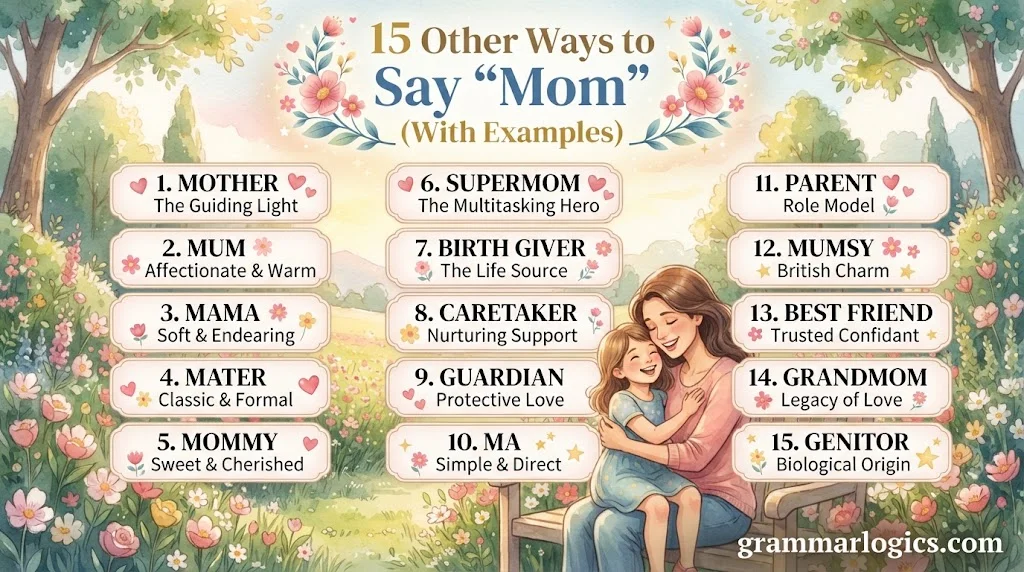
The word “Mom” carries a deep sense of love, comfort, and connection. Choosing the right alternative can make your message feel more personal, respectful, or heartfelt.
Whether you are writing a family message, a heartfelt note, or simply looking for a different way to address your mother, the words you choose can reflect your relationship and emotional tone. While “Mom” is warm and familiar, other expressions may sound more affectionate, formal, playful, or culturally natural. Understanding these alternative ways to say “Mom” can help you communicate your feelings more clearly and naturally in different situations. From everyday conversations to meaningful messages, the right expression can add warmth and personality to your words.
The way we refer to our mothers often depends on family traditions, culture, age, and personal preference. Some people naturally say “Mom,” while others use expressions such as Mother, Mama, Mommy, Mum, or Ma. Each term can carry a slightly different feeling and may suit a particular relationship or situation. Exploring different ways to say “Mom” can help you find wording that feels genuine and appropriate. Whether you want something sweet, respectful, casual, or affectionate, these alternatives offer simple ways to express love and appreciation for your mother while keeping your communication natural.
What Does “Mom” Mean?
Mom is an informal and affectionate word for one’s mother. It normally refers to the woman who raised, gave birth to, or has a parental role toward a child. In everyday American English, “Mom” is one of the most common ways children and adults address or refer to their mother. The word can communicate familiarity, affection, closeness, and respect, depending on the relationship. “Mom” is usually used in casual speech, personal writing, text messages, and family conversations rather than highly formal writing.
Common Situations Where “Mom” Is Used
People use “Mom” in many ordinary family situations. A child might say, “Mom, can you help me?” while an adult may write, “I’m calling Mom tonight.” It is also common in text messages, social media posts, greeting cards, personal conversations, and family discussions.
The word is particularly natural when speaking directly to your mother or referring to her in a familiar way. Someone might choose a different expression when they want to sound more affectionate, use a regional form, describe a specific parental relationship, or write in a more formal context.
Is It Professional or Polite to Say “Mom”?

“Mom” is polite but informal. It is perfectly appropriate when talking about your mother in ordinary conversation, personal emails, messages, and other relaxed settings. However, it may not be the most suitable choice in formal documents where a more precise term such as “mother” or “parent” is expected. The appropriate wording depends largely on the audience and purpose rather than whether “Mom” is inherently polite or impolite.
Advantages and Disadvantages of Saying “Mom”
Advantages
“Mom” is simple, familiar, and emotionally warm. It sounds natural in everyday English and immediately communicates a close family relationship. It is also widely understood, particularly in American English. For personal conversations and messages, its informal quality often makes communication feel comfortable and genuine.
Disadvantages
The main limitation is that “Mom” is informal and somewhat region-specific. Someone writing for a formal audience may prefer “mother” or “parent.” In addition, terms such as “Mama,” “Mommy,” or “Ma” can communicate a different age, relationship, cultural background, or emotional tone, so replacing “Mom” with them without considering context can change the feeling of the message.
Synonyms for “Mom”
- Mother
- Mama
- Mommy
- Mum
- Mummy
- Ma
- Mam
- Momma
- Maternal Figure
- Mother Figure
- Birth Mother
- Biological Mother
- Adoptive Mother
- Foster Mother
- Parent
1. Mother
Meaning
Mother is the standard and more formal word for “Mom.” It refers to a female parent and can be used both when speaking about one’s mother and in more formal writing.
Definition
Mother means a woman who has a child or who fulfills the parental role of raising a child.
Detailed Explanation
“Mother” has essentially the same basic meaning as “Mom,” but it sounds more neutral and formal. It works well in writing, official documents, school assignments, and serious conversations. Unlike “Mom,” it does not necessarily carry the same casual feeling of a familiar term of address. It is often the safest choice when you need precise, standard English.
Scenario Examples
Scenario: Writing a school assignment about your family.
Example: “My mother taught me how important patience can be.”
Scenario: Speaking to someone you do not know well.
Example: “My mother will be visiting us this weekend.”
Best Use
Best for formal writing, professional communication, schoolwork, and neutral conversation.
Tone
Tone: Neutral, respectful, formal
“Mother” sounds more polished and less conversational than “Mom.”
2. Mama
Meaning
Mama is a warm and affectionate way of referring to or addressing one’s mother.
Definition
Mama is an informal term for a mother, often associated with affection and family closeness.
Detailed Explanation
“Mama” can sound tender, loving, and intimate. It is common in many families and cultures, although its frequency varies by region and individual preference. Young children may naturally use it, while adults sometimes continue using it as an affectionate family term. Compared with “Mom,” it often creates a softer emotional impression.
Scenario Examples
Scenario: A child calling for their mother.
Example: “Mama, can you come here for a minute?”
Scenario: Writing an affectionate social media caption.
Example: “Happy birthday to my wonderful mama.”
Best Use
Best for family conversations, affectionate messages, cards, and personal writing.
Tone
Tone: Warm, affectionate, intimate
“Mama” emphasizes emotional closeness more strongly than the neutral “mother.”
3. Mommy
Meaning
Mommy is an affectionate form of “Mom,” especially common among young children.
Definition
Mommy means one’s mother and is generally used as a childlike or especially affectionate form of address.
Detailed Explanation
“Mommy” is strongly associated with childhood and tenderness. Young children commonly use it when speaking directly to their mothers. Adults may also use the word in nostalgic, playful, or highly affectionate contexts, but it can sound unusual in ordinary adult conversation. Its suitability therefore depends heavily on the speaker and situation.
Scenario Examples
Scenario: A young child asking for help.
Example: “Mommy, will you read me another story?”
Scenario: A parent sharing a childhood memory.
Example: “When I was little, I used to run to Mommy whenever I was scared.”
Best Use
Best for children’s speech, family conversations, childhood memories, and affectionate contexts.
Tone
Tone: Childlike, tender, affectionate
“Mommy” sounds more youthful and emotionally soft than “Mom.”
4. Mum
Meaning
Mum is a common British, Australian, and other regional English equivalent of “Mom.”
Definition
Mum is an informal word for one’s mother, especially common in British English.
Detailed Explanation
“Mum” carries essentially the same everyday meaning as “Mom,” but the spelling and pronunciation reflect regional English usage. It is particularly natural in the United Kingdom and several other English-speaking regions. An American speaker would normally use “Mom” instead. The difference is primarily regional rather than emotional.
Scenario Examples
Scenario: A British speaker talking about family.
Example: “I need to call Mum after work.”
Scenario: Writing a birthday card in British English.
Example: “Happy birthday, Mum. I hope you have a wonderful day.”
Best Use
Best for British English, Australian English, family messages, and informal conversation.
Tone
Tone: Casual, familiar, affectionate
“Mum” is as natural and familiar in its regional context as “Mom” is in American English.
5. Mummy
Meaning
Mummy is an affectionate form of “mum,” especially associated with children and British English.
Definition
Mummy is a childlike or affectionate term for one’s mother.
Detailed Explanation
“Mummy” has a similar relationship to “mum” that “mommy” has to “mom.” It is commonly associated with young children and affectionate family speech. Adults may use it when speaking about their mother in a playful, nostalgic, or emotionally tender way. In formal contexts, “mother” would generally be more appropriate.
Scenario Examples
Scenario: A young child asking a question.
Example: “Mummy, are we going to the park today?”
Scenario: An adult recalling childhood.
Example: “My mummy always made that recipe for us when we were young.”
Best Use
Best for children’s speech, affectionate family communication, and nostalgic writing.
Tone
Tone: Tender, childlike, affectionate
“Mummy” creates a softer and more youthful impression than “mum.”
6. Ma
Meaning
Ma is a short, informal term for one’s mother.
Definition
Ma is a familiar form of address for a mother, often used in casual family speech.
Detailed Explanation
“Ma” is brief, direct, and familiar. It is used in various English-speaking communities and can have strong regional or cultural associations. Depending on the speaker, it may sound affectionate, practical, old-fashioned, or simply natural. It is less universally neutral than “mother,” so the surrounding context matters.
Scenario Examples
Scenario: Calling to your mother from another room.
Example: “Ma, have you seen my keys?”
Scenario: Writing dialogue for a family story.
Example: “Ma, I’ll be home before dinner.”
Best Use
Best for casual conversation, family dialogue, regional speech, and informal writing.
Tone
Tone: Casual, direct, familiar
“Ma” is usually more concise and conversational than “Mom.”
7. Mam
Meaning
Mam is a regional form of “Mom” or “Mum,” particularly associated with parts of the United Kingdom and Ireland.
Definition
Mam is an informal regional term for one’s mother.
Detailed Explanation
“Mam” has the same basic family meaning as “Mom,” but its use is strongly influenced by regional dialect and family tradition. It is especially familiar in some areas of Northern England, Wales, Ireland, and surrounding communities. It may sound completely natural to speakers from those regions while sounding unfamiliar or unusual elsewhere. It is therefore best understood as a regional alternative rather than a universal replacement.
Scenario Examples
Scenario: A speaker using their family’s regional vocabulary.
Example: “I’m going to visit Mam this weekend.”
Scenario: A personal message to a sibling.
Example: “Did you remember to call Mam?”
Best Use
Best for regional English, family conversations, and informal messages.
Tone
Tone: Familiar, regional, affectionate
“Mam” reflects regional identity and family usage more than a difference in meaning.
8. Momma
Meaning
Momma is an affectionate and informal variation of “Mom.”
Definition
Momma is a familiar term for one’s mother, often used to express affection or a distinctive family style.
Detailed Explanation
“Momma” can sound warm, folksy, nostalgic, or affectionate. It is used more often in some American communities and families than in others. The word can also appear in songs, stories, captions, and informal speech where a strong sense of family warmth is intended. It is not normally the best choice for formal writing.
Scenario Examples
Scenario: Writing an affectionate family caption.
Example: “Momma always knows how to make everyone feel at home.”
Scenario: A character speaking warmly about their mother.
Example: “My momma taught me never to give up on people.”
Best Use
Best for personal messages, family conversations, creative writing, and affectionate social media posts.
Tone
Tone: Warm, affectionate, informal
“Momma” often sounds more expressive and sentimental than the straightforward “Mom.”
9. Maternal Figure
Meaning
Maternal figure refers to a woman who provides care, guidance, protection, or emotional support in a mother-like role.
Definition
A maternal figure is someone who performs an important mother-like role without necessarily being the person’s biological or legal mother.
Detailed Explanation
“Maternal figure” is not an exact synonym for “Mom.” It is useful when describing someone who has provided motherly care or guidance. The person could be a relative, mentor, guardian, teacher, or another important adult. The expression is more descriptive and formal than “Mom,” so it is generally not used as a direct form of address.
Scenario Examples
Scenario: Writing about an aunt who helped raise you.
Example: “My aunt became an important maternal figure in my childhood.”
Scenario: Describing a supportive adult in a personal essay.
Example: “She was a maternal figure who always encouraged me to believe in myself.”
Best Use
Best for personal essays, biographies, reflective writing, and formal descriptions.
Tone
Tone: Respectful, descriptive, formal
“Maternal figure” focuses on the role someone plays, rather than simply identifying her as a mother.
10. Mother Figure
Meaning
Mother figure describes someone who provides support, guidance, or care similar to that of a mother.
Definition
A mother figure is a person who fulfills some of the emotional or practical functions commonly associated with a mother.
Detailed Explanation
Like “maternal figure,” “mother figure” is broader than “Mom.” It does not necessarily mean the person is your actual mother. The phrase is useful when acknowledging someone who has played an important mother-like role in your life. It is somewhat more conversational than “maternal figure.”
Scenario Examples
Scenario: Talking about a grandmother who raised you.
Example: “My grandmother was more than a relative; she was a mother figure to me.”
Scenario: Writing about an influential mentor.
Example: “She became a mother figure during one of the most difficult periods of my life.”
Best Use
Best for personal writing, storytelling, interviews, biographies, and emotional reflections.
Tone
Tone: Warm, respectful, reflective
“Mother figure” highlights emotional influence and caregiving rather than biological relationship.
11. Birth Mother
Meaning
Birth mother refers specifically to the woman who gave birth to a person.
Definition
A birth mother is the woman who gave birth to a child, particularly when another person or family has taken on the primary parenting role.
Detailed Explanation
“Birth mother” is more specific than “Mom.” It describes a biological relationship connected to giving birth and is especially useful in adoption-related contexts. A birth mother may or may not be the person a child considers their everyday mother. Because of this distinction, the terms should not be treated as automatically interchangeable.
Scenario Examples
Scenario: Discussing adoption history.
Example: “She chose to learn more about her birth mother as an adult.”
Scenario: Writing an adoption profile.
Example: “The agency helped the child understand more about his birth mother.”
Best Use
Best for adoption discussions, family history, legal or social-service contexts, and precise personal writing.
Tone
Tone: Neutral, precise, respectful
“Birth mother” provides specific factual detail that the broader word “Mom” does not.
12. Biological Mother
Meaning
Biological mother identifies a person’s mother through a biological relationship.
Definition
A biological mother is the woman who is genetically related to a child as their mother.
Detailed Explanation
“Biological mother” is a technical and precise expression rather than a casual term of address. It can be useful when distinguishing biological relationships from adoptive, foster, or other parental relationships. It does not necessarily describe who raised the child or who the child emotionally considers their mother. For everyday family conversation, “Mom” is generally much more natural.
Scenario Examples
Scenario: Explaining family relationships clearly.
Example: “Her biological mother and adoptive mother remained different people in her family story.”
Scenario: Discussing medical family history.
Example: “He wanted to learn more about his biological mother’s medical history.”
Best Use
Best for medical, legal, adoption, genealogical, and precise family discussions.
Tone
Tone: Neutral, factual, precise
“Biological mother” emphasizes genetic relationship, not necessarily emotional closeness.
13. Adoptive Mother
Meaning
Adoptive mother refers to a woman who becomes a child’s legal parent through adoption.
Definition
An adoptive mother is a woman who legally becomes the mother of a child through an adoption process.
Detailed Explanation
“Adoptive mother” is a specific parental term, not a universal synonym for “Mom.” A person may call their adoptive mother “Mom,” but the more precise expression is useful when the adoption relationship itself is relevant. In everyday family communication, the person may simply be referred to as a mother. The choice depends on whether the speaker wants to emphasize the family relationship or the adoption history.
Scenario Examples
Scenario: Writing about an adoption journey.
Example: “Her adoptive mother supported her throughout the process of learning about her heritage.”
Scenario: Explaining a family relationship to someone unfamiliar with the situation.
Example: “My adoptive mother raised me from the time I was a baby.”
Best Use
Best for adoption-related writing, family histories, biographies, and contexts requiring precision.
Tone
Tone: Respectful, precise, neutral
“Adoptive mother” identifies a legal and family relationship without necessarily describing how affectionate the relationship is.
14. Foster Mother
Meaning
Foster mother refers to a woman who provides care for a child placed with her through a foster-care arrangement.
Definition
A foster mother is a woman who cares for a child as part of a formal or informal foster-care relationship.
Detailed Explanation
“Foster mother” is another context-specific parental term rather than a direct replacement for “Mom.” A foster mother may provide daily care and emotional support without being the child’s permanent legal parent. The expression is appropriate when the foster-care relationship is important to the meaning. Calling someone “Mom” instead may communicate a different and more personal relationship.
Scenario Examples
Scenario: Discussing a foster-care experience.
Example: “My foster mother helped me feel safe during a difficult transition.”
Scenario: Writing a personal story.
Example: “He stayed with his foster mother until a permanent family arrangement was made.”
Best Use
Best for foster-care discussions, social-service contexts, personal stories, and family histories.
Tone
Tone: Respectful, descriptive, caring
“Foster mother” emphasizes the caregiving arrangement and parental role.
15. Parent
Meaning
Parent is a broader term that can refer to a mother or father.
Definition
A parent is a person who has a child and has a biological, legal, or caregiving parental relationship with that child.
Detailed Explanation
“Parent” is broader than “Mom” because it does not specify gender. It can be useful when the mother’s identity does not need to be singled out or when discussing parents collectively. However, it should not be treated as an exact substitute when you specifically mean your mother. In formal settings, “parent” can sometimes sound more neutral and inclusive.
Scenario Examples
Scenario: Completing a school form.
Example: “Please ask a parent or guardian to sign this form.”
Scenario: Discussing family responsibilities generally.
Example: “A parent may need to attend the meeting with the child.”
Best Use
Best for formal communication, schools, official forms, policies, and general family discussions.
Tone
Tone: Neutral, formal, inclusive
“Parent” is less personal than “Mom” because it describes a family role rather than a specific term of affection.
FAQs
1. What are some other ways to say “Mom”?
Some common other ways to say “Mom” include Mama, Mommy, Mum, Ma, Mother, and Mamma. The best choice depends on your family, culture, age, and the level of affection or formality you want to express.
2. What is a more affectionate way to say “Mom”?
Words such as Mama, Mommy, Momma, and Mamma can sound especially warm and affectionate. They are often used in close family relationships and heartfelt conversations.
3. Is “Mother” more formal than “Mom”?
Yes. “Mother” generally sounds more formal and respectful, while “Mom” is more casual and familiar. “Mother” may be suitable for formal writing, respectful references, or situations where a more traditional tone is preferred.
4. What is the British way to say “Mom”?
In British English, “Mum” is the most common equivalent of “Mom.” You may also hear affectionate forms such as “Mummy” depending on the speaker, age, and context.
5. How can I choose the right alternative to “Mom”?
Consider the relationship, context, tone, and audience before choosing an alternative. Use affectionate terms for personal messages, casual expressions for everyday conversations, and more formal options such as “Mother” when the situation calls for respectful or professional wording.
Conclusion
Finding the right alternative to “Mom” can make your words feel more personal and meaningful. Although “Mom” is simple and familiar, expressions such as Mama, Mum, Mommy, Ma, and Mother can communicate different shades of affection, respect, and warmth. The best expression depends on your relationship, cultural background, personal preference, and the situation.
Whether you are writing a loving message, speaking casually with family, or choosing a respectful term for your mother, using the right wording can make your communication feel more natural. Explore these other ways to say “Mom” and choose the expression that best reflects your feelings and the bond you share.