Finding the right expression can make your writing sound more natural, clear, and engaging. Learning other ways to say “not only” helps you express ideas with greater variety.
The phrase “not only” is commonly used to connect two related ideas and emphasize that something is true in addition to something else. While it is correct and useful, repeating the same expression can sometimes make your writing feel predictable. Using suitable alternatives to “not only” can help you create smoother sentences, improve your vocabulary, and match different tones or contexts. Whether you are writing an email, blog post, essay, professional message, or everyday conversation, choosing the right wording can make your communication more natural, precise, and effective.
Exploring different ways to say “not only” can also help you communicate ideas with more flexibility. Depending on the sentence, you may want to emphasize an additional point, show a stronger connection between ideas, or make your writing sound more polished. Some expressions work well in formal and professional writing, while others feel more natural in casual communication. Understanding the meaning, tone, and context of each alternative allows you to choose wording that fits your message instead of relying on the same phrase repeatedly. This variety can make your English writing clearer, smoother, and more engaging.
What Does “Not Only” Mean?
“Not only” is used to show that something is true or included in addition to another thing. It often introduces one fact, quality, or action and emphasizes that there is something more to consider. For example, “She is not only talented but also hardworking” means that her talent is one positive quality, but her hard work is another.
The expression commonly appears in the structure “not only … but also …”, although it can sometimes be used without “but also.” In everyday English, it can emphasize an unexpected additional point, while in formal writing it can create a clear contrast or build emphasis. The exact meaning depends on the surrounding sentence, so alternatives such as “as well as” or “in addition to” may work better in some contexts than others.
Common Situations Where “Not Only” Is Used
People use “not only” in many forms of communication. In everyday conversation, it can emphasize that someone or something has more than one notable quality: “He’s not only funny, but he’s incredibly thoughtful too.”
In workplace communication, the expression can help describe multiple benefits, responsibilities, or achievements. A report might say that a new system “not only saves time but also reduces errors.” In academic and formal writing, it is useful for connecting related arguments or emphasizing that a point has more than one consequence.
It can also appear in personal messages, social media posts, presentations, and customer communication. Someone might write, “The hotel was not only comfortable but also close to everything we wanted to visit.” An alternative may be preferable when the writer wants a less emphatic or more concise sentence.
Is It Professional or Polite to Say “Not Only”?

Yes. “Not only” is both professional and polite when it is used naturally. It is not inherently casual or formal, so its tone comes largely from the sentence surrounding it. For example, “The proposal not only addresses the immediate issue but also provides a long-term solution” sounds appropriate in a professional report.
The expression can sometimes feel emphatic or structured, particularly when used repeatedly in formal writing. In those cases, expressions such as “as well as,” “in addition to,” or “along with” can create a smoother rhythm. In casual conversation, “and,” “plus,” or “more than just” may sound more natural depending on the intended meaning.
Advantages and Disadvantages of Saying “Not Only”
Advantages
The main advantage of “not only” is its ability to create clear emphasis. It tells the reader or listener that the first point is important, but there is an additional point worth noticing. The familiar “not only … but also …” structure also makes relationships between ideas easy to understand.
It can be especially effective when you want to highlight multiple strengths, benefits, actions, or characteristics in one sentence.
Disadvantages
The expression can become repetitive if it appears frequently throughout the same piece of writing. Its paired structure can also sound somewhat formal or deliberate when a simpler construction would communicate the same idea.
In some sentences, “as well as,” “and,” or “along with” creates a more natural flow. In others, “more than just” better captures the idea that something exceeds a basic expectation rather than simply having an additional feature.
Synonyms for “Not Only”
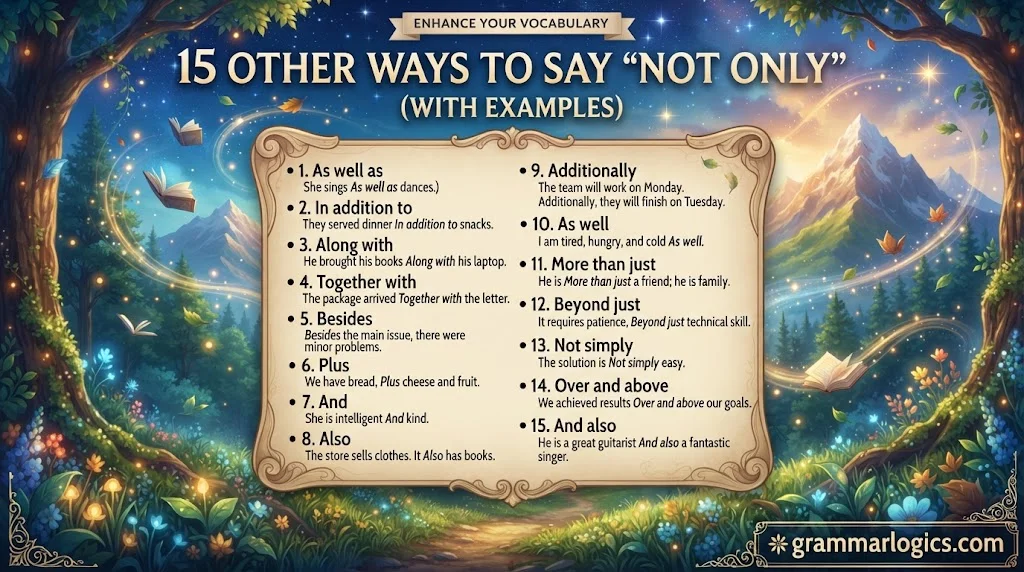
- As well as
- In addition to
- Along with
- Together with
- Besides
- Plus
- And
- Also
- Additionally
- As well
- More than just
- Beyond just
- Not simply
- Over and above
- And also
1. As well as
Meaning
“As well as” means in addition to or together with something else. It is one of the most natural alternatives when “not only” is simply adding another person, thing, action, or quality.
Definition
As well as means that something is included alongside another thing.
Detailed Explanation
“As well as” is often a smoother and less emphatic choice than “not only.” It does not usually create the same strong expectation of a second clause that “not only … but also” does. It works particularly well when you want to connect two related ideas without making either one sound dramatically more important. It is common in both professional and everyday English.
Scenario Examples
Scenario: You are describing an employee’s skills.
Example: “She manages client accounts as well as training new employees.”
Scenario: You are explaining what a course provides.
Example: “The course covers grammar as well as practical writing skills.”
Best Use
Use “as well as” in professional communication, formal writing, everyday conversation, and descriptions where you want a natural addition without strong emphasis.
Tone
Tone: Neutral, polished, and versatile. It sounds natural without being overly formal or dramatic.
2. In addition to
Meaning
“In addition to” means besides something else or as another part of something. It is a useful alternative when you want to make an additional point clearly.
Definition
In addition to means that something is included alongside an existing thing or activity.
Detailed Explanation
This expression is more explicit than “as well as” and often sounds slightly more formal. It works especially well when discussing responsibilities, requirements, features, services, or facts. Unlike “not only,” it does not necessarily suggest a dramatic contrast; it simply adds information.
Scenario Examples
Scenario: You are explaining job responsibilities.
Example: “In addition to answering calls, Maya handles customer emails.”
Scenario: You are describing a service.
Example: “In addition to free delivery, the company offers flexible returns.”
Best Use
Use it in professional emails, reports, academic writing, instructions, and formal explanations.
Tone
Tone: Professional, clear, and informative. Its straightforward wording makes relationships between ideas easy to follow.
3. Along with
Meaning
“Along with” means together with or in addition to. It is useful when two people, things, or actions are being considered together.
Definition
Along with means together with something or someone else.
Detailed Explanation
“Along with” tends to feel more conversational than “in addition to.” It can describe people, objects, responsibilities, activities, and qualities. It is not always a direct replacement for the emphatic “not only,” because it usually adds information rather than highlighting a surprising second point.
Scenario Examples
Scenario: You are describing someone’s role at work.
Example: “Along with managing the project, Daniel prepares the weekly reports.”
Scenario: You are talking about a trip.
Example: “Along with visiting the museum, we explored the old market.”
Best Use
It works well in conversation, emails, workplace communication, travel writing, and everyday descriptions.
Tone
Tone: Natural, friendly, and neutral. It connects related ideas without sounding overly formal.
4. Together with
Meaning
“Together with” emphasizes that something happens or exists in combination with something else.
Definition
Together with means in combination or association with another person or thing.
Detailed Explanation
This expression can replace “not only” when the main idea involves things being considered or done together. It is somewhat more formal than “along with.” It can be particularly useful when describing cooperation, combined features, or accompanying circumstances.
Scenario Examples
Scenario: You are describing a business initiative.
Example: “The new training program, together with regular feedback, should help employees develop their skills.”
Scenario: You are describing someone’s contribution.
Example: “Her research, together with years of field experience, shaped the final proposal.”
Best Use
Use “together with” in formal writing, professional communication, reports, and carefully worded explanations.
Tone
Tone: Formal, composed, and precise. It gives the sentence a slightly more structured feel.
5. Besides
Meaning
“Besides” can mean in addition to or apart from something. It is useful when adding another reason, fact, or consideration.
Definition
Besides means in addition to something already mentioned.
Detailed Explanation
“Besides” is generally more conversational than “not only.” It often works when the speaker is adding another point to an argument or explanation. Depending on the sentence, it can also mean “apart from,” so context matters. Because of this, it should not be treated as a perfect substitute in every grammatical structure.
Scenario Examples
Scenario: A friend asks why you want to leave early.
Example: “Besides being tired, I have an early meeting tomorrow.”
Scenario: You are discussing reasons to choose a restaurant.
Example: “Besides the good food, the place has a great atmosphere.”
Best Use
Use it in casual conversation, personal messages, informal writing, and everyday explanations.
Tone
Tone: Casual, conversational, and direct. It sounds like a natural way to introduce an additional consideration.
6. Plus
Meaning
“Plus” means in addition and is commonly used to add another positive point, reason, or feature.
Definition
Plus means with something extra added to what has already been mentioned.
Detailed Explanation
“Plus” is considerably more casual than “not only.” It works particularly well in speech and informal writing when you want to add another reason or advantage quickly. It can make a sentence sound energetic and conversational, but it is usually inappropriate for highly formal academic or legal writing.
Scenario Examples
Scenario: You are recommending a café to a friend.
Example: “The coffee is excellent, plus the place stays open late.”
Scenario: You are discussing a purchase.
Example: “It is affordable, plus it comes with a two-year warranty.”
Best Use
Use “plus” in text messages, casual conversations, social media, and informal recommendations.
Tone
Tone: Casual, upbeat, and conversational. It adds information with a light and uncomplicated feel.
7. And
Meaning
“And” connects two ideas without adding the special emphasis associated with “not only.” It is often the simplest way to express that one thing is true along with another.
Definition
And is a coordinating conjunction used to join words, phrases, clauses, or related ideas.
Detailed Explanation
Sometimes the best alternative to “not only” is simply “and.” It removes unnecessary emphasis and makes the sentence more direct. This is especially useful when the writer does not actually need to highlight the second idea. Although “and” is less expressive than “not only … but also,” its simplicity often makes the writing smoother.
Scenario Examples
Scenario: You are describing a colleague.
Example: “She is reliable and extremely organized.”
Scenario: You are describing a weekend activity.
Example: “We visited the gallery and had lunch nearby.”
Best Use
Use it in almost any context, particularly when a simple connection is enough.
Tone
Tone: Neutral, simple, and universally natural. Its strength is its flexibility rather than emphasis.
8. Also
Meaning
“Also” means in addition or as another point. It allows you to add information without using the paired structure of “not only … but also.”
Definition
Also means in addition to what has already been stated.
Detailed Explanation
“Also” is a concise way to introduce an additional fact, action, or quality. It is common in both spoken and written English, although its position in the sentence can vary. Unlike “not only,” it does not necessarily emphasize a contrast or surprise. It simply tells the reader that another point belongs in the discussion.
Scenario Examples
Scenario: You are explaining a colleague’s responsibilities.
Example: “She writes the reports and also coordinates the meetings.”
Scenario: You are giving a friend travel advice.
Example: “The beach is beautiful, and you can also rent bicycles nearby.”
Best Use
Use “also” in everyday communication, workplace writing, emails, essays, and general explanations.
Tone
Tone: Neutral, clear, and flexible. It is suitable for a wide range of situations without sounding strongly formal or casual.
9. Additionally
Meaning
“Additionally” introduces another piece of information that supports or extends the previous point.
Definition
Additionally means also or furthermore.
Detailed Explanation
“Additionally” is more formal than “also” and is often used to organize information in professional or academic writing. It works especially well when moving from one supporting point to another. It does not carry the same emphasis as “not only,” so it is best when the goal is clear addition rather than rhetorical contrast.
Scenario Examples
Scenario: You are writing a business report.
Example: “The software reduces administrative work. Additionally, it provides detailed usage reports.”
Scenario: You are explaining a service to a customer.
Example: “The package includes installation. Additionally, technical support is available throughout the first year.”
Best Use
Use it in reports, business communication, academic writing, formal emails, and structured explanations.
Tone
Tone: Professional, formal, and organized. It clearly signals that another relevant point is being introduced.
10. As well
Meaning
“As well” means also or in addition. It is commonly placed at the end of a sentence or clause.
Definition
As well means also or too.
Detailed Explanation
“As well” is a natural alternative when you want to add another action, quality, or fact. It is especially common in British English, although it is understood widely in other varieties of English too. Because its grammatical placement differs from “not only,” it often requires a different sentence structure rather than a direct word-for-word replacement.
Scenario Examples
Scenario: You are making plans with a friend.
Example: “I can bring some snacks as well.”
Scenario: You are discussing a coworker’s skills.
Example: “She speaks Spanish and can handle basic French as well.”
Best Use
Use it in conversation, friendly messages, emails, and everyday English.
Tone
Tone: Friendly, natural, and conversational. It adds information softly without strong emphasis.
11. More than just
Meaning
“More than just” means that something goes beyond a basic or expected description.
Definition
More than just means something is greater, broader, or more significant than the simple description suggests.
Detailed Explanation
This expression is not an exact grammatical substitute for every use of “not only.” Instead, it is useful when you want to emphasize that someone or something has additional significance or value. It often sounds warmer and more expressive than a simple additive phrase. It is particularly effective when describing people, experiences, relationships, or services that exceed expectations.
Scenario Examples
Scenario: You are describing a close friend.
Example: “She is more than just a colleague; she has become a trusted friend.”
Scenario: You are describing a community project.
Example: “The garden is more than just a place to grow vegetables.”
Best Use
Use it in personal writing, speeches, creative writing, social media, and emotionally meaningful communication.
Tone
Tone: Warm, expressive, and emphatic. It suggests that the subject has greater depth or importance than the basic description implies.
12. Beyond just
Meaning
“Beyond just” suggests that something extends past a basic, limited, or obvious role.
Definition
Beyond just means extending further than a simple or narrow description.
Detailed Explanation
“Beyond just” is useful when the writer wants to show that something has a broader effect or purpose. Like “more than just,” it is not interchangeable with every grammatical use of “not only.” It is particularly effective when discussing impact, purpose, identity, or value.
Scenario Examples
Scenario: You are discussing education.
Example: “The program goes beyond just teaching technical skills.”
Scenario: You are describing a workplace initiative.
Example: “The campaign is beyond just a marketing exercise; it encourages employees to participate in the community.”
Best Use
Use it in professional presentations, essays, speeches, reflective writing, and discussions about broader meaning or impact.
Tone
Tone: Thoughtful, emphatic, and slightly formal. It encourages the reader to look past the most obvious interpretation.
13. Not simply
Meaning
“Not simply” means that something should not be understood as only one basic or straightforward thing.
Definition
Not simply means not merely or not only in a basic sense.
Detailed Explanation
“Not simply” is close to “not only,” but it often focuses more strongly on complexity or a deeper interpretation. It suggests that reducing something to one explanation would leave out an important part of the picture. This makes it useful in thoughtful, analytical, and formal writing.
Scenario Examples
Scenario: You are writing about leadership.
Example: “Good leadership is not simply about giving instructions; it also involves listening.”
Scenario: You are discussing a difficult decision.
Example: “The choice was not simply a financial decision.”
Best Use
Use it in academic writing, professional analysis, essays, presentations, and serious discussions.
Tone
Tone: Thoughtful, analytical, and measured. It signals that the subject deserves a broader or deeper explanation.
14. Over and above
Meaning
“Over and above” means in addition to something already expected or included.
Definition
Over and above means in addition to or beyond what is normally expected.
Detailed Explanation
This expression can emphasize an extra contribution, amount, effort, or benefit. It is less common in everyday American English than simpler alternatives such as “in addition to,” so context matters. It works particularly well when describing something that exceeds an established requirement or expectation.
Scenario Examples
Scenario: You are praising an employee’s contribution.
Example: “She consistently puts in effort over and above what the role requires.”
Scenario: You are discussing additional costs.
Example: “The quoted price covers the basic service, with any extras charged over and above that amount.”
Best Use
Use it in formal or semi-formal writing, workplace communication, business discussions, and situations involving additional effort or requirements.
Tone
Tone: Formal, emphatic, and somewhat traditional. It highlights something that goes beyond an existing baseline.
15. And also
Meaning
“And also” adds another point using two familiar connecting words. It can sometimes replace the idea of “not only … but also” when the goal is simply to mention another feature or action.
Definition
And also means and, in addition, another point or action.
Detailed Explanation
“And also” is straightforward and easy to understand, but it is generally more conversational than the formal “not only … but also” structure. It is useful when clarity matters more than rhetorical emphasis. In polished writing, “also” or “as well” may sometimes be more concise, so the choice depends on sentence rhythm.
Scenario Examples
Scenario: You are telling a friend about someone’s personality.
Example: “He is funny and also very considerate.”
Scenario: You are explaining what a product offers.
Example: “The device tracks your steps and also monitors your sleep.”
Best Use
Use it in conversation, informal emails, personal messages, and straightforward explanations.
Tone
Tone: Casual, clear, and conversational. It feels natural when the speaker simply wants to add another point.
FAQs
1. What does “not only” mean?
“Not only” is used to show that something is true in addition to another fact, quality, or action. It often adds emphasis and connects two related ideas in a sentence.
2. What are some other ways to say “not only”?
Some useful alternatives to “not only” include “as well as,” “in addition to,” “besides,” “also,” “along with,” and “more than just.” The best choice depends on the sentence and the intended tone.
3. Is “not only” formal or informal?
“Not only” can be used in both formal and informal communication. It is common in essays, professional writing, emails, conversations, and everyday English, making it a versatile expression.
4. How can I avoid repeating “not only” in my writing?
You can avoid repetition by using suitable synonyms, alternatives, and expressions based on the context. However, make sure the replacement keeps the original meaning and fits naturally within the sentence.
5. What is the best alternative to “not only”?
There is no single best alternative because the appropriate expression depends on the context, meaning, and tone of your sentence. Words such as “also,” “as well as,” or “in addition to” may work well in different situations.
Conclusion
Knowing different ways to say “not only” can make your English more varied, natural, and effective. Although “not only” is a useful expression, choosing an appropriate alternative can help you avoid repetition and communicate your ideas more clearly. The right wording depends on your sentence, audience, and intended tone.
Whether you are writing a professional email, academic assignment, blog post, or casual message, understanding different alternatives to “not only” gives you greater flexibility. Choose expressions that preserve your intended meaning while making your communication sound clear, polished, and natural.