Inviting someone to join us can sound warm and welcoming, but choosing the right words can make your invitation feel more personal, natural, and sincere.
The phrase “Join Us” is a simple and friendly way to invite someone to become part of a gathering, activity, event, team, or shared experience. However, depending on the situation, you may want to use different expressions to sound more welcoming, professional, casual, or enthusiastic. Knowing other ways to say “Join Us” can help you communicate your invitation more naturally and match the right tone with your audience. Whether you are writing an email, event invitation, social media post, workplace message, or personal note, the right wording can make your invitation more engaging.
Choosing the right alternative to “Join Us” can make a simple invitation feel warmer, clearer, and more meaningful. For professional communication, you might prefer polished expressions that encourage participation without sounding too casual. In friendly conversations, a relaxed and welcoming phrase may feel more natural. These small changes in wording can help you create invitations that fit different situations and audiences. In this article, you will discover useful ways to say “Join Us”, along with examples and practical guidance to help you choose an expression that sounds appropriate, friendly, and confident in everyday and professional communication.
What Does “Join Us” Mean?
“Join us” is an invitation asking someone to come with a group, participate in an activity, attend an event, or become part of something. The exact meaning depends on the context. For example, “Join us for dinner” usually means “come and have dinner with us,” while “Join us for the meeting” means “attend and participate in the meeting.” In a workplace or organization, “join us” can also suggest becoming part of a team or group.
The phrase is generally friendly, inclusive, and direct. It does not normally sound demanding because the wording presents participation as an invitation. Its meaning can range from a simple social invitation to a more formal request for participation, so the surrounding words and situation determine how it is understood.
Common Situations Where “Join Us” Is Used
“Join us” works in many everyday and professional situations. Friends might say it when inviting someone to dinner, a trip, or a casual gathering. A school may use it when inviting students to an activity, while a company might use it in an announcement about a meeting, event, webinar, or team opportunity.
The phrase is also common in social media posts, event invitations, newsletters, websites, and email communication. Businesses may use it to encourage customers to attend an event, and community groups may use it to welcome people to an activity.
People sometimes look for an alternative because “join us” can become repetitive, especially when writing several invitations. A different expression can also make the intended action clearer. For example, one alternative may emphasize attendance, while another may emphasize participation or belonging.
Is It Professional or Polite to Say “Join Us”?

Yes. “Join us” can be both polite and professional, depending on the context. In a workplace email such as “Please join us for Friday’s meeting,” it is a normal and courteous invitation. In a social message such as “Join us for dinner tonight,” it sounds warm and informal.
The phrase is relatively flexible because it does not inherently sound overly formal or overly casual. However, a more specific expression may suit certain situations better. A formal invitation might benefit from wording that emphasizes attendance, while a friendly gathering may sound more natural with a warmer, more conversational expression.
Advantages and Disadvantages of Saying “Join Us”
Advantages
The biggest advantage of “join us” is its simplicity. It is short, immediately understandable, and suitable for many audiences. It also creates a sense of inclusion because the speaker is inviting another person into an activity or group. The phrase can sound warm without becoming overly emotional, making it useful for everything from personal messages to professional announcements.
Another benefit is its flexibility. “Join us” can refer to attending an event, participating in an activity, spending time with friends, or becoming part of a group. That broad usefulness makes it a dependable expression in everyday English.
Disadvantages
The main limitation is that “join us” can sometimes be too general. It may not tell the reader whether you want them to attend, actively participate, become a member, or simply spend time with the group. In repetitive invitations, the phrase can also start to sound predictable.
In some situations, a more specific expression can communicate the intended action or tone more clearly. A formal event may call for wording focused on attendance, while a community project may benefit from language that emphasizes active participation.
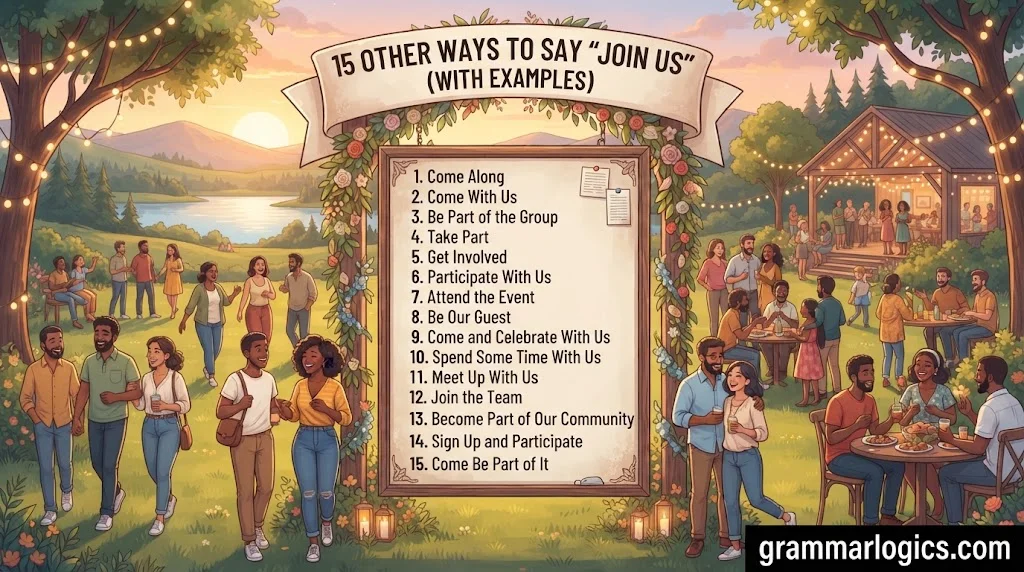
15 Synonyms for “Join Us”
- Come Along
- Come With Us
- Be Part of the Group
- Take Part
- Get Involved
- Participate With Us
- Attend the Event
- Be Our Guest
- Come and Celebrate With Us
- Spend Some Time With Us
- Meet Up With Us
- Join the Team
- Become Part of Our Community
- Sign Up and Participate
- Come Be Part of It
1. Come Along
Meaning
“Come along” is a friendly way to invite someone to accompany you or participate in an activity. It is especially natural in casual spoken English.
Definition
Come along means to come with someone or go somewhere with them, often as part of a friendly invitation.
Detailed Explanation
Compared with “join us,” “come along” often feels more relaxed and conversational. It works especially well when the speaker is already going somewhere and wants another person to accompany the group. It can also suggest that the person does not need to make the event overly formal or complicated. Because of its casual character, it is less suitable for highly formal invitations.
Scenario Examples
Scenario: You are inviting a friend to a weekend outing.
Example: “We’re heading to the market Saturday morning. Come along if you’re free.”
Scenario: Your coworkers are going for coffee after work.
Example: “A few of us are grabbing coffee after work. Come along!”
Best Use
Use “come along” for casual conversation, texting, friendly invitations, and informal social plans.
Tone
Tone: Casual, friendly, relaxed
It sounds easygoing and welcoming rather than formal or ceremonial.
2. Come With Us
Meaning
“Come with us” directly invites someone to accompany the speaker and the group.
Definition
Come with us means to go somewhere together with the people making the invitation.
Detailed Explanation
This expression is more specific than “join us” when the main idea is accompanying the group. It is natural when everyone is going somewhere together, such as a restaurant, concert, trip, or outing. The wording is straightforward and personal, although it can sound slightly more direct than “join us.” It does not necessarily imply membership or long-term participation.
Scenario Examples
Scenario: You and your friends are going to a restaurant.
Example: “We’re trying the new restaurant downtown tonight. Come with us!”
Scenario: Your family is going to a local festival.
Example: “We’re leaving around six. Come with us if you’d like.”
Best Use
Use it for personal invitations, outings, travel plans, family activities, and casual messages where accompanying the group is the main idea.
Tone
Tone: Friendly, direct, personal
The phrase feels natural because it clearly tells the person that you would like their company.
3. Be Part of the Group
Meaning
“Be part of the group” emphasizes belonging rather than simply attending one activity.
Definition
Be part of the group means to belong to or participate as a member of a particular group.
Detailed Explanation
This expression carries a stronger sense of inclusion and belonging than “join us.” It is useful when you want someone to feel welcomed into an ongoing group rather than invited to a single occasion. The phrase can work in community, school, volunteer, and organizational contexts. However, it may sound less natural for a simple invitation to dinner because it suggests a broader relationship.
Scenario Examples
Scenario: A student is being welcomed into a school club.
Example: “We’d love for you to be part of the group this semester.”
Scenario: A community organization is welcoming new volunteers.
Example: “If you care about local projects, we’d be happy to have you be part of the group.”
Best Use
Use it for clubs, teams, communities, volunteer groups, school activities, and ongoing organizations.
Tone
Tone: Welcoming, inclusive, supportive
It highlights the person’s place within the group rather than merely their physical presence at an event.
4. Take Part
Meaning
“Take part” means to participate actively in an activity or event.
Definition
Take part means to participate in something rather than simply observe it.
Detailed Explanation
“Take part” shifts the emphasis from being present to actively participating. That makes it useful when the invitation involves an activity, discussion, competition, project, or organized event. It can sound somewhat more formal than “join us,” particularly in written communication. It is not usually the best choice when you simply want someone to come along socially.
Scenario Examples
Scenario: A school is inviting students to participate in a debate competition.
Example: “Students from every year group are welcome to take part.”
Scenario: A company is organizing a charity challenge.
Example: “We hope everyone will take part in this year’s charity event.”
Best Use
Use “take part” for school activities, organized events, projects, competitions, community programs, and professional communication.
Tone
Tone: Clear, neutral, moderately formal
It sounds purposeful and emphasizes participation.
5. Get Involved
Meaning
“Get involved” encourages someone to actively participate rather than remain on the sidelines.
Definition
Get involved means to become actively engaged in an activity, group, project, or cause.
Detailed Explanation
This phrase is more active than “join us” because it suggests ongoing engagement. It is especially useful when an organization wants people to contribute ideas, effort, time, or skills. It can also be used casually, but it often appears in community, workplace, educational, and volunteer contexts. Unlike a simple invitation to attend, “get involved” usually implies doing something rather than merely showing up.
Scenario Examples
Scenario: A neighborhood group wants more volunteers.
Example: “If you have some spare time, we’d love for you to get involved.”
Scenario: A new employee is encouraged to participate in company activities.
Example: “There are several employee groups you can get involved with.”
Best Use
Use it for volunteering, community activities, workplace initiatives, school organizations, projects, and causes.
Tone
Tone: Encouraging, active, inclusive
It motivates participation while suggesting that the person’s contribution matters.
6. Participate With Us
Meaning
“Participate with us” invites someone to actively take part alongside the speaker or group.
Definition
Participate with us means to take part in an activity together with the people extending the invitation.
Detailed Explanation
This expression is more explicitly participation-focused than “join us.” It works when you want the reader to understand that they will have an active role. The wording is suitable for events, workshops, discussions, programs, and organized activities. In ordinary conversation, however, “join us” or “come with us” often sounds more natural.
Scenario Examples
Scenario: A professional group is hosting an online workshop.
Example: “We’d be delighted if you could participate with us in the afternoon session.”
Scenario: A community group is organizing a public discussion.
Example: “Residents are invited to participate with us in the conversation.”
Best Use
Use it for organized activities, workshops, discussions, educational events, and professional communication.
Tone
Tone: Professional, inclusive, purposeful
It makes active involvement clear and is more formal than many everyday alternatives.
7. Attend the Event
Meaning
“Attend the event” specifically means to be present at an organized event.
Definition
Attend the event means to go to and be present at a particular event or occasion.
Detailed Explanation
This is one of the most specific and formal alternatives to “join us.” Instead of emphasizing companionship or group membership, it focuses on attendance. That makes it particularly useful when the main action required is simply showing up. It does not necessarily suggest active participation, so it should not replace “join us” when attendees are expected to contribute or collaborate.
Scenario Examples
Scenario: A company is inviting clients to a conference.
Example: “We hope you’ll be able to attend the event on Thursday.”
Scenario: A school sends an invitation to parents.
Example: “Parents and guardians are warmly invited to attend the event.”
Best Use
Use it for formal invitations, conferences, ceremonies, school events, business events, and official announcements.
Tone
Tone: Formal, polite, clear
It is practical and precise, particularly in written communication.
8. Be Our Guest
Meaning
“Be our guest” warmly invites someone to attend or enjoy something as an invited guest.
Definition
Be our guest means to accept an invitation and attend as a welcomed guest.
Detailed Explanation
This expression adds a sense of hospitality and warmth that “join us” may not always carry. It works particularly well when the host wants to make the invitation feel generous or welcoming. Depending on the context, it can sound playful or traditional, so it may not suit every business situation. It is especially natural for dinners, celebrations, receptions, open houses, and hospitality-oriented invitations.
Scenario Examples
Scenario: You are hosting a dinner for friends.
Example: “We’re having a small dinner Saturday night. Be our guest!”
Scenario: A gallery is inviting local residents to an opening.
Example: “Be our guest at the gallery’s opening reception this Friday.”
Best Use
Use it for social gatherings, celebrations, dinners, receptions, hospitality, and warm invitations.
Tone
Tone: Warm, gracious, welcoming
It emphasizes hospitality and makes the recipient feel personally invited.
9. Come and Celebrate With Us
Meaning
“Come and celebrate with us” invites someone to attend a celebration and share the occasion with the group.
Definition
Come and celebrate with us means to attend a celebration and enjoy the occasion together.
Detailed Explanation
This phrase is more specific than “join us” because it tells the reader why they are being invited. It works especially well for birthdays, anniversaries, graduations, milestones, holidays, and other happy occasions. The wording is warm and enthusiastic, but it would sound out of place when the event is serious or purely business-related. Its emotional character makes it useful when the purpose is shared enjoyment.
Scenario Examples
Scenario: A family is celebrating a graduation.
Example: “Come and celebrate with us as Maya graduates this Saturday.”
Scenario: A business is marking an anniversary.
Example: “Come and celebrate with us as we mark ten years in the community.”
Best Use
Use it for celebrations, milestone events, parties, announcements, social media invitations, and personal messages.
Tone
Tone: Warm, enthusiastic, celebratory
The wording immediately communicates happiness and shared occasion.
10. Spend Some Time With Us
Meaning
“Spend some time with us” invites someone to be together without requiring a specific type of participation.
Definition
Spend some time with us means to come and enjoy time together with the speaker or group.
Detailed Explanation
This expression is softer and more personal than “join us.” It focuses on companionship rather than attendance or membership. That makes it particularly appropriate for friends, family, and informal social situations. It can feel more heartfelt when the real purpose of the invitation is simply to enjoy one another’s company.
Scenario Examples
Scenario: You are inviting a relative to a family gathering.
Example: “We’ll be at Mom’s house Sunday afternoon. Come spend some time with us.”
Scenario: You want to invite a friend who has been busy.
Example: “It would be nice to see you. Come spend some time with us this weekend.”
Best Use
Use it for family gatherings, friendships, personal messages, informal visits, and relaxed social occasions.
Tone
Tone: Warm, personal, gentle
It expresses a desire for someone’s company without sounding demanding.
11. Meet Up With Us
Meaning
“Meet up with us” suggests getting together with a group at a particular time or place.
Definition
Meet up with us means to get together with the speaker and others, usually for a social activity.
Detailed Explanation
This alternative is especially natural when there is a specific meeting point or plan. It is more casual than “join us” and strongly associated with everyday spoken English and texting. It does not necessarily imply that the person will stay for the entire activity; they may simply meet the group and spend some time together. It is therefore useful for flexible social plans.
Scenario Examples
Scenario: Friends are meeting before a concert.
Example: “We’ll be outside the theater at seven. Meet up with us there.”
Scenario: A group is exploring a city.
Example: “We’re getting lunch around noon. Meet up with us when you arrive.”
Best Use
Use it for texting, casual conversation, outings, travel, friends, and informal social plans.
Tone
Tone: Casual, relaxed, conversational
It sounds spontaneous and natural in everyday communication.
12. Join the Team
Meaning
“Join the team” invites someone to become a member of a specific team or working group.
Definition
Join the team means to become a member of a team and contribute alongside its existing members.
Detailed Explanation
This expression is narrower than “join us” because it focuses on membership and collaboration. It is particularly common in employment, sports, school activities, and organized projects. It can refer to formally becoming a team member rather than simply attending a meeting or event. Because of that distinction, it should be used when team membership is genuinely what you are offering.
Scenario Examples
Scenario: A company is welcoming a new employee.
Example: “We’re excited to have you join the team.”
Scenario: A sports coach is recruiting players.
Example: “If you enjoy the game and want to compete, we’d love you to join the team.”
Best Use
Use it for workplaces, sports, school groups, project teams, and collaborative organizations.
Tone
Tone: Professional, encouraging, inclusive
It communicates belonging while emphasizing cooperation and shared goals.
13. Become Part of Our Community
Meaning
“Become part of our community” invites someone to develop a connection with an ongoing community or group.
Definition
Become part of our community means to join and participate in a community with shared interests, activities, or values.
Detailed Explanation
This phrase carries a stronger sense of belonging and long-term connection than a simple event invitation. It works well for community organizations, membership groups, educational networks, online communities, and businesses that have an established audience. It may sound too broad for a one-time social gathering. When used appropriately, it presents participation as an ongoing relationship rather than a single appearance.
Scenario Examples
Scenario: A local organization welcomes new residents.
Example: “We’d love for you to become part of our community.”
Scenario: An online learning group is inviting new members.
Example: “Become part of our community and connect with other learners.”
Best Use
Use it for community organizations, membership programs, online groups, educational networks, and long-term relationships.
Tone
Tone: Welcoming, inclusive, community-focused
The wording emphasizes connection and a sense of belonging.
14. Sign Up and Participate
Meaning
“Sign up and participate” tells someone both to register and to take part.
Definition
Sign up and participate means to register for an activity and then actively take part in it.
Detailed Explanation
This expression is more action-oriented than “join us.” It is useful when an event requires registration, enrollment, or advance confirmation. Because it gives a clear instruction, it is particularly effective in announcements and event promotions. It is not a natural substitute when someone is simply being invited to an informal dinner or spontaneous outing.
Scenario Examples
Scenario: A company is organizing a professional workshop that requires registration.
Example: “Sign up and participate in our leadership workshop next month.”
Scenario: A school is organizing a student competition.
Example: “Students can sign up and participate in this year’s writing challenge.”
Best Use
Use it for workshops, courses, competitions, programs, organized activities, and registration-based events.
Tone
Tone: Direct, practical, action-oriented
It clearly communicates what the reader needs to do next.
15. Come Be Part of It
Meaning
“Come be part of it” warmly invites someone to experience and contribute to an occasion or shared activity.
Definition
Come be part of it means to attend and share in an event, experience, or activity.
Detailed Explanation
This expression combines the friendly invitation of “come” with the inclusive idea of participation and belonging. It is especially effective when an event has a strong sense of shared experience, such as a celebration, community gathering, performance, or special occasion. It sounds more emotional and inviting than a straightforward request to attend. However, it can be less precise than “attend the event” when formal instructions are required.
Scenario Examples
Scenario: A community is holding an annual festival.
Example: “The festival returns this Saturday. Come be part of it!”
Scenario: A group is celebrating a major milestone.
Example: “We’ve reached an exciting milestone, and we’d love you to come be part of it.”
Best Use
Use it for community events, celebrations, public gatherings, social media invitations, and meaningful shared experiences.
Tone
Tone: Warm, enthusiastic, inclusive
It makes the invitation feel like an opportunity to share an experience rather than simply attend.
FAQs
1. What is another way to say “Join Us”?
Some alternatives to “Join Us” include “Come along,” “Be part of it,” “Come and join us,” “We’d love to have you,” and “You’re invited.” The best expression depends on the situation, audience, and tone you want to create.
2. How can I say “Join Us” professionally?
In professional communication, you can say “We invite you to join us,” “We welcome your participation,” “We’d be pleased to have you,” or “We invite you to be part of the event.” These expressions sound polite, clear, and appropriate for workplace emails, meetings, and formal events.
3. Is “Join Us” a polite phrase?
Yes, “Join Us” is generally a polite, friendly, and welcoming expression. It works well for social gatherings, events, meetings, celebrations, and group activities. However, choosing a more specific alternative can make your invitation better suited to a particular audience or occasion.
4. What is a friendly way to say “Join Us”?
For a casual or friendly invitation, you can use phrases such as “Come along,” “Come hang out with us,” “Come be part of the fun,” or “We’d love for you to come.” These expressions create a warm and relaxed tone.
5. When should I use alternatives to “Join Us”?
You can use alternatives to “Join Us” when you want your invitation to sound more personal, professional, enthusiastic, or casual. Choosing the right wording helps you match your message to the context, audience, and purpose of your invitation.
Conclusion
Finding the right alternative to “Join Us” can make your invitations sound more natural, welcoming, and engaging. While “Join Us” is simple and versatile, different situations may call for different expressions. A professional event may benefit from formal wording, while a gathering with friends may sound better with a relaxed and friendly phrase. Understanding these differences allows you to communicate your invitation with greater confidence and choose words that fit your intended tone.
Whether you are writing an email, event announcement, social media post, workplace invitation, or personal message, using the right wording can make a noticeable difference. The expressions covered in this article give you practical ways to invite others while keeping your communication clear, warm, and appropriate. Choose the phrase that best matches your audience, situation, and relationship with the people you are inviting.