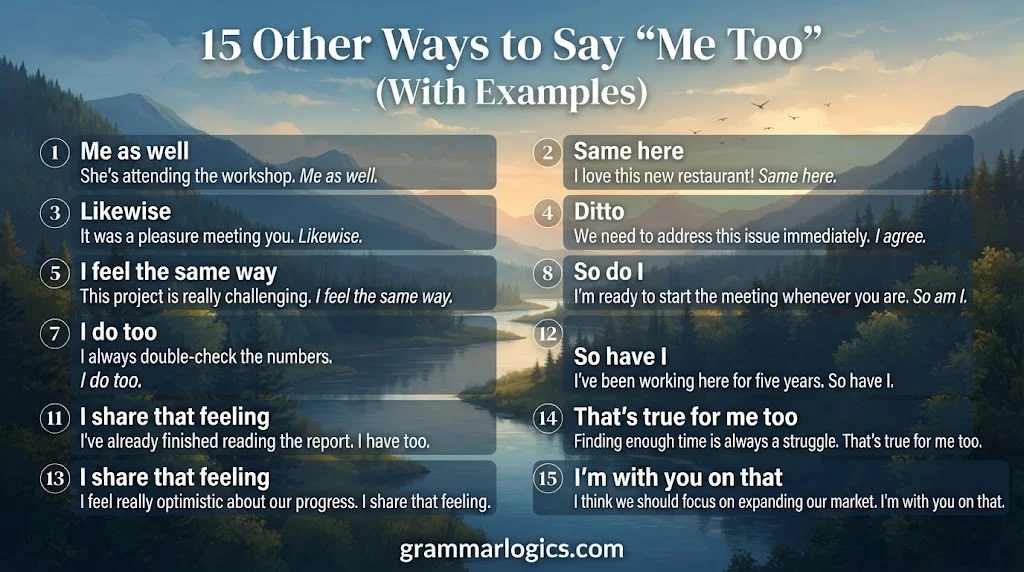
Finding the right ways to say “Me Too” can make everyday conversations feel more natural, friendly, and engaging in different social situations.
The phrase “Me Too” is a simple way to show agreement, shared feelings, or a similar experience. However, using the same expression repeatedly can sometimes make your conversations feel less natural or varied. Learning different ways to say “Me Too” helps you communicate with greater confidence while matching the tone of each situation. Whether you are chatting with friends, responding to a colleague, or joining a casual discussion, having several alternative phrases can make your English sound smoother, more expressive, and conversational.
In this guide, we explore useful alternatives to “Me Too” that you can use in everyday conversations, professional communication, and friendly interactions. Some expressions sound casual and warm, while others are more polished or enthusiastic. Understanding these differences can help you choose the right phrase based on your relationship, setting, and intended meaning. If you want to improve your English vocabulary, sound more natural, or avoid repeating the same words, these practical expressions will give you plenty of options for expressing agreement and shared experiences.
What Does “Me Too” Mean?
“Me too” is a common English expression used to say that you share the same feeling, experience, opinion, situation, or preference as someone else. For example, if someone says, “I love rainy evenings,” another person can reply, “Me too,” meaning “I love rainy evenings as well.” It is generally understood as a short way of expressing agreement or similarity.
The exact meaning depends on the statement that comes before it. If someone says, “I’m tired,” “Me too” means “I’m tired too.” If someone says, “I enjoyed the movie,” “Me too” means “I enjoyed it too.” Because it is so flexible, “me too” works especially well in everyday spoken English, texting, and informal personal communication.
It is also important to distinguish the everyday phrase “me too” from “Me Too,” the name associated with the broader movement against sexual harassment and sexual violence. In ordinary vocabulary and conversation, however, lowercase “me too” usually means “I share that experience, feeling, or opinion.”
Common Situations Where “Me Too” Is Used
People commonly use “me too” during casual conversations when they want to quickly show that they feel or think the same way. It is especially natural when responding to statements about preferences, emotions, experiences, habits, or opinions.
For example, friends may use it while talking about food, hobbies, movies, travel, school, or everyday life. In text messages, “Me too!” is often enough to show enthusiasm or agreement without writing a complete sentence.
The phrase can also appear in personal and workplace conversations, although the level of formality matters. In a professional email, a more specific expression such as “I agree,” “I feel the same way,” or “I have had a similar experience” may communicate the intended meaning more clearly.
Choosing an alternative can be useful when you want to avoid repetition, make your response more precise, or match the tone of a particular relationship or setting.
Is It Professional or Polite to Say “Me Too”?

“Me too” is polite and natural, but it is generally casual rather than formal. It works well when speaking with friends, family members, classmates, coworkers you know well, or people in relaxed conversations. Its friendly simplicity makes it a very common response in everyday English.
In professional communication, “me too” is not automatically wrong, but it can sometimes sound too brief or conversational. For example, replying to a manager with only “Me too” may be less clear than saying “I feel the same way” or “I agree with you.” The best choice depends on what you are agreeing with and how formal the situation is.
The expression can also sound warm and enthusiastic when followed by an exclamation mark, as in “Me too!” However, when the subject involves a serious personal experience, a fuller response may be more appropriate than a quick “me too.”
Advantages and Disadvantages of Saying “Me Too”
Advantages
The main advantage of “me too” is its simplicity. It lets you show agreement or shared experience without repeating the entire statement. It is also highly versatile and can communicate everything from a simple preference to a shared emotion. In casual conversation, its short form can make an exchange feel natural, friendly, and relaxed.
Another benefit is that “me too” encourages connection. When someone shares an experience and you respond with “me too,” you immediately show that you understand or relate to what they said.
Disadvantages
Because it is so short, “me too” can sometimes be vague. The listener has to infer exactly which part of the previous statement you are agreeing with. It can also sound repetitive if used frequently throughout the same conversation.
In professional or sensitive situations, a more specific phrase may communicate your meaning more carefully. For example, “I had a similar experience” gives more information than simply saying “me too,” while “I agree” makes it clear that you are responding to an opinion rather than an emotion or personal experience.
Synonyms for “Me Too”
- Me as well
- Same here
- Likewise
- Ditto
- I feel the same way
- I agree
- I do too
- So do I
- I am too
- So am I
- I have too
- So have I
- I share that feeling
- That’s true for me too
- I’m with you on that
1. Me as well
Meaning
“Me as well” means that you share the same feeling, preference, experience, or situation that someone has just mentioned. It is very close in meaning to “me too.”
Definition
Me as well: An expression used to indicate that the speaker shares the same experience, opinion, feeling, or preference.
Detailed Explanation
“Me as well” is a slightly more polished-sounding alternative to “me too,” while still remaining conversational. It is useful when you want to agree without sounding overly casual. The expression is flexible, but it generally works best when the previous statement clearly establishes what you are agreeing with. It can fit both spoken and written communication.
Scenario Examples
Scenario: A coworker says they enjoy working early in the morning. Example: “I actually prefer starting early.” — “Me as well.”
Scenario: A friend says they miss traveling. Example: “I really miss traveling.” — “Me as well. I hope we can plan a trip soon.”
Best Use
Use “me as well” in casual conversations, friendly messages, and relaxed workplace communication when you want a slightly more polished alternative to “me too.”
Tone
Tone: Friendly, polite, moderately casual
It sounds warm without being as informal or abrupt as some shorter expressions.
2. Same here
Meaning
“Same here” means “I feel the same way” or “The same is true for me.” It is commonly used when two people are experiencing a similar situation.
Definition
Same here: A casual expression showing that the speaker has the same feeling, condition, experience, or opinion.
Detailed Explanation
“Same here” is one of the most natural alternatives to “me too” in everyday conversation. It is especially useful when the other person’s statement describes a current situation or feeling, such as being tired, busy, excited, or confused. It has a relaxed quality that makes it particularly common in spoken English and text messages.
Scenario Examples
Scenario: Two coworkers are discussing a busy week. Example: “I’ve barely had time to relax this week.” — “Same here.”
Scenario: A friend says they are excited about the weekend. Example: “I’m really looking forward to Saturday.” — “Same here!”
Scenario: Someone says they are having trouble concentrating. Example: “I can’t focus today.” — “Same here.”
Best Use
Use “same here” in texting, casual conversation, friendly workplace exchanges, and other relaxed situations.
Tone
Tone: Casual, friendly, relatable
It creates a sense of shared experience and sounds very natural in informal English.
3. Likewise
Meaning
“Likewise” means “the same applies to me” or “I feel the same way.” It can also mean that you are returning a sentiment or courtesy.
Definition
Likewise: An expression indicating that the same statement, feeling, or sentiment applies to the speaker.
Detailed Explanation
“Likewise” is more concise and somewhat more polished than “me too.” It is particularly useful when responding to a positive statement or courtesy, such as “Nice to meet you” or “Have a great day.” It can express agreement, but it is not always a direct substitute for “me too,” especially when the original sentence requires a specific grammatical response.
Scenario Examples
Scenario: Someone says they enjoyed meeting you. Example: “It was great talking with you.” — “Likewise.”
Scenario: A colleague says they hope you have a productive afternoon. Example: “Hope the rest of your day goes smoothly.” — “Likewise.”
Best Use
Use “likewise” in polite conversation, professional communication, greetings, and situations where you are returning a sentiment.
Tone
Tone: Polite, concise, slightly formal
Its polished tone makes it useful when “me too” feels a little too casual.
4. Ditto
Meaning
“Ditto” means “the same” or “I agree with the statement just made.” It is often used as a playful or very concise response.
Definition
Ditto: A word used to indicate that the speaker means the same thing as the person who spoke immediately before.
Detailed Explanation
“Ditto” is a compact way to show agreement or similarity. It can sound playful, humorous, or deliberately brief, so it does not fit every context. While it may replace “me too” in casual conversation, it can feel less warm if the situation calls for an emotional or thoughtful response.
Scenario Examples
Scenario: Two friends are discussing their favorite part of a trip. Example: “The food was my favorite part.” — “Ditto.”
Scenario: A friend says they are exhausted after a long day. Example: “I’m completely worn out.” — “Ditto.”
Best Use
Use “ditto” in informal conversation, texting, and playful exchanges with people who understand your style.
Tone
Tone: Casual, playful, concise
Its playful quality makes it less suitable for serious, formal, or emotionally sensitive conversations.
5. I feel the same way
Meaning
“I feel the same way” means that your emotional response or personal feeling is similar to the other person’s.
Definition
I feel the same way: A direct statement that the speaker shares another person’s emotional reaction, attitude, or personal feeling.
Detailed Explanation
This expression is more specific than “me too” because it clearly tells the listener that you are sharing a feeling or emotional response. It works particularly well when someone expresses sadness, excitement, appreciation, frustration, or affection. It can also sound more thoughtful because it acknowledges the emotional content of the original statement.
Scenario Examples
Scenario: A friend says they are sad that a class is ending. Example: “I’m going to miss everyone in this class.” — “I feel the same way.”
Scenario: Your partner says they are excited about an upcoming trip. Example: “I can’t wait for our vacation.” — “I feel the same way.”
Best Use
Use it for personal conversations, emotional discussions, relationships, supportive messages, and thoughtful workplace conversations.
Tone
Tone: Warm, sincere, empathetic
It sounds more emotionally attentive than a simple “me too.”
6. I agree
Meaning
“I agree” means that you share the same opinion, judgment, or conclusion as another person.
Definition
I agree: A direct expression showing that the speaker accepts or shares another person’s opinion or viewpoint.
Detailed Explanation
“I agree” is not a universal replacement for “me too.” It works when the original statement expresses an opinion or position, rather than simply a feeling or physical condition. For example, “I think this plan will work” can be followed by “I agree,” but “I’m tired” would normally call for a different expression. This distinction makes “I agree” particularly useful in professional and academic communication.
Scenario Examples
Scenario: Colleagues are discussing a proposed project timeline. Example: “We should give the team another week.” — “I agree.”
Scenario: A friend gives an opinion about a movie. Example: “The ending felt rushed.” — “I agree.”
Best Use
Use “I agree” in discussions, meetings, emails, academic conversations, and everyday situations involving opinions.
Tone
Tone: Direct, clear, professional or neutral
It clearly identifies your response as agreement with an idea or opinion.
7. I do too
Meaning
“I do too” means that you perform the same action, have the same habit, or share the same preference expressed with a suitable do construction.
Definition
I do too: A response used to say that the speaker also performs or experiences the action described by another person.
Detailed Explanation
“I do too” is useful when the original statement contains a verb that can naturally be represented by do. For example, “I drink coffee every morning” can receive the response “I do too.” It is more grammatically specific than simply saying “me too.” Because it depends on the structure of the previous sentence, it cannot replace “me too” in every situation.
Scenario Examples
Scenario: A friend says they exercise before work. Example: “I exercise before breakfast.” — “I do too.”
Scenario: A classmate says they study better in the library. Example: “I concentrate better at the library.” — “I do too.”
Best Use
Use “I do too” when agreeing with a statement about an action, habit, or activity.
Tone
Tone: Natural, conversational, neutral
It sounds clear and grammatically connected to the original statement.
8. So do I
Meaning
“So do I” means that you also perform the action or share the situation described in a positive statement.
Definition
So do I: A concise structure used to express agreement with a positive statement involving a verb that takes do.
Detailed Explanation
“So do I” is a natural English agreement structure, but it follows specific grammar. For example, “I enjoy hiking” can be answered with “So do I.” It is not appropriate for every sentence; “I am tired” requires “So am I,” not “So do I.” This makes it more precise than “me too” but also more dependent on sentence structure.
Scenario Examples
Scenario: Someone says they enjoy cooking. Example: “I love cooking for friends.” — “So do I.”
Scenario: A colleague says they prefer working in the morning. Example: “I work better before lunch.” — “So do I.”
Best Use
Use “so do I” in spoken and written English when the original statement uses a verb that fits the do-support structure.
Tone
Tone: Conversational, clear, neutral
It sounds natural and confident while following standard English grammar.
9. I am too
Meaning
“I am too” means that you share a state, condition, or description expressed with “I am.”
Definition
I am too: A response indicating that the speaker is also in the same state or condition.
Detailed Explanation
“I am too” is useful when the original statement uses be, particularly for feelings, conditions, or descriptions. For example, “I’m exhausted” can be answered with “I am too.” It is more specific than “me too,” and its usefulness depends on the grammar of the original statement.
Scenario Examples
Scenario: A friend says they are nervous about an interview. Example: “I’m really nervous about tomorrow.” — “I am too.”
Scenario: A family member says they are ready to leave. Example: “I’m ready whenever you are.” — “I am too.”
Best Use
Use “I am too” when responding to statements that describe a shared state, feeling, or condition using the verb “to be.”
Tone
Tone: Natural, conversational, direct
It is friendly and clear without being especially formal or informal.
10. So am I
Meaning
“So am I” means “I am also in that same state or situation.”
Definition
So am I: A grammatical structure used to agree with a positive statement containing the verb to be.
Detailed Explanation
“So am I” is the inverted grammatical equivalent of saying “I am too” in many contexts. It is useful after statements such as “I’m excited,” “I’m tired,” or “I’m ready.” The phrase is concise, but unlike “me too,” it is specifically tied to the verb be. This makes it precise but less flexible.
Scenario Examples
Scenario: A friend says they are excited about the concert. Example: “I’m really excited for tonight.” — “So am I.”
Scenario: A coworker says they are concerned about a deadline. Example: “I’m worried we won’t finish on time.” — “So am I.”
Best Use
Use “so am I” in everyday conversation, workplace discussions, and other situations where the original statement uses am/is/are.
Tone
Tone: Conversational, precise, neutral
It sounds natural while making the grammatical relationship between the two statements clear.
11. I have too
Meaning
“I have too” means that you have experienced or done the same thing as another person, particularly when the original statement uses have.
Definition
I have too: A response showing that the speaker also has the same experience, possession, or completed experience described by another person.
Detailed Explanation
“I have too” can be useful when someone talks about an experience using the present perfect or possession with have. For example, “I have visited that city” can be answered with “I have too.” It is more specific than “me too,” because it reflects the grammatical structure of the original statement.
Scenario Examples
Scenario: A friend says they have visited a particular museum. Example: “I’ve been to that museum twice.” — “I have too.”
Scenario: A colleague says they have worked with the same software. Example: “I’ve used that program before.” — “I have too.”
Best Use
Use “I have too” when agreeing with statements involving have, particularly shared experiences.
Tone
Tone: Neutral, conversational, clear
It sounds natural in both spoken English and informal written communication.
12. So have I
Meaning
“So have I” means that you have the same experience or have done the same thing as the person who spoke before you.
Definition
So have I: An agreement structure used when the preceding positive statement uses have.
Detailed Explanation
“So have I” is especially common when talking about shared experiences. For example, if someone says, “I’ve seen that movie,” you can respond, “So have I.” It is grammatically more structured than “me too,” but the two expressions may communicate essentially the same idea in suitable contexts.
Scenario Examples
Scenario: A friend says they have traveled to Japan. Example: “I’ve visited Japan twice.” — “So have I.”
Scenario: A colleague says they have completed the same training course. Example: “I’ve taken that course before.” — “So have I.”
Best Use
Use “so have I” for conversations about past experiences, completed actions, or things that have happened to you too.
Tone
Tone: Neutral, conversational, slightly polished
It sounds clear and grammatically precise without being overly formal.
13. I share that feeling
Meaning
“I share that feeling” means that you experience the same emotion or emotional reaction as another person.
Definition
I share that feeling: A thoughtful expression showing that the speaker experiences the same emotion or sentiment.
Detailed Explanation
This phrase places emphasis on emotional connection rather than simple agreement. It can be useful when someone expresses a personal emotion and you want to acknowledge that you understand or experience something similar. Compared with “me too,” it sounds more deliberate and empathetic. It is not usually the best choice for simple factual statements.
Scenario Examples
Scenario: A friend says they feel nostalgic about school. Example: “I sometimes miss those school days.” — “I share that feeling.”
Scenario: A colleague says they are proud of what the team accomplished. Example: “I’m really proud of how everyone handled the project.” — “I share that feeling.”
Best Use
Use it in thoughtful personal conversations, supportive messages, reflective writing, and emotionally meaningful discussions.
Tone
Tone: Warm, empathetic, thoughtful
It shows that you are responding to the person’s emotion rather than merely repeating agreement.
14. That’s true for me too
Meaning
“That’s true for me too” means that the same statement or condition applies to you.
Definition
That’s true for me too: A clear expression showing that a fact, experience, condition, or observation also applies to the speaker.
Detailed Explanation
This phrase is more explicit than “me too,” which makes it useful when you want to avoid ambiguity. It can refer to experiences, situations, preferences, or observations without sounding overly formal. Because it clearly states that the same thing applies to you, it can be helpful when the previous statement is somewhat detailed or complicated.
Scenario Examples
Scenario: A classmate says they learn better by taking handwritten notes. Example: “I remember things better when I write them down.” — “That’s true for me too.”
Scenario: A coworker says they need quiet surroundings to concentrate. Example: “I work best when the office is quiet.” — “That’s true for me too.”
Best Use
Use it in conversation, workplace communication, study discussions, and personal messages when you want to make the shared point especially clear.
Tone
Tone: Clear, conversational, thoughtful
It sounds more complete than “me too” while remaining approachable.
15. I’m with you on that
Meaning
“I’m with you on that” means that you agree with someone about a particular idea, opinion, or position.
Definition
I’m with you on that: An informal expression meaning that the speaker agrees with another person’s viewpoint.
Detailed Explanation
This phrase is useful when “me too” would be too vague because you are specifically agreeing with an opinion or judgment. It has a sense of alignment and support, although the exact strength depends on the conversation. It is not normally used to say that you share a physical condition such as being tired. In those situations, another alternative would be more natural.
Scenario Examples
Scenario: A friend says a restaurant should offer more vegetarian options. Example: “They really need more choices on the menu.” — “I’m with you on that.”
Scenario: A colleague suggests simplifying a complicated process. Example: “We should make this process easier for new employees.” — “I’m with you on that.”
Best Use
Use it for opinions, suggestions, informal discussions, workplace conversations, and friendly debates.
Tone
Tone: Friendly, supportive, informal
It communicates agreement while also suggesting that you support the person’s point of view.
FAQs
1. What are some other ways to say “Me Too”?
Some common alternatives to “Me Too” include “Same here,” “I feel the same way,” “So do I,” “I agree,” and “That’s true for me too.” The best expression depends on the situation and tone.
2. What is a casual way to say “Me Too”?
“Same here” is one of the most natural and casual alternatives to “Me Too.” It works especially well in friendly conversations, texts, and informal discussions.
3. How can I say “Me Too” professionally?
In professional situations, you can use phrases such as “I feel the same way,” “I agree,” or “I share that view.” These expressions sound more polished and appropriate for workplace communication.
4. Can I use “Same here” instead of “Me Too”?
Yes, “Same here” is a natural alternative to “Me Too.” It is commonly used when you want to show that you have the same feeling, opinion, or experience as another person.
5. Why should I learn different ways to say “Me Too”?
Learning different ways to say “Me Too” can make your English more varied, natural, and expressive. It also helps you choose an expression that fits the conversation and level of formality.
Conclusion
Knowing different ways to say “Me Too” can help you communicate more naturally and confidently in everyday conversations. From casual expressions like “Same here” to more professional phrases such as “I agree,” each alternative can add variety while clearly showing agreement or shared experience.
The key is to choose an expression that matches the tone, context, and relationship involved. By adding these useful alternatives to your English vocabulary, you can avoid repetition and make your conversations sound more fluent, flexible, and engaging.