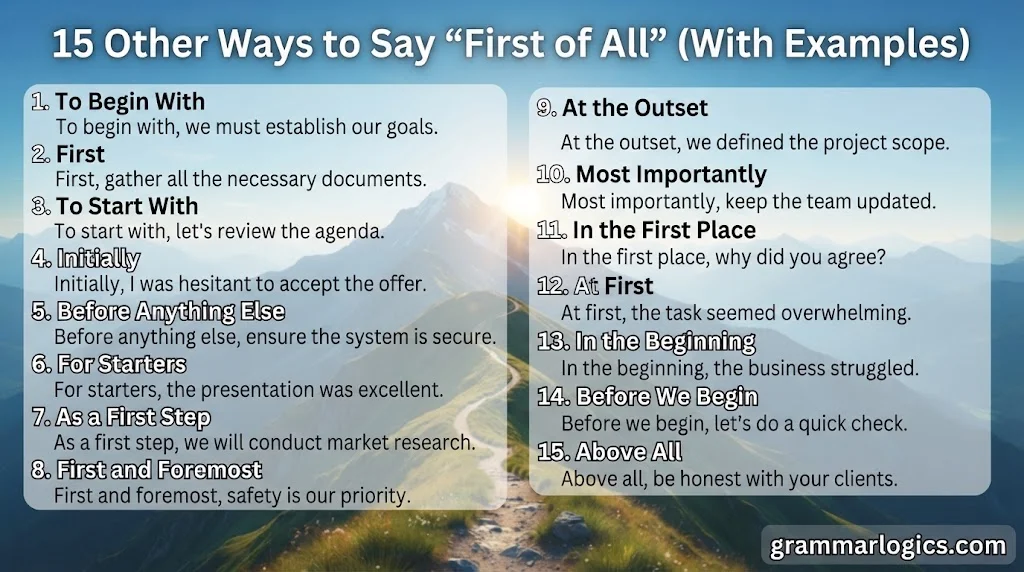
The phrase “first of all” is useful when you want to introduce your first point, instruction, or consideration, but repeating it can make your writing or speech feel predictable.
Choosing a different expression can make your message sound more natural, polished, friendly, direct, or formal depending on the situation. In this guide, you’ll learn 15 practical alternatives to “first of all,” along with their meanings, definitions, tones, and realistic examples.When organizing thoughts, “First of All” helps introduce the initial point clearly, but using different expressions can make your writing more natural and engaging. There are many other ways to say “First of All” depending on the situation, tone, and purpose of your communication. Whether you are writing an email, preparing a presentation, creating a blog post, or speaking in everyday conversation, choosing the right alternative can make your message sound smoother and more professional.
Expressions such as “To Begin With,” “First and Foremost,” “Initially,” and “For Starters” can add variety while keeping your meaning clear. Understanding these alternatives helps you communicate your ideas naturally without repeating the same phrase throughout your writing. In this guide, you will discover useful synonyms and alternatives for “First of All” with clear examples to help you understand when and how to use them. Some expressions are more suitable for formal writing, while others work naturally in casual conversations, presentations, and friendly messages. Learning these alternatives can improve your vocabulary, strengthen your communication skills, and make your sentences more engaging.
What Does “First of All” Mean?
“First of all” is an expression used to introduce the first point, task, reason, or consideration in a sequence. It often tells the listener or reader that something is being discussed before other related points. For example, someone might say, “First of all, we need to understand the problem,” before explaining what should happen next. The phrase can also be used to emphasize an important starting point, as in “First of all, thank you for helping me.” In everyday English, it is generally clear, natural, and widely understood.
The expression does not always mean that something is literally the first event in time. Often, it simply signals where the speaker wants to begin. Depending on context, alternatives such as “to begin with,” “before anything else,” or “first and foremost” can communicate a similar idea while adding a different tone or emphasis.
Common Situations Where “First of All” Is Used
People use “first of all” in everyday conversations, presentations, emails, instructions, discussions, and written explanations. It is particularly useful when someone wants to organize several ideas or explain what should happen first. For example, a teacher might say, “First of all, read the instructions carefully,” while a colleague might write, “First of all, I’d like to thank everyone for their hard work.”
The phrase also appears in personal communication, such as when someone wants to address the most immediate point before moving on to another subject. In professional settings, it can introduce the opening point in a meeting, explanation, or recommendation. However, alternatives can help when the speaker wants to sound less repetitive, more formal, more conversational, or more precise.
Is It Professional or Polite to Say “First of All”?

Yes, “first of all” can be both professional and polite, depending on how it is used. It is a standard English expression and is appropriate in many workplace conversations, presentations, emails, and discussions. For example, “First of all, I appreciate everyone’s effort on this project” sounds perfectly natural in a professional setting.
The phrase is also common in casual conversation. Its main limitation is not that it is impolite or unprofessional, but that it can sometimes sound formulaic or repetitive, especially when used frequently. In formal writing, “to begin with” or “at the outset” may sound more polished, while “for starters” is generally more conversational. The best choice depends on the relationship, purpose, and level of formality.
Advantages and Disadvantages of Saying “First of All”
Advantages
One advantage of “first of all” is its clarity. It immediately signals that the speaker is beginning with a particular point or task. It is also versatile, working in casual speech, professional communication, teaching, presentations, and general writing. Because most English speakers understand it easily, it is a safe choice when you want your meaning to be immediately clear.
Another benefit is that it helps organize information. When several points follow, “first of all” gives the audience a clear starting point. It can also introduce an important preliminary thought without requiring complicated wording.
Disadvantages
The main limitation of “first of all” is that it can become repetitive if it appears frequently in the same conversation or piece of writing. It may also be less precise when the writer actually means something other than sequence. For example, if the intended meaning is “the most important point,” “most importantly” may communicate the idea more accurately.
In highly formal writing, expressions such as “at the outset” can sometimes sound more polished. Likewise, casual situations may call for something more relaxed, such as “for starters.” The issue is therefore usually one of tone and context, rather than correctness.
Synonyms for “First of All”
- To begin with
- First
- To start with
- Initially
- Before anything else
- For starters
- As a first step
- First and foremost
- At the outset
- Most importantly
- In the first place
- At first
- In the beginning
- Before we begin
- Above all
1. To begin with
Meaning
“To begin with” means to start by discussing or considering a particular point. It is one of the closest and most natural alternatives to “first of all.”
Definition
To begin with is an expression used to introduce the first point, reason, or stage of a discussion or explanation.
Detailed Explanation
“To begin with” is especially useful when you are organizing several thoughts and want to introduce the first one naturally. It sounds slightly more polished than “first of all” while remaining conversational. It can also introduce a reason or fact that provides the foundation for what follows. Unlike “most importantly,” it primarily signals sequence, not importance.
Scenario Examples
Scenario: You are explaining why a project needs more time. Example: “To begin with, we still need approval from the design team.”
Scenario: You are discussing a problem with a friend. Example: “To begin with, I think we should talk about what actually happened.”
Scenario: You are starting a presentation. Example: “To begin with, let’s look at the main objectives of the project.”
Best Use
Use “to begin with” in professional communication, presentations, explanations, essays, and everyday conversation. It works well when you expect to introduce additional points afterward.
Tone
Tone: Clear, natural, moderately polished
It feels organized without sounding overly formal.
2. First
Meaning
“First” introduces the first item, action, or point in a sequence. It is a shorter and more direct alternative to “first of all.”
Definition
First means before anything else in a sequence or order.
Detailed Explanation
“First” is more concise than “first of all” and is particularly useful when giving instructions or listing steps. It can sound direct and efficient, especially in professional or instructional writing. Because it is so short, it avoids unnecessary wording. However, it does not carry the same conversational emphasis that “first of all” sometimes provides.
Scenario Examples
Scenario: You are explaining how to complete a form. Example: “First, enter your full name and contact information.”
Scenario: You are giving instructions to a colleague. Example: “First, check the figures, then send me the final version.”
Scenario: You are teaching a student how to solve a problem. Example: “First, identify what information the question gives you.”
Best Use
Use “first” for instructions, lists, presentations, professional writing, and concise explanations.
Tone
Tone: Direct, clear, efficient
Its simplicity makes it useful when you want to get straight to the point.
3. To start with
Meaning
“To start with” means to begin with a particular point, action, or consideration.
Definition
To start with is an expression used to introduce the initial part of an explanation, activity, or discussion.
Detailed Explanation
“To start with” is very close in meaning to “to begin with,” but it often feels slightly more conversational. It works naturally in spoken English and informal writing. The expression can introduce the first reason, observation, or task without sounding overly structured. It is a good choice when you want your wording to feel relaxed but organized.
Scenario Examples
Scenario: You are discussing plans with a friend. Example: “To start with, let’s decide where we want to go.”
Scenario: You are explaining why a proposal needs changes. Example: “To start with, the budget doesn’t cover the full cost.”
Scenario: You are beginning a practical lesson. Example: “To start with, gather all the materials you’ll need.”
Best Use
Use it in conversation, friendly messages, meetings, instructions, and informal professional communication.
Tone
Tone: Friendly, conversational, organized
It sounds natural without being overly formal.
4. Initially
Meaning
“Initially” means at the beginning of a process, situation, or period.
Definition
Initially means at first or during the earliest stage of something.
Detailed Explanation
“Initially” differs slightly from “first of all” because it often describes the early stage of a situation, rather than simply introducing the first point in a list. It is particularly useful when circumstances change later. For example, “Initially, we planned to stay for two days” suggests that the plan was later changed. This makes it useful when discussing development, timing, or changing decisions.
Scenario Examples
Scenario: You are explaining how a project developed. Example: “Initially, the team planned to launch the product in June.”
Scenario: You are describing your first reaction. Example: “Initially, I was unsure about the idea, but it grew on me.”
Scenario: You are writing a project report. Example: “Initially, the process required several manual steps.”
Best Use
Use “initially” in formal writing, reports, professional communication, academic writing, and explanations of changing situations.
Tone
Tone: Formal, precise, neutral
It is more polished than “first of all” and focuses on an early stage in time.
5. Before anything else
Meaning
“Before anything else” means that something should happen or be considered before all other things.
Definition
Before anything else means as the first priority or before taking other actions.
Detailed Explanation
This expression emphasizes priority more strongly than a simple sequencing phrase. It can suggest that one action is necessary before anything else can happen. It is therefore useful when giving advice, setting priorities, or emphasizing a preliminary responsibility. Depending on context, it can sound more purposeful and firm than “first of all.”
Scenario Examples
Scenario: You are advising someone before an important meeting. Example: “Before anything else, make sure you have all the documents ready.”
Scenario: You are helping a friend solve a problem. Example: “Before anything else, take a moment to calm down.”
Scenario: You are explaining a safety procedure. Example: “Before anything else, switch off the equipment.”
Best Use
Use it for instructions, advice, safety guidance, personal conversations, and situations involving clear priorities.
Tone
Tone: Direct, purposeful, caring
It strongly communicates that something deserves attention before other actions.
6. For starters
Meaning
“For starters” means as an initial point or example. It often introduces the first of several reasons, ideas, or observations.
Definition
For starters means as a beginning point or as one initial consideration.
Detailed Explanation
“For starters” is considerably more casual than “first of all.” It works well when talking with friends or making an informal argument. It can also introduce one obvious reason among several, rather than formally numbering a list. Because of its relaxed style, it is generally less suitable for highly formal documents.
Scenario Examples
Scenario: You are explaining why you like a restaurant. Example: “For starters, the food is excellent and the service is friendly.”
Scenario: You are discussing weekend plans. Example: “For starters, we could go for coffee and see where the day takes us.”
Scenario: You are casually explaining a problem. Example: “For starters, nobody told me the schedule had changed.”
Best Use
Use it in casual conversation, texting, friendly emails, informal discussions, and social media.
Tone
Tone: Casual, confident, conversational
It sounds relaxed and often adds a little personality to an explanation.
7. As a first step
Meaning
“As a first step” refers to the first action taken in a process.
Definition
As a first step means as the initial action toward achieving something.
Detailed Explanation
This expression is more specific than “first of all” because it focuses on an action or procedure. It works particularly well when describing plans, projects, problem-solving, or instructions. It suggests that other steps will follow. If you are simply introducing an opinion rather than an action, “to begin with” may be more natural.
Scenario Examples
Scenario: You are advising a customer about a problem. Example: “As a first step, please restart the device and check the connection.”
Scenario: You are planning a business project. Example: “As a first step, we need to identify the resources we already have.”
Scenario: You are helping a student plan an essay. Example: “As a first step, create a simple outline of your main ideas.”
Best Use
Use it in professional communication, instructions, project planning, education, and problem-solving.
Tone
Tone: Practical, professional, structured
It clearly signals that an action is the beginning of a larger process.
8. First and foremost
Meaning
“First and foremost” means above everything else or before other considerations.
Definition
First and foremost means most importantly or as the highest priority.
Detailed Explanation
Although it can introduce a first point, “first and foremost” often emphasizes importance rather than sequence. It is useful when you want to tell someone what matters most. The phrase can sound more emphatic and polished than “first of all.” Because of that emphasis, it should not be used when you simply mean that something happens first chronologically.
Scenario Examples
Scenario: You are discussing customer service. Example: “First and foremost, we need to make sure our customers feel heard.”
Scenario: You are writing a personal message. Example: “First and foremost, I want you to know how grateful I am.”
Scenario: You are discussing team values. Example: “First and foremost, everyone should treat one another with respect.”
Best Use
Use it in speeches, professional communication, personal statements, formal discussions, and situations involving priorities.
Tone
Tone: Emphatic, respectful, sincere
It highlights what the speaker considers particularly important.
9. At the outset
Meaning
“At the outset” means at the very beginning of a process, event, discussion, or situation.
Definition
At the outset means at the beginning or at the earliest stage of something.
Detailed Explanation
“At the outset” is more formal than “first of all” and is often used in professional, academic, or formal written communication. It can refer to the beginning of a project, agreement, discussion, or process. Unlike “first,” it has a distinctly polished and formal feel. It is most natural when discussing a situation or process, rather than giving everyday instructions.
Scenario Examples
Scenario: You are writing a business report. Example: “At the outset, the project faced several unexpected challenges.”
Scenario: You are discussing an agreement. Example: “At the outset, both parties agreed to review the terms annually.”
Scenario: You are giving a formal presentation. Example: “At the outset, I would like to clarify the purpose of this meeting.”
Best Use
Use it in formal writing, business reports, academic contexts, presentations, and official communication.
Tone
Tone: Formal, polished, professional
It gives an explanation a more structured and authoritative feel.
10. Most importantly
Meaning
“Most importantly” means the point that matters the most.
Definition
Most importantly means above all in terms of importance or significance.
Detailed Explanation
“Most importantly” is not a perfect synonym for “first of all” because it focuses on priority of importance, not necessarily position in a sequence. Use it when you want readers to pay special attention to a particular point. It is especially useful when the most important idea comes before or after several supporting details. Choosing this phrase can make your communication more precise when importance is what you really mean.
Scenario Examples
Scenario: You are giving advice to a new employee. Example: “Most importantly, ask questions whenever something is unclear.”
Scenario: You are thanking someone. Example: “Most importantly, I appreciate the trust you placed in me.”
Scenario: You are explaining what makes a good team. Example: “Most importantly, everyone needs to communicate openly.”
Best Use
Use it in professional communication, presentations, advice, personal messages, and persuasive or explanatory writing.
Tone
Tone: Emphatic, thoughtful, confident
It signals that the following point deserves particular attention.
11. In the first place
Meaning
“In the first place” can mean at the beginning or, in another common use, for the original or fundamental reason.
Definition
In the first place means first in order or as an original/fundamental consideration.
Detailed Explanation
This expression has more than one use, so context matters. It can introduce an initial point, but it is also commonly used when questioning why something happened at all, as in “Why did we agree to this in the first place?” That second use is not interchangeable with “first of all.” When used to organize an explanation, it can sound somewhat formal or deliberate.
Scenario Examples
Scenario: You are explaining the first reason for a decision. Example: “In the first place, we didn’t have enough information to proceed.”
Scenario: You are questioning an earlier decision. Example: “Why did we choose that option in the first place?”
Scenario: You are explaining a disagreement. Example: “In the first place, we never agreed on the final deadline.”
Best Use
Use it in reasoning, explanations, formal discussions, essays, and situations where you want to discuss an original reason.
Tone
Tone: Thoughtful, deliberate, sometimes questioning
Its tone depends strongly on context and can sound more analytical than “first of all.”
12. At first
Meaning
“At first” means during the initial period of a situation or experience.
Definition
At first means initially or during the beginning stage of something.
Detailed Explanation
“At first” is mainly about time, rather than introducing the first point in a list. It is often followed by a change, contrast, or later development. For example, “At first, I disliked the idea, but eventually I understood it.” This makes it useful for describing experiences, reactions, plans, or situations that develop over time.
Scenario Examples
Scenario: You are describing your reaction to a new job. Example: “At first, I found the new schedule difficult, but I adjusted quickly.”
Scenario: You are talking about a new hobby. Example: “At first, the technique seemed complicated.”
Scenario: You are describing a relationship with a new colleague. Example: “At first, we barely spoke, but we eventually became good friends.”
Best Use
Use it in storytelling, personal conversations, explanations of change, and descriptions of experiences.
Tone
Tone: Neutral, reflective, conversational
It naturally suggests that the situation may change later.
13. In the beginning
Meaning
“In the beginning” refers to the earliest part of a situation, process, period, or story.
Definition
In the beginning means during the initial stage or at the start of something.
Detailed Explanation
This phrase usually has a stronger connection to time or development than “first of all.” It is useful when describing how something was when it started, especially when the situation later changed. It can also have a storytelling quality. For simply introducing the first point in an argument, “to begin with” is often more natural.
Scenario Examples
Scenario: You are describing a new business. Example: “In the beginning, the company had only three employees.”
Scenario: You are telling someone about a new friendship. Example: “In the beginning, we didn’t have much in common.”
Scenario: You are explaining how a project developed. Example: “In the beginning, we focused on research rather than implementation.”
Best Use
Use it for storytelling, personal experiences, project histories, and descriptions of development over time.
Tone
Tone: Reflective, narrative, neutral
It works naturally when describing how something started and changed.
14. Before we begin
Meaning
“Before we begin” means before an activity, meeting, discussion, lesson, or event officially starts.
Definition
Before we begin is an expression used to introduce something that should be said or done prior to starting.
Detailed Explanation
“Before we begin” differs from “first of all” because it specifically refers to something that happens before the main activity starts. It is common in presentations, meetings, classes, workshops, and group discussions. The expression can introduce a reminder, announcement, thank-you, or preliminary instruction. It sounds natural and inclusive because it directly addresses a group.
Scenario Examples
Scenario: You are opening a meeting. Example: “Before we begin, does anyone have any urgent questions?”
Scenario: You are teaching a class. Example: “Before we begin, please make sure your phones are on silent.”
Scenario: You are starting a presentation. Example: “Before we begin, I’d like to thank everyone for joining us.”
Best Use
Use it in meetings, presentations, classes, workshops, group discussions, and public speaking.
Tone
Tone: Polite, organized, welcoming
It prepares people for what is about to happen without sounding overly formal.
15. Above all
Meaning
“Above all” means more importantly than anything else.
Definition
Above all means more than anything else or as the highest priority.
Detailed Explanation
“Above all” is another alternative that emphasizes importance rather than sequence. It is useful when you want to identify the value, principle, or consideration that matters most. It can sound warm and sincere in personal communication, while also working in formal writing. Because it expresses priority, it should not automatically replace “first of all” when you simply mean “the first point.”
Scenario Examples
Scenario: You are describing what matters in a friendship. Example: “Above all, trust is essential in a lasting friendship.”
Scenario: You are giving advice to a new manager. Example: “Above all, listen carefully before making a decision.”
Scenario: You are writing a personal note. Example: “Above all, I hope you know that I’m always here for you.”
Best Use
Use it in personal messages, speeches, advice, reflective writing, and discussions about values or priorities.
Tone
Tone: Warm, sincere, emphatic
It gives special importance to the idea that follows.
FAQs
1. What are other ways to say “First of All”?
Some common alternatives include “To Begin With,” “First and Foremost,” “Initially,” “For Starters,” and “At the Beginning.” The best choice depends on your tone and context.
2. What is a formal way to say “First of All”?
For formal writing, you can use expressions such as “To Begin With,” “First and Foremost,” “Initially,” or “At the Outset.” These phrases work well in professional and academic contexts.
3. What can I say instead of “First of All” in an essay?
In an essay, alternatives such as “To Begin With,” “Firstly,” “Initially,” and “First and Foremost” can introduce your opening point clearly and smoothly.
4. Is “To Begin With” the same as “First of All”?
Yes, “To Begin With” can often replace “First of All” because both phrases introduce the first idea or point. However, the exact meaning can vary slightly depending on the sentence.
5. Why should I use alternatives to “First of All”?
Using different expressions and synonyms can make your writing more natural, varied, and engaging. It also helps you choose language that suits formal, casual, academic, or professional communication.
Conclusion
Knowing other ways to say “First of All” can make your communication more flexible, natural, and engaging. Expressions such as “To Begin With,” “First and Foremost,” “Initially,” and “For Starters” allow you to introduce ideas without repeatedly using the same phrase. Choosing the right alternative depends on your context, audience, and tone, so consider whether you are writing an essay, email, presentation, blog post, or casual message.
By learning these useful alternatives to “First of All,” you can expand your vocabulary and express your ideas with greater clarity and confidence. Keep the context in mind when selecting a phrase, and practice using different expressions in your everyday writing and conversations. With the right alternatives, your sentences can sound smoother, more polished, and more interesting.