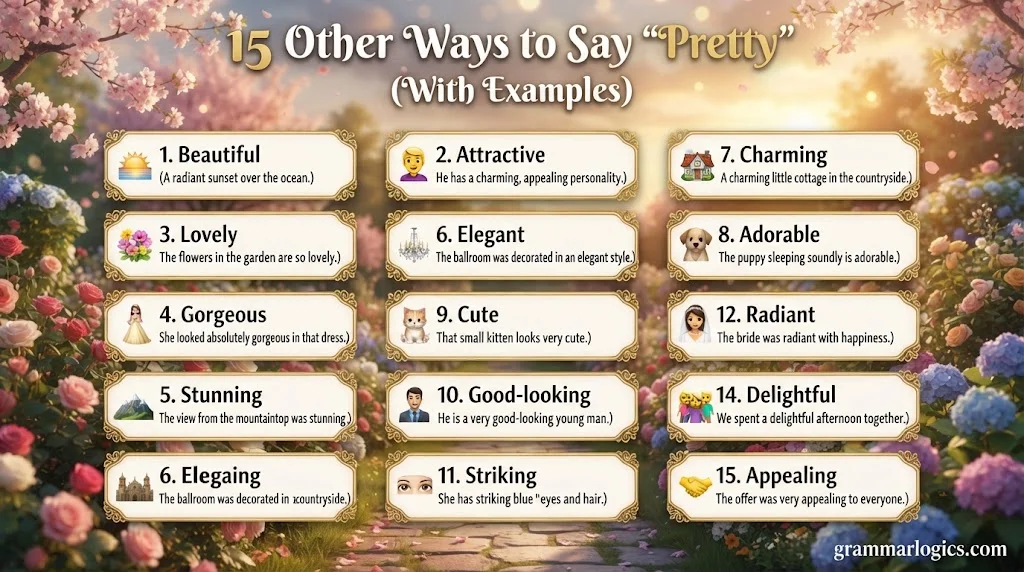
Other Ways to Say “Pretty” can help you express beauty, charm, and attractiveness in more natural and varied ways.
Finding the right words to describe someone or something as pretty can make your communication more expressive and engaging. While “pretty” is a common and versatile word, using different synonyms and alternative phrases can add personality, warmth, and precision to your writing or conversation. Whether you are describing a person, appearance, place, outfit, artwork, or a beautiful moment, choosing the right expression helps you communicate exactly what you mean. From casual compliments like “beautiful” and “lovely” to more thoughtful expressions such as “elegant,” “charming,” and “stunning,” there are many natural alternatives to explore.
In this guide, we’ll explore useful other ways to say “pretty” for different situations, including everyday conversations, compliments, professional writing, and creative descriptions. Each alternative has its own tone and meaning, so understanding the context can help you choose the most suitable expression. You’ll discover natural synonyms for pretty, along with clear examples that show how each phrase can be used effectively. Whether you want to compliment someone, describe something attractive, or make your writing more descriptive and engaging, these alternatives will help you expand your vocabulary and express yourself with greater confidence.
What Does “Pretty” Mean?
Pretty commonly means attractive, pleasing, or pleasant to look at. When describing a person, it usually suggests that someone has an appealing or attractive appearance, often in a gentle or complimentary way. For example, saying “She looks pretty in that dress” expresses admiration without necessarily suggesting dramatic or striking beauty. The word can also describe things such as flowers, rooms, clothes, scenery, or designs: “That’s a pretty garden” means the garden is visually pleasing.
“Pretty” can also have another common meaning when used as an adverb. In expressions such as “pretty good,” “pretty difficult,” or “pretty expensive,” it means “fairly” or “quite.” This article focuses mainly on pretty as a description of attractiveness or pleasant appearance, because the best alternative depends heavily on what or whom you are describing.
Common Situations Where “Pretty” Is Used
People commonly use pretty in everyday conversation, text messages, compliments, social media posts, and personal communication. You might tell a friend, “You look pretty today,” describe a photograph as “pretty,” or comment that a particular room has a pretty design. It is especially common when the speaker wants to sound friendly and complimentary without being overly dramatic.
The word can also appear in creative writing, casual workplace conversation, and customer-facing communication when appearance is relevant. However, the most suitable alternative depends on the situation. A romantic compliment might call for something warmer, while a description of a building or piece of artwork might benefit from a word such as beautiful or elegant. Choosing a more precise expression can make your wording feel less repetitive and better suited to the context.
Is It Professional or Polite to Say “Pretty”?

Yes, pretty is generally a polite and ordinary English word, but its suitability depends on what you are describing and who you are speaking to. Complimenting a friend by saying, “You look pretty,” is usually warm and natural. However, commenting on a colleague’s physical appearance can sometimes feel more personal than intended, particularly in a formal workplace.
When discussing objects, places, designs, or visual work, pretty is generally unproblematic. In professional or formal writing, alternatives such as beautiful, elegant, attractive, or visually appealing may provide greater precision. The important distinction is context: a word that sounds perfectly natural among friends may not communicate the same way in a professional setting.
Advantages and Disadvantages of Saying “Pretty”
Advantages
The main advantage of pretty is its versatility. It is simple, familiar, positive, and easy to understand. It can express admiration without sounding excessively intense, which makes it useful for everyday compliments. It can also describe people, clothing, scenery, objects, and designs, giving it a broad range of uses.
Disadvantages
Because pretty is so common, it can sometimes feel general or less distinctive when you want to express stronger admiration. It may also be too mild when you mean exceptionally beautiful, and it may not communicate a specific quality such as elegance, attractiveness, charm, or visual appeal. When describing someone’s appearance in a professional setting, it can also feel more personal than a neutral expression such as attractive or well-presented.
Natural Alternatives to “Pretty”
- Beautiful
- Attractive
- Lovely
- Gorgeous
- Stunning
- Elegant
- Charming
- Adorable
- Cute
- Good-looking
- Striking
- Radiant
- Alluring
- Delightful
- Appealing
1. Beautiful
Meaning
Beautiful describes someone or something that is highly pleasing or attractive in appearance. It is broader and often stronger than pretty, and it can suggest a deeper sense of admiration.
Definition
Beautiful means exceptionally pleasing to the senses, especially in appearance, although it can also describe qualities, experiences, ideas, or actions.
Detailed Explanation
Beautiful is one of the most natural alternatives when pretty feels too mild. It can describe a person, place, object, artwork, or experience, making it more versatile than many appearance-related words. The expression often carries a stronger emotional quality than pretty. It is suitable for both everyday conversation and more thoughtful or expressive writing.
Scenario Examples
Scenario: You are complimenting a friend after seeing a new photograph.
Example: “You look absolutely beautiful in that photo.”
Scenario: You are describing a peaceful landscape.
Example: “The view from the mountain was incredibly beautiful.”
Scenario: You are complimenting someone’s thoughtful work.
Example: “That was a beautiful piece of writing.”
Best Use
Use beautiful for personal compliments, creative writing, photography, nature, art, and situations where you want to express stronger admiration.
Tone
Tone: Warm, sincere, expressive. It sounds heartfelt without necessarily being romantic.
2. Attractive
Meaning
Attractive means pleasing or appealing in appearance. It is more neutral and objective than pretty.
Definition
Attractive describes someone or something that has qualities that draw interest or admiration.
Detailed Explanation
Attractive is useful when you want to describe appearance without sounding overly emotional. It is particularly useful in professional, descriptive, or neutral contexts. When describing a person, it can refer to physical appearance, while with objects or places it can mean visually appealing. Compared with pretty, it usually sounds less delicate and more matter-of-fact.
Scenario Examples
Scenario: You are discussing the design of a website.
Example: “The new layout is clean and attractive.”
Scenario: Someone asks how you would describe a person in a neutral way.
Example: “He has a very attractive appearance.”
Scenario: You are discussing a product.
Example: “The packaging is simple but attractive.”
Best Use
Use attractive for neutral descriptions, professional communication, product descriptions, design discussions, and situations where emotional language is unnecessary.
Tone
Tone: Neutral, polished, direct. It communicates appreciation without sounding especially intimate.
3. Lovely
Meaning
Lovely describes someone or something that is pleasing, pleasant, attractive, or delightful. It often feels warmer and more affectionate than pretty.
Definition
Lovely means very pleasant, attractive, enjoyable, or pleasing.
Detailed Explanation
Lovely is a gentle alternative that works especially well when you want your compliment to feel personal and warm. It can describe appearance, personality, experiences, places, and objects. Unlike pretty, it can communicate something about the overall pleasant impression a person or thing creates. In British English, lovely is particularly common in everyday speech.
Scenario Examples
Scenario: You are complimenting a friend’s new outfit.
Example: “That’s a lovely dress. The color really suits you.”
Scenario: A friend sends you a picture of their garden.
Example: “Your garden looks lovely this spring.”
Scenario: You are thanking someone for a thoughtful gesture.
Example: “That was such a lovely thing to do.”
Best Use
Use lovely for friendly compliments, personal messages, everyday conversation, descriptions of pleasant things, and warm social communication.
Tone
Tone: Warm, affectionate, gentle. It often feels more personal than a straightforward description of appearance.
4. Gorgeous
Meaning
Gorgeous means extremely attractive or beautiful. It is generally stronger and more enthusiastic than pretty.
Definition
Gorgeous describes someone or something that is exceptionally attractive or visually impressive.
Detailed Explanation
Gorgeous is a good choice when pretty does not seem strong enough to express your admiration. It is common in casual conversation and can sound enthusiastic when used as a compliment. Depending on the situation, it can be romantic or simply expressive. Because it is quite strong, it may feel exaggerated for a neutral or formal description.
Scenario Examples
Scenario: Your friend shows you their outfit before an event.
Example: “You look gorgeous tonight!”
Scenario: You are describing a spectacular interior.
Example: “The hotel has a gorgeous lobby.”
Scenario: Someone shares a vacation photograph.
Example: “That beach looks gorgeous.”
Best Use
Use gorgeous for enthusiastic compliments, fashion, photographs, travel, beauty, and informal personal communication.
Tone
Tone: Enthusiastic, warm, expressive. It conveys strong admiration and can sometimes sound flirtatious.
5. Stunning
Meaning
Stunning describes something so attractive or impressive that it immediately captures attention.
Definition
Stunning means extremely impressive or beautiful, often to the point of making a strong visual impact.
Detailed Explanation
Stunning is stronger than pretty and usually suggests that something stands out immediately. It works especially well for photographs, outfits, scenery, architecture, and dramatic visual appearances. Unlike lovely, it is less gentle and more striking. It can be used for people, but context determines whether the compliment feels casual, romantic, or simply admiring.
Scenario Examples
Scenario: A friend shares a formal-event photograph.
Example: “You look stunning in that outfit.”
Scenario: You arrive at a scenic location.
Example: “The view from here is stunning.”
Scenario: You are discussing a building.
Example: “The museum has a stunning entrance.”
Best Use
Use stunning when you want to emphasize visual impact, especially in photography, fashion, architecture, travel, and special occasions.
Tone
Tone: Strong, admiring, dramatic. It suggests that something immediately catches the eye.
6. Elegant
Meaning
Elegant describes beauty that is graceful, refined, and tasteful rather than simply attractive.
Definition
Elegant means attractive in a graceful, refined, and sophisticated way.
Detailed Explanation
Elegant is not a direct replacement for pretty in every situation because it emphasizes style and refinement. It is especially appropriate for clothing, interiors, architecture, writing, manners, and someone’s overall appearance. Choosing elegant suggests that the appeal comes from simplicity, balance, or sophistication. It therefore gives your compliment a more polished quality.
Scenario Examples
Scenario: You are complimenting someone at a formal event.
Example: “Your dress looks incredibly elegant.”
Scenario: You are describing an apartment.
Example: “The room has an elegant and timeless design.”
Scenario: You are reviewing a presentation.
Example: “The slides have a simple, elegant layout.”
Best Use
Use elegant for formal occasions, fashion, interior design, architecture, writing, presentations, and refined visual styles.
Tone
Tone: Sophisticated, polished, respectful. It sounds more refined and formal than pretty.
7. Charming
Meaning
Charming describes someone or something that is pleasantly attractive in a way that creates affection or interest.
Definition
Charming means pleasantly attractive, appealing, or engaging, often because of personality or character.
Detailed Explanation
Charming differs from pretty because it is not limited to physical appearance. A person can be charming because of their personality, manners, smile, humor, or behavior. Places and objects can also be charming when they have a distinctive or appealing character. This makes it useful when you want to compliment more than someone’s looks.
Scenario Examples
Scenario: You meet someone who makes everyone feel comfortable.
Example: “She has such a charming personality.”
Scenario: You are describing a small town.
Example: “We stayed in a charming little village.”
Scenario: You are describing someone’s manner.
Example: “He gave us a charming smile.”
Best Use
Use charming for personalities, smiles, manners, small places, homes, and anything with a pleasant character.
Tone
Tone: Warm, affectionate, personable. It focuses on appeal and character rather than appearance alone.
8. Adorable
Meaning
Adorable describes someone or something that inspires strong affection because they are especially cute, endearing, or lovable.
Definition
Adorable means extremely cute, lovable, or endearing.
Detailed Explanation
Adorable is more specific than pretty because it expresses affection and cuteness rather than general attractiveness. It is often used for babies, children, pets, small objects, outfits, and affectionate moments. It can also describe adults, although the context should support the playful or affectionate feeling. It is usually less suitable for formal communication.
Scenario Examples
Scenario: A friend shows you a photograph of their puppy.
Example: “Your puppy is absolutely adorable!”
Scenario: Someone buys a small handmade gift.
Example: “This little notebook is adorable.”
Scenario: A child proudly shows you their drawing.
Example: “That’s an adorable drawing!”
Best Use
Use adorable for pets, children, cute objects, playful compliments, and affectionate personal messages.
Tone
Tone: Playful, affectionate, warm. It emphasizes cuteness and emotional affection rather than sophistication.
9. Cute
Meaning
Cute describes something that is attractive in a small, appealing, playful, or endearing way.
Definition
Cute means pleasantly attractive, especially in a youthful, charming, or playful way.
Detailed Explanation
Cute is one of the most common casual alternatives to pretty, but the two words are not identical. Pretty often focuses on beauty, while cute emphasizes playfulness, charm, or endearment. It can describe people, pets, clothes, rooms, objects, messages, and designs. In personal conversation, it is usually relaxed and friendly.
Scenario Examples
Scenario: Your friend gets a new haircut.
Example: “That’s a really cute haircut.”
Scenario: You see a small café while walking around town.
Example: “This is such a cute little café.”
Scenario: Someone sends you a sweet message.
Example: “That’s cute of you to say.”
Best Use
Use cute for casual conversation, texting, social media, pets, outfits, small places, and playful compliments.
Tone
Tone: Casual, playful, friendly. It sounds relaxed rather than formal or sophisticated.
10. Good-looking
Meaning
Good-looking means physically attractive, particularly when describing a person’s appearance.
Definition
Good-looking means having an attractive physical appearance.
Detailed Explanation
Good-looking is a straightforward way to describe physical attractiveness. It is commonly applied to people and is generally more neutral than gorgeous or stunning. Unlike pretty, which can sound softer or more delicate, good-looking is direct and matter-of-fact. It is usually less suitable for describing objects unless the context makes that usage natural.
Scenario Examples
Scenario: You are describing an actor in a casual conversation.
Example: “He’s definitely good-looking, but his personality is what really stands out.”
Scenario: Someone asks how you would describe a person.
Example: “She’s very good-looking and has a confident presence.”
Scenario: You are talking with a friend about a character in a film.
Example: “The main character is supposed to be young and good-looking.”
Best Use
Use good-looking for people when you want a clear, neutral description of physical attractiveness.
Tone
Tone: Direct, casual, neutral. It is less emotionally expressive than beautiful or gorgeous.
11. Striking
Meaning
Striking describes an appearance that is unusually noticeable, distinctive, or impressive.
Definition
Striking means very noticeable or impressive because of a distinctive appearance or quality.
Detailed Explanation
Striking is useful when something is not merely pretty but has a feature that immediately attracts attention. It can describe a person’s appearance, a photograph, architecture, artwork, or a visual design. The word does not necessarily mean traditionally beautiful. Instead, it emphasizes memorability and visual impact.
Scenario Examples
Scenario: You are describing someone’s distinctive appearance.
Example: “She has a striking appearance and a very confident style.”
Scenario: You visit a modern building.
Example: “The building has a striking geometric design.”
Scenario: You review a photograph.
Example: “The contrast between the mountains and sky is really striking.”
Best Use
Use striking for distinctive people, photography, art, architecture, fashion, and designs with strong visual impact.
Tone
Tone: Sophisticated, observant, expressive. It emphasizes distinctiveness more than conventional beauty.
12. Radiant
Meaning
Radiant describes someone who looks especially happy, healthy, bright, or glowing.
Definition
Radiant means visibly glowing with beauty, happiness, health, or positive energy.
Detailed Explanation
Radiant is more expressive than pretty because it often connects appearance with emotion or energy. It is commonly used when someone looks especially happy, confident, healthy, or joyful. The word can be particularly effective for special occasions such as weddings, celebrations, or reunions. It is less neutral than attractive and more emotionally descriptive.
Scenario Examples
Scenario: You see a friend after they receive wonderful news.
Example: “You look absolutely radiant today.”
Scenario: Someone shares a wedding photograph.
Example: “She looked radiant on her wedding day.”
Scenario: You are writing a personal compliment.
Example: “Your smile makes you look radiant.”
Best Use
Use radiant for personal compliments, celebrations, photographs, smiles, and situations where happiness or positive energy is visible.
Tone
Tone: Warm, glowing, affectionate. It combines physical attractiveness with a sense of joy or vitality.
13. Alluring
Meaning
Alluring describes someone or something that is strongly attractive or appealing, often in a captivating way.
Definition
Alluring means highly attractive or fascinating in a way that draws people toward someone or something.
Detailed Explanation
Alluring is a more sophisticated and sometimes more sensual alternative to pretty. It often suggests that an appearance, style, voice, place, or quality has a compelling attraction. Because of this nuance, it is not appropriate for every everyday compliment. The word works best when you want to emphasize a powerful or captivating appeal.
Scenario Examples
Scenario: You are describing a mysterious setting in creative writing.
Example: “The old garden had an alluring atmosphere.”
Scenario: You are discussing a distinctive fragrance.
Example: “The perfume has an alluring scent.”
Scenario: You are describing someone’s captivating style.
Example: “Her alluring style made her stand out from the crowd.”
Best Use
Use alluring in creative writing, descriptions of style, atmosphere, fragrance, beauty, and situations involving captivating appeal.
Tone
Tone: Sophisticated, captivating, sometimes sensual. It carries a stronger sense of attraction than ordinary compliments such as pretty.
14. Delightful
Meaning
Delightful describes something that gives pleasure, enjoyment, or a strong positive feeling.
Definition
Delightful means very pleasant, enjoyable, or charming.
Detailed Explanation
Delightful is not an exact synonym for pretty because it focuses more on pleasantness and enjoyment than physical beauty. It can describe people, experiences, places, conversations, meals, objects, or moments. This makes it useful when the positive quality goes beyond appearance. It is especially helpful when you want a compliment to sound warm without focusing directly on someone’s looks.
Scenario Examples
Scenario: You spend an enjoyable afternoon with someone.
Example: “We had a delightful afternoon together.”
Scenario: You are reviewing a small restaurant.
Example: “The restaurant has a delightful atmosphere.”
Scenario: Someone gives a thoughtful performance.
Example: “That was a delightful performance.”
Best Use
Use delightful for experiences, places, conversations, performances, personalities, and things that create pleasure or enjoyment.
Tone
Tone: Warm, positive, courteous. It sounds pleasant and polished without being overly intense.
15. Appealing
Meaning
Appealing means attractive or interesting in a way that makes someone like or choose something.
Definition
Appealing means attractive, interesting, or pleasing enough to create interest or approval.
Detailed Explanation
Appealing is broader and more neutral than pretty. It can describe appearance, design, ideas, products, places, or choices, making it particularly useful outside personal compliments. When describing a person, it may refer to both appearance and general attractiveness. In professional contexts, appealing can sound more objective than beautiful or gorgeous.
Scenario Examples
Scenario: You are discussing a product’s design.
Example: “The new packaging is simple and appealing.”
Scenario: You are describing a website to a colleague.
Example: “The updated design is much more appealing to visitors.”
Scenario: You are talking about a vacation destination.
Example: “The town is small but very appealing.”
Best Use
Use appealing for products, designs, websites, places, ideas, and situations where you want a neutral, broadly applicable description.
Tone
Tone: Neutral, polished, practical. It works especially well when the focus is on overall appeal rather than emotional admiration.
FAQs
1. What are other ways to say “pretty”?
Some common alternatives to pretty include beautiful, lovely, attractive, gorgeous, charming, elegant, and stunning. The best choice depends on the person, object, or situation you are describing.
2. What is a more sophisticated word for “pretty”?
Words such as elegant, exquisite, graceful, radiant, and captivating can sound more sophisticated. These expressions work especially well in formal, creative, or descriptive writing.
3. How can I say “pretty” as a compliment?
You can say “You look beautiful,” “You look lovely,” “You look stunning,” or “You look absolutely gorgeous.” These phrases can make a compliment sound more expressive and sincere.
4. What is a casual synonym for “pretty”?
For casual conversations, words such as cute, lovely, beautiful, attractive, and charming are natural choices. The appropriate synonym depends on the tone and context.
5. Can “pretty” describe things other than people?
Yes. Pretty can describe places, clothes, decorations, flowers, artwork, scenery, and many other things. Alternatives such as beautiful, lovely, attractive, delightful, and gorgeous can make descriptions more specific and engaging.
Conclusion
Knowing different other ways to say “pretty” can make your conversations and writing more expressive. Instead of relying on the same word repeatedly, you can choose alternatives such as beautiful, lovely, charming, elegant, gorgeous, or stunning based on the situation and tone. Each expression adds a slightly different meaning, helping you describe beauty and attractiveness more naturally.
Whether you are writing a blog post, complimenting someone, describing an attractive place, or improving your English vocabulary, these alternatives can give your language more variety and personality. Understanding the context behind each synonym for pretty will help you choose the right expression and communicate your ideas with greater clarity and confidence.