The phrase “About Us” introduces a website, business, or organization and helps visitors understand who you are and what you do.
Finding the right alternative to “About Us” can make your website sound more professional, engaging, and welcoming. Whether you run a personal blog, an online store, a business website, or a creative portfolio, choosing suitable words can help you communicate your brand’s identity more effectively. Phrases such as “Our Story,” “Who We Are,” and “Meet Our Team” offer different ways to introduce your organization while creating a stronger connection with readers. The best choice depends on your website’s purpose, audience, and overall tone. A thoughtful heading can encourage visitors to explore your content, learn about your values, and understand what makes your brand unique.
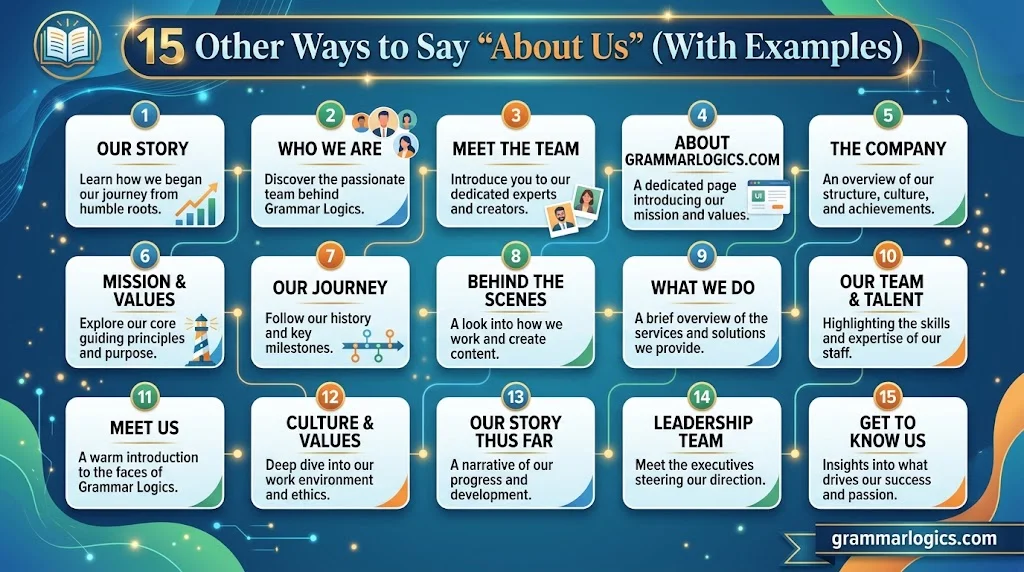
In this guide, you will discover 15 other ways to say “About Us”, along with clear explanations and practical examples to help you choose the right phrase. Each alternative serves a slightly different purpose, making it easier to find wording that matches your website’s personality and goals. For example, “Our Story” works well for sharing your journey, while “Our Mission” highlights your purpose and values. Similarly, “Get to Know Us” creates a friendly, conversational feeling, and “Who We Are” provides a simple, direct introduction. These alternatives can improve your website’s navigation, support a consistent brand voice, and create a more engaging visitor experience. Let’s explore the best options for your next page heading.
What Does “About Us” Mean?
“About Us” is a common website heading that introduces a person, business, organization, or group. It usually leads to information about who they are, what they do, what they believe in, and why they exist. On a company website, this section may describe the business’s background, mission, values, team, and experience. On a personal website, it might explain the owner’s interests, professional background, or goals. The phrase is simple, familiar, and easy to understand. Although it can refer to people or groups in general conversation, its most common website use is to help visitors learn more about the organization or individual behind a website.
Common Situations Where “About Us” Is Used
The phrase “About Us” appears in many types of online and professional communication. Businesses use it in website navigation to introduce their history, services, and values. Nonprofit organizations may use the heading to explain their purpose and community work, while schools use it to share their background and educational goals. Bloggers and content creators sometimes use similar headings to introduce their interests, experience, and reasons for creating content.
In e-commerce, this section can help customers understand the people behind a brand. On a portfolio website, a more personal heading may work better because it introduces an individual rather than a company. Choosing an alternative allows website owners to communicate their identity more clearly and create a stronger connection with visitors.
Is It Professional or Polite to Say “About Us”?
Yes, “About Us” is professional, neutral, and widely accepted as a website heading. It works well for businesses, agencies, nonprofits, educational institutions, and other organizations. Its main advantage is familiarity: visitors generally understand what to expect when they click it. The phrase is neither overly formal nor particularly emotional, making it suitable for many audiences.
However, some brands may prefer a more distinctive heading. A creative business might choose “Our Story,” while a service provider could use “What We Do” to emphasize its work. A personal portfolio might benefit from “Meet the Founder” or “Who I Am.” These alternatives are not exact synonyms in every context because each highlights a different aspect of an organization or individual. The best choice depends on brand personality, audience expectations, and the information presented on the page.
Advantages and Disadvantages of Saying “About Us”
Advantages
- Clear and familiar: Visitors immediately understand that the page introduces a business, person, or organization.
- Professional and neutral: It suits formal businesses, small companies, nonprofits, and personal websites.
- Easy to navigate: The short heading fits naturally into website menus and page layouts.
- Broad in meaning: It can introduce a company’s history, team, mission, values, or background without limiting the content to one subject.
Disadvantages
- Common wording: Many websites use the same heading, so it may not communicate a distinctive brand personality.
- Limited emotional appeal: It does not automatically create the personal connection that a story-focused heading might offer.
- Broad expectations: Visitors may not know whether the page focuses on the team, mission, history, or services.
- Less specific: A heading such as “Our Mission” may be more effective when the page discusses one particular purpose.
Synonyms for “About Us”
The following alternatives are useful website headings, but they are not all exact synonyms. Each emphasizes a different aspect of a person, business, or organization.
- Our Story
- Who We Are
- Meet Our Team
- Our Mission
- Our Company
- Our Journey
- Get to Know Us
- Our Background
- What We Do
- Our Values
- Meet the Founder
- Our History
- The People Behind the Brand
- Discover Our Story
- Learn More About Us
1. Our Story
Meaning
“Our Story” introduces the experiences, ideas, and events that explain how a business or organization began. It focuses on the journey behind the brand rather than simply providing general information.
Definition
A short or detailed account of how a person, company, or organization developed over time.
Detailed Explanation
“Our Story” creates a personal and engaging tone by inviting visitors to learn how a brand came to exist. It can include the original idea, important milestones, challenges, and inspiration behind the business. Unlike “About Us,” which can cover many topics, this heading suggests a narrative with a beginning and a purpose. It works particularly well for brands that want visitors to connect with their background and motivations.
Scenario Examples
Scenario 1: A small business website
Example: “Our Story began with a simple idea: making handmade products that bring joy to everyday life.”
Scenario 2: A family-owned bakery
Example: “Discover Our Story and learn how our family recipes became a neighborhood favorite.”
Scenario 3: A creative agency
Example: “Our Story explains the passion and collaboration that shaped our creative studio.”
Best Use
Use this heading for brand storytelling, family businesses, startups, creative agencies, and companies with a meaningful origin story.
Tone
Tone: Warm, personal, inviting.
It encourages visitors to connect with the people and experiences behind the brand.
2. Who We Are
Meaning
“Who We Are” introduces the identity of a company, team, or organization. It emphasizes the people, purpose, and characteristics that define the group.
Definition
A heading that explains the identity and nature of a person or group.
Detailed Explanation
This expression is a straightforward alternative when you want to explain your identity rather than tell a chronological story. It can introduce a company’s team, expertise, principles, and overall purpose. Compared with “Our Story,” it is less narrative and more focused on identity and organizational character. It works for both professional and community-focused websites.
Scenario Examples
Scenario 1: A digital marketing agency
Example: “Who We Are: A team of strategists, designers, and writers helping businesses communicate clearly.”
Scenario 2: A nonprofit organization
Example: “Learn Who We Are and why our volunteers work to improve access to education.”
Scenario 3: A school website
Example: “Who We Are reflects our commitment to learning, curiosity, and student development.”
Best Use
Choose this heading for business websites, nonprofits, educational institutions, and team introductions.
Tone
Tone: Professional, direct, informative.
It tells visitors that the page will explain the organization’s identity.
3. Meet Our Team
Meaning
“Meet Our Team” introduces the individuals who work together in a company or organization. It places the focus on people rather than the business’s general history.
Definition
A heading that presents team members and their roles, backgrounds, or expertise.
Detailed Explanation
This phrase is ideal when visitors need to know who delivers a service or manages an organization. It may introduce staff photographs, short biographies, job titles, or professional qualifications. Unlike “About Us,” it does not naturally cover every aspect of a business; instead, it highlights the people behind the work. It is especially useful when personal relationships and professional credibility matter.
Scenario Examples
Scenario 1: A consulting firm
Example: “Meet Our Team of experienced consultants who help clients solve complex business problems.”
Scenario 2: A healthcare practice
Example: “Meet Our Team and learn about the professionals who support our patients.”
Scenario 3: A creative studio
Example: “Get to know the designers and writers who bring every project to life.”
Best Use
Use it for staff directories, agency websites, professional practices, company profiles, and team pages.
Tone
Tone: Friendly, welcoming, professional.
The wording makes a business feel more personal by introducing the people behind it.
4. Our Mission
Meaning
“Our Mission” explains the central purpose of a business or organization. It tells visitors what the organization aims to accomplish and whom it hopes to serve.
Definition
A statement describing an organization’s primary purpose and intended contribution.
Detailed Explanation
This heading is more focused than “About Us” because it directs attention to purpose rather than general background. A mission statement may explain the problem a business wants to solve, the people it serves, or the difference it hopes to make. It is particularly effective when the organization has a clear, meaningful goal. However, it is not a suitable replacement when the page mainly discusses the company’s founders or history.
Scenario Examples
Scenario 1: An environmental nonprofit
Example: “Our Mission is to help communities protect local wildlife and natural habitats.”
Scenario 2: An educational platform
Example: “Our Mission is to make practical learning resources accessible to more students.”
Scenario 3: A customer-focused business
Example: “We built our services around a simple mission: making everyday tasks easier for our customers.”
Best Use
Choose this heading for nonprofits, educational organizations, social enterprises, and businesses with a clearly defined purpose.
Tone
Tone: Purposeful, sincere, inspiring.
It communicates a clear reason for the organization’s existence.
5. Our Company
Meaning
“Our Company” introduces a business and provides information about its operations, structure, or professional identity.
Definition
A heading used to present general information about a company and its activities.
Detailed Explanation
This expression is a practical choice for corporate websites and business-to-business communication. It can lead to information about company services, structure, industry experience, or operating principles. Unlike “Our Story,” it does not necessarily promise a personal narrative. Its straightforward wording suits organizations that want a businesslike and established presentation. For a personal blog or creative portfolio, however, it may feel less natural.
Scenario Examples
Scenario 1: A software company
Example: “Our Company develops tools that help small businesses manage their daily operations.”
Scenario 2: A manufacturing business
Example: “Visit Our Company page to learn about our production capabilities and quality standards.”
Scenario 3: A corporate website
Example: “Our Company brings together experienced professionals across several service areas.”
Best Use
Use this heading for corporate websites, manufacturers, established businesses, and B2B service providers.
Tone
Tone: Formal, businesslike, informative.
It keeps the emphasis on the company as a professional organization.
6. Our Journey
Meaning
“Our Journey” describes the progress a business or organization has made from its beginnings to its current position.
Definition
An account of the important stages, changes, and milestones in an organization’s development.
Detailed Explanation
“Our Journey” emphasizes progress, growth, and the experiences that shaped a brand. It may cover the first idea, early difficulties, new opportunities, and major achievements. Compared with “Our History,” it often feels more personal and forward-looking. It can be a strong choice for a company that wants to share its development while acknowledging that it continues to evolve.
Scenario Examples
Scenario 1: A startup website
Example: “Our Journey started in a small home office and grew into a team serving clients nationwide.”
Scenario 2: A family business
Example: “Explore Our Journey through three generations of craftsmanship and dedication.”
Scenario 3: A nonprofit organization
Example: “Our Journey highlights the community partnerships that have helped expand our programs.”
Best Use
Choose this heading for startups, growing companies, family businesses, and organizations documenting major milestones.
Tone
Tone: Reflective, optimistic, personal.
It presents growth as an ongoing process rather than simply listing dates.
7. Get to Know Us
Meaning
“Get to Know Us” invites visitors to learn more about the people, personality, and purpose behind a business or group.
Definition
A friendly invitation to discover more information about an individual, team, or organization.
Detailed Explanation
This heading sounds conversational and approachable. It suggests that the page will help visitors become familiar with the brand rather than simply read a formal company profile. It can introduce the team’s interests, working style, values, or background. Compared with “Our Company,” it feels less corporate and more relationship-focused, making it especially useful for small businesses and brands that want to sound accessible.
Scenario Examples
Scenario 1: A local photography studio
Example: “Get to Know Us and discover the creative approach behind our photography sessions.”
Scenario 2: A family-run shop
Example: “Get to Know Us—we are a family business passionate about helping our customers find the right products.”
Scenario 3: A community group
Example: “Get to Know Us and learn how our volunteers support local families.”
Best Use
Use this expression for small businesses, community organizations, personal brands, and friendly service-based websites.
Tone
Tone: Casual, welcoming, personable.
It feels like an invitation to start a conversation.
8. Our Background
Meaning
“Our Background” explains the experience, history, education, or circumstances that shaped a person or organization.
Definition
Information about the previous experiences and development that provide context for an individual or group.
Detailed Explanation
This heading works when visitors need context about a business’s experience or professional foundation. A company might describe its industry knowledge, original purpose, or founders’ qualifications. It differs from “Our Story” because it usually emphasizes relevant background information rather than an engaging narrative. It can sound slightly more formal, making it suitable when experience and credibility are important to the audience.
Scenario Examples
Scenario 1: A consulting business
Example: “Our Background includes years of experience in business planning and operations.”
Scenario 2: A professional portfolio
Example: “Read about Our Background in graphic design, branding, and digital communication.”
Scenario 3: An educational organization
Example: “Our Background explains how our teaching approach developed over time.”
Best Use
Choose this heading for consulting firms, professional portfolios, educational organizations, and experience-focused business profiles.
Tone
Tone: Informative, professional, factual.
It emphasizes context and qualifications rather than emotion.
9. What We Do
Meaning
“What We Do” explains the work a company or organization performs. It usually focuses on services, products, capabilities, or the problems it solves.
Definition
A heading that describes an organization’s activities and the value it provides.
Detailed Explanation
This is an effective choice when visitors primarily want to understand what a business offers. It answers a practical question quickly and helps potential customers decide whether the organization meets their needs. Unlike “About Us,” it focuses on activities and services rather than company history or team identity. If the page explains only the organization’s background, however, this heading may create the wrong expectation.
Scenario Examples
Scenario 1: A web design agency
Example: “What We Do: We design accessible websites for growing businesses.”
Scenario 2: A home repair service
Example: “Explore What We Do, from routine maintenance to kitchen renovations.”
Scenario 3: A marketing company
Example: “What We Do includes content strategy, email campaigns, and brand development.”
Best Use
Use it for service pages, agencies, freelancers, product companies, and businesses that want to explain their offerings clearly.
Tone
Tone: Direct, practical, professional.
It quickly tells visitors what the organization can help them accomplish.
10. Our Values
Meaning
“Our Values” describes the principles and beliefs that guide how a business or organization operates.
Definition
A statement or explanation of the standards and principles that influence an organization’s decisions and behavior.
Detailed Explanation
This heading works well when a brand wants to explain what matters to it and how those principles influence its work. Common topics include honesty, quality, accessibility, teamwork, and customer care, provided these genuinely reflect the organization. Unlike “Our Mission,” which explains a purpose, “Our Values” focuses on how the organization intends to act. It is most useful when the page offers specific examples rather than vague promises.
Scenario Examples
Scenario 1: An ethical clothing brand
Example: “Our Values guide our decisions about materials, suppliers, and product quality.”
Scenario 2: A customer service company
Example: “Our Values include clear communication, accountability, and respect for every customer.”
Scenario 3: A nonprofit
Example: “Our Values shape how we work with communities and support local initiatives.”
Best Use
Choose this heading for purpose-driven businesses, nonprofits, ethical brands, and organizations explaining their guiding principles.
Tone
Tone: Sincere, principled, thoughtful.
It helps visitors understand the standards behind the organization’s decisions.
11. Meet the Founder
Meaning
“Meet the Founder” introduces the person who established a business, project, or organization.
Definition
A heading that presents the founder’s background, motivation, experience, or role in an organization.
Detailed Explanation
This phrase is especially useful for businesses where the founder’s perspective is central to the brand. The page might explain what inspired the original idea, what experience the founder brings, or how the business developed. Unlike “About Us,” this heading focuses on one individual, not necessarily the entire company. For organizations with several founders, “Meet the Founders” may be more accurate.
Scenario Examples
Scenario 1: A personal coaching business
Example: “Meet the Founder, Sarah, and learn why she created a coaching program for new professionals.”
Scenario 2: A handmade-products store
Example: “Meet the Founder behind our collection of handcrafted home accessories.”
Scenario 3: A startup website
Example: “Meet the Founder and discover the problem that inspired our first product.”
Best Use
Use this heading for founder-led businesses, personal brands, startups, independent creators, and small companies.
Tone
Tone: Personal, approachable, transparent.
It helps visitors connect with the individual responsible for starting the business.
12. Our History
Meaning
“Our History” presents the important events, dates, and developments in a company’s or organization’s past.
Definition
A record or account of how an organization began and changed over time.
Detailed Explanation
This heading is appropriate when the page focuses on a company’s origins, milestones, leadership changes, or long-term development. It is more factual and chronological than “Our Story,” which may include personal experiences and emotional details. Organizations with a long track record can use it to explain how their work has evolved. Newer businesses may find it less suitable if they have little history to share.
Scenario Examples
Scenario 1: An established manufacturer
Example: “Our History traces the company’s growth from a local workshop to a regional supplier.”
Scenario 2: A school website
Example: “Explore Our History to learn how the school has developed its educational programs.”
Scenario 3: A cultural organization
Example: “Our History documents the people and events that shaped our community center.”
Best Use
Choose this heading for established companies, schools, cultural institutions, and organizations with significant historical milestones.
Tone
Tone: Factual, formal, informative.
It emphasizes documented events and long-term development.
13. The People Behind the Brand
Meaning
“The People Behind the Brand” introduces the individuals whose work, skills, or ideas make a brand possible.
Definition
A heading that highlights the people responsible for creating, managing, or delivering a brand’s products and services.
Detailed Explanation
This phrase combines the human focus of a team page with the broader identity of a brand. It can introduce founders, employees, makers, designers, or other contributors. Compared with “Meet Our Team,” it may feel more editorial and storytelling-oriented, particularly for businesses that emphasize craftsmanship or personal service. It is not a general company profile heading; its main purpose is to show the human side of the brand.
Scenario Examples
Scenario 1: A handmade jewelry business
Example: “The People Behind the Brand are skilled artisans who create each piece with care.”
Scenario 2: A small creative agency
Example: “Meet the People Behind the Brand and learn how our team collaborates on each project.”
Scenario 3: A specialty food company
Example: “The People Behind the Brand include the growers and makers who help bring our products to customers.”
Best Use
Use it for artisan businesses, independent brands, creative studios, and companies that want to highlight the people involved in their work.
Tone
Tone: Human, engaging, story-driven.
It shifts attention from the brand name to the people who bring it to life.
14. Discover Our Story
Meaning
“Discover Our Story” invites visitors to explore the background and experiences behind a business or organization.
Definition
A call to action encouraging readers to learn about an organization’s origins, development, or purpose.
Detailed Explanation
This phrase combines storytelling with an invitation to take action. It works well as a website heading, banner, or link leading to a brand’s history and identity page. Compared with the simple “Our Story,” it is more promotional and encourages visitors to explore further. It is especially suitable for brands that use strong visuals or engaging narratives, but it may feel unnecessarily dramatic for a purely factual corporate profile.
Scenario Examples
Scenario 1: A sustainable homeware brand
Example: “Discover Our Story and see how thoughtful design influences our everyday products.”
Scenario 2: A local coffee company
Example: “Discover Our Story, from our first small batch to the blends we share today.”
Scenario 3: A creative business
Example: “Discover Our Story to learn about the ideas that shaped our studio.”
Best Use
Choose this heading for brand storytelling pages, promotional website sections, creative businesses, and lifestyle brands.
Tone
Tone: Inviting, engaging, promotional.
The word “Discover” encourages visitors to explore rather than simply read.
15. Learn More About Us
Meaning
“Learn More About Us” invites visitors to explore additional information about a person, company, or organization.
Definition
A phrase encouraging readers to access more details about an individual or group’s identity, work, or background.
Detailed Explanation
This expression is broader than many alternatives because it does not limit the content to a company’s mission, history, or team. It works especially well as a link or button that takes visitors to a detailed introduction page. Compared with the shorter “About Us,” it sounds more conversational and action-oriented. However, it may be too long for a compact navigation menu, where a shorter heading is usually easier to scan.
Scenario Examples
Scenario 1: A business homepage
Example: “Want to know how we work? Learn More About Us and explore our approach to customer service.”
Scenario 2: A nonprofit website
Example: “Learn More About Us to discover our programs and the communities we support.”
Scenario 3: An online store
Example: “Learn More About Us and find out how we select the products in our collection.”
Best Use
Use this phrase for homepage links, website calls to action, introductory sections, and pages that provide a broad overview.
Tone
Tone: Friendly, informative, inviting.
It encourages visitors to take the next step and explore additional details.
FAQs
1. What is another way to say “About Us”?
Some useful alternatives are “Our Story,” “Who We Are,” “Our Company,” “Meet Our Team,” and “Get to Know Us.” The best choice depends on your page. For example, “Our Story” emphasizes your background, while “What We Do” focuses on your services.
2. What does “About Us” mean on a website?
“About Us” is a heading for a page that introduces a business, individual, or organization. It commonly explains who they are, what they do, their background, and their values.
3. Is “About Us” professional?
Yes. “About Us” is a professional and widely understood website heading. It works for corporate websites, small businesses, nonprofits, and many other organizations. A more specific heading may be useful when the page has a particular focus.
4. What is a more engaging alternative to “About Us”?
“Our Story” is often a good choice for an engaging introduction because it invites visitors to learn how a brand began. “Get to Know Us” is another friendly option when you want to emphasize the people behind the organization.
5. Which alternative works best for a business website?
For a general company introduction, “Who We Are” or “Our Company” works well. Choose “Our Mission” for a purpose-focused page, “Meet Our Team” for staff profiles, and “What We Do” when explaining products or services.
Conclusion
Choosing the right alternative to “About Us” helps you introduce your website in a way that reflects your identity and purpose. While the original phrase is clear and professional, alternatives such as “Our Story,” “Who We Are,” and “Get to Know Us” can create a more personal connection.
Other headings, including “Our Mission,” “Our Values,” and “What We Do,” work better when you want to highlight a specific aspect of your organization. Consider what visitors need to understand when they arrive on the page and choose wording that sets accurate expectations. A thoughtful heading makes navigation clearer and helps your brand communicate naturally. Ultimately, the best choice is the one that represents your organization honestly and speaks directly to your audience.