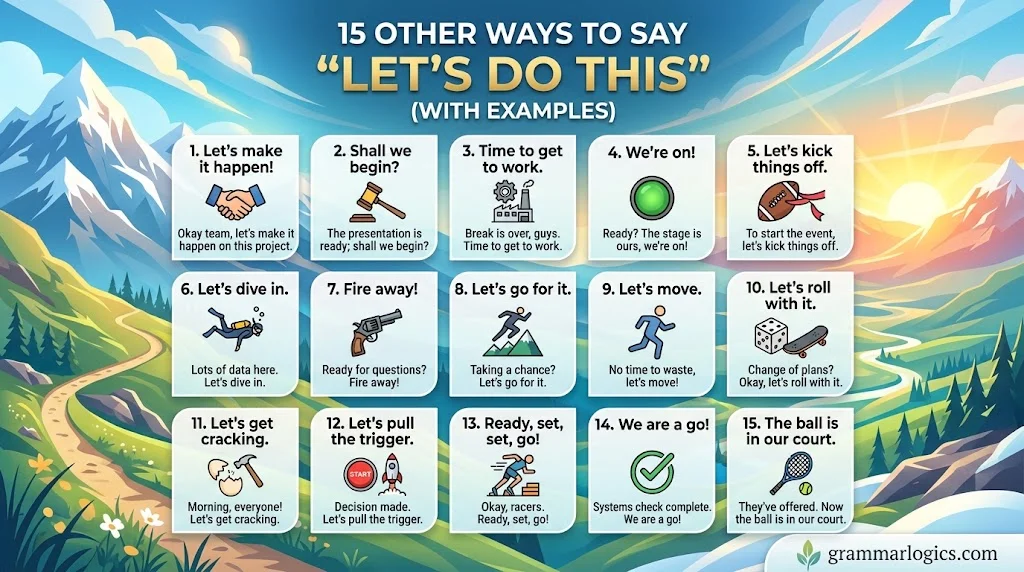
“Let’s do this” is a popular phrase used to express enthusiasm, confidence, and motivation when starting a task or taking action.
Whether you are encouraging a friend, motivating your team, or preparing for an important challenge, saying “Let’s Do This” can create excitement and inspire people to move forward. However, using the same expression repeatedly may make your conversations sound less interesting. Learning other ways to say “Let’s Do This” can help you communicate more naturally and confidently in different situations. From casual conversations to professional meetings, choosing the right words can make your message more engaging. The best alternative depends on your audience, purpose, and the level of excitement you want to express.
In this article, we will explore 15 other ways to say “Let’s Do This” with clear explanations and practical examples. These alternatives will help you express motivation, determination, teamwork, and readiness without repeating the same phrase. Whether you need an energetic expression for friends, a confident statement for the workplace, or an encouraging phrase to inspire others, you will find useful options for different situations. Each alternative includes an example to show how it works in everyday communication. By learning these expressions, you can improve your vocabulary, make your writing more engaging, and communicate your enthusiasm more effectively in emails, messages, conversations, and professional settings.
What Does “Let’s Do This” Mean?
“Let’s do this” is an informal, encouraging expression that means let’s begin, take action, or move forward with something we have planned. People commonly use it when they feel ready to start a task, face a challenge, make a decision, or participate in an activity. The phrase often communicates enthusiasm, confidence, determination, and a willingness to act. The word “let’s” suggests that the speaker wants to participate with others, although it can also be used when addressing a group before an individual or shared activity. Depending on the context and delivery, it can sound playful, motivational, assertive, or reassuring.
Common Situations Where “Let’s Do This” Is Used
People use this expression in everyday conversations, text messages, social media posts, and motivational speeches. Friends might say it before starting a road trip, playing a game, or trying something new. At school, students may use it before an exam or group presentation. In the workplace, colleagues might say it before launching a project, beginning a meeting, or tackling a challenging assignment. It is also common in fitness settings, team activities, and personal goals. When the situation requires a more polished or specific message, alternatives such as “Let’s get started” or “Shall we begin?” can communicate the same readiness with a different level of formality.
Is It Professional or Polite to Say “Let’s Do This”?
“Let’s do this” is generally friendly, positive, and informal. It can work well in modern workplaces, especially when encouraging teammates, starting a collaborative project, or building excitement around a shared goal. It is not inherently impolite, but its energetic and casual tone may feel too relaxed in a formal presentation, a client proposal, or a conversation with someone who expects more reserved language. In those situations, “Let’s get started,” “Let’s move forward,” or “Shall we proceed?” may be more appropriate. The best choice depends on your audience, relationship, and purpose. A confident phrase can motivate people without sounding overly casual when it fits the setting.
Advantages and Disadvantages of Saying “Let’s Do This”
Advantages
The phrase is short, energetic, and easy to understand. It communicates readiness without requiring a lengthy explanation, making it useful when a group needs encouragement or a clear signal to begin. Its inclusive wording can also create a sense of teamwork because it suggests that everyone is moving forward together. In casual conversations, it adds excitement and confidence to an ordinary moment. It works particularly well before activities, important decisions, and challenging tasks.
Disadvantages
The expression can sound too casual in highly formal or traditional professional settings. It is also somewhat general, so it does not explain what action should happen next unless the context is already clear. In serious situations, its upbeat tone might feel inappropriate or dismissive of the challenges involved. Repeating it frequently can also make your communication less expressive. Choosing a more specific phrase, such as “Let’s review the next steps,” can provide greater clarity when people need direction rather than motivation.
15 Synonyms for “Let’s Do This”
- Let’s get started
- Let’s make it happen
- Let’s go for it
- Let’s get to work
- Let’s get the ball rolling
- Time to get moving
- Let’s dive in
- We’ve got this
- Let’s take the plunge
- Let’s make a start
- Shall we begin?
- Let’s move forward
- Bring it on
- Let’s give it our best
- Here we go
1. Let’s Get Started
Meaning
“Let’s get started” means it is time to begin an activity, task, meeting, or project. Like “Let’s do this,” it signals readiness, but it focuses more on beginning the work than expressing excitement.
Definition
An expression used to invite people to begin an activity or task.
Detailed Explanation
This phrase is a natural choice when everyone is ready and there is no need for a long introduction. It sounds organized, clear, and welcoming without being overly formal. Unlike the original expression, it emphasizes the first step rather than the challenge ahead. It works equally well in professional meetings, classrooms, and everyday conversations.
Scenario Examples
– Scenario: A manager opens a team meeting.
Example: “Everyone has the agenda, so let’s get started.”
– Scenario: A student begins a study session with a friend.
Example: “We have two chapters to review. Let’s get started.”
Best Use
Use it for meetings, lessons, projects, study sessions, and everyday tasks when you want to begin promptly.
Tone
Tone: Clear, friendly, organized. It encourages action without sounding overly excited.
2. Let’s Make It Happen
Meaning
“Let’s make it happen” means working together to turn an idea, plan, or goal into reality. It communicates determination and a willingness to take practical steps.
Definition
An encouraging expression that means making a desired result happen through action.
Detailed Explanation
This phrase is especially useful when a group has a goal but still needs to accomplish the work required to reach it. Compared with “Let’s do this,” it places greater emphasis on results and commitment. It can inspire people to overcome obstacles and cooperate toward a shared outcome. Although it works well in business and personal conversations, it may sound overly enthusiastic if the situation calls for a neutral response.
Scenario Examples
– Scenario: Friends are organizing a charity event.
Example: “We have the volunteers and the venue. Let’s make it happen!”
– Scenario: A colleague proposes a new business idea.
Example: “I like the plan. Let’s make it happen this quarter.”
Best Use
Choose this phrase for team goals, business projects, personal ambitions, and collaborative plans.
Tone
Tone: Motivational, confident, determined. It emphasizes turning intentions into results.
3. Let’s Go for It
Meaning
“Let’s go for it” means deciding to try something, pursue an opportunity, or take a chance. It expresses willingness to act even when the outcome is uncertain.
Definition
An informal expression that encourages people to attempt something or pursue an opportunity.
Detailed Explanation
This expression is especially appropriate when someone is hesitating about whether to try something new. It suggests courage and willingness to take a chance, rather than simply starting an already agreed-upon task. It can sound enthusiastic and supportive among friends or colleagues. However, it is not always interchangeable with the original phrase because it specifically encourages taking an opportunity or accepting a challenge.
Scenario Examples
– Scenario: Friends are considering entering a local competition.
Example: “We might not win, but let’s go for it!”
– Scenario: A colleague is unsure about applying for a promotion.
Example: “You have the experience. Let’s go for it and submit your application.”
Best Use
Use it when taking opportunities, trying new activities, making bold decisions, or encouraging someone to take a reasonable risk.
Tone
Tone: Encouraging, adventurous, optimistic. It helps people feel more confident about trying.
4. Let’s Get to Work
Meaning
“Let’s get to work” means it is time to begin working seriously on a task. It shifts attention away from planning or talking and toward practical effort.
Definition
A direct expression inviting people to begin working on something.
Detailed Explanation
This phrase is more task-focused than “Let’s do this.” It is particularly effective when responsibilities are clear and the group needs to concentrate. Depending on the speaker’s delivery, it can sound productive and motivating or slightly commanding. In professional environments, a friendly tone helps it feel collaborative rather than bossy. It is less suitable for situations where the main purpose is celebrating, relaxing, or simply enjoying an activity.
Scenario Examples
– Scenario: A project team has finished discussing its plan.
Example: “We know what needs to be done, so let’s get to work.”
– Scenario: A student is preparing for an important exam.
Example: “The exam is next week. Let’s get to work on these practice questions.”
Best Use
Choose it for workplace projects, study sessions, deadlines, and tasks that require focused effort.
Tone
Tone: Direct, productive, purposeful. It communicates that action and effort should begin now.
5. Let’s Get the Ball Rolling
Meaning
“Let’s get the ball rolling” means starting an activity or process so that progress can begin. It often suggests taking the first step that helps everything else move forward.
Definition
An informal idiom meaning to initiate an activity, project, or process.
Detailed Explanation
This expression works particularly well when a project has been discussed but nobody has started acting on it yet. It emphasizes creating momentum rather than completing the entire task immediately. Compared with “Let’s do this,” it often sounds more conversational and less forceful. It is widely understood in everyday and workplace English, although a more literal phrase may be preferable in highly formal writing.
Scenario Examples
– Scenario: A team is ready to plan a company event.
Example: “We have everyone’s ideas, so let’s get the ball rolling with the schedule.”
– Scenario: Two friends want to organize a weekend trip.
Example: “Let’s book the hotel first and get the ball rolling.”
Best Use
Use it for planning sessions, new projects, group activities, and situations where the first step matters.
Tone
Tone: Casual, collaborative, encouraging. It suggests getting things moving without creating unnecessary pressure.
6. Time to Get Moving
Meaning
“Time to get moving” means it is time to stop waiting and begin taking action. Depending on the context, it can also mean physically leaving a place or continuing toward a destination.
Definition
An expression used to encourage prompt action or movement.
Detailed Explanation
This phrase is useful when people have spent enough time preparing, discussing, or waiting. It creates a sense of urgency and forward motion without necessarily sounding aggressive. Unlike “Let’s do this,” it can suggest that time is limited or that a delay needs to end. Its meaning depends on context: someone might use it before starting a project or when a group needs to leave for an appointment.
Scenario Examples
– Scenario: Friends are getting ready for a morning hike.
Example: “Everyone has their water bottles? Time to get moving!”
– Scenario: A team needs to finish its work before a deadline.
Example: “We have a lot left to finish. Time to get moving.”
Best Use
Choose it for busy schedules, deadlines, travel plans, exercise, and situations that require prompt action.
Tone
Tone: Energetic, practical, slightly urgent. It encourages people to stop delaying and move ahead.
7. Let’s Dive In
Meaning
“Let’s dive in” means beginning an activity with enthusiasm and getting directly involved. It is often used when exploring a topic, starting a discussion, or working through something in detail.
Definition
An informal expression inviting people to begin an activity or engage deeply with a subject.
Detailed Explanation
This phrase is particularly natural when the activity involves learning, discussing, exploring, or examining something. It suggests active participation rather than simply announcing that a task will start. Compared with “Let’s do this,” it can sound more curious and engaging. It is common in presentations, workshops, tutorials, and conversations, but it may be less appropriate when the situation requires a solemn or highly formal opening.
Scenario Examples
– Scenario: A teacher begins a new lesson.
Example: “Today, we’re learning about persuasive writing. Let’s dive in.”
– Scenario: A team begins reviewing customer feedback.
Example: “We have all the survey results ready, so let’s dive in.”
Best Use
Use it for lessons, workshops, presentations, brainstorming, discussions, and detailed projects.
Tone
Tone: Engaging, curious, upbeat. It invites people to participate actively.
8. We’ve Got This
Meaning
“We’ve got this” means that you believe you or your group can handle a situation successfully. It offers reassurance and builds confidence before or during a challenge.
Definition
An informal expression of confidence in someone’s ability to manage a task or situation.
Detailed Explanation
Unlike “Let’s do this,” which signals readiness to act, this phrase emphasizes confidence and reassurance. It is especially helpful when people feel nervous, uncertain, or overwhelmed. Using “we” can reinforce a sense of teamwork, while the same expression can also be adapted to “You’ve got this” when encouraging one person. It should be used thoughtfully when a situation is genuinely difficult, since excessive confidence may otherwise seem dismissive of real concerns.
Scenario Examples
– Scenario: A team prepares for a major presentation.
Example: “We’ve practiced everything twice. We’ve got this.”
– Scenario: A friend feels nervous before an exam.
Example: “You studied hard and prepared well. You’ve got this!”
Best Use
Choose it for encouragement, exams, presentations, sports, difficult assignments, and supportive personal messages.
Tone
Tone: Reassuring, supportive, confident. It helps people feel capable rather than simply telling them to begin.
9. Let’s Take the Plunge
Meaning
“Let’s take the plunge” means making a significant decision or committing to something despite uncertainty. It often refers to a bold step that someone has been considering for a while.
Definition
An idiom describing the decision to commit to an important or uncertain course of action.
Detailed Explanation
This expression is stronger and more specific than “Let’s do this.” It implies that the decision involves some uncertainty, personal commitment, or perceived risk. People often use it when starting a business, making a major purchase, or pursuing a long-considered ambition. It would sound excessive for an ordinary task such as opening a notebook or starting a routine meeting. Use it when the decision itself feels meaningful.
Scenario Examples
– Scenario: Two friends are considering starting a small business.
Example: “We’ve researched the costs for months. Let’s take the plunge and launch our shop.”
– Scenario: Someone has been thinking about moving abroad.
Example: “If this is what you really want, maybe it’s time to take the plunge.”
Best Use
Use it for major decisions, new ventures, career changes, and meaningful personal commitments.
Tone
Tone: Bold, determined, adventurous. It recognizes that taking the next step may require courage.
10. Let’s Make a Start
Meaning
“Let’s make a start” means beginning an activity, even if everything is not fully organized or completed yet. It emphasizes taking the first practical step.
Definition
A straightforward expression meaning to begin doing something.
Detailed Explanation
This phrase is useful when a task feels large or difficult and people need to start with something manageable. It sounds a little more measured than “Let’s do this,” making it suitable for situations where calm progress matters more than excitement. In British English, “make a start” is a familiar construction. It can also reassure a group that progress does not require having every detail figured out in advance.
Scenario Examples
– Scenario: A student feels overwhelmed by a long assignment.
Example: “We don’t need to finish it tonight. Let’s make a start on the introduction.”
– Scenario: Colleagues begin organizing a new project.
Example: “We can refine the details later. Let’s make a start with the outline.”
Best Use
Choose it for writing, studying, planning, large projects, and situations where gradual progress is sensible.
Tone
Tone: Calm, practical, encouraging. It makes beginning feel manageable instead of overwhelming.
11. Shall We Begin?
Meaning
“Shall we begin?” means asking whether everyone is ready to start an activity. It invites participation while allowing others a moment to respond.
Definition
A polite question used to propose starting an activity or proceeding with a planned event.
Detailed Explanation
This expression is more formal and restrained than “Let’s do this.” It works especially well when addressing a group in a meeting, presentation, interview, or organized event. Because it is phrased as a question, it sounds less forceful than a direct instruction. It is particularly useful when the speaker wants to show courtesy or acknowledge that other people are involved in the decision. In casual conversations, however, it may sound slightly formal or theatrical.
Scenario Examples
– Scenario: A consultant opens a scheduled meeting.
Example: “It looks like everyone has arrived. Shall we begin?”
– Scenario: A teacher is ready to start an examination.
Example: “Please put your books away. Shall we begin?”
Best Use
Use it for meetings, formal discussions, presentations, interviews, and organized group activities.
Tone
Tone: Polite, composed, professional. Its question format gives others an opportunity to be ready before proceedings start.
12. Let’s Move Forward
Meaning
“Let’s move forward” means continuing toward a goal, making progress, or proceeding with a decision. It can also suggest leaving a disagreement or difficult period behind.
Definition
An expression encouraging continued progress toward a goal or the next stage of a process.
Detailed Explanation
This phrase is particularly useful when a group has finished discussing options and needs to decide what comes next. Unlike “Let’s do this,” it can refer to ongoing progress rather than the beginning of an activity. It sounds appropriate in professional communication because it focuses on progress and next steps. In personal conversations, it can also encourage people to stop dwelling on a setback. When used after conflict, though, it should not pressure others to ignore unresolved concerns.
Scenario Examples
– Scenario: A project team agrees on a proposed strategy.
Example: “We’ve reviewed the options and agreed on a plan. Let’s move forward.”
– Scenario: Two colleagues want to improve their working relationship after a disagreement.
Example: “We understand each other better now. Let’s move forward with clearer communication.”
Best Use
Choose it for business decisions, project planning, teamwork, resolving disagreements, and discussing future steps.
Tone
Tone: Professional, constructive, forward-looking. It emphasizes progress and a willingness to continue.
13. Bring It On
Meaning
“Bring it on” means welcoming a challenge with confidence, excitement, or determination. It suggests that the speaker is ready to face whatever difficulty comes next.
Definition
An informal expression used to show eagerness to face a challenge or competition.
Detailed Explanation
This phrase has a more daring and competitive feel than “Let’s do this.” It is often used before sports competitions, demanding tasks, or situations where someone wants to show confidence. It can also be playful among friends when accepting a challenge. However, it is not a general substitute for every planned activity: using it before a routine meeting may sound exaggerated, and using it during a sensitive situation may appear insensitive.
Scenario Examples
– Scenario: A runner prepares for a difficult race.
Example: “The course looks challenging, but bring it on!”
– Scenario: Friends challenge each other to a friendly trivia competition.
Example: “You think you know more movie facts than I do? Bring it on!”
Best Use
Use it for competitions, demanding challenges, fitness goals, and playful situations involving confidence.
Tone
Tone: Bold, energetic, competitive. It shows that the speaker is eager to face a challenge.
14. Let’s Give It Our Best
Meaning
“Let’s give it our best” means making a sincere effort and trying as hard as possible. It emphasizes commitment and effort rather than guaranteeing a particular result.
Definition
An encouraging expression asking people to put forth their strongest reasonable effort.
Detailed Explanation
This phrase is especially useful when the outcome is uncertain but the group can still control the quality of its effort. Compared with “Let’s do this,” it places greater emphasis on trying sincerely and working together. It can feel more considerate because it encourages commitment without promising success. The expression works well in educational, professional, and personal settings, particularly when people need encouragement rather than pressure to win.
Scenario Examples
– Scenario: A school team prepares for a competition.
Example: “We’ve practiced for weeks. Let’s give it our best tomorrow.”
– Scenario: Colleagues are preparing a proposal for an important client.
Example: “We have one more day to polish the presentation. Let’s give it our best.”
Best Use
Choose it for exams, competitions, collaborative projects, presentations, and situations where effort matters as much as results.
Tone
Tone: Encouraging, sincere, team-oriented. It motivates people while leaving room for realistic expectations.
15. Here We Go
Meaning
“Here we go” is an expression used when something is about to begin or is finally happening. Depending on the speaker’s delivery, it can express excitement, anticipation, determination, or mild frustration.
Definition
A conversational expression signaling the beginning of an activity or event.
Detailed Explanation
This phrase is short and flexible, making it common in spoken English and informal messages. Like “Let’s do this,” it can signal readiness, but it does not necessarily invite other people to participate. Its meaning depends heavily on context and tone: said enthusiastically, it expresses excitement; said with a sigh, it can suggest that a familiar problem is happening again. This flexibility makes it natural in everyday conversation, though it may be too vague for formal instructions.
Scenario Examples
– Scenario: Friends are about to begin a board game.
Example: “Everyone’s ready, the snacks are here, and the rules are clear. Here we go!”
– Scenario: A presenter is about to deliver an important speech.
Example: “I’ve checked my notes and tested the microphone. Here we go.”
Best Use
Use it for everyday activities, games, performances, presentations, and moments when something is about to start.
Tone
Tone: Casual, anticipatory, expressive. Its emotional meaning changes depending on the situation and how it is said.
FAQs
1. What is another way to say “Let’s Do This”?
Some natural alternatives are “Let’s get started,” “Let’s make it happen,” “Let’s go for it,” and “Let’s get to work.” Choose one based on your intention. For example, “Let’s get started” works well for beginning a meeting, while “Let’s go for it” is better when encouraging someone to take a chance.
2. What does “Let’s Do This” mean?
“Let’s do this” means that you are ready to begin an activity, take action, or face a challenge. It usually communicates enthusiasm, confidence, and determination. The phrase can be used with friends, teammates, colleagues, or anyone participating in a shared activity.
3. Is “Let’s Do This” professional?
Yes, “Let’s do this” can be appropriate in professional settings, especially in friendly workplaces, team meetings, and collaborative projects. However, it is relatively informal. For formal presentations, client emails, or official discussions, “Let’s get started” or “Let’s move forward” may sound more polished.
4. What is a more polite way to say “Let’s Do This”?
“Shall we begin?” is a polite alternative that works well in meetings, presentations, and formal discussions. You can also say “Let’s get started” when you want to sound friendly and professional. Both expressions communicate readiness without sounding overly forceful.
5. Which alternative works best in formal communication?
“Let’s move forward” is a strong choice when discussing decisions, project progress, or next steps. “Shall we begin?” is particularly suitable when formally opening a meeting or presentation. The best expression depends on whether you want to start an activity, invite participation, or communicate progress.
Conclusion
Choosing the right words can make your communication more effective, encouraging, and natural. While “Let’s do this” expresses enthusiasm and readiness, other phrases can communicate specific intentions, such as beginning a task, accepting a challenge, building confidence, or moving toward a goal. Expressions like “Let’s get started” work well in professional settings, while “Bring it on” adds a bold, competitive feeling to casual conversations.
If you want to encourage a team, “Let’s make it happen” can emphasize commitment and shared effort. Always consider your audience, situation, and intended tone before choosing an expression. By understanding these 15 alternatives, you can expand your vocabulary, avoid repetitive wording, and express your ideas with greater confidence in everyday conversations and professional communication.