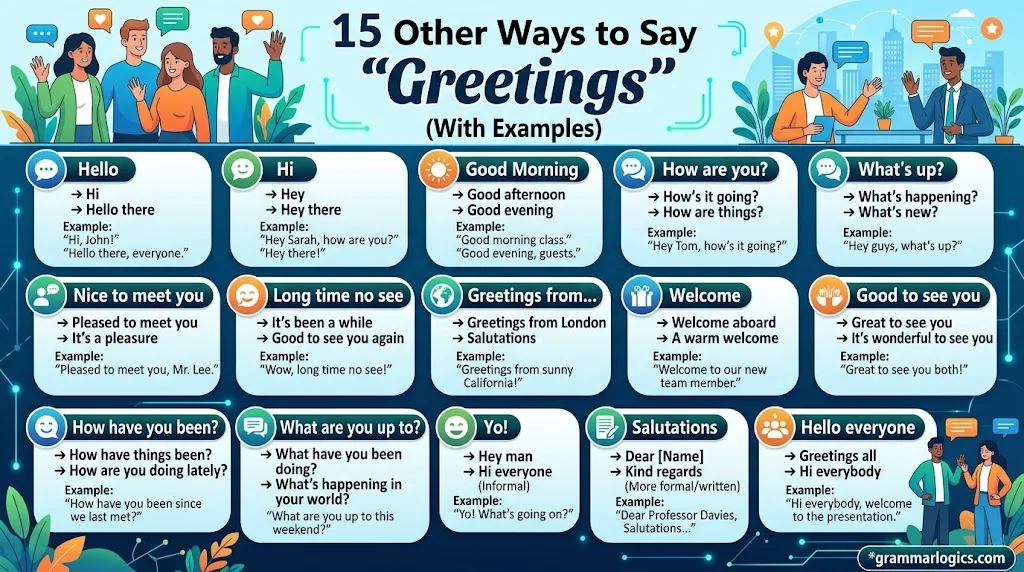
Finding the right words to greet someone can make every conversation more friendly, polite, and meaningful.
There are many other ways to say “greetings” depending on the situation, your relationship with the person, and the tone you want to express. For example, you might use “Hello,” “Hi there,” “Good day,” or “Warm wishes” to begin a conversation naturally. Some greetings are perfect for professional emails and formal meetings, while others work better with friends, family, and colleagues. Learning different greeting expressions can help you communicate more confidently and avoid repeating the same words. It also allows you to adjust your language to suit different audiences and occasions. By exploring these alternatives, you can make your everyday communication more engaging, natural, and effective.
In this guide, you will discover 15 alternatives to “greetings” with clear explanations and practical examples to help you choose the best expression for every occasion. Whether you need a respectful opening for a business letter, a cheerful greeting for a friend, or a warm phrase for a special event, these alternatives will give you plenty of useful options. You will also learn when to use formal, informal, and friendly greetings so your words sound appropriate in different situations. Understanding these expressions can improve your English vocabulary, writing skills, and everyday conversations. Explore these alternatives to make your messages more welcoming, express yourself clearly, and leave a positive impression on the people you communicate with.
What Does “Greetings” Mean?
Greetings are words or expressions used to acknowledge someone, start a conversation, or show welcome and goodwill. In everyday English, common greetings include “Hello,” “Hi,” and “Good morning.” The word can also refer to a friendly message or a formal expression of respect, such as “Season’s greetings” or “Warm greetings.” Depending on the context, greetings can communicate friendliness, politeness, happiness, or professional courtesy. Although the word is often used as a general term for welcoming or acknowledging people, the best expression depends on whom you are addressing, the occasion, and whether you are speaking face-to-face or writing a message.
Common Situations Where “Greetings” Is Used
Greetings are used in many everyday situations. People say hello when meeting friends, greet colleagues at work, and welcome guests to events. In emails and letters, greetings such as “Dear Sarah” or “Hello, Team” help introduce the message politely. On social media, short expressions like “Hi everyone” make posts feel more approachable. Greetings are also common at conferences, school events, customer service interactions, and celebrations.
Choosing an alternative can make your opening sound more natural. For example, “Good morning” may suit a workplace meeting, while “Hey there” may feel more comfortable in a casual conversation. A seasonal expression such as “Season’s greetings” works well during holiday periods. Understanding these differences helps you select wording that matches the audience, occasion, and level of formality.
Is It Professional or Polite to Say “Greetings”?
Yes, “greetings” can be polite and professional, especially when used in formal announcements, welcoming speeches, or ceremonial messages. However, using “Greetings” by itself at the beginning of an ordinary business email may sound somewhat stiff or unusual in some workplaces. “Hello,” “Good morning,” and “Dear [Name]” are often more natural choices, depending on the recipient and situation. In casual conversation, “Hi” and “Hey” usually feel warmer and more relaxed. The expression “Warm greetings” communicates friendliness, while “Season’s greetings” is associated with holiday wishes. For professional communication, consider your relationship with the recipient and the purpose of your message rather than assuming that one greeting fits every situation.
Advantages and Disadvantages of Saying “Greetings”
Advantages
The word “greetings” is versatile and can suit formal welcomes, announcements, public addresses, and seasonal messages. It communicates politeness and goodwill without being overly familiar. It can also address a group of people collectively, making it useful for opening a speech or welcoming attendees to an event. Because it has a broad meaning, it works in many written and spoken contexts.
Disadvantages
Although the expression is polite, it can sound impersonal or overly formal in everyday conversation. It does not always communicate the warmth of “Hi, how are you?” or the time-specific courtesy of “Good morning.” In a business email, a standalone “Greetings” may feel less natural than addressing the recipient by name. Repeatedly using the same expression can also make messages sound generic. Choosing a more specific alternative can help communicate the right tone and intention.
15 Alternatives to “Greetings”
- Hello
- Hi
- Good morning
- Good afternoon
- Good evening
- Hey there
- How are you?
- Welcome
- Warm regards
- Best wishes
- Dear [Name]
- Salutations
- Pleased to meet you
- Season’s greetings
- Welcome aboard
1. Hello
Meaning
Hello is a common, friendly, and polite way to greet someone when beginning a conversation. It is one of the most versatile alternatives to “greetings” because it works in both formal and informal situations.
Definition
Hello is an expression used to acknowledge someone or start speaking to them.
Detailed Explanation
“Hello” sounds natural in everyday conversation and professional communication. Unlike the broader word “greetings,” it directly addresses the person you are speaking to. It is suitable when meeting someone, answering a phone call, or starting an email or online conversation. You can make it warmer by adding the person’s name or following it with a friendly question.
Scenario Examples
– Scenario: Starting a conversation with a colleague.
Example: “Hello, Sarah! Do you have a moment to discuss the project?”
– Scenario: Opening a message to a new contact.
Example: “Hello, Mr. Ahmed. Thank you for getting in touch.”
– Scenario: Greeting a group at an event.
Example: “Hello, everyone. Thank you for joining us today.”
Best Use
Use “Hello” in emails, meetings, phone calls, everyday conversations, and introductions. It is particularly helpful when you want a neutral expression that is neither too casual nor overly formal.
Tone
Tone: Polite, friendly, versatile.
Its balanced tone makes it suitable for people you know well and those you are meeting for the first time.
2. Hi
Meaning
Hi is a short, familiar greeting that communicates friendliness and approachability. It is a natural alternative when you want your opening to feel relaxed rather than formal.
Definition
Hi is an informal expression used to acknowledge someone or begin a conversation.
Detailed Explanation
“Hi” is especially common in spoken English, text messages, chats, and everyday workplace interactions. Compared with “greetings,” it sounds more personal and less ceremonial. It works well when speaking to friends, classmates, colleagues, or familiar customers. In highly formal letters, however, a more traditional salutation may be preferable.
Scenario Examples
– Scenario: Texting a friend.
Example: “Hi! Are we still meeting for lunch today?”
– Scenario: Messaging a familiar coworker.
Example: “Hi, Daniel. I’ve shared the updated document with you.”
– Scenario: Starting a friendly group chat.
Example: “Hi, everyone! I hope your week is going well.”
Best Use
Choose “Hi” for texting, casual emails, online conversations, and friendly professional messages. It is particularly effective when you want to sound approachable without writing a long opening.
Tone
Tone: Casual, warm, approachable.
Its simplicity creates a comfortable opening, although it may be too informal for some highly formal correspondence.
3. Good morning
Meaning
Good morning is a time-specific greeting used to acknowledge someone during the morning. It expresses courtesy and can create a positive beginning to a conversation or meeting.
Definition
Good morning is a polite expression used when greeting someone in the morning.
Detailed Explanation
This expression is more specific than “greetings” because it connects the greeting to a particular time of day. It is widely used in workplaces, schools, shops, and personal conversations. It can sound professional without being distant, making it a strong choice when welcoming colleagues or customers. Its natural use generally depends on the local understanding of when morning ends.
Scenario Examples
– Scenario: Arriving at the office.
Example: “Good morning, everyone. I hope you had a restful weekend.”
– Scenario: Welcoming a customer.
Example: “Good morning! How may I assist you today?”
– Scenario: Sending an early message.
Example: “Good morning, Mom. Have a wonderful day!”
Best Use
Use “Good morning” for workplace conversations, customer service, school, meetings, and early-day messages. It is particularly useful when you want to sound courteous and acknowledge the time of day.
Tone
Tone: Respectful, cheerful, professional.
The expression combines everyday friendliness with a level of politeness that suits many professional settings.
4. Good afternoon
Meaning
Good afternoon is a polite greeting used during the afternoon. It offers a respectful way to begin a conversation, especially in professional or service-related settings.
Definition
Good afternoon is an expression used to greet someone in the afternoon.
Detailed Explanation
This greeting helps establish a courteous tone when starting an afternoon meeting, visiting an office, or speaking with a customer. It sounds more formal than “Hi” but remains natural in ordinary conversation. Unlike “greetings,” it identifies the time of day and can make an opening feel more situationally appropriate. The exact transition from afternoon to evening may vary by location and personal habit.
Scenario Examples
– Scenario: Opening an afternoon presentation.
Example: “Good afternoon, everyone. Thank you for being here.”
– Scenario: Speaking to a customer at a service desk.
Example: “Good afternoon, welcome to our office.”
– Scenario: Joining a scheduled meeting.
Example: “Good afternoon, team. Let’s begin with today’s updates.”
Best Use
Choose “Good afternoon” for business meetings, customer interactions, formal visits, presentations, and polite everyday exchanges during the afternoon.
Tone
Tone: Courteous, composed, professional.
It communicates respect without sounding excessively formal or distant.
5. Good evening
Meaning
Good evening is a courteous greeting used when meeting or addressing someone in the evening. It is especially useful at social events, dinners, formal gatherings, and evening appointments.
Definition
Good evening is an expression used to greet someone during the evening.
Detailed Explanation
This phrase is a natural alternative when you want to welcome someone at an evening event or begin a conversation after the day has progressed. It generally sounds more formal than “Hey there” and more occasion-specific than “greetings.” It is suitable for professional dinners, receptions, restaurants, and social gatherings. Remember that “Good evening” is used to greet people, while “Good night” is generally used when leaving or going to bed.
Scenario Examples
– Scenario: Welcoming attendees to an event.
Example: We’re delighted to have you here.”
– Scenario: Arriving at a dinner party.
Example: “Good evening! Thank you for inviting me.”
– Scenario: Starting an evening meeting.
Example: “Good evening, everyone. Let’s review the agenda.”
Best Use
Use “Good evening” for dinners, receptions, evening meetings, formal occasions, and polite social interactions.
Tone
Tone: Elegant, respectful, welcoming.
Its measured wording suits situations where courtesy and a calm, polished impression matter.
6. Hey there
Meaning
Hey there is a relaxed, personable greeting that makes a conversation feel friendly and informal. It is useful when you want to sound more expressive than a simple “Hi.”
Definition
Hey there is an informal expression used to get someone’s attention or greet them warmly.
Detailed Explanation
This expression is common in casual conversation, friendly messages, and informal online communication. It feels more playful and familiar than “Greetings,” so it may not suit every professional or formal situation. Adding someone’s name can make it feel even more personal. The phrase is especially useful when you want to open a message in a lighthearted way without immediately asking a question.
Scenario Examples
– Scenario: Messaging a close friend.
Example: “Hey there! How have you been lately?”
– Scenario: Welcoming a familiar visitor.
Example: “Hey there, come on in! We’re just getting started.”
– Scenario: Opening a casual online conversation.
Example: “Hey there! Thanks for stopping by my page.”
Best Use
Use “Hey there” in casual texts, friendly online chats, personal messages, and relaxed social situations. Avoid it when the setting calls for a traditional formal salutation.
Tone
Tone: Cheerful, informal, welcoming.
Its conversational style helps create an easygoing atmosphere, particularly between people who are comfortable with one another.
7. How are you?
Meaning
How are you? is a greeting that also asks about someone’s well-being. It adds a personal touch by showing interest in the other person rather than simply acknowledging their presence.
Definition
How are you? is a common expression used to greet someone and ask how they are feeling or doing.
Detailed Explanation
Unlike a basic greeting, this expression invites a response about someone’s condition or current situation. In many everyday conversations, it functions as a polite social opening, and a brief answer is usually expected. With a close friend, it can lead to a more meaningful discussion. In professional settings, it is courteous when used naturally, but it should not be treated as an invitation to share personal information if the other person seems uncomfortable.
Scenario Examples
– Scenario: Meeting a friend after a long time.
Example: “Hi, Emma! How are you? It’s been ages!”
– Scenario: Checking in with a colleague.
Example: “Good morning, Ali. How are you today?”
– Scenario: Talking to a family member.
Example: “How are you, Grandma? I wanted to see how you’ve been feeling.”
Best Use
Choose this expression for personal conversations, friendly workplace interactions, reconnecting with people, and everyday social exchanges. It works best when you are willing to listen to the response.
Tone
Tone: Caring, conversational, considerate.
Its question format communicates interest, although the depth of that interest depends on the relationship and context.
8. Welcome
Meaning
Welcome is an expression used to receive someone warmly or show that they are accepted in a place, group, or event. It is more focused on hospitality and inclusion than a general greeting.
Definition
Welcome is a word used to greet someone arriving at a place or joining a group, or to express that their presence is appreciated.
Detailed Explanation
“Welcome” is particularly suitable when someone arrives somewhere, joins a team, or participates in an event for the first time. Unlike “Hello,” it communicates more than acknowledgment: it suggests that the person is invited, accepted, or received positively. It can be used in professional announcements, customer service, and personal gatherings. The phrase “You’re welcome” has a different common use, namely responding to someone’s thanks, so context matters.
Scenario Examples
– Scenario: Greeting guests at a gathering.
Example: “Welcome to our home! Please make yourself comfortable.”
– Scenario: Introducing a new colleague.
Example: “Welcome to the team, Maya. We’re happy to have you with us.”
– Scenario: Opening a workshop.
Example: “Welcome, everyone. Today’s session will focus on practical communication skills.”
Best Use
Use “Welcome” for events, hospitality, new employees, visitors, customers, and group introductions. It is especially effective when your goal is to make someone feel included.
Tone
Tone: Warm, inviting, inclusive.
The word communicates acceptance and hospitality rather than merely starting a conversation.
9. Warm regards
Meaning
Warm regards is a friendly yet polished closing expression used in written communication. It communicates goodwill and respect at the end of a message rather than serving as a direct spoken greeting.
Definition
Warm regards is a complimentary email or letter closing that expresses friendliness and goodwill toward the recipient.
Detailed Explanation
Although “warm regards” is related to greetings, it is not a direct synonym for a greeting at the beginning of a conversation. It belongs at the end of an email or letter. It can be a good alternative when you want your written communication to feel professional without becoming cold or impersonal. It is generally suitable for colleagues, clients, acquaintances, and people with whom you have a cordial relationship.
Scenario Examples
– Scenario: Ending a professional email.
Example: “Thank you for reviewing the proposal. Warm regards, Nadia.”
– Scenario: Writing to a regular client.
Example: “I appreciate your continued cooperation. Warm regards, Ahmed.”
– Scenario: Following up after a meeting.
Example: “It was lovely speaking with you. Warm regards, Sara.”
Best Use
Use “Warm regards” in professional emails, business correspondence, polite follow-ups, and friendly formal letters. Do not use it as the opening salutation.
Tone
Tone: Warm, respectful, professional.
It combines professional courtesy with a personal touch, making it suitable for relationships that are friendly but not necessarily intimate.
10. Best wishes
Meaning
Best wishes is an expression of goodwill that communicates hope for someone’s happiness, success, or future well-being. It is most often used when sending a message for a particular occasion or ending written correspondence.
Definition
Best wishes is a phrase used to express positive hopes for another person’s future or circumstances.
Detailed Explanation
“Best wishes” is not a direct replacement for “Greetings” in every situation because it usually expresses goodwill rather than simply acknowledging someone. It works especially well for birthdays, new jobs, personal milestones, and farewell messages. It can also serve as a polite written closing. When opening a routine conversation, “Hello” is usually more natural; when expressing support or celebrating an occasion, “Best wishes” may be more meaningful.
Scenario Examples
– Scenario: Congratulating a friend on a new job.
Example: “Best wishes for your new role! I hope it brings you exciting opportunities.”
– Scenario: Writing a farewell card.
Example: “Best wishes for your next adventure. You’ll be missed!”
– Scenario: Sending a message before an important event.
Example: “Best wishes for your presentation tomorrow. You’ve prepared well.”
Best Use
Choose “Best wishes” for celebratory messages, farewell notes, personal cards, and suitable email closings. Use it when you want to communicate goodwill rather than simply say hello.
Tone
Tone: Supportive, thoughtful, encouraging.
The phrase focuses on positive feelings and hopes for another person, giving it a more purposeful meaning than a routine greeting.
11. Dear [Name]
Meaning
Dear [Name] is a conventional salutation used at the beginning of letters and emails. It acknowledges the recipient directly and establishes a respectful tone for the message.
Definition
Dear [Name] is a written greeting that addresses a person by name at the start of correspondence.
Detailed Explanation
This expression is especially useful when writing to someone in a professional, academic, or formal context. Unlike “Greetings,” it identifies the intended recipient and makes the message feel directed rather than generic. “Dear” does not necessarily communicate romantic affection; in correspondence, it is a standard courtesy. For close colleagues or routine internal emails, “Hi [Name]” may feel more natural, while “Dear [Name]” remains suitable for formal letters and important professional messages.
Scenario Examples
– Scenario: Contacting a potential employer.
Example: “Dear Ms. Khan, I am writing to inquire about the advertised position.”
– Scenario: Emailing a university instructor.
Example: “Dear Professor Ahmed, could you please clarify the submission deadline?”
– Scenario: Writing a formal customer letter.
Example: “Dear Mr. Ali, thank you for contacting our support team.”
Best Use
Use “Dear [Name]” in formal emails, cover letters, academic correspondence, official letters, and first-time professional contact. Use the recipient’s correct name and title whenever possible.
Tone
Tone: Respectful, formal, professional.
Its traditional style signals courtesy and is particularly helpful when communicating with someone you do not know well.
12. Salutations
Meaning
Salutations is a formal word associated with greetings and expressions of acknowledgment. It is often used when discussing greeting conventions or when a writer wants a deliberately formal or distinctive opening.
Definition
Salutations refers to greetings or expressions used to acknowledge or address someone.
Detailed Explanation
“Salutations” is closely related to “greetings” in meaning, but it sounds more formal and sometimes old-fashioned in everyday English. It can work in ceremonial language, playful messages, or discussions about written correspondence. However, it is less common than “Hello” in ordinary conversation. Although some people use “Salutations!” as a distinctive opening, “Dear [Name]” or “Hello” is generally a more natural choice for routine professional correspondence.
Scenario Examples
– Scenario: Opening a playful message to a friend who enjoys unusual expressions.
Example: “Salutations, my friend! What adventures are planned for today?”
– Scenario: Discussing business-letter conventions in a classroom.
Example: “Today, we’ll examine common salutations used in formal correspondence.”
– Scenario: Welcoming attendees to a themed event.
Example: “Salutations, distinguished guests, and welcome to our annual celebration.”
Best Use
Use “Salutations” in formal discussions of language, creative writing, ceremonial settings, or playful messages. For most everyday emails, simpler greetings are more natural.
Tone
Tone: Formal, distinctive, sometimes playful.
Its unusual style can create a memorable opening, but it may sound unnatural if used in ordinary conversations without a suitable context.
13. Pleased to meet you
Meaning
Pleased to meet you is a polite expression used when meeting someone for the first time. It communicates a positive attitude toward the introduction and shows respect for the other person.
Definition
Pleased to meet you means that you are happy or glad to make someone’s acquaintance.
Detailed Explanation
This expression goes beyond a general greeting by acknowledging a new introduction. It is particularly suitable for business networking, interviews, social gatherings, and professional meetings. Compared with “Greetings,” it communicates a specific feeling of pleasure about meeting someone. It is not normally used to greet a person you already know well, although it may be appropriate if you are being introduced to them for the first time. In casual conversation, “Nice to meet you” is a common, slightly more relaxed alternative.
Scenario Examples
– Scenario: Meeting a business partner for the first time.
Example: “I’m pleased to meet you, Mr. Hassan. I’ve heard wonderful things about your work.”
– Scenario: Being introduced to a new classmate.
Example: “Hi, I’m Ayesha. Pleased to meet you!”
– Scenario: Attending a professional networking event.
Example: “Pleased to meet you, Daniel. I’d love to hear more about your research.”
Best Use
Choose this expression for introductions, interviews, networking events, business meetings, and formal social occasions where you meet someone new.
Tone
Tone: Courteous, professional, welcoming.
It communicates genuine politeness while making the introduction feel more personal than a general greeting.
14. Season’s greetings
Meaning
Season’s greetings is a traditional expression used to send good wishes during the holiday season. It is especially associated with end-of-year celebrations and messages shared with friends, customers, colleagues, and family members.
Definition
Season’s greetings is a phrase used to express goodwill and happiness during a holiday period.
Detailed Explanation
Unlike a general greeting, this expression is connected to a particular season or holiday period. It is useful when sending cards, writing newsletters, or communicating with a broad audience during the festive season. It can be especially appropriate for businesses addressing people who celebrate different holidays because it does not name one specific celebration. However, it would feel out of place in an ordinary conversation during an unrelated time of year.
Scenario Examples
– Scenario: Sending a holiday card to a client.
Example: “Season’s greetings from our entire team. We wish you a peaceful and joyful holiday season.”
– Scenario: Writing a festive newsletter.
Example: “Season’s greetings to all our readers, and thank you for being part of our community.”
– Scenario: Posting a holiday message on social media.
Example: “Season’s greetings, everyone! Wishing you happiness and special moments with your loved ones.”
Best Use
Use “Season’s greetings” for holiday cards, seasonal newsletters, business messages, festive social media posts, and end-of-year correspondence.
Tone
Tone: Festive, courteous, inclusive.
Its seasonal focus makes it a thoughtful choice for sharing goodwill during holiday periods.
15. Welcome aboard
Meaning
Welcome aboard is a friendly expression used to greet someone who has joined a team, organization, project, or group. It communicates acceptance and enthusiasm about the person’s participation.
Definition
Welcome aboard is an expression used to welcome a new member to a team, organization, or shared activity.
Detailed Explanation
This expression is more specific than “Greetings” because it welcomes someone into a group or shared undertaking. It is common in workplaces, volunteer organizations, collaborative projects, and team introductions. The phrase can make a newcomer feel included and appreciated. However, it is not a general greeting for every encounter; it is most natural when someone is joining something rather than simply arriving at a place.
Scenario Examples
– Scenario: Welcoming a newly hired employee.
Example: “Welcome aboard, Fatima! We’re excited to have you on the marketing team.”
– Scenario: Introducing a new project contributor.
Example: “Welcome aboard, James. Your experience will be a valuable addition to the project.”
– Scenario: Greeting a new volunteer.
Example: “Welcome aboard! We’re glad you’ve decided to support our community program.”
Best Use
Choose “Welcome aboard” for new employees, project members, volunteers, team introductions, and organizational announcements. Use it when someone is joining a group or undertaking.
Tone
Tone: Encouraging, friendly, inclusive.
It creates a sense of belonging and communicates enthusiasm about the new member’s involvement.
FAQs
What is another way to say “Greetings”?
Common alternatives include “Hello,” “Hi,” “Good morning,” “Welcome,” and “Hey there.” The best choice depends on the situation. Use “Hello” for a versatile greeting, “Good morning” for a polite time-specific opening, and “Welcome” when receiving guests or new members.
What does “Greetings” mean?
Greetings are expressions used to acknowledge someone, begin a conversation, or communicate goodwill. Depending on the context, the word can refer to everyday salutations, formal welcomes, or seasonal messages such as “Season’s greetings.”
Is “Greetings” professional?
Yes, “Greetings” can be professional, particularly in formal announcements, ceremonial addresses, and general welcomes. However, a standalone “Greetings” may sound stiff in routine business correspondence. “Hello [Name]” or “Dear [Name]” is often more natural for professional emails.
What is a more polite way to say “Greetings”?
“Good morning,” “Good afternoon,” and “Dear [Name]” are polite alternatives in suitable situations. For a formal introduction, “Pleased to meet you” is appropriate. If you are welcoming someone into a group, “Welcome” offers a warm and respectful option.
Which alternative works best in formal communication?
“Dear [Name]” is a reliable choice for formal letters, cover letters, and professional emails. “Good morning” or “Good afternoon” works well in meetings and face-to-face conversations. Choose the expression that matches the recipient, communication channel, and level of formality.
Conclusion
Choosing the right greeting helps you make a positive first impression and communicate with greater clarity. Although “greetings” is a useful, polite expression, alternatives such as “Hello,” “Good morning,” “Welcome,” and “Dear [Name]” may feel more natural in particular situations. Some expressions are designed for everyday conversations, while others suit professional correspondence, introductions, holiday messages, or welcoming new team members.
Remember that similar phrases do not always serve the same purpose: “Warm regards” is generally a closing, while “Welcome aboard” celebrates someone’s arrival in a group. Consider your audience, relationship, and intended tone before choosing your words. With a little attention to context, you can make your written and spoken communication sound more thoughtful, confident, and appropriate. The best greeting is the one that feels natural for the moment and makes the other person feel acknowledged.