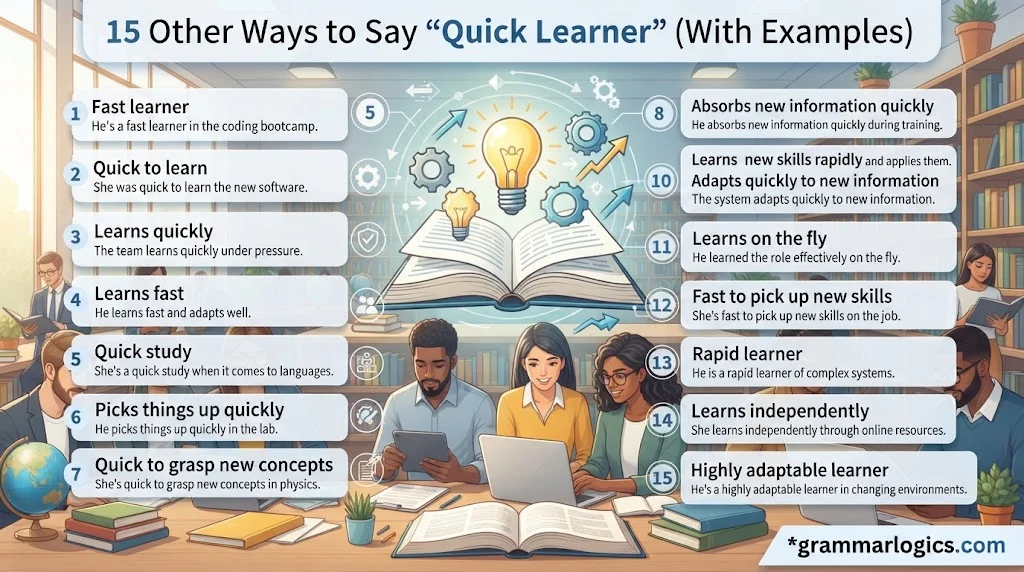
Quick learners are valued for their ability to understand new ideas, adapt to change, and gain skills efficiently.
Finding the right words to describe this quality can make your communication more precise and engaging. Whether you are writing a resume, describing a colleague, praising a student, or highlighting someone’s abilities, there are many natural alternatives to saying “quick learner.” Expressions such as fast learner, rapid learner, adaptable, and eager to learn can communicate slightly different qualities depending on the situation. Choosing the right phrase helps your writing sound more professional, natural, and specific. In this guide, you will discover useful alternatives to “quick learner,” along with examples that show how each expression can be used effectively in everyday, academic, and professional communication.
Using varied language can also make your writing more engaging and polished, especially when you want to describe someone’s ability to learn new concepts quickly. Instead of repeatedly using the phrase “quick learner,” you can choose an expression that emphasizes adaptability, intelligence, curiosity, or the ability to master new skills. These alternatives are particularly helpful for resumes, cover letters, interviews, performance reviews, and personal descriptions. By understanding the meaning and context behind each phrase, you can confidently select the most appropriate wording and make your communication clearer, more natural, and more effective.
What Does “Quick Learner” Mean?
A quick learner is someone who can understand, remember, or apply new information and skills in a relatively short amount of time. The phrase generally describes a person’s ability to learn efficiently and adapt to new knowledge, rather than simply suggesting that they are intelligent. For example, someone who quickly understands a new software program after a short demonstration could be described as a quick learner.
The expression is commonly used as a positive description of someone’s learning ability. It can refer to academic subjects, workplace procedures, technical skills, practical tasks, languages, or everyday activities. Calling someone a quick learner usually implies that they need relatively little repetition or instruction before they can work independently. However, the exact meaning depends on context: a quick learner may understand something rapidly without necessarily being an expert in it.
Common Situations Where “Quick Learner” Is Used
“Quick learner” appears in many everyday and professional situations. At work, a manager might describe a new employee as a quick learner after noticing how quickly they understand unfamiliar procedures. A résumé or cover letter may use the phrase to highlight adaptability and learning ability, particularly when the applicant is entering a new field.
The phrase can also appear in school, personal communication, and informal conversation. A teacher might tell a parent that a student is a quick learner, while a friend might use the expression to compliment someone who picked up a new game or skill unusually fast. On social media, the phrase can be used casually when celebrating someone’s progress.
People sometimes look for alternatives because “quick learner” is broad and familiar. A more specific expression can explain what the person actually does well. Someone may be especially good at grasping new concepts, adapting to unfamiliar situations, remembering information, or learning independently. Choosing wording that reflects the particular strength makes the description more precise.
Is It Professional or Polite to Say “Quick Learner”?

Yes, “quick learner” is generally positive, polite, and professional. It is particularly common in résumés, interviews, performance discussions, recommendations, and workplace conversations. The phrase communicates that someone can become familiar with new information or responsibilities without suggesting anything negative about people who learn at a different pace.
The main limitation is that it can sometimes sound general or formulaic, especially in professional writing where many applicants use similar descriptions. In those situations, a more specific alternative can make the statement stronger and more informative. For example, “quick to grasp new concepts” focuses on understanding, while “adapts quickly to new systems” emphasizes flexibility. The best choice depends on the quality you actually want to describe.
Advantages and Disadvantages of Saying “Quick Learner”
Advantages
The phrase “quick learner” is concise and immediately understandable. Most English speakers recognize it as a compliment describing someone who picks up new knowledge or skills efficiently. It also works across many settings, from casual conversations to professional communication.
Another advantage is its positive and flexible tone. You can describe a student, employee, colleague, friend, or family member as a quick learner without making the statement sound overly formal. It can also be useful when you want to praise someone’s potential without claiming that they already have advanced expertise.
Disadvantages
The phrase can be too general when you need to explain exactly what makes someone good at learning. It does not tell the reader whether the person understands concepts quickly, remembers details, adapts to change, or learns through experience.
It can also sound somewhat generic in professional writing. If a résumé contains several broad qualities without examples, “quick learner” may provide less information than a specific description of the person’s abilities. A more precise alternative can show how the person learns rather than simply labeling them.
Synonyms for “Quick Learner”
- Fast learner
- Quick to learn
- Learns quickly
- Learns fast
- Quick study
- Picks things up quickly
- Quick to grasp new concepts
- Absorbs new information quickly
- Learns new skills rapidly
- Adapts quickly to new information
- Learns on the fly
- Fast to pick up new skills
- Rapid learner
- Learns independently
- Highly adaptable learner
1. Fast learner
Meaning
Fast learner is a straightforward alternative to “quick learner.” It describes someone who can understand or acquire new knowledge and skills in a relatively short time.
Definition
A fast learner is a person who learns new information, skills, or processes quickly.
Detailed Explanation
“Fast learner” has almost the same meaning as “quick learner,” so it is one of the easiest substitutions. It sounds natural, direct, and slightly more conversational than some formal alternatives. The expression works particularly well when describing someone’s general ability rather than one specific learning experience. Because it is so similar to the original phrase, it is useful when you want variation without changing the basic meaning.
Scenario Examples
Scenario: A manager is complimenting a new employee.
Example: “Maya is a fast learner and needed very little training to get started.”
Scenario: A friend is learning a new instrument.
Example: “You’re a fast learner—you already know the basic chords.”
Scenario: A teacher is discussing a student’s progress.
Example: “He’s a fast learner and usually understands new material after one explanation.”
Best Use
Use “fast learner” in casual conversation, workplace communication, school discussions, and general descriptions of someone’s abilities.
Tone
Tone: Positive, direct, conversational
It feels friendly and complimentary without sounding overly formal.
2. Quick to learn
Meaning
Quick to learn emphasizes the speed at which someone becomes familiar with something new.
Definition
Someone who is quick to learn can acquire new information, skills, or procedures with relatively little time or instruction.
Detailed Explanation
Unlike the noun phrase “quick learner,” this expression focuses more directly on the learning process. It can fit naturally into a sentence describing how someone handles a particular responsibility or subject. It also sounds less like a fixed label, which can make professional writing feel more natural. Use it when you want to describe learning ability while keeping the wording simple.
Scenario Examples
Scenario: A supervisor is giving feedback about an employee.
Example: “She’s quick to learn and adapted to our new process within a few days.”
Scenario: A student starts a difficult course.
Example: “Daniel is quick to learn, so he should be able to handle the new material.”
Scenario: Someone is learning how to use a new app.
Example: “You’re really quick to learn when it comes to new technology.”
Best Use
This expression works well in professional feedback, school settings, personal conversations, and written descriptions.
Tone
Tone: Neutral, positive, natural
It sounds polished enough for work while remaining comfortable in everyday speech.
3. Learns quickly
Meaning
Learns quickly directly states that someone is capable of understanding or acquiring something in a short period.
Definition
“Learns quickly” means that a person understands or acquires new knowledge and skills at a relatively fast pace.
Detailed Explanation
This wording is useful when you want to describe someone’s actual behavior rather than give them a general label. It can be especially effective when supported by a specific example of something the person learned. Compared with “quick learner,” it often sounds more evidence-based and specific because it describes what the person does. It is also easy to adapt to different subjects, jobs, and situations.
Scenario Examples
Scenario: A recommendation letter describes a student’s academic ability.
Example: “She learns quickly and applies new concepts confidently in class.”
Scenario: A colleague is learning unfamiliar software.
Example: “He learns quickly and was using the new system independently by the end of the week.”
Scenario: A friend is learning to cook.
Example: “You learn quickly—your second attempt was already much better.”
Best Use
Use “learns quickly” when describing observable ability in recommendations, evaluations, school, work, and everyday conversation.
Tone
Tone: Clear, factual, positive
It sounds slightly more descriptive than “quick learner” because it focuses on an action.
4. Learns fast
Meaning
Learns fast is a casual way to say that someone understands or develops a new skill quickly.
Definition
“Learns fast” means a person picks up new knowledge or skills in a short amount of time.
Detailed Explanation
This phrase communicates the same basic idea as “learns quickly,” but fast gives it a more conversational feel. It is common in spoken English and informal writing. It can sound enthusiastic when used as a compliment, although “learns quickly” may be preferable in more formal documents. The phrase works best when the surrounding language is relaxed rather than highly polished.
Scenario Examples
Scenario: A coach is talking about an athlete.
Example: “She’s talented and learns fast, so we’ve been able to introduce more advanced drills.”
Scenario: A friend is learning a new game.
Example: “Give him a few rounds—he learns fast.”
Scenario: A parent describes a child’s progress.
Example: “Sam learns fast when he can practice things himself.”
Best Use
Use it in conversation, texts, informal feedback, social media, and friendly messages.
Tone
Tone: Casual, encouraging, upbeat
It sounds relaxed and natural, particularly in spoken English.
5. Quick study
Meaning
A quick study is someone who can learn or understand something quickly, especially when introduced to a new subject, task, or situation.
Definition
A quick study is a person who rapidly understands and becomes competent in something new.
Detailed Explanation
“Quick study” is a well-established English expression and can be an elegant alternative to “quick learner.” It often suggests more than simply receiving information; it can imply that someone quickly figures out how something works and becomes capable at it. The phrase is especially useful when describing someone who enters an unfamiliar situation and becomes effective quickly. It is usually more idiomatic than attempting to use a literal synonym such as “rapid student.”
Scenario Examples
Scenario: A manager describes a new team member.
Example: “Nina is a quick study and understood the reporting process almost immediately.”
Scenario: Someone joins a new project.
Example: “Although he had never worked in this area before, he’s a quick study.”
Scenario: A friend is learning a complicated board game.
Example: “Don’t worry about explaining every rule twice. She’s a quick study.”
Best Use
This expression works particularly well in workplace conversations, recommendations, interviews, and informal descriptions.
Tone
Tone: Confident, complimentary, idiomatic
It sounds natural and polished without being excessively formal.
6. Picks things up quickly
Meaning
Picks things up quickly means that someone can understand or learn a new skill, idea, or process without much difficulty.
Definition
To pick something up quickly means to learn or become familiar with it in a short time.
Detailed Explanation
This is a highly natural phrasal expression in everyday English. It often suggests that someone learns through observation, practice, or experience rather than through lengthy formal instruction. The phrase can feel warmer and more conversational than “quick learner.” Because it is informal, it may not be the best choice for a highly formal résumé or academic document, but it works beautifully in speech and personal communication.
Scenario Examples
Scenario: A coworker learns a new task by watching another employee.
Example: “Jordan picks things up quickly, so I only had to show him the process once.”
Scenario: A friend starts learning photography.
Example: “You really pick things up quickly—your photos already look much more confident.”
Scenario: A child learns a new game.
Example: “She picks things up quickly when you let her try things herself.”
Best Use
Use it in casual conversation, friendly messages, workplace discussions, and informal recommendations.
Tone
Tone: Friendly, conversational, encouraging
The phrasal verb makes the expression sound natural and approachable.
7. Quick to grasp new concepts
Meaning
Quick to grasp new concepts emphasizes someone’s ability to understand unfamiliar ideas rapidly.
Definition
Someone who is quick to grasp new concepts can understand new ideas, principles, or information with relatively little explanation.
Detailed Explanation
This alternative is more specific than “quick learner” because it focuses on understanding ideas, rather than learning every type of skill. It is particularly useful when describing academic, technical, analytical, or professional abilities. The word “grasp” suggests genuine comprehension rather than simple memorization. Choose this expression when the person’s strength is understanding complicated or unfamiliar material.
Scenario Examples
Scenario: A teacher comments on a student’s academic progress.
Example: “Leah is quick to grasp new concepts, especially in mathematics.”
Scenario: A technical manager discusses a new employee.
Example: “He’s quick to grasp new concepts and asks thoughtful questions during training.”
Scenario: A colleague joins a complex project.
Example: “Priya was quick to grasp the new concepts behind the project.”
Best Use
This expression is especially suitable for education, professional evaluations, technical communication, recommendations, and formal descriptions.
Tone
Tone: Professional, intelligent, precise
It sounds more polished than “quick learner” because it identifies a specific type of learning strength.
8. Absorbs new information quickly
Meaning
Absorbs new information quickly describes someone who can take in and understand new information at a fast pace.
Definition
To absorb new information quickly means to receive, understand, and retain new information efficiently.
Detailed Explanation
This phrase highlights a person’s ability to take in information efficiently, making it useful when learning involves reading, listening, presentations, instructions, or training. It can suggest strong information-processing ability without necessarily claiming exceptional intelligence. The wording is somewhat more formal than “picks things up quickly.” It works particularly well when discussing professional development or academic learning.
Scenario Examples
Scenario: A trainer discusses an employee during onboarding.
Example: “Omar absorbs new information quickly and remembers the procedures we cover.”
Scenario: A student is preparing for a new subject.
Example: “She absorbs new information quickly, especially when the material is explained with examples.”
Scenario: A colleague attends a technical workshop.
Example: “He absorbed the new information quickly and was soon helping the rest of the team.”
Best Use
Use this phrase in professional communication, education, training, recommendations, and formal descriptions of learning ability.
Tone
Tone: Professional, positive, thoughtful
It sounds more formal and specific than everyday alternatives.
9. Learns new skills rapidly
Meaning
Learns new skills rapidly focuses specifically on someone’s ability to develop practical or professional skills in a short time.
Definition
Someone who learns new skills rapidly can acquire and apply unfamiliar abilities efficiently.
Detailed Explanation
This alternative is more concrete than “quick learner” because it refers specifically to skills rather than learning in general. It works well when someone has demonstrated the ability to become competent at practical tasks, software, tools, techniques, or job responsibilities. The word “rapidly” gives the phrase a somewhat formal tone. Use it when you want to emphasize speed while still sounding professional.
Scenario Examples
Scenario: A supervisor describes a new employee.
Example: “She learns new skills rapidly and has already taken on several additional responsibilities.”
Scenario: Someone is learning a new digital tool.
Example: “Marcus learns new skills rapidly, so he was comfortable with the editing software within a week.”
Scenario: A student joins a practical training program.
Example: “The student learns new skills rapidly when given opportunities to practice.”
Best Use
This expression is useful for résumés, performance reviews, professional recommendations, training evaluations, and educational contexts.
Tone
Tone: Professional, confident, specific
It emphasizes practical development rather than general intelligence.
10. Adapts quickly to new information
Meaning
Adapts quickly to new information emphasizes flexibility when a person encounters new facts, instructions, systems, or changing circumstances.
Definition
Someone who adapts quickly to new information can adjust their understanding or actions effectively when they receive something new.
Detailed Explanation
This phrase is related to being a quick learner, but it has a distinct emphasis on adaptability. Instead of simply saying that someone understands information quickly, it suggests that they can use new information to change their approach. That makes it especially valuable when describing people who work in changing environments. It is not a perfect synonym for “quick learner,” so it should be used when adaptability is genuinely part of the person’s strength.
Scenario Examples
Scenario: A team changes its workflow.
Example: “Aisha adapts quickly to new information, which has been valuable during the transition.”
Scenario: A student receives new instructions for a project.
Example: “He adapted quickly to the new information and changed his approach.”
Scenario: An employee works with changing customer requirements.
Example: “She’s good at adapting quickly to new information without losing sight of the overall goal.”
Best Use
Use this wording in professional communication, performance reviews, interviews, project work, and situations involving change.
Tone
Tone: Professional, adaptable, capable
It highlights flexibility rather than learning speed alone.
11. Learns on the fly
Meaning
Learns on the fly means learning or figuring something out while actively doing it rather than through extensive preparation beforehand.
Definition
To learn on the fly means to acquire knowledge or skills while responding to a situation in real time.
Detailed Explanation
This expression differs from “quick learner” because it emphasizes real-time learning and adaptability. Someone who learns on the fly can deal with unfamiliar circumstances and figure things out as they go. It often suggests confidence and resourcefulness, but it is fairly informal. It is therefore more suitable for conversation or informal workplace communication than formal academic writing.
Scenario Examples
Scenario: An employee has to handle an unfamiliar task unexpectedly.
Example: “There wasn’t much time to prepare, so I learned on the fly.”
Scenario: A new team member handles an unfamiliar customer request.
Example: “She learns on the fly and managed the situation calmly.”
Scenario: A friend learns how to use unfamiliar equipment during a trip.
Example: “We didn’t have a tutorial, so we learned on the fly.”
Best Use
This expression works best in conversation, storytelling, informal workplace discussions, and personal communication.
Tone
Tone: Casual, resourceful, confident
It conveys the idea of staying capable even when learning happens unexpectedly.
12. Fast to pick up new skills
Meaning
Fast to pick up new skills describes someone who develops unfamiliar abilities quickly.
Definition
Someone who is fast to pick up new skills can learn and begin using new abilities in a relatively short time.
Detailed Explanation
This expression combines the idea of learning speed with practical skill development. It is especially useful when discussing activities that require practice, such as software, sports, tools, crafts, or workplace procedures. Compared with “quick learner,” it gives the reader more information about what is being learned. The phrase is somewhat conversational, so a more formal alternative may be preferable in highly polished professional writing.
Scenario Examples
Scenario: A coach talks about a new player.
Example: “He’s fast to pick up new skills, especially when he can practice them repeatedly.”
Scenario: A new employee learns a workplace tool.
Example: “Nora is fast to pick up new skills and was soon handling the system independently.”
Scenario: A friend tries a new creative hobby.
Example: “You’re fast to pick up new skills—you’ve improved a lot in just a few sessions.”
Best Use
Use it for practical skills, hobbies, training, workplace tasks, sports, and informal recommendations.
Tone
Tone: Encouraging, practical, conversational
It focuses on visible progress and useful ability.
13. Rapid learner
Meaning
Rapid learner describes a person who acquires knowledge or skills at a notably fast pace.
Definition
A rapid learner is someone who learns new information, concepts, or skills quickly.
Detailed Explanation
“Rapid learner” is grammatically understandable and can be used as a more formal-sounding variation of “quick learner.” However, it is less common in everyday conversation than “quick learner” or “fast learner.” It can work when a writer wants concise wording in a professional or descriptive context. Because it is somewhat less idiomatic, “quick learner” may still sound more natural in many situations.
Scenario Examples
Scenario: A professional profile describes an employee.
Example: “She is a rapid learner who quickly became familiar with the company’s systems.”
Scenario: A training program evaluates a participant.
Example: “The participant proved to be a rapid learner during the technical sessions.”
Scenario: A manager gives informal feedback.
Example: “He’s a rapid learner, so I’m confident he’ll become comfortable with the role soon.”
Best Use
Use it selectively in professional descriptions, profiles, training contexts, and formal-ish writing.
Tone
Tone: Professional, concise, slightly formal
It sounds more formal than “learns fast,” although it is less common in ordinary conversation.
14. Learns independently
Meaning
Learns independently describes someone who can acquire knowledge or skills without needing constant instruction or supervision.
Definition
Someone who learns independently can study, practice, research, and develop new abilities largely on their own.
Detailed Explanation
This expression does not mean exactly the same thing as “quick learner.” Instead, it highlights self-directed learning, which is a different but related strength. A person may learn independently at a normal pace, while a quick learner may still need significant guidance. Use this alternative when the important quality is initiative and the ability to take responsibility for one’s own development.
Scenario Examples
Scenario: A manager describes an employee who learns new software through documentation.
Example: “Daniel learns independently and rarely needs step-by-step guidance once he has the basic information.”
Scenario: A student studies outside the classroom.
Example: “She learns independently and often explores topics beyond the assigned material.”
Scenario: Someone develops a new professional skill.
Example: “He learned independently through online resources and hands-on practice.”
Best Use
This phrase works especially well in résumés, interviews, academic contexts, professional recommendations, and discussions of personal development.
Tone
Tone: Professional, responsible, self-directed
It emphasizes initiative and independence rather than speed alone.
15. Highly adaptable learner
Meaning
A highly adaptable learner is someone who can adjust their learning approach and continue developing when circumstances, information, or requirements change.
Definition
A highly adaptable learner is a person who responds effectively to new learning environments, information, methods, or expectations.
Detailed Explanation
This phrase is broader than “quick learner” because it combines learning ability with adaptability. It does not necessarily mean that the person learns everything immediately; instead, it suggests that they can adjust successfully when faced with unfamiliar situations. This makes it useful when describing people who work well with changing systems, responsibilities, or environments. Use it when flexibility is more important than pure learning speed.
Scenario Examples
Scenario: A company introduces new technology.
Example: “She’s a highly adaptable learner who became comfortable with the new tools after the transition.”
Scenario: A student changes learning environments.
Example: “He’s a highly adaptable learner and adjusts well to different teaching styles.”
Scenario: A professional moves into a new field.
Example: “Her ability to become familiar with unfamiliar processes shows that she’s a highly adaptable learner.”
Best Use
Use this expression in professional profiles, interviews, résumés, education, training, and situations involving change or new environments.
Tone
Tone: Professional, capable, flexible
It highlights adaptability and continued development rather than speed alone.
FAQs
1. What is another way to say “quick learner”?
Some alternatives to “quick learner” include fast learner, rapid learner, adaptable, eager to learn, and quick to grasp new concepts. The best phrase depends on the context.
2. How do you describe a quick learner professionally?
In professional writing, you can say someone is highly adaptable, quick to master new skills, proficient at learning new systems, or able to grasp new concepts quickly.
3. What is a good synonym for “quick learner” on a resume?
For a resume, phrases such as fast learner, adaptable professional, quick to acquire new skills, and rapidly develops new competencies can sound more specific and professional.
4. How can I say “I am a quick learner” in a better way?
Instead of saying “I am a quick learner,” you can write “I quickly adapt to new environments,” “I readily acquire new skills,” or “I quickly grasp new concepts and processes.”
5. Is “quick learner” a good phrase to use in professional communication?
Yes, “quick learner” is clear and positive, but using a more specific expression can make your writing more professional and impactful. Choose wording that highlights the particular learning ability you want to describe.
Conclusion
Finding the right alternative to “quick learner” can make your writing more precise, natural, and professional. Whether you are describing yourself, a colleague, a student, or a candidate, phrases such as fast learner, highly adaptable, and quick to master new skills can help communicate learning ability effectively.
The best expression depends on your context, audience, and purpose. By choosing specific and natural alternatives, you can make your resumes, cover letters, professional conversations, and everyday writing more engaging. Use these other ways to say “quick learner” to express learning ability confidently while keeping your communication clear and polished.