When we say “Let Me Know,” we are asking someone to share information, give an update, or respond when they have something to say.
“Let Me Know” is a simple and commonly used phrase in everyday English communication. It works well in conversations, emails, messages, and professional situations when you want someone to share their thoughts, provide information, or give you an update. However, using the same phrase repeatedly can sometimes make your communication feel less natural or engaging. Choosing the right alternative to “Let Me Know” can help you sound more polite, professional, friendly, or specific, depending on the situation and the person you are speaking with.
There are many useful ways to express the same idea without always saying “Let Me Know.” For example, you might ask someone to keep you updated, get back to you, share their thoughts, or tell you what they think. The best expression depends on your tone, relationship, and context. In a professional email, a more polished phrase may sound appropriate, while a casual conversation may call for something warmer and more relaxed. Learning these different ways to say “Let Me Know” can make your writing and speaking more flexible, natural, and effective.
What Does “Let Me Know” Mean?
“Let me know” means tell me, inform me, or give me some information when you have it. It is commonly used when someone wants another person to communicate a decision, update, opinion, answer, or change in circumstances.
The phrase is flexible because the timing does not always have to be immediate. For example, “Let me know when you’re free” asks someone to provide information later, while “Let me know what you think” asks for an opinion. In everyday English, it usually sounds friendly, neutral, and conversational, although the surrounding words can make it more formal or more casual.
Common Situations Where “Let Me Know” Is Used
People use “Let me know” in many everyday situations. You might use it when asking a friend to tell you whether they can attend dinner, when asking a colleague to confirm a meeting time, or when inviting someone to share their opinion.
It is also common in emails, text messages, customer communication, school-related conversations, and workplace discussions. For example, a manager might write, “Let me know if you have any questions,” while a friend might say, “Let me know when you get home.”
Because the phrase is so versatile, alternatives are useful when you want to avoid repetition or communicate a more specific intention. “Keep me posted,” for example, focuses on receiving ongoing updates, while “Give me a heads-up” usually asks for an advance warning.
Is It Professional or Polite to Say “Let Me Know”?
Yes. “Let me know” is generally polite and professional, especially when used in a complete sentence such as “Please let me know if you need anything else.” It is common in workplace emails because it is direct without normally sounding demanding.
The phrase is also perfectly natural in casual conversation. Its tone depends partly on context: “Let me know what you decide” is neutral, while “Please let me know at your earliest convenience” is more formal. If you need a particularly formal tone, expressions such as “inform me” or “notify me” may be more appropriate, although they can sound less conversational.
Advantages and Disadvantages of Saying “Let Me Know”
Advantages
The biggest advantage of “let me know” is its flexibility. It works for requests involving information, decisions, opinions, plans, availability, and updates. It is also short, clear, polite, and natural, making it suitable for both spoken and written English.
Another benefit is that it does not usually sound overly demanding. “Let me know if you need help” gives the other person room to decide whether they want assistance.
Disadvantages
Because “let me know” is extremely versatile, it can become repetitive when used several times in the same email or conversation. It can also be too general when you actually want something more specific, such as an ongoing update or advance warning.
In more formal contexts, “inform me” or “notify me” may communicate the purpose more precisely. Similarly, “give me a heads-up” may be better when you specifically want advance notice rather than information at any point.
Synonyms for “Let Me Know”
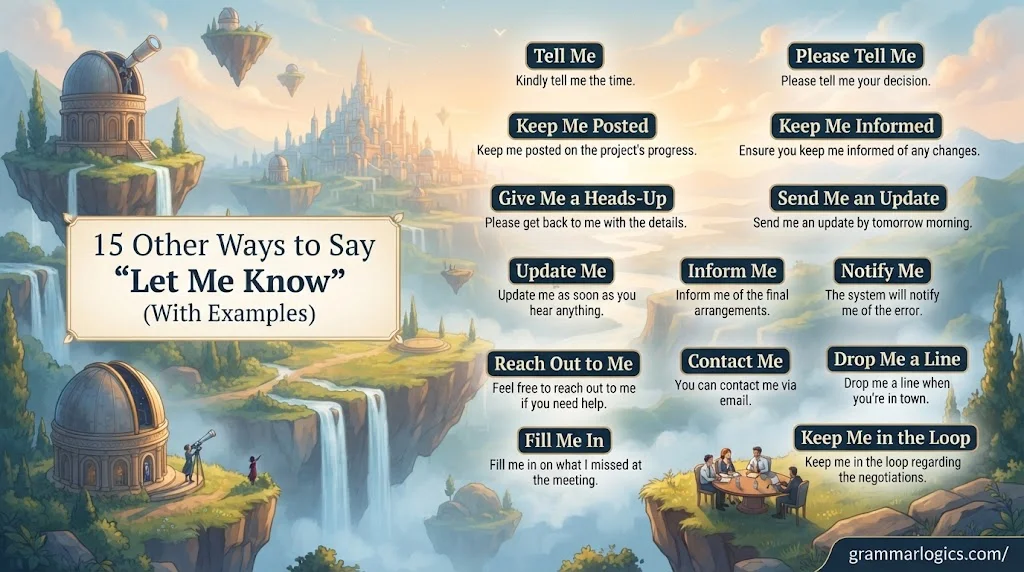
- Tell Me
- Please Tell Me
- Keep Me Posted
- Keep Me Informed
- Get Back to Me
- Give Me a Heads-Up
- Send Me an Update
- Update Me
- Inform Me
- Notify Me
- Reach Out to Me
- Contact Me
- Drop Me a Line
- Fill Me In
- Keep Me in the Loop
1. Tell Me
Meaning
“Tell me” is the most direct and straightforward alternative to “let me know.” It asks someone to provide information, an answer, or their thoughts.
Definition
Tell me means give me information by speaking or writing to me.
Detailed Explanation
“Tell me” is broader and more direct than “let me know.” It works especially well when you want a person to answer a specific question or share information with you. Depending on the wording, it can sound friendly or quite direct. Adding “please” can soften the request when necessary.
Scenario Examples
Scenario: You are asking a friend about weekend plans.
Example: “Tell me what time you want to leave.”
Scenario: A colleague has an opinion about a proposal.
Example: “Tell me what you think about the new layout.”
Scenario: You are asking someone to explain a problem.
Example: “Tell me what happened after the meeting.”
Best Use
Best for everyday conversation, texting, personal messages, and direct questions. It can also work professionally when the surrounding wording is polite.
Tone
Tone: Direct, neutral, conversational
It is simple and natural, but usually more direct than “let me know.”
2. Please Tell Me
Meaning
“Please tell me” communicates the same basic request as “tell me” while adding a clear marker of politeness.
Definition
Please tell me means kindly provide me with the information or answer I am asking for.
Detailed Explanation
Adding “please” makes the request softer and more courteous. It can be useful when you want information from someone without sounding abrupt. Unlike “let me know,” which often allows the information to come later, “please tell me” can sometimes sound like you want an answer more directly.
Scenario Examples
Scenario: You are asking a coworker to clarify a detail.
Example: “Please tell me if I’ve misunderstood the instructions.”
Scenario: A friend is explaining a complicated situation.
Example: “Please tell me what happened.”
Best Use
Best for polite requests, personal communication, customer interactions, and workplace messages.
Tone
Tone: Polite, direct, respectful
The word “please” gives this expression a softer and more courteous quality.
3. Keep Me Posted
Meaning
“Keep me posted” means continue giving me updates as a situation develops.
Definition
Keep me posted means keep me informed about new developments or changes.
Detailed Explanation
This expression is not always an exact substitute for “let me know.” It is more specifically about ongoing information. If a project, trip, event, or decision is still developing, “keep me posted” tells someone that you want updates along the way. It is common in workplace and casual communication.
Scenario Examples
Scenario: A colleague is waiting for approval on a project.
Example: “Keep me posted on what the client decides.”
Scenario: A friend is arranging travel plans.
Example: “Keep me posted about your flight.”
Scenario: You are following a repair at your home.
Example: “Keep me posted if the technician gives you a new arrival time.”
Best Use
Best for workplace communication, project updates, ongoing situations, and casual conversations.
Tone
Tone: Friendly, practical, informal
It sounds natural and cooperative rather than formal.
4. Keep Me Informed
Meaning
“Keep me informed” asks someone to provide relevant information as a situation changes or develops.
Definition
Keep me informed means continue giving me important information about a situation.
Detailed Explanation
This expression is similar to “keep me posted,” but it can sound somewhat more professional and formal. It works particularly well when the information matters to a decision, responsibility, or process. It can imply that you expect to receive relevant updates rather than every minor detail.
Scenario Examples
Scenario: A manager wants updates about a project.
Example: “Please keep me informed about any major changes to the schedule.”
Scenario: A school administrator is communicating with a parent.
Example: “We’ll keep you informed about any changes to the event.”
Best Use
Best for professional communication, formal emails, project management, and organizational settings.
Tone
Tone: Professional, respectful, informative
It has a more businesslike feel than the casual “keep me posted.”
5. Get Back to Me
Meaning
“Get back to me” asks someone to respond or contact you again after they have considered something or obtained information.
Definition
Get back to me means respond to me later with an answer, decision, or update.
Detailed Explanation
This phrase emphasizes a future response rather than simply sharing information. It is useful when the other person needs time to think, check something, or make a decision. In professional settings, it is common, although “please get back to me” is generally more courteous than a bare command.
Scenario Examples
Scenario: A colleague needs to check availability.
Example: “Check with the supplier and get back to me tomorrow.”
Scenario: Someone is deciding whether they can attend an event.
Example: “Take your time and get back to me when you’ve decided.”
Scenario: A customer-service representative needs to investigate an issue.
Example: “We’ll look into the problem and get back to you shortly.”
Best Use
Best for work emails, customer communication, decisions, follow-ups, and situations requiring a later response.
Tone
Tone: Direct, practical, professional
It clearly communicates that a response is expected later.
6. Give Me a Heads-Up
Meaning
“Give me a heads-up” means warn me or tell me about something in advance.
Definition
Give me a heads-up means provide advance notice about something that may affect me.
Detailed Explanation
This is more specific than “let me know.” It usually means that you want early notice, especially before an event, change, problem, or decision. The expression is informal and friendly, so it is better suited to casual or relaxed workplace communication than highly formal writing.
Scenario Examples
Scenario: Your coworker expects a schedule change.
Example: “Give me a heads-up if the meeting time changes.”
Scenario: A friend is coming over.
Example: “Give me a heads-up before you leave the house.”
Scenario: A neighbor plans construction work.
Example: “Just give me a heads-up if the work will block the driveway.”
Best Use
Best for casual conversation, texting, friendly workplace communication, and advance warnings.
Tone
Tone: Casual, friendly, informal
The expression feels relaxed and conversational rather than formal.
7. Send Me an Update
Meaning
“Send me an update” directly asks someone to provide new information about a situation.
Definition
Send me an update means give me the latest information about something, usually in writing or electronically.
Detailed Explanation
This expression is more specific than “let me know” because it focuses on an update. It is especially natural when discussing projects, orders, applications, schedules, or ongoing work. It can sound professional without being overly formal.
Scenario Examples
Scenario: You are waiting for progress on a work assignment.
Example: “Send me an update when you’ve finished the first draft.”
Scenario: A customer is waiting for information about an order.
Example: “Please send me an update once the delivery has been scheduled.”
Best Use
Best for emails, project communication, customer service, work updates, and written communication.
Tone
Tone: Professional, clear, practical
It tells the recipient exactly what kind of information you want.
8. Update Me
Meaning
“Update me” means give me the latest information about a situation.
Definition
Update me means tell me what has changed or what has happened since the last information I received.
Detailed Explanation
This is a concise alternative that focuses on new developments. It is particularly useful when both people already understand the subject being discussed. Because it is brief and imperative in form, “please update me” can make the request sound more courteous in professional situations.
Scenario Examples
Scenario: You return to a project after being away.
Example: “Can you update me on what I missed?”
Scenario: A colleague has spoken with a client.
Example: “Update me when you hear back from them.”
Scenario: You want information about a developing situation.
Example: “Please update me if anything changes.”
Best Use
Best for workplace communication, ongoing projects, meetings, and situations where previous context is already understood.
Tone
Tone: Direct, efficient, professional
Its brevity makes it useful when communication needs to be clear and efficient.
9. Inform Me
Meaning
“Inform me” means give me information or tell me about something.
Definition
Inform me means provide me with relevant information.
Detailed Explanation
“Inform me” can replace “let me know” when a more formal or official tone is appropriate. It is grammatically correct and clear, but it may sound more formal or impersonal in casual conversation. For that reason, everyday speakers often prefer “tell me” or “let me know.”
Scenario Examples
Scenario: You are writing a formal business message.
Example: “Please inform me of any changes to the agreement.”
Scenario: An organization needs to communicate a procedure.
Example: “The office will inform me when the application has been reviewed.”
Best Use
Best for formal emails, official correspondence, administrative communication, and business writing.
Tone
Tone: Formal, professional, neutral
It creates more distance than conversational alternatives such as “tell me.”
10. Notify Me
Meaning
“Notify me” means officially tell me about a particular event, decision, or change.
Definition
Notify me means give me formal notice about something.
Detailed Explanation
“Notify me” is narrower than “let me know.” It is usually used when there is a specific event, status change, decision, or official notice involved. It is common in administrative, technical, legal, customer-service, and workplace contexts. It can sound unnatural in casual conversation.
Scenario Examples
Scenario: You are waiting for an application decision.
Example: “Please notify me when a decision has been made.”
Scenario: A service provider needs to alert customers about an outage.
Example: “We will notify customers if the service is interrupted.”
Scenario: You want an alert when a product becomes available.
Example: “Please notify me when the item is back in stock.”
Best Use
Best for formal communication, official notices, customer service, applications, systems, and administrative situations.
Tone
Tone: Formal, precise, official
The word suggests a structured or official communication rather than a casual conversation.
11. Reach Out to Me
Meaning
“Reach out to me” means contact me, usually to discuss something, ask a question, or continue communication.
Definition
Reach out to me means make contact with me.
Detailed Explanation
This expression is related to “let me know,” but it is not an exact synonym. It focuses more on starting or continuing contact than simply providing information. It is common in professional communication and friendly messages, although some people may find it more indirect than simply saying “contact me.”
Scenario Examples
Scenario: A recruiter invites someone to ask questions.
Example: “If you have any questions, feel free to reach out to me.”
Scenario: A friend wants to continue a conversation later.
Example: “Reach out to me when you’re ready to talk.”
Scenario: A business offers customer assistance.
Example: “Please reach out to me if you need further assistance.”
Best Use
Best for professional emails, customer communication, networking, and supportive personal messages.
Tone
Tone: Warm, professional, approachable
It often feels more welcoming than the blunt “contact me.”
12. Contact Me
Meaning
“Contact me” means communicate with me through an appropriate channel.
Definition
Contact me means get in touch with me.
Detailed Explanation
“Contact me” is a practical alternative when the main point is that someone should communicate with you. It is broader than “let me know” because the person may be contacting you to discuss something rather than simply provide information. The phrase can sound professional and clear, but it may feel more formal or transactional in personal conversations.
Scenario Examples
Scenario: A business provides a way for customers to ask questions.
Example: “Please contact me if you need any additional information.”
Scenario: You are arranging an appointment.
Example: “Contact me if you need to change the appointment time.”
Scenario: Someone needs to discuss a project.
Example: “Contact me when you’re ready to discuss the next step.”
Best Use
Best for business communication, customer service, formal messages, professional correspondence, and practical arrangements.
Tone
Tone: Direct, professional, neutral
It is clear and efficient, though slightly less warm than “reach out to me.”
13. Drop Me a Line
Meaning
“Drop me a line” is a friendly way to ask someone to send you a message or get in touch.
Definition
Drop me a line means send me a short message or contact me.
Detailed Explanation
This expression is informal and conversational. It does not necessarily ask for a specific piece of information; instead, it encourages the person to get in touch. It can sound warm and personable, but it is less suitable for formal business writing.
Scenario Examples
Scenario: You have just met someone and want to stay in contact.
Example: “Drop me a line when you’re back in town.”
Scenario: You are ending a friendly email.
Example: “Drop me a line if you’re ever visiting the area.”
Best Use
Best for friendly emails, personal messages, casual conversation, and informal correspondence.
Tone
Tone: Warm, casual, friendly
It has a personable quality and works well when there is already some familiarity between the speakers.
14. Fill Me In
Meaning
“Fill me in” means give me the information I missed or explain what has happened.
Definition
Fill me in means tell me the relevant details about a situation.
Detailed Explanation
This phrase is especially useful when someone already knows something that you do not know yet. It is therefore more specific than “let me know.” It often implies that you want the background or important details rather than a single short answer.
Scenario Examples
Scenario: You missed a team meeting.
Example: “I couldn’t make the meeting. Can you fill me in?”
Scenario: Friends have been discussing plans without you.
Example: “Fill me in—what did I miss?”
Scenario: You arrive late to a conversation.
Example: “Can someone fill me in on what’s happening?”
Best Use
Best for casual conversation, workplace discussions, meetings, group communication, and situations where you missed information.
Tone
Tone: Casual, conversational, curious
It sounds friendly and natural, especially when asking for context or details.
15. Keep Me in the Loop
Meaning
“Keep me in the loop” means continue including me in relevant information or discussions.
Definition
Keep me in the loop means make sure I receive important updates as a situation develops.
Detailed Explanation
This expression is especially useful when several people are involved in an ongoing project or decision. Unlike a one-time request to “let me know,” it suggests that you want to remain informed throughout the process. It is common in workplaces but can also be used casually.
Scenario Examples
Scenario: Several coworkers are coordinating a project.
Example: “Keep me in the loop as you work through the revisions.”
Scenario: A friend is organizing a group trip.
Example: “Keep me in the loop about the travel plans.”
Scenario: You are involved in an ongoing decision.
Example: “Please keep me in the loop if anything important changes.”
Best Use
Best for workplace communication, team projects, group plans, ongoing decisions, and collaborative situations.
Tone
Tone: Professional, friendly, collaborative
It communicates that you want to remain involved without demanding constant updates.
FAQs
1. What are some other ways to say “Let Me Know”?
Some useful alternatives to “Let Me Know” include “Keep me posted,” “Please keep me informed,” “Feel free to update me,” “Tell me when you know,” and “I’d appreciate an update.” The best expression depends on your tone, relationship, and context.
2. Is “Let Me Know” professional?
Yes, “Let Me Know” is professional and commonly used in work emails, business communication, and everyday conversations. However, phrases such as “Please keep me informed” or “I’d appreciate an update” may sound more formal in certain professional situations.
3. How can I say “Let Me Know” politely?
To sound more polite and friendly, you can say “Please feel free to let me know,” “I’d be happy to hear from you,” or “Please keep me updated.” These expressions make your request sound warm without being too direct.
4. What is a casual way to say “Let Me Know”?
For casual conversations, you can use phrases such as “Keep me posted,” “Give me a heads-up,” “Tell me what you think,” or “Drop me a message.” These alternatives work well when speaking with friends, family, classmates, or familiar coworkers.
5. What is the best alternative to “Let Me Know” in an email?
The best alternative depends on the purpose of your email. For a professional message, “Please keep me informed” or “I’d appreciate an update” works well. For a friendly email, “Keep me posted” or “Feel free to update me” can sound more natural and conversational.
Conclusion
Knowing other ways to say “Let Me Know” can help you communicate with greater clarity and flexibility. While the original phrase is simple and widely useful, choosing a more specific alternative expression can make your message sound more professional, polite, friendly, or casual, depending on the situation. Whether you are writing a work email, sending a message to a friend, or asking someone for an update, the right wording can make your communication feel more natural.
The key is to choose an expression that matches your tone, relationship, and purpose. Phrases like “Keep me posted,” “Please keep me informed,” and “I’d appreciate an update” each carry a slightly different feeling. By using these alternatives to “Let Me Know,” you can avoid repetition, express yourself more naturally, and make your everyday and professional communication more effective.