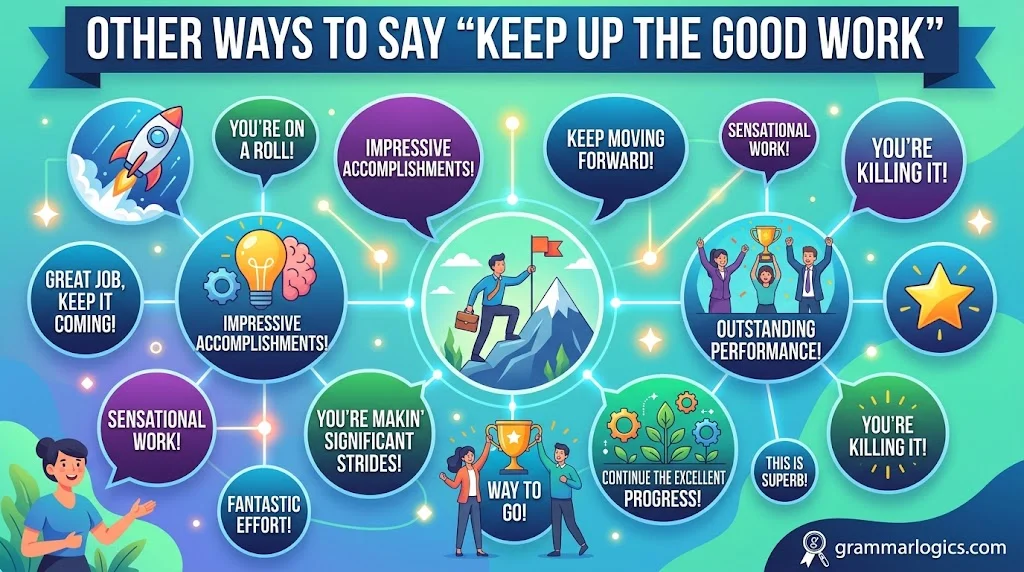
Praising someone for their effort can make encouragement feel more personal, positive, and meaningful, especially when you want to recognize progress without sounding repetitive today.
Keep Up the Good Work is a phrase used to encourage someone to continue performing well. It expresses appreciation, motivation, and confidence in their efforts. However, repeating the same expression can sometimes make your writing or conversations feel predictable. Using thoughtful alternatives can help you match your message to the situation, whether you are speaking with a coworker, student, friend, employee, or family member. The right wording can sound more professional, friendly, or warm, while still delivering encouragement. Exploring different ways to say Keep Up the Good Work gives you more flexibility in everyday communication.
When choosing another expression, consider the person, setting, and relationship before you respond. A workplace message may need professional encouragement, while a casual conversation can sound more relaxed and personal. You might want to praise a specific achievement instead of offering encouragement. Expressions such as “Great job,” “You’re doing wonderfully,” or “Keep it going” can add variety while preserving the same supportive meaning. In this guide, you will discover natural ways to say Keep Up the Good Work with examples, context, and tone guidance, making it easier to choose words that feel sincere, and engaging.
What Does “Keep Up the Good Work” Mean?
“Keep up the good work” is an encouraging expression used to tell someone to continue doing something well. It recognizes that the person has already made a positive effort or achieved a good result and encourages them to maintain that standard. In everyday English, the phrase communicates approval, encouragement, and support without being overly emotional or formal. It can be directed at a student who has improved, a colleague who has completed a task successfully, a friend making progress, or someone working toward a personal goal.
Common Situations Where “Keep Up the Good Work” Is Used
People commonly use “keep up the good work” in everyday conversations, workplace communication, education, personal messages, and online interactions. A teacher might use it after seeing a student’s improvement, while a manager may say it after an employee handles a task particularly well. Friends and family members can also use it to encourage someone who is making progress toward a goal.
The phrase is useful because it is positive without being complicated. However, an alternative may be better when you want to recognize a specific achievement, express stronger enthusiasm, sound more professional, or offer encouragement that feels more personal.
Is It Professional or Polite to Say “Keep Up the Good Work”?
Yes. “Keep up the good work” is generally polite, positive, and professional enough for many workplace situations. It is especially natural in conversations between colleagues, managers and employees, teachers and students, or supervisors and team members. Its tone is usually friendly rather than formal.
That said, it can sometimes sound routine or generic, particularly when used repeatedly in workplace feedback. For a formal evaluation or a detailed professional message, a more specific expression can communicate appreciation more precisely. In casual settings, however, “keep up the good work” is perfectly natural.
Advantages and Disadvantages of Saying “Keep Up the Good Work”
Advantages
The main advantage is its simplicity. The phrase is immediately understood and communicates encouragement without requiring a long explanation. It also works across many situations and can acknowledge both effort and results. Because it is familiar, it rarely sounds confusing or overly dramatic.
Disadvantages
Its familiarity can also be a limitation. If you use it frequently, it may begin to sound formulaic or repetitive. It does not explain exactly what the person did well, and it may not convey the stronger emotion you intend. In some formal situations, more specific wording can make praise sound more thoughtful and meaningful.
Synonyms for “Keep Up the Good Work”
- Keep It Up
- Great Job—Keep Going
- You’re Doing a Great Job
- Keep Up the Excellent Work
- Keep Moving Forward
- Stay on Track
- Keep Up Your Great Effort
- You’re Doing Really Well
- Keep Making Progress
- Well Done—Keep Going
- Keep Up the Progress
- You’re on the Right Track
- Keep Striving for Excellence
- Keep Up Your Strong Work
- Keep Going—You’re Doing Great
1. Keep It Up
Meaning
“Keep it up” tells someone to continue performing at the same good level. It is very close in meaning to “keep up the good work,” but it is usually more casual and conversational.
Definition
Keep it up: Continue doing what you are doing successfully.
Detailed Explanation
This expression is short, natural, and common in spoken English. It focuses on continuing a positive effort rather than explicitly mentioning that the work is good. Because it is informal, it fits naturally between friends, classmates, teammates, and colleagues who have a comfortable relationship. It can also sound energetic when used as a quick message of encouragement.
Scenario Examples
Scenario: Your friend has been exercising consistently.
Example: “You’ve been sticking with your workouts—keep it up!”
Scenario: A colleague has been handling customer requests efficiently.
Example: “The response times have been excellent. Keep it up!”
Best Use
Best for casual conversation, texting, friendly workplace communication, and everyday encouragement.
Tone
Tone: Casual, upbeat, encouraging. It feels relaxed and supportive without sounding overly formal.
2. Great Job Keep Going
Meaning
“Great job—keep going” combines praise with encouragement to continue. It recognizes a successful effort while emphasizing continued progress.
Definition
Great job—keep going: You have done well so far, so continue with your effort.
Detailed Explanation
This phrase is especially useful when someone is partway through a task or goal. Unlike “keep up the good work,” it can acknowledge a specific achievement and then encourage the person not to stop. It works particularly well when someone needs motivation during a longer process. The wording is warmer and more energetic than a simple statement of approval.
Scenario Examples
Scenario: A student has improved significantly during a difficult assignment.
Example: “Great job—keep going. You’re making real progress.”
Scenario: A friend is training for a long-distance event.
Example: “You’ve already made it this far. Great job—keep going!”
Best Use
Best for personal encouragement, coaching, education, fitness, and supportive messages.
Tone
Tone: Warm, enthusiastic, motivating. The phrase sounds actively supportive rather than merely complimentary.
3. You’re Doing a Great Job
Meaning
“You’re doing a great job” directly tells someone that their current performance is excellent.
Definition
You’re doing a great job: Your present effort or performance is very good.
Detailed Explanation
This expression puts more emphasis on the person’s current performance than on the instruction to continue. It can therefore feel more personal than “keep up the good work.” It is useful when you want to reassure someone that their efforts are being noticed.
Scenario Examples
Scenario: A new employee is learning a complicated process.
Example: “You’re doing a great job with the new system.”
Scenario: Someone is helping organize a community event.
Example: “You’re doing a great job keeping everything organized.”
Best Use
Best for workplace feedback, personal conversations, education, and supportive communication.
Tone
Tone: Warm, positive, reassuring. It focuses directly on recognizing someone’s performance.
4. Keep Up the Excellent Work
Meaning
“Keep up the excellent work” is a stronger and somewhat more polished version of “keep up the good work.”
Definition
Keep up the excellent work: Continue producing work of a very high standard.
Detailed Explanation
The word “excellent” makes the praise stronger than the original phrase. It is particularly suitable when someone’s performance genuinely stands out. The expression can work in professional communication, though it still sounds like praise rather than formal evaluation language. It is best used when the quality of the work deserves clear recognition.
Scenario Examples
Scenario: An employee consistently submits accurate reports.
Example: “Your reports have been clear and thorough. Keep up the excellent work.”
Scenario: A student has achieved outstanding results.
Example: “Your recent assignments have been excellent. Keep up the excellent work!”
Best Use
Best for professional feedback, academic encouragement, formal praise, and written messages.
Tone
Tone: Professional, positive, appreciative. “Excellent” gives the expression more weight and specificity.
5. Keep Moving Forward
Meaning
“Keep moving forward” encourages someone to continue making progress, especially when they are working toward a longer-term goal.
Definition
Keep moving forward: Continue progressing rather than stopping or becoming discouraged.
Detailed Explanation
This expression is broader than “keep up the good work.” It does not necessarily mean that everything someone has done is excellent; instead, it emphasizes progress and persistence. That makes it useful when a person has encountered difficulties but is still moving in a positive direction. It can sound more motivational and reflective than the original phrase.
Scenario Examples
Scenario: A friend is rebuilding a project after an unsuccessful first attempt.
Example: “The first version taught you a lot. Keep moving forward.”
Scenario: A colleague is working through a demanding project.
Example: “We’ve solved the biggest issues. Let’s keep moving forward.”
Best Use
Best for personal goals, difficult projects, coaching, teamwork, and motivational messages.
Tone
Tone: Encouraging, resilient, motivational. It emphasizes progress rather than perfection.
6. Stay on Track
Meaning
“Stay on track” encourages someone to continue following a successful plan or course of action.
Definition
Stay on track: Continue following the intended plan or direction.
Detailed Explanation
This expression differs from “keep up the good work” because it emphasizes direction and consistency rather than praise alone. It is particularly useful when someone has a goal, deadline, schedule, or plan. It can be encouraging, but depending on context, it may also sound more practical and direct.
Scenario Examples
Scenario: A student is preparing for an important examination.
Example: “Your study schedule is working well. Stay on track.”
Scenario: A team is progressing toward a project deadline.
Example: “We’re ahead of schedule, so let’s stay on track.”
Best Use
Best for work, school, planning, project management, and goal-setting.
Tone
Tone: Practical, focused, encouraging. It highlights consistency and direction.
7. Keep Up Your Great Effort
Meaning
“Keep up your great effort” recognizes someone’s effort and encourages them to maintain it.
Definition
Keep up your great effort: Continue putting forth the strong effort you have already demonstrated.
Detailed Explanation
This expression focuses specifically on effort, rather than only the final result. That makes it useful when someone is working hard even though the outcome may still be developing. It can sound more personal than a generic compliment because it acknowledges the work being invested. In very casual conversation, “keep it up” may sound more natural.
Scenario Examples
Scenario: A student is struggling but consistently completing their assignments.
Example: “Your effort has been impressive. Keep up your great effort.”
Scenario: A colleague has taken on extra responsibilities.
Example: “Thank you for staying engaged throughout the project. Keep up your great effort.”
Best Use
Best for education, workplace encouragement, mentoring, and personal messages.
Tone
Tone: Supportive, appreciative, sincere. It gives special attention to dedication and effort.
Read More: 15 Other Ways to Say “Hope All Is Well” (With Examples)
8. You’re Doing Really Well
Meaning
“You’re doing really well” tells someone that their current progress or performance is good.
Definition
You’re doing really well: You are performing or progressing successfully.
Detailed Explanation
This is a natural, flexible expression that sounds less like a command than “keep up the good work.” It can reassure someone who is learning something new or facing an unfamiliar situation. The phrase is softer and more conversational than stronger expressions such as “keep striving for excellence.” Because it is broad, the surrounding context usually provides the specific meaning.
Scenario Examples
Scenario: Someone has just started learning a new language.
Example: “You’re doing really well with your pronunciation.”
Scenario: A new employee is settling into a role.
Example: “You’re doing really well for your first month.”
Best Use
Best for casual conversation, mentoring, teaching, workplace support, and personal encouragement.
Tone
Tone: Warm, reassuring, conversational. It feels natural when someone needs confidence as well as praise.
9. Keep Making Progress
Meaning
“Keep making progress” encourages someone to continue improving or moving toward a goal.
Definition
Keep making progress: Continue advancing toward a desired result.
Detailed Explanation
This expression focuses on forward movement and improvement rather than the quality of completed work. It is particularly helpful when progress matters more than perfection. It can also avoid implying that the person must maintain exactly the same level of performance. The phrase is practical enough for professional settings but still natural in personal conversations.
Scenario Examples
Scenario: A learner is gradually improving a technical skill.
Example: “Your understanding is getting stronger. Keep making progress.”
Scenario: A team has completed several stages of a project.
Example: “We’ve finished the first phase. Let’s keep making progress.”
Best Use
Best for education, professional projects, personal goals, and long-term improvement.
Tone
Tone: Encouraging, constructive, forward-looking. It emphasizes development over praise alone.
10. Well Done—Keep Going
Meaning
“Well done—keep going” praises an achievement and immediately encourages further effort.
Definition
Well done—keep going: You have succeeded so far; continue with your effort.
Detailed Explanation
This phrase works especially well when someone has reached a milestone but still has more to accomplish. “Well done” recognizes what has already happened, while “keep going” looks ahead. Compared with “keep up the good work,” it creates a stronger sense of momentum. It can be used warmly without sounding overly formal.
Scenario Examples
Scenario: A student finishes the first half of a challenging assignment.
Example: “Well done—keep going. You’re almost there.”
Scenario: A friend completes an important personal goal.
Example: “Well done on reaching that milestone. Keep going!”
Best Use
Best for personal encouragement, education, coaching, and milestone-based praise.
Tone
Tone: Enthusiastic, supportive, motivating. It combines recognition and forward momentum.
11. Keep Up the Progress
Meaning
“Keep up the progress” encourages someone to maintain their current improvement or forward movement.
Definition
Keep up the progress: Continue progressing at the positive rate or direction already established.
Detailed Explanation
This expression is understandable, but it is somewhat more specific and less idiomatic than “keep it up” or “keep making progress.” It fits situations where progress itself is the main subject. In professional or educational contexts, a more natural alternative may sometimes be preferable depending on the sentence. Use it when the emphasis is clearly on maintaining improvement.
Scenario Examples
Scenario: A team has reduced delays in a work process.
Example: “The turnaround time has improved considerably. Keep up the progress.”
Scenario: A student is steadily improving in mathematics.
Example: “Your scores are improving each week. Keep up the progress.”
Best Use
Best for progress-focused workplace, educational, or goal-setting contexts.
Tone
Tone: Positive, practical, moderately formal. It draws attention to measurable improvement.
12. You’re on the Right Track
Meaning
“You’re on the right track” tells someone that their current approach is likely moving in the correct direction.
Definition
You’re on the right track: Your current approach or progress is heading toward the desired result.
Detailed Explanation
Unlike “keep up the good work,” this phrase does not necessarily praise the quality of the finished work. Instead, it provides reassurance about direction. It is especially useful when someone is still developing an idea, solving a problem, or learning a process. It can be encouraging without overstating the result.
Scenario Examples
Scenario: A student is developing an argument for an essay.
Example: “Your main idea is clear, and you’re on the right track.”
Scenario: A colleague is troubleshooting a technical issue.
Example: “That explanation makes sense. You’re on the right track.”
Best Use
Best for teaching, mentoring, brainstorming, problem-solving, and workplace guidance.
Tone
Tone: Reassuring, constructive, supportive. It gives someone confidence in their direction.
13. Keep Striving for Excellence
Meaning
“Keep striving for excellence” encourages someone to continue aiming for a very high standard.
Definition
Keep striving for excellence: Continue working toward exceptional quality or performance.
Detailed Explanation
This expression is considerably more formal and ambitious than “keep up the good work.” It suggests an ongoing commitment to high standards rather than simply maintaining current performance. Because of its elevated tone, it can sound unnatural in an ordinary text message between friends. It works better when the context calls for formal encouragement or aspirational language.
Scenario Examples
Scenario: A school leader is praising students at an academic event.
Example: “Your dedication has produced impressive results. Keep striving for excellence.”
Scenario: A professional organization is encouraging continued high standards.
Example: “Your attention to quality makes a difference. Keep striving for excellence.”
Best Use
Best for formal speeches, academic settings, professional recognition, and inspirational writing.
Tone
Tone: Formal, aspirational, motivational. It communicates high standards and ambition.
14. Keep Up Your Strong Work
Meaning
“Keep up your strong work” encourages someone to maintain a consistently good level of performance.
Definition
Keep up your strong work: Continue producing work of a strong and satisfactory quality.
Detailed Explanation
This wording is more focused on performance quality than effort alone. It can be useful in professional feedback when you want to acknowledge consistent contributions without sounding excessively enthusiastic. However, native speakers may often prefer “keep up the great work” or “keep up the good work,” depending on context. The phrase works best when “strong work” has already been established as a meaningful description of someone’s performance.
Scenario Examples
Scenario: A manager is recognizing consistent contributions from a team member.
Example: “Your attention to detail has been valuable. Keep up your strong work.”
Scenario: A student has produced several solid assignments.
Example: “Your recent work has been consistent and thoughtful. Keep up your strong work.”
Best Use
Best for professional feedback, academic comments, and performance-related communication.
Tone
Tone: Professional, measured, encouraging. It sounds more restrained than highly enthusiastic praise.
15. Keep Going—You’re Doing Great
Meaning
“Keep going—you’re doing great” encourages someone to continue while reassuring them that their efforts are already successful.
Definition
Keep going—you’re doing great: Continue your effort because your current progress is very positive.
Detailed Explanation
This expression combines reassurance, praise, and motivation. It is especially useful when someone may be tired, uncertain, or close to completing something difficult. Compared with “keep up the good work,” it feels more personal and emotionally encouraging. It is generally better suited to friendly or supportive communication than highly formal writing.
Scenario Examples
Scenario: A friend is finishing a demanding personal project.
Example: “You’ve done so much already. Keep going—you’re doing great!”
Scenario: A colleague is handling a stressful presentation.
Example: “The presentation is going smoothly. Keep going—you’re doing great.”
Best Use
Best for texting, personal messages, coaching, supportive workplace conversations, and encouragement.
Tone
Tone: Warm, enthusiastic, reassuring. It combines confidence-building praise with motivation.
FAQs
1. What is another way to say “Keep Up the Good Work”?
Some natural alternatives include “Great job,” “Keep it going,” “You’re doing a great job,” “Keep up the excellent work,” and “You’re on the right track.” The best choice depends on the situation and the tone you want to convey.
2. Is “Keep Up the Good Work” professional?
Yes, “Keep Up the Good Work” is generally considered professional and polite. It works well when giving positive feedback to a coworker, employee, student, or team member. However, more specific praise can sometimes sound more meaningful in formal communication.
3. How can I say “Keep Up the Good Work” to a coworker?
You can say “You’re doing a great job,” “Excellent work,” “Keep it going,” or “I really appreciate your effort.” These expressions can make workplace encouragement sound natural, supportive, and professional.
4. What can I say instead of “Keep Up the Good Work” to a student?
For a student, you could say “You’re making great progress,” “Keep going,” “You’re doing really well,” or “I’m impressed with your effort.” These phrases recognize both achievement and continued improvement.
5. Why should I use alternatives to “Keep Up the Good Work”?
Using different expressions of encouragement helps your communication sound more natural and specific. Instead of repeating the same phrase, you can choose wording that better matches the person, situation, and level of formality.
Conclusion
“Keep Up the Good Work” is a simple and effective way to show encouragement, appreciation, and support. However, using different alternatives can make your communication more personal, specific, and engaging. Whether you are praising a coworker, encouraging a student, supporting a friend, or recognizing someone’s progress, the right expression can make your message feel more sincere.
From “Great job” to “You’re doing wonderfully,” each phrase carries a slightly different tone and purpose. Choose an expression that fits the situation and relationship, and your encouragement will sound natural while making the other person feel genuinely appreciated.










1 thought on “15 Other Ways to Say “Keep Up the Good Work” (With Examples)”